- Company Articles
- Company Articles
- Free Flow Chain Conveyor Cost-Benefit Analysis: Long-Term ROI Calculation

Free Flow Chain Conveyor Cost-Benefit Analysis: Long-Term ROI Calculation
Related Product
Free Flow Chain Conveyor
The free flow conveyor system uses a free flow chain that can increase the speed of the tooling board that supports the products. This can improve the efficiency and quality of the production process, as well as reduce the wear and tear of the system.
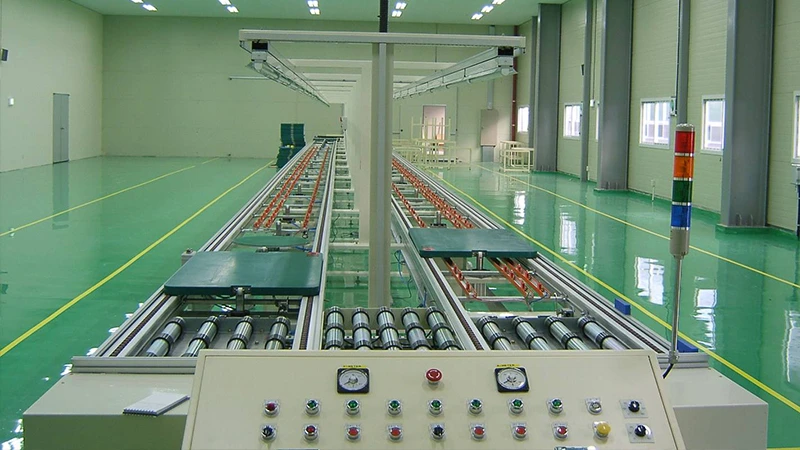
In the fast-paced world of manufacturing and logistics, every second counts. When materials get stuck in bottlenecks, when workers spend more time moving parts than assembling them, and when errors pile up from manual handling, your bottom line takes a hit. That's where smart material handling solutions come in—and few are as impactful as the free flow chain conveyor. But as a decision-maker, you're probably thinking: Is this investment worth it? How do the costs stack up against the benefits? And most importantly, when will I see a return?
In this guide, we'll break down the true cost of owning a free flow chain conveyor, from initial setup to long-term maintenance. We'll then dive into the tangible benefits—labor savings, error reduction, scalability—and walk through a real-world ROI calculation. By the end, you'll have a clear picture of why this humble piece of equipment might just be the key to unlocking your facility's efficiency potential. Plus, we'll touch on how partnering with the right conveyor supplier and integrating components like roller track can maximize your returns.
What Is a Free Flow Chain Conveyor, Anyway?
Before we crunch numbers, let's make sure we're on the same page. A free flow chain conveyor is a material handling system designed to move goods smoothly and continuously between workstations, storage areas, or production lines. Unlike traditional belt conveyors, it uses a series of interconnected chains or rollers (often paired with roller track components) to allow items to glide along with minimal friction. Think of it as a "highway" for your materials—no stops, no delays, just steady movement.
What makes it "free flow"? Unlike powered conveyors that move at a fixed speed, free flow systems often use gravity or gentle inclines to let items move on demand. This flexibility is a game-changer for lean system principles, where adaptability and waste reduction are priorities. Whether you're moving small electronic components, heavy automotive parts, or packages in a warehouse, a well-designed free flow chain conveyor can be tailored to your needs—often with add-ons like adjustable roller track, workbench integration, or ESD-safe features for sensitive products.
Understanding Total Cost of Ownership (TCO)
Let's start with the hard part: the costs. When evaluating a free flow chain conveyor, it's easy to fixate on the upfront price tag. But true TCO includes three key components: initial investment, operational costs, and maintenance expenses. Let's break each down.
1. Initial Investment: What You'll Pay Upfront
The initial cost is the most obvious line item, and it varies widely based on your needs. A small, basic system for a local workshop might start at $15,000, while a large, custom-designed setup for a automotive plant could run $100,000 or more. Here's what factors into this number:
- Conveyor Length and Configuration: Longer systems or those with complex layouts (curves, inclines, multiple branches) cost more. A straight 50-foot conveyor will be cheaper than a 100-foot system with 90-degree turns and integration with workbench stations.
- Materials and Build Quality: Options range from basic steel to lightweight aluminum (common in food or pharmaceutical settings) or stainless steel for corrosive environments. Aluminum roller track, for example, is durable and rust-resistant but may cost more upfront than standard steel.
- Accessories and Customization: Do you need roller track with side guides to keep items aligned? ESD-safe workbench attachments for electronics assembly? Casters for mobility? Each add-on—from roller track connectors to specialized brackets—adds to the cost.
- Installation: Unless you have an in-house team with conveyor expertise, you'll need to hire professionals. Installation costs typically range from 10-20% of the equipment price, depending on complexity.
Pro tip: Work with a reputable conveyor supplier early in the process. They can help design a system that avoids over-engineering (and over-spending) while still meeting your needs. A good supplier will also account for future scalability—so you don't have to replace the entire system when production grows.
2. Operational Costs: The Ongoing Expenses
Once the conveyor is up and running, operational costs kick in. Fortunately, free flow chain conveyors are generally low-maintenance compared to powered systems (like belt or chain-driven conveyors), but they're not entirely cost-free:
- Energy: If your system uses gravity alone, energy costs are near zero. For powered free flow conveyors (common in larger setups), expect minimal electricity use—often less than $50 per month for a mid-sized system.
- Labor for Monitoring: While the conveyor reduces manual handling, you'll still need staff to load/unload items and monitor flow. This is usually a fraction of the labor required for manual transport, but it's worth factoring in.
- Training: Workers may need a few hours of training to operate the system safely, especially if it has advanced features like emergency stops or programmable flow controls.
3. Maintenance Costs: Keeping It Running Smoothly
Like any equipment, a free flow chain conveyor needs regular upkeep to avoid breakdowns. The good news? Maintenance costs are typically low, especially if you invest in quality components upfront. Here's what to budget for:
- Routine Checks: Weekly inspections of roller track, chains, and joints to ensure nothing is loose or worn. This can be done by your maintenance team at little to no extra cost.
- Replacement Parts: Over time, roller track wheels may wear down, or joints may loosen. A set of replacement roller track guide rails or swivel roller balls might cost $200–$500 annually, depending on usage.
- Professional Servicing: Every 1–2 years, a technician from your conveyor supplier may need to perform a deep dive—lubricating chains, adjusting tension, or replacing worn sprockets. This could run $1,000–$3,000 per visit.
*Example Initial TCO Breakdown:* For a mid-sized manufacturer needing a 75-foot conveyor with aluminum roller track, workbench integration, and basic accessories, the initial investment might be $45,000 (conveyor: $30k, installation: $8k, accessories: $7k). Annual operational costs: ~$1,200 (energy + minor labor). Annual maintenance: ~$2,500 (parts + servicing). Total 5-year TCO: $45k + ($1.2k*5) + ($2.5k*5) = $45k + $6k + $12.5k = $63,500.
Quantifying the Benefits: Where the ROI Really Lives
Now, let's shift to the upside. The true value of a free flow chain conveyor lies in the savings it generates—often in ways that go beyond just "faster material movement." Let's break down the key benefits and how to put a dollar amount to them.
1. Labor Savings: Time Is Money
This is often the biggest driver of ROI. Manual material handling is labor-intensive: workers pushing carts, carrying bins, or loading/unloading pallets. A free flow chain conveyor automates these tasks, freeing up staff to focus on higher-value work (like assembly, quality control, or problem-solving). Let's put this into numbers:
Suppose your facility has 8 workers spending 3 hours per day moving materials (that's 24 hours of labor daily). At an average wage of $25/hour (including benefits), that's 24 * $25 = $600/day, or $150,000/year (assuming 250 workdays). After installing a conveyor, those same workers might spend just 30 minutes daily on material handling—a 75% reduction. New daily labor cost: 4 hours * $25 = $100/day, or $25,000/year. Annual labor savings: $150k – $25k = $125,000.
Even a smaller operation with 3 workers saving 2 hours/day would see $37,500 in annual labor savings ($3 workers * $25/hour * 2 hours * 250 days). That alone can offset the initial investment in under a year.
2. Error and Damage Reduction: Fewer Mistakes, Less Waste
Manual handling is prone to errors: parts get dropped, mixed up, or delayed. A free flow chain conveyor with roller track guide rails keeps items moving smoothly and consistently, reducing damage and mistakes. Let's say your facility currently loses $10,000/year to damaged parts (e.g., 200 units at $50/unit) and $5,000/year to shipping delays from misrouted materials. After installing the conveyor, damage drops by 80% (saving $8,000) and delays by 60% (saving $3,000). Total annual savings: $11,000.
3. Scalability and Lean System Alignment
A free flow chain conveyor isn't just a one-time fix—it grows with your business. Need to add a new production line? Extend the roller track. Launch a new product? Reconfigure the workbench stations. This flexibility avoids the need for costly overhauls down the line. For example, a competitor without a conveyor might spend $20,000 to rework their manual handling system when scaling up; with a modular conveyor, you might only need $5,000 in additional roller track and connectors. Over 5 years, this could save $75,000 or more in rework costs.
4. Space Optimization: More Room for Production
Manual handling requires wide aisles for carts and storage space for staging materials. A free flow chain conveyor, especially one integrated with overhead or vertical storage, frees up floor space. Reclaiming even 200 square feet of production area could allow you to add another workbench or machine, boosting output by $50,000/year (depending on your industry). It's a hidden benefit, but one that adds up quickly.
Calculating Long-Term ROI: A Step-by-Step Example
Now, let's tie it all together. To calculate ROI, we'll use this formula: ROI (%) = [(Total Savings – Total Cost) / Total Cost] x 100 . Let's plug in the numbers from our earlier mid-sized manufacturer example:
| Category | 5-Year Total |
|---|---|
| Total Cost (TCO) | $63,500 |
| Total Savings | |
| Labor Savings ($125k/year x 5) | $625,000 |
| Damage/Delay Savings ($11k/year x 5) | $55,000 |
| Scalability Savings ($15k/year x 5) | $75,000 |
| Space Optimization ($10k/year x 5) | $50,000 |
| Total 5-Year Savings | $805,000 |
| Net Gain (Savings – Cost) | $805,000 – $63,500 = $741,500 |
| 5-Year ROI (%) | ($741,500 / $63,500) x 100 = 1,168% |
*Key Takeaway:* In this example, the conveyor delivers a 1,168% ROI over 5 years. Even if we adjust for conservative savings (e.g., labor savings drop to $100k/year), the 5-year ROI still exceeds 800%. For most manufacturers, the payback period is 6–18 months—meaning the conveyor has paid for itself long before the 5-year mark.
Real-World Success Stories
Numbers tell a story, but real examples bring it to life. Let's look at two businesses that transformed their operations with free flow chain conveyors.
Case Study 1: Electronics Manufacturer Cuts Labor Costs by 60%
A mid-sized electronics company in Texas was struggling with inefficiencies on their circuit board assembly line. Workers were manually transporting PCBs between 8 workbench stations, leading to bottlenecks and frequent delays. Their goal: Reduce labor costs and improve throughput.
They partnered with a conveyor supplier to install a 100-foot free flow chain conveyor with aluminum roller track (to prevent static damage) and ESD workbench integration. The system cost $65,000 upfront, with annual maintenance of $3,000.
Results after 1 year: Labor hours spent on material handling dropped from 400/week to 160/week, saving $120,000 annually (based on $30/hour wages). Damage to PCBs fell by 90%, saving an additional $9,000. Total first-year savings: $129,000. ROI: ($129k – $65k)/$65k = 106%—the conveyor paid for itself in 6 months.
Case Study 2: Automotive Supplier Boosts Output by 25%
A Michigan-based automotive parts supplier was struggling to keep up with demand for brake components. Their manual system relied on forklifts and hand trucks, leading to long lead times and limited space for expansion.
They invested in a custom free flow chain conveyor with stainless steel roller track (for durability in their oil-rich environment) and integrated material racks. The total cost was $95,000, including installation and training.
Results after 2 years: The conveyor freed up 300 square feet of floor space, allowing them to add two new assembly machines. Labor costs dropped by $150,000/year, and output increased by 25% (generating $200,000 in additional revenue). Total 2-year savings + revenue: $350,000. ROI: ($350k – $95k)/$95k = 268%.
Choosing the Right Conveyor Supplier: Key to Maximizing ROI
Not all free flow chain conveyors are created equal—and neither are suppliers. To ensure you get the best ROI, look for these qualities in a partner:
- Experience with Your Industry: A supplier who specializes in food packaging may not understand the unique needs of electronics manufacturing (e.g., ESD protection). Look for expertise in your sector.
- Modular Design Focus: Opt for suppliers who offer modular roller track and components. This makes it easier to expand or reconfigure the system as your needs change.
- Strong After-Sales Support: Maintenance is critical to long-term ROI. Choose a supplier with a local service team and fast turnaround on replacement parts (like roller track guide rails or swivel roller balls).
- Customization Capabilities: Your operation is unique—your conveyor should be too. Whether you need specialized roller track connectors or custom workbench layouts, a supplier who listens to your needs will deliver a better system.
Conclusion: Why Free Flow Chain Conveyors Are a Smart Long-Term Investment
At the end of the day, a free flow chain conveyor isn't just a piece of equipment—it's an investment in your operation's efficiency, scalability, and profitability. While the upfront cost may seem steep, the labor savings, error reduction, and space optimization quickly add up. For most businesses, the payback period is under 2 years, with ROI exceeding 500% over 5 years.
The key is to focus on total cost of ownership, not just the initial price tag. Partner with a conveyor supplier who understands your industry, uses quality components (like durable roller track and aluminum profiles), and offers the support you need to keep the system running smoothly. With the right setup, your free flow chain conveyor won't just move materials—it will move your business forward.