- Company Articles
- Company Articles
- Lean Pipe Clamp B and 'Continuous Improvement': Aligning with Lean Principles

Lean Pipe Clamp B and 'Continuous Improvement': Aligning with Lean Principles
Related Product
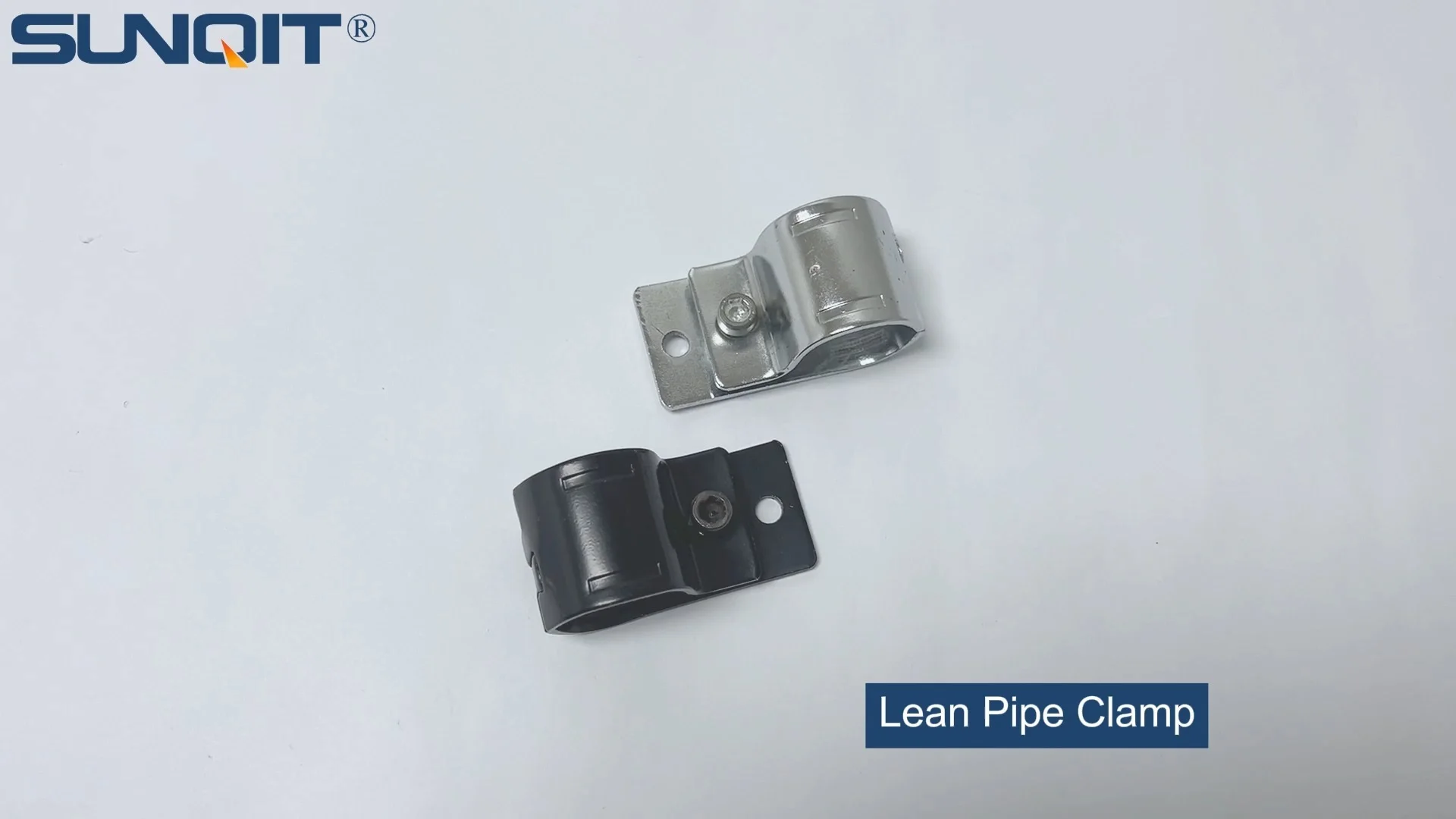
Lean Pipe Clamp
Lean pipe clamp is used for rack system hang monitor or other panel for workbenck, flowrack in production daily use.
How a Small Component Drives Big Changes in Modern Manufacturing
Walk into any thriving manufacturing facility today, and you'll likely hear the hum of machinery, the rhythm of assembly lines, and—if you listen closely—the quiet buzz of lean system principles at work. Lean manufacturing isn't just a buzzword; it's a mindset, a commitment to stripping away waste, streamlining processes, and, above all, embracing continuous improvement . It's about asking, "How can we do this better tomorrow than we did today?"
In this world of relentless optimization, even the smallest tools play outsized roles. Take, for example, the Lean Pipe Clamp B —a deceptively simple component that connects pipes, secures workbenches, and holds together the flexible structures that power modern production lines. At first glance, it might seem like just another metal bracket. But dig deeper, and you'll find a tool that embodies the very spirit of lean: adaptability, durability, and the freedom to evolve.
This article explores the relationship between Lean Pipe Clamp B and continuous improvement, uncovering how this unassuming accessory empowers teams to build, test, and refine their workflows. We'll dive into its design, its role in workbench and material flow systems, and real-world stories of how it has transformed operations. Along the way, we'll see why lean isn't just about big-picture strategies—it's about the small, flexible tools that make those strategies possible.
What is Lean Pipe Clamp B, Anyway?
Let's start with the basics. Lean Pipe Clamp B is a specialized connector designed to join lean pipes (often aluminum or steel) in modular workbench setups, material racks, and production lines. Unlike rigid, one-size-fits-all fasteners, it's engineered for flexibility. Picture a clamp that can pivot, tighten, and release with minimal effort—no welding, no complex tools, just a simple lever or screw to adjust its grip.
Most Lean Pipe Clamp B models are made from high-grade aluminum or zinc-plated steel, balancing strength with lightweight portability. They typically feature a "split" design, where two curved jaws wrap around the pipe, and a central bolt or cam mechanism draws them tight. Some versions include rubberized inserts to prevent slippage, while others have lean pipe joint compatibility, allowing them to connect to swivel joints, T-junctions, or roller track components.
But what truly sets it apart is its modularity. In traditional manufacturing setups, workbenches and racks are fixed—built to last decades, even if the production needs they serve change yearly. Lean Pipe Clamp B flips that script. Need to raise a workbench by 6 inches? Loosen the clamps, adjust the pipes, retighten. Want to add a shelf to a material rack? Slide in a new pipe section, secure it with clamps, and you're done. It's like building with industrial Legos, but for grown-ups solving real production problems.
| Feature | Lean Pipe Clamp B | Traditional Welded Fasteners |
|---|---|---|
| Reconfigurability | Adjustable in minutes; no tools needed | Permanent; requires cutting/welding to modify |
| Weight | Lightweight (aluminum/steel alloy) | Heavy (solid steel welds) |
| Cost Over Time | Higher upfront, but reusable across setups | Lower upfront, but obsolete if needs change |
| Worker Empowerment | Operators can adjust layouts independently | Requires maintenance team for changes |
This table highlights a critical point: Lean Pipe Clamp B isn't just a tool—it's a democratizing force. It puts the power to improve workflows directly into the hands of the people using them daily: assembly line workers, supervisors, and technicians who spot inefficiencies first. And that's where continuous improvement begins.
Lean Systems and the Need for Flexibility
To understand why Lean Pipe Clamp B matters, we need to zoom out to the broader context of lean systems. At its core, lean manufacturing is about eliminating seven types of waste: overproduction, waiting, transport, defects, inventory, motion, and overprocessing. But here's the catch: waste isn't static. What's wasteful today might be efficient tomorrow, and vice versa. A product line that runs smoothly for a quarter might hit a bottleneck when demand spikes or a new model is introduced.
This is why flexibility is the backbone of lean systems. Rigid infrastructure—fixed workbenches, immovable conveyor belts, static material racks—traps teams in outdated workflows. They become reactive, forced to work around the tools instead of with them. Lean systems, by contrast, demand adaptability: the ability to shrink a production line when orders dip, expand it when demand surges, or reconfigure it entirely for a new product.
Enter Lean Pipe Clamp B. By enabling quick, tool-free adjustments, it turns workbenches and racks into "living" systems that evolve with needs. Let's take a common scenario: a electronics manufacturer producing smartphones. In Q1, they're assembling Model X, which requires a workbench with specific tool holders and a conveyor track angled at 15 degrees. In Q2, Model Y launches, with a larger battery that needs a wider workspace and a flat conveyor to prevent tipping.
With traditional setups, this would mean weeks of downtime: hiring contractors to cut new workbenches, weld new conveyor supports, and rewire tool stations. With Lean Pipe Clamp B and aluminum profiles, the team can reconfigure the workbench in hours. They loosen the clamps, adjust the pipe heights, swap out the conveyor track (using roller track connectors and clamps), and retighten. No downtime, no contractors—just the night shift crew making tweaks based on their own observations.
This flexibility isn't just about saving time and money (though it does that). It's about fostering a culture of continuous improvement. When workers see that their input leads to tangible changes—"I suggested raising the left shelf, and now reaching components is easier"—they're more likely to speak up, experiment, and own the process. Over time, this creates a feedback loop: better workflows → happier, more engaged teams → more ideas for improvement.

The Workbench: Where Clamps Meet Continuous Improvement
If lean systems are the body, the workbench is the heart. It's where operators spend most of their shifts, where parts are assembled, tested, and packaged. A poorly designed workbench leads to wasted motion (reaching for tools across the table), defects (parts slipping off unstable surfaces), and frustration. A well-designed one? It becomes a catalyst for efficiency.
Lean Pipe Clamp B transforms workbenches from static pieces of furniture into customizable hubs. Let's meet Maria, a production supervisor at a small automotive parts plant. A few years ago, her team was stuck with heavy wooden workbenches bolted to the floor. "Every time we changed the part we were assembling, we'd have to jury-rig solutions," she recalls. "If a part was taller, we'd stack phone books under the fixture. If it was wider, we'd push two workbenches together and hope they stayed aligned."
The breaking point came when they introduced a new brake caliper model. The wooden bench's surface was too narrow, causing operators to lean over the edge, straining their backs. "We had three workers report shoulder injuries in a month," Maria says. "That's when we invested in aluminum profile workbenches with Lean Pipe Clamp B."
The difference was immediate. The team used clamps to add side extensions to the workbench, creating a wider surface. They mounted tool holders on adjustable arms (secured with clamps) so each operator could position their tools at shoulder height. When a new caliper variant launched six months later, they simply loosened the clamps, repositioned the extensions, and added a second tier for smaller parts—all in under an hour.
"Injuries dropped to zero, and productivity went up 18%," Maria says. "But the best part? The operators started suggesting changes. One noticed that the conveyor was too low, so he adjusted the clamp heights himself. Another added a small shelf for screws using leftover pipes and clamps. They weren't just working at the bench—they were improving it."
This story illustrates a key truth: continuous improvement thrives when barriers to change are low. Lean Pipe Clamp B removes those barriers. It turns "we need to call maintenance" into "I can fix this right now." And when improvement is that accessible, it becomes habit.

From Tool to Mindset: Clamps and the PDCA Cycle
Continuous improvement isn't just about making changes—it's about making smart changes. That's where the PDCA cycle (Plan-Do-Check-Act) comes in: a four-step framework for testing ideas, measuring results, and refining processes. Lean Pipe Clamp B isn't just a tool for the "Do" phase; it supports the entire cycle, making PDCA accessible to frontline teams.
Plan: It starts with identifying a problem. Maybe workers are wasting time walking to a distant material rack, or a workbench corner is causing parts to pile up. With Lean Pipe Clamp B, teams can sketch solutions quickly. "What if we add a small material rack next to the workbench using these pipes and clamps?" They don't need to wait for engineering approval—they can outline the idea using a simple diagram, knowing the clamps make it feasible.
Do: Next, test the idea on a small scale. Instead of overhauling the entire line, build a prototype. Using leftover pipes, clamps, and a few aluminum profiles, the team assembles the mini-rack in an hour. They place it by the workbench and observe for a shift. Does it reduce walking time? Do parts fall off the rack? The clamps make this "test and learn" phase low-risk—if the idea flops, they can disassemble the rack and try again.
Check: Measure the results. Maybe the mini-rack cut walking time by 20 minutes per shift, but parts slide off the smooth surface. The team realizes they need a non-slip mat or a tilted shelf. With clamps, they adjust the rack's angle by 5 degrees, add the mat, and check again. This iterative testing—supported by the clamp's adjustability—turns vague ideas into data-driven solutions.
Act: If the solution works, standardize it. Roll out the mini-rack to all workbenches, training teams on how to assemble and adjust it using the clamps. If not, document what was learned and start the cycle again. Either way, the process is fast, cheap, and worker-led.
This is the magic of Lean Pipe Clamp B: it turns PDCA from a management buzzword into a daily practice. It's not reserved for quarterly reviews or kaizen events; it's happening on the factory floor, in real time, because the tools make it possible.

Real-World Impact: Beyond the Factory Floor
While Lean Pipe Clamp B is most commonly associated with manufacturing, its impact extends far beyond assembly lines. Any industry that relies on flexible workspaces—warehousing, logistics, even healthcare—can benefit from its adaptability. Let's explore a few examples:
Warehousing and Order Fulfillment: E-commerce warehouses face seasonal chaos: Black Friday spikes, holiday rushes, and post-holiday lulls. Fixed shelving and picking stations can't keep up. A major online retailer in the U.S. recently switched to lean pipe racking with Lean Pipe Clamp B. During peak season, they expand picking stations by adding pipe extensions and roller tracks (secured with clamps) to handle more orders. In slow months, they collapse the stations to free up floor space for inventory storage. "We used to lease extra warehouse space during peaks," says the operations manager. "Now we just reconfigure with clamps. It saved us $200k last year alone."
Healthcare: Hospitals and clinics are embracing lean principles to reduce wait times and improve patient care. A pediatric clinic in Canada used Lean Pipe Clamp B to build adjustable exam tables. Instead of buying separate tables for infants, toddlers, and teens, they created a modular setup: clamps allow the table height to be raised or lowered, and side rails (added or removed with clamps) keep small children secure. "Nurses can adjust the table in 30 seconds between patients," says the clinic administrator. "No more wasted time switching rooms, and patients feel more comfortable in a space that fits them."
Education: Technical schools and vocational training centers often struggle with outdated equipment. A community college in Germany teaching industrial maintenance replaced its fixed workbenches with lean pipe setups using Lean Pipe Clamp B. Students now build and reconfigure mock production lines as part of their coursework, gaining hands-on experience with the same tools they'll use in careers. "It's one thing to teach lean principles from a textbook," says the instructor. "It's another to let students design a workstation, test it, and improve it using clamps. They learn problem-solving by doing."
In each case, Lean Pipe Clamp B isn't just solving a logistical problem—it's enabling a shift in mindset. It's proving that continuous improvement isn't limited to "big" industries or corporate budgets. It's for anyone who wants to work smarter, not harder, and who believes that even small tools can drive big change.
The Future of Lean Tools: What's Next for Clamp B?
As lean systems evolve, so too will the tools that power them. What does the future hold for Lean Pipe Clamp B? Manufacturers are already experimenting with new materials and designs to push flexibility even further. One trend is the integration of smart technology: clamps with built-in sensors that track how often they're adjusted, flagging wear and tear before failure. Imagine a workbench clamp that sends an alert to maintenance when its tension weakens, preventing unexpected breakdowns.
Another direction is sustainability. With pressure to reduce carbon footprints, suppliers are developing clamps from recycled aluminum and biodegradable coatings. Some are even exploring modular clamp designs, where worn parts (like rubber inserts) can be replaced individually instead of discarding the entire clamp—a small change that cuts waste significantly.
Perhaps most exciting is the potential for "digital twins." Using 3D modeling and AR, teams could design workbench configurations on a tablet, test them virtually, and then use the digital blueprint to assemble the real thing with Lean Pipe Clamp B. This would reduce trial-and-error time, making even complex reconfigurations faster and more precise.
But no matter how advanced the technology gets, the core value of Lean Pipe Clamp B will remain the same: empowering people to improve their work. As long as continuous improvement is the heart of lean systems, tools that make change accessible—like a simple, adjustable clamp—will be irreplaceable.
Conclusion: Small Tools, Big Dreams
Lean Pipe Clamp B is a reminder that lean manufacturing isn't about perfection—it's about progress. It's about the idea that every process, no matter how efficient, can be better. And it's about giving teams the tools to make that betterment possible, one adjustment at a time.
From the factory worker loosening a clamp to raise a shelf, to the warehouse manager reconfiguring a rack for peak season, to the student building a mock production line—each of these actions is a step in the continuous improvement journey. They add up to more than just efficiency gains; they build resilient, adaptable, and human-centered workplaces.
So the next time you walk past a workbench or a material rack, take a closer look. If you see a simple clamp holding it all together, remember: it's not just a piece of metal. It's a symbol of what's possible when we stop accepting "good enough" and start asking, "How can we make this better?"
In the end, that's the true power of Lean Pipe Clamp B—and of continuous improvement itself. It's not about the tool. It's about the mindset it inspires.