- Company Articles
- Company Articles
- Strengthen Lean Management in Precision Manufacturing: Tolerance Control with Flexible Stations

Strengthen Lean Management in Precision Manufacturing: Tolerance Control with Flexible Stations
Related Product
Strengthen Lean Management
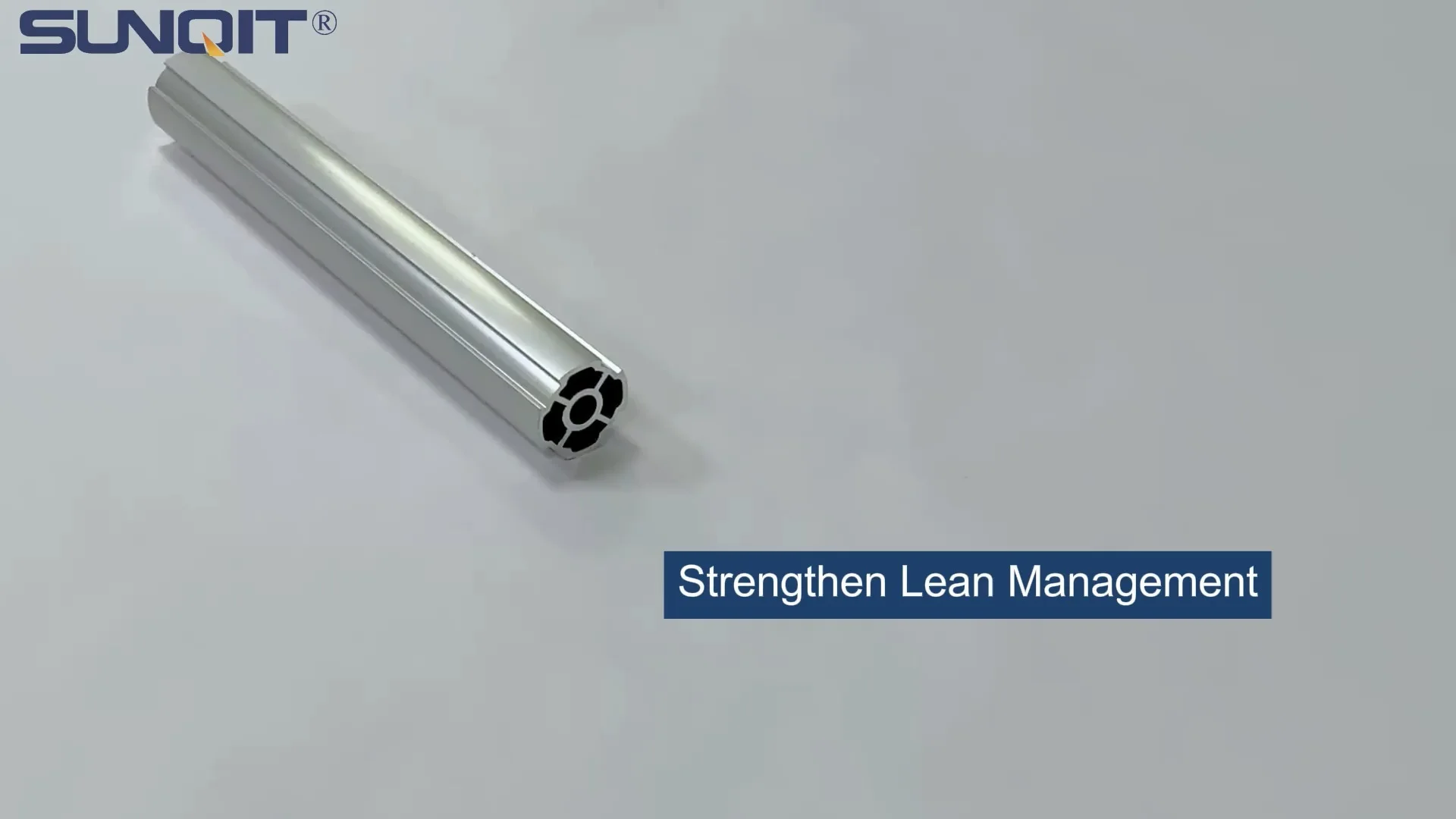
This product is called reinforced aluminum tube, and its bending strength is about twice that of the basic aluminum tube. The end face can process m1o threaded holes, install foot cups and other accessories, or convert internal and external screws in
The Precision Paradox: Why Tight Tolerances Demand Smarter Workflows
Walk into any precision manufacturing facility today—whether it's churning out medical implants, aerospace components, or semiconductor parts—and you'll hear a common refrain: "Closer. Faster. Better." The modern world runs on products that fit together with microscopic precision; a medical device's 0.001mm tolerance, for example, isn't just a specification—it's a matter of patient safety. Yet here's the paradox: as tolerances shrink, the margin for error becomes razor-thin, and the traditional manufacturing setups built for rigidity struggle to keep up. Waste creeps in: time lost reconfiguring fixed workbenches, materials sitting idle on static racks, operators stretching to reach tools, and worst of all, defects that slip through because the workflow itself wasn't designed to prioritize precision.
This is where lean management steps in—not as a buzzword, but as a lifeline. Lean isn't just about cutting costs; it's about creating systems that enable precision by eliminating the waste that distracts from what matters. And in today's factories, the most powerful tool for this isn't a new machine or a software upgrade. It's something simpler, yet transformative: flexible stations. These modular, adaptable workspaces—built around components like adjustable workbenches, dynamic flow racks, and responsive conveyors—are redefining how teams manage tolerances. They turn static lines into living, breathing systems that adjust to change, reduce human error, and keep precision at the forefront of every operation.
Lean Management: More Than Tools—A Mindset for Precision
Before diving into flexible stations, let's ground ourselves in what lean management really means for precision manufacturing. Too often, lean is reduced to 5S posters on the wall or a one-time kaizen event. But true lean is a culture—a relentless focus on value . Every step, every tool, every square inch of the factory floor should contribute directly to creating a product that meets customer needs. Everything else is waste: overproduction, waiting, unnecessary motion, defects, and yes, even rigid, unchangeable workspaces that force teams to work around the setup instead of with it.
At its core, lean thrives on five principles: identifying value, mapping the value stream, creating flow, establishing pull, and pursuing perfection. For precision manufacturers, "flow" is where the rubber meets the road. A smooth, uninterrupted workflow minimizes the chances of human error or material mishandling—two of the biggest enemies of tight tolerances. Imagine an operator assembling a delicate sensor: if they have to walk 10 feet to grab a tool, or wait for a material bin to be wheeled over, their focus shifts. A momentary distraction, a slight misalignment, and suddenly that 0.002mm tolerance is missed. Flexible stations eliminate these disruptions by bringing the work to the worker, not the other way around.
Key Insight: Lean management in precision manufacturing isn't about doing more with less. It's about doing exactly what's needed, exactly when it's needed—so that every action contributes to maintaining the tolerances that define quality.

Tolerance Control: The Hidden Cost of Rigid Workflows
Why "Good Enough" Isn't Enough Anymore
Let's talk about tolerances. In the simplest terms, a tolerance is the allowable variation in a dimension—say, the diameter of a shaft or the thickness of a circuit board. For most of manufacturing history, tolerances were measured in thousandths of an inch. Today, in industries like semiconductors, they're measured in nanometers. But here's the thing: even a "small" tolerance, like 0.01mm, can become a nightmare if the workflow isn't designed to protect it. Why? Because tolerance control isn't just about the machine that cuts the part—it's about the entire ecosystem around it.
Consider a typical scenario: A team is assembling a high-precision valve. The blueprint calls for a seal that fits within 0.005mm of the housing. The CNC machine cuts the parts perfectly, but when they reach the assembly station, problems start. The workbench is fixed at a height that forces the operator to hunch, leading to hand tremors. The tools are stored on a shelf three feet away, so the operator sets the delicate seal down while grabbing a wrench—only to have it shift slightly. The flow rack holding the housings is angled incorrectly, so parts slide too quickly, bumping into each other and nicking edges. By the time the valve is assembled, the tolerance is off by 0.003mm. It's still functional, but over time, that tiny gap could lead to leaks, failures, or recalls.
This isn't a failure of skill—it's a failure of the workspace. Rigid setups treat operators like cogs, expecting them to adapt to the station rather than the station adapting to them. They ignore the human element of precision: fatigue, distraction, awkward positioning. And when tolerances are tight, the human element can't be ignored.

Flexible Stations: The Lean Solution to Adaptive Precision
Modular, Mobile, and Built for Tolerance Control
Flexible stations flip the script. Instead of building workflows around fixed infrastructure, they build infrastructure around workflows. They're made from components designed to be reconfigured, adjusted, and repurposed—think of them as manufacturing's equivalent of Lego blocks. At their core are four key elements: workbenches that adjust to operator height and task, flow racks that deliver materials exactly where and when they're needed, conveyors that maintain a steady, controlled flow of parts, and specialized setups like ESD workstations for sensitive electronics. Together, these components create a system that protects tolerances by design.
Workbenches: Where Precision Meets Comfort
Let's start with the workbench—the operator's home base. A traditional workbench is a static slab of wood or metal, bolted to the floor at a one-size-fits-all height. A flexible workbench, by contrast, is a masterpiece of adaptability. Height-adjustable legs let operators set it to elbow height, reducing strain and steadying hands. Modular accessories—tool rails, LED task lights, bin holders—keep everything within arm's reach, so operators never have to break focus. For precision tasks, some workbenches even feature vibration-dampening surfaces to prevent micro-movements from throwing off measurements. And because they're built with lightweight aluminum profiles or lean pipes, they can be reconfigured in minutes: add a shelf for new tools, reposition a clamp for a different part, or roll in a new accessory without disrupting the line.
Take, for example, an aerospace parts manufacturer that switched to adjustable workbenches for their turbine blade assembly. Previously, operators of different heights struggled with the fixed setup, leading to inconsistent torque application on bolts—a critical issue, since uneven torque can create stress points that fail under extreme conditions. After adjusting the workbenches to each operator's ideal height, torque variation dropped by 40%, and first-pass yield on blade assemblies improved by 15%. The tolerances didn't change; the workspace did.
Flow Racks: Keeping Materials Moving, Not Waiting
Next up: flow racks. In lean terms, "flow" means materials should move smoothly from one step to the next, without stopping. Static racks kill flow—parts sit idle, get mixed up, or become damaged when workers rummage through them. Flow racks solve this with gravity-fed roller tracks (think of a mini roller coaster for parts) that deliver materials to the front of the rack as soon as the previous one is taken. This isn't just about convenience; it's about precision. When parts are organized and easy to access, operators are less likely to rush or mishandle them. For example, a medical device manufacturer using flow racks for surgical instrument components reduced the time spent searching for parts by 60%—and with that, the number of scratched or bent components (a common cause of tolerance failures) dropped by nearly half.
The magic of flow racks lies in their modularity. Using components like swivel roller balls or plastic roller track guide rails, teams can adjust the angle of the rack to control how quickly parts flow—critical for delicate items that can't slide too fast. Need to switch from small washers to larger gears? Swap out the roller track guides in minutes. No more waiting for a new rack to be built; the existing one adapts.
Conveyors: The Glue That Holds Lean Flow Together
If workbenches are the operator's home and flow racks are the pantry, conveyors are the roads that connect them. But not all conveyors are created equal. Traditional belt conveyors are often fixed-speed and rigid, leading to bottlenecks when a station falls behind or parts pile up. Flexible conveyors, by contrast, are modular: sections can be added or removed, speed can be adjusted on the fly, and they can even be curved or elevated to fit the workspace. This adaptability ensures that parts arrive at the next station exactly when they're needed—not too early (causing congestion) or too late (causing waiting).
Consider a electronics assembly line where circuit boards move from soldering to inspection. A rigid conveyor might carry boards past the inspection station at a fixed rate, forcing inspectors to rush through checks to keep up. A flexible conveyor with variable speed lets the inspector slow things down for critical components, ensuring they catch tiny solder bridges that could cause short circuits. It's not just about speed; it's about control. And control is everything when tolerances are measured in microns.
ESD Workstations: Protecting Sensitive Tolerances from Invisible Threats
For industries like electronics or semiconductors, there's an added layer of complexity: electrostatic discharge (ESD). A single static shock can fry a microchip or damage a sensor, even if the physical dimensions are perfect. ESD workstations are specialized flexible stations built to neutralize this threat. They feature grounded surfaces, anti-static mats, and ionizers to dissipate static charges. But what makes them "flexible" is that they're not one-trick ponies. Need to add a new tool holder for a larger circuit board? Just clamp it on. Switching from assembling phones to tablets? Adjust the shelf height and reposition the ionizer—done. ESD workstations prove that flexibility and protection don't have to compete; they can work together to safeguard both tolerances and sensitive components.

From Blueprint to Bench: Building a Flexible Lean System
So, how do you actually build a flexible station that strengthens lean management and controls tolerances? It starts with a value stream map—identifying every step in the process, from raw material to finished product, and asking: What creates value for the customer? What wastes are we tolerating? Once you've mapped the flow, you can design stations around the answers.
Let's walk through a hypothetical (but realistic) example. A precision sensor manufacturer wants to improve their assembly line. Their current setup has fixed workbenches, static steel racks, and a single-speed conveyor. Key issues: long changeover times between sensor models (2 hours), high defect rates due to operator fatigue, and frequent ESD damage to components.
Step 1: Analyze the workflow. They realize that changeover time is wasted on reconfiguring workbenches and rearranging tools. Defects are linked to operators leaning over fixed-height benches, and ESD damage happens because the static mats are worn and not integrated with the tool storage.
Step 2: Design flexible solutions. They invest in height-adjustable workbenches with modular tool rails, flow racks with roller tracks to feed components to each station, a variable-speed conveyor to match assembly pace, and ESD-safe surfaces with integrated grounding. They also add casters to the workbenches so stations can be repositioned for different sensor models in minutes, not hours.
Step 3: Train the team. Flexibility means empowerment—operators need to know how to adjust their workbenches, reconfigure the flow racks, and troubleshoot minor issues. Training turns the stations from "fancy furniture" into tools the team owns and improves over time.
Step 4: Measure and iterate. After implementation, they track metrics: changeover time drops to 20 minutes, defect rates fall by 25%, and ESD damage is eliminated. But they don't stop there—operators suggest adding a second tool rail to one workbench, and the team adjusts the flow rack angle to reduce part sliding speed even further. Lean is never "done," and flexible stations make iteration easy.
Pro Tip: Start small. Don't try to overhaul the entire factory at once. Pick one bottleneck station, implement flexible components, measure the results, and then scale. Success breeds buy-in, and buy-in is critical for lean adoption.
The Results: When Flexible Stations Transform Tolerance Control
Numbers tell the story best. Let's look at the impact flexible stations have had on real (and anonymized) precision manufacturers:
| Industry | Challenge | Flexible Station Solution | Results |
|---|---|---|---|
| Medical Devices | 0.002mm tolerance failures in catheter assemblies; 2-hour changeovers between models. | Adjustable workbenches with vibration-dampening surfaces; flow racks with swivel roller balls for delicate parts. | Changeover time: 20 minutes. Defect rate: down 35%. Operator-reported fatigue: reduced by 50%. |
| Semiconductors | ESD damage to microchips; static-related defects costing $100k/month. | ESD workstations with modular tool holders and ionizers; variable-speed conveyors with static-dissipative belts. | ESD damage eliminated. First-pass yield: up 12%. Annual savings: $1.2M. |
| Aerospace | Torque inconsistency on turbine blade bolts; 40% rework rate. | Height-adjustable workbenches with torque tool holders; flow racks angled for FIFO part delivery. | Torque variation: down 40%. Rework rate: down to 8%. Time per assembly: reduced by 18%. |
These aren't just numbers—they're stories of teams reclaiming control over their processes. When operators no longer have to fight against their workspace, they can focus on what matters: building parts that meet the tightest tolerances, every single time.
The Future of Lean Precision: Flexible Stations and Industry 4.0
As we look ahead, flexible stations are poised to become even more powerful. Industry 4.0—with its IoT sensors, AI analytics, and connected machines—is turning factories into smart ecosystems, and flexible stations are the perfect partners for this transformation. Imagine a workbench with built-in sensors that track tool usage and alert you when a calibration is due, or a flow rack that sends real-time data to a dashboard when parts are running low. A conveyor that adjusts its speed automatically based on sensor data from the next workstation. These aren't science fiction; they're already being tested in forward-thinking plants.
The goal? A self-optimizing workflow where the station itself identifies waste and suggests improvements. A workbench that "learns" the best height for each operator, or a flow rack that predicts which parts will be needed next based on production schedules. This is lean management taken to the next level—precision not just in the product, but in the process itself.
Conclusion: Tolerance Control Starts with the Workspace
In the end, strengthening lean management in precision manufacturing isn't about chasing the latest technology or cutting corners. It's about respecting the complexity of the work—and the people doing it. Tolerances don't exist in a vacuum; they're shaped by every tool, every movement, and every minute of waiting in the process. Flexible stations—with their adaptable workbenches, dynamic flow racks, responsive conveyors, and specialized ESD setups—create the conditions where precision can thrive. They turn rigid lines into flexible systems that eliminate waste, reduce errors, and empower teams to focus on what they do best: building products that change the world, one tight tolerance at a time.
So, the next time you walk through a factory, look beyond the machines. Look at the workbenches, the racks, the conveyors. Are they holding your team back, or lifting them up? The answer might just be the key to strengthening your lean management—and mastering the precision that defines your success.