- Company Articles
- Company Articles
- Supporting Continuous Improvement: Small Iron Corner Codes in Lean Workplace Design

Supporting Continuous Improvement: Small Iron Corner Codes in Lean Workplace Design
Related Product
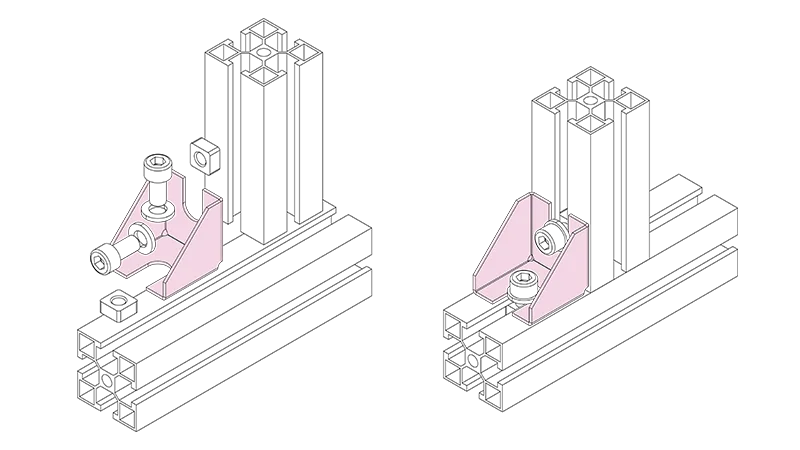
Small Iron Corner Code
Used for 30 series aluminum profile 90° plane connection
In the world of manufacturing and production, where every second counts and efficiency is the name of the game, lean systems have become more than just a buzzword—they're a way of life. At the heart of these systems lies a simple truth: great results often come from the smallest details. Today, we're shining a spotlight on one such detail that's quietly revolutionizing workplace design: the small iron corner code. These unassuming, metal fasteners might not grab headlines, but they're the unsung heroes holding together the flexible, adaptive structures that make lean manufacturing possible. From workbenches to roller tracks, from aluminum profiles to material racks, small iron corner codes are the glue that turns static setups into dynamic, ever-improving workspaces.
The Role of Small Iron Corner Codes in Lean Systems
Lean systems are built on the principle of eliminating waste—whether it's time, materials, or space. To do that, workplaces need to be flexible. A production line that can't adapt to new product designs, a workbench that can't be reconfigured for a new task, or a material rack that can't expand with demand—these are all sources of waste. This is where small iron corner codes step in. Designed to connect and secure components like aluminum profiles, steel pipes, and workbench frames, these tiny fasteners enable the creation of modular structures that can be assembled, disassembled, and reimagined in hours, not days.
Think about it: traditional manufacturing setups often rely on welded joints or permanent fasteners. If you need to adjust a workbench height or add a shelf to a material rack, you're looking at cutting, welding, and repainting—processes that take time and disrupt workflow. Small iron corner codes change that. With a few simple tools, workers can loosen a bolt, reposition a component, and tighten it back up, turning a static workbench into one that fits a new operator's needs or a shifting production goal. This flexibility is the cornerstone of continuous improvement, a key pillar of lean systems. When your workspace can evolve as quickly as your processes, you're not just reducing waste—you're empowering your team to innovate.
Building Better Workbenches: A Closer Look
Workbenches are the workhorses of any production floor. Whether it's assembling electronics, packing products, or inspecting parts, a well-designed workbench can make or break operator efficiency. And at the core of a well-designed workbench? You guessed it—small iron corner codes. Let's take a common setup: the single-deck workbench without casters, often used in assembly lines where stability is key. To build this, manufacturers typically use aluminum profiles or steel pipes for the frame, and a sturdy top (like an aluminum honeycomb panel) for the work surface. The corners where the frame meets the top, or where vertical supports meet horizontal beams, need to be strong enough to handle daily use—think tools being set down, parts being stacked, operators leaning on the bench—but also easy to adjust if, say, the top needs to be replaced or the height needs to be modified.
Small iron corner codes excel here. Unlike plastic joints, which can crack under heavy loads, or adhesive bonds, which weaken over time, these metal fasteners are built to last. They're often made from high-grade steel, coated to resist rust and corrosion, ensuring they hold tight even in busy, sometimes messy production environments. What's more, their simple design—usually a right-angle bracket with pre-drilled holes for bolts—makes installation a breeze. A worker with a wrench can secure a corner code in minutes, no specialized training required. This means that if a workbench top gets damaged, instead of replacing the entire bench, you can just swap out the top and reattach it with the same corner codes. It's a small change that adds up to big savings in time and money.

Synergy with Aluminum Profiles: Strength Meets Flexibility
Aluminum profiles have become a staple in lean workplace design, and for good reason. Lightweight yet strong, resistant to corrosion, and easy to cut and shape, they're ideal for building everything from material racks to conveyor frames. But even the best aluminum profile is only as good as the joints that hold it together. This is where small iron corner codes truly shine. Aluminum profiles often have T-slots—longitudinal grooves that allow for easy attachment of accessories. Small iron corner codes are designed to fit into these slots, creating a secure connection that's both rigid and adjustable.
Imagine a material rack with three rows and three floors, used to store components for an assembly line. As production ramps up, you might need to add a fourth floor or widen the shelves to fit larger boxes. With aluminum profiles and small iron corner codes, this is straightforward. Loosen the bolts on the corner codes securing the horizontal beams, slide the beams up or out to the new position, and retighten. No welding, no cutting, no waiting for a maintenance crew. The rack adapts, and production keeps moving. This synergy between aluminum profiles and small iron corner codes is why so many lean system suppliers prioritize these components—they turn static structures into dynamic tools that grow with your business.
Enhancing Roller Track Efficiency: Keeping Materials Flowing
In lean systems, material flow is everything. Parts need to move from storage to assembly to shipping smoothly, without bottlenecks or delays. Roller tracks are a critical part of this flow, using gravity or motorized rollers to move products along a path. But a roller track is only effective if it's properly aligned and stable. Misaligned rollers can cause jams; loose frames can lead to uneven movement. Small iron corner codes play a vital role here, securing the roller track to its support structure—whether that's an aluminum profile frame, a workbench edge, or a standalone rack.
Take, for example, a 40 steel roller track with yellow wheels, commonly used in automotive parts assembly. The track itself is made up of a series of rollers mounted on a frame. To ensure the track stays level and the rollers spin freely, the frame needs to be rigid. Small iron corner codes connect the frame's vertical supports to its horizontal rails, preventing wobbling or shifting during use. If the track needs to be extended to reach a new workstation, adding a section is as simple as attaching new rails with corner codes. This modularity means that as your production line expands, your roller tracks can expand with it—no need to replace the entire system.
Comparing Fasteners: Why Small Iron Corner Codes Stand Out
To truly appreciate the value of small iron corner codes, it helps to see how they stack up against other common fasteners. Let's compare them to three alternatives: traditional welding, plastic joints, and adhesive bonds.
| Feature | Small Iron Corner Codes | Traditional Welding | Plastic Joints | Adhesive Bonds |
|---|---|---|---|---|
| Flexibility | High: Easy to disassemble and reconfigure | Low: Permanent; requires cutting to modify | Medium: Can be disassembled, but may wear over time | Low: Permanent; difficult to remove without damage |
| Installation Time | Fast: 5-10 minutes per joint with basic tools | Slow: Requires skilled labor; 30+ minutes per joint | Fast: 5-15 minutes per joint | Slow: Requires curing time (hours to days) |
| Durability | High: Steel construction resists wear and heavy loads | High: Strong, but prone to rust if not painted | Low: Can crack under heavy loads or temperature changes | Medium: Weakens with moisture or mechanical stress |
| Cost | Moderate: Affordable per unit; no specialized labor | High: Skilled labor and equipment costs add up | Low: Cheap per unit, but frequent replacement needed | Moderate: Adhesive cost + labor for preparation |
As the table shows, small iron corner codes strike a balance that's hard to beat: they're flexible enough to support continuous improvement, durable enough to handle daily use, and cost-effective enough to scale across an entire facility. It's no wonder lean system suppliers often recommend them as a go-to fastener for modular setups.
Real-World Impact: A Case Study
To put this in perspective, let's look at a real example. A mid-sized electronics manufacturer in the Midwest was struggling with a common problem: their production line for smartphone chargers was rigid. Every time they introduced a new charger model, the workbenches, material racks, and roller tracks had to be completely rebuilt—a process that took 2-3 days and forced production to halt. This not only delayed product launches but also frustrated the team, who often had ideas for improving the line but couldn't implement them quickly.
The solution? They switched to a modular setup using aluminum profiles, roller tracks, and—you guessed it—small iron corner codes. Within a month, their workbenches were reconfigurable in under an hour, their material racks could be adjusted to fit new component sizes, and their roller tracks could be extended or shortened with minimal effort. The result? When they launched their next charger model, the line was ready in just 4 hours. Downtime dropped by 85%, and the team started suggesting more improvements, knowing they could see results quickly. Productivity increased by 15% in the first quarter alone, and employee satisfaction scores rose—all because of a shift to a system built on small, flexible components like the small iron corner code.
The Future of Lean Workplace Design
As manufacturing continues to evolve—with trends like automation, customization, and shorter product lifecycles—flexibility will only become more important. Small iron corner codes are poised to play an even bigger role in this future. Imagine a smart factory where workbenches adjust automatically to operator heights, or material racks reconfigure based on real-time inventory data. These systems will rely on modular components, and modular components rely on fasteners that can keep up—fasteners like small iron corner codes.
Suppliers are already innovating, too. New designs of small iron corner codes now include features like quick-release levers (eliminating the need for wrenches) and corrosion-resistant coatings for use in harsh environments. Some even come with built-in leveling feet, making it easier to ensure workbenches and racks are stable on uneven floors. These advancements are making small iron corner codes more versatile than ever, further cementing their place in the lean toolkit.
Conclusion: Small Parts, Big Results
In the end, lean systems are about more than just cutting costs—they're about creating workplaces that empower people to do their best work. Small iron corner codes might not seem like much, but they're a testament to the idea that greatness lies in the details. By enabling flexible, modular, and adaptable structures, these tiny fasteners help businesses eliminate waste, respond to change, and continuously improve. They're the quiet partners in every efficient workbench, every smooth roller track, and every innovative material rack.
So the next time you walk through a production floor, take a closer look at the workbenches and racks. Chances are, you'll spot small iron corner codes holding them together—small in size, but enormous in impact. In the world of lean, that's the power of the little things.