- Company Articles
- Industry articles
- Industry standards
- Aluminum 2020 National Standard Profile: Material Composition & Durability Tests

Aluminum 2020 National Standard Profile: Material Composition & Durability Tests
Related Product
2020 National Standard Profile
45° external bending joint, used for 45° external connection of two aluminum pipes.
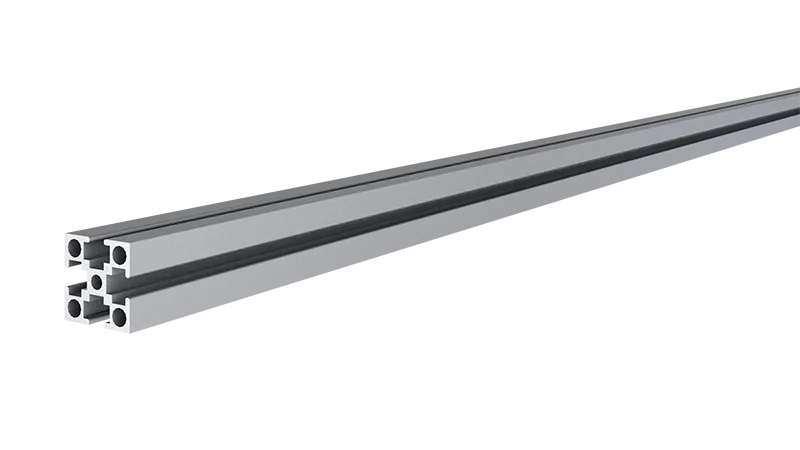
Walk into any modern factory, and you'll spot aluminum profiles everywhere – in workbenches, material racks, and trolleys shuttling parts across the floor. These unassuming components are the backbone of efficient manufacturing, blending strength, flexibility, and durability to keep operations running smoothly. Among the many types of aluminum profiles available, the 2020 national standard profile stands out as a versatile workhorse, trusted by industries from electronics to automotive. But what exactly makes this profile so reliable? In this article, we'll dive into its material composition, explore how it's made, and put its durability to the test – all to show why it's become a staple in workshops worldwide.
What Is the 2020 National Standard Aluminum Profile?
First things first: let's clarify what we mean by "2020 national standard profile." The name itself gives a clue – "2020" refers to its cross-sectional dimensions, typically 20mm in width and 20mm in height, though exact measurements can vary slightly based on specific industry standards. This compact size makes it ideal for applications where space is limited but strength can't be compromised, like small workbenches, lightweight material racks, or component frames in electronics assembly lines.
But it's not just about size. The "national standard" label means this profile meets strict quality and performance criteria set by regulatory bodies, ensuring consistency in material, dimensions, and durability across manufacturers. This standardization is critical for businesses: when you order a 2020 national standard profile, you know exactly what you're getting, whether you're sourcing from a local supplier or an international manufacturer. It eliminates guesswork and ensures compatibility with aluminum profile accessories like connectors, end caps, and hinges – a detail that saves countless hours in assembly and maintenance.
Material Composition: The Science Behind the Strength
At its core, the 2020 national standard profile is an aluminum extrusion profile , meaning it's formed by pushing heated aluminum through a shaped die to create its distinct cross-section. But the real magic lies in its alloy composition. Most 2020 profiles are made from 6063 aluminum alloy, a popular choice for extrusions thanks to its excellent formability, corrosion resistance, and moderate strength. Let's break down the key elements in this alloy and why they matter:
Aluminum (Al): The Base Metal
Aluminum makes up over 97% of the alloy, providing the profile's lightweight nature. Pure aluminum is soft and malleable, but when combined with other elements, it transforms into a material that's both strong and easy to shape – perfect for extrusion.
Silicon (Si): Enhancing Flow and Formability
Silicon, typically around 0.2-0.6% by weight, acts as a "lubricant" during the extrusion process. When the aluminum billet is heated, silicon lowers its melting point slightly and improves its flow through the die, ensuring the profile takes on the exact shape of the die with crisp, uniform edges. Without enough silicon, the metal might crack or deform during extrusion, leading to weak spots in the final product.
Magnesium (Mg): Boosting Strength
Magnesium is the secret to the profile's strength. At around 0.45-0.9% by weight, it forms compounds with silicon (called Mg2Si) during heat treatment, creating tiny particles that reinforce the aluminum matrix. This process, known as precipitation hardening, gives the 2020 profile its impressive tensile strength – the ability to resist breaking under tension – without adding significant weight.
Iron (Fe): Controlling Impurities
Iron is present in small amounts (usually less than 0.35%) as an impurity from the raw materials. While too much iron can form brittle intermetallic compounds that weaken the alloy, controlled levels help prevent the growth of other harmful impurities, ensuring the profile remains ductile (bendable without breaking) and durable.
Copper (Cu) and Manganese (Mn): Fine-Tuning Performance
Copper (up to 0.1%) and manganese (up to 0.1%) are often added in trace amounts to further enhance strength and corrosion resistance. Copper, in particular, helps the alloy respond better to heat treatment, while manganese improves its ability to withstand repeated stress – useful for profiles that might be multiple times, like modular workbenches.
Together, these elements create an alloy that's lightweight (about 2.7g/cm³, a third the density of steel), strong enough to support heavy loads, and flexible enough to be cut, drilled, or connected with accessories. But how does this composition translate to real-world performance? Let's take a closer look at the extrusion process, which plays a huge role in shaping the profile's final properties.

From Billet to Profile: The Extrusion Process
The 2020 national standard profile isn't just "made" – it's crafted through a precise process called extrusion, which turns a solid aluminum billet into a long, uniform profile. Here's a step-by-step look at how it's done:
1. Billet Preparation
The process starts with a cylindrical aluminum billet, typically 6-12 meters long, made from the 6063 alloy we discussed. Before extrusion, the billet is cut into shorter lengths (usually 1-2 meters) and heated to around 480-520°C – hot enough to make the metal pliable but not molten. This heating step is critical: too cold, and the billet won't flow through the die; too hot, and it might warp or develop internal defects.
2. Extrusion: Shaping the Profile
Once heated, the billet is loaded into an extrusion press, where a hydraulic ram pushes it through a steel die. The die is precision-machined with a 20x20mm opening (the profile's cross-section) and any additional features, like T-slots for accessories. As the billet is forced through the die, it takes on the die's shape, emerging as a long, continuous profile. Think of it like squeezing toothpaste through a tube – the paste (aluminum) takes the shape of the tube's opening (the die).
The speed of extrusion matters too. For the 2020 profile, manufacturers typically aim for a speed of 5-15 meters per minute. Faster speeds can cause surface defects, while slower speeds increase production time and cost. Skilled operators monitor the process closely, adjusting pressure and temperature to ensure the profile comes out smooth and uniform.
3. Cooling and Stretching
After exiting the die, the hot profile is cooled rapidly using fans or water sprays to lock in its shape. But cooling can cause slight warping, so the profile is then stretched by 1-3% of its length using a tensioning machine. This stretching straightens the profile and removes internal stresses, ensuring it remains dimensionally stable over time – no more bending or twisting when you mount it on a workbench.
4. Aging: Strengthening the Alloy
The final step is artificial aging, where the profile is heated to 170-190°C for 4-8 hours. This process encourages the Mg2Si particles to precipitate (form small, hard crystals) throughout the aluminum matrix, as we mentioned earlier. The result? A significant boost in strength – the profile's tensile strength jumps from around 100 MPa (megapascals) in its "as-extruded" state to 180-220 MPa after aging, making it tough enough to handle the rigors of daily use in a factory.
By the end of this process, the 2020 national standard profile is ready to be cut into custom lengths, packaged, and shipped to manufacturers. But before it reaches the factory floor, it must pass a series of durability tests to ensure it meets the national standard. Let's put it to the test.
Durability Tests: How Does the 2020 Profile Hold Up?
A profile's composition and manufacturing process are only part of the story – the real proof is in how it performs under stress. To verify its durability, the 2020 national standard profile undergoes a battery of tests, from tensile strength checks to corrosion resistance trials. Let's walk through the most important ones and see how the profile measures up.
Tensile Strength: Can It Withstand Pulling Forces?
Tensile strength is a measure of how much pulling force a material can withstand before breaking. For the 2020 profile, this is tested using a universal testing machine, which clamps a sample of the profile and pulls it until it fractures. The result is given in megapascals (MPa), where 1 MPa is roughly equivalent to the pressure of 10 atmospheres.
The national standard requires the 2020 profile to have a minimum tensile strength of 180 MPa. In real-world tests, most samples exceed this, hitting 200-220 MPa – more than enough to support the weight of tools, components, or even small machinery on a workbench. For context, that's stronger than many types of wood (which typically maxes out at 50-100 MPa) and even some low-carbon steels (around 200 MPa), but at a fraction of the weight.
Corrosion Resistance: Does It Stand Up to Moisture and Chemicals?
Factories are harsh environments, with moisture, oils, and cleaning chemicals everywhere. To test corrosion resistance, the 2020 profile undergoes a salt spray test, where it's exposed to a fine mist of 5% saltwater at 35°C for 500 hours. Afterward, the profile is inspected for rust, pitting, or discoloration – common signs of corrosion.
Thanks to its aluminum composition, the profile naturally forms a thin oxide layer on its surface, which acts as a barrier against corrosion. In the salt spray test, the national standard allows for minimal discoloration but no pitting or rust. In practice, most 2020 profiles pass with flying colors, showing only slight dulling after 500 hours – more than enough to last for years in a typical factory setting, even in humid climates.
Load-Bearing Capacity: How Much Weight Can It Support?
When you're building a workbench or a material rack, you need to know how much weight the profile can hold without bending or collapsing. For the 2020 profile, load-bearing tests involve mounting a 1-meter length of the profile between two supports and gradually adding weight to the center until it deflects (bends) by more than 0.2% of its length (about 2mm for a 1-meter sample).
On average, a single 2020 profile can support 50-80 kg before reaching this deflection limit. But in real use, profiles are rarely used alone – they're connected with brackets and cross-members to form frames, which distributes weight evenly. A simple frame made from four 2020 profiles (forming a 1m x 1m square) can easily support 200-300 kg – enough for a workbench loaded with tools, parts, and even a small assembly station.
Thermal Stability: Does It Warp in Extreme Temperatures?
Factories can get hot in summer and cold in winter, so the profile must remain stable across a wide temperature range. To test this, samples are placed in a thermal chamber and exposed to temperatures from -40°C to 80°C, cycling between extremes for 100 hours. Afterward, the profile is checked for warping, cracking, or changes in dimensions.
Aluminum has a low coefficient of thermal expansion (how much it expands when heated), so the 2020 profile holds up well in these tests. Even at 80°C, it expands by less than 0.1% of its length – negligible for most applications. At -40°C, it contracts slightly but remains ductile, avoiding the brittleness that plagues some plastics or even steel at low temperatures.
Impact Resistance: Can It Handle Accidental Drops?
In a busy factory, tools or parts are bound to be dropped on the profile from time to time. To test impact resistance, a 1kg weight is dropped onto a sample of the profile from a height of 1 meter (simulating a typical accident). The profile should absorb the impact without cracking or deforming permanently.
The 2020 profile's ductility – its ability to bend without breaking – shines here. In tests, it typically dents slightly but doesn't crack, and the dent can often be straightened with minimal effort. This resilience makes it far more durable than brittle materials like ceramic or some plastics, which would shatter on impact.
| Test Category | Test Method | Result for 2020 Profile | Industry Standard Requirement | Why It Matters |
|---|---|---|---|---|
| Tensile Strength | Universal testing machine pull test | 200-220 MPa | Minimum 180 MPa | Ensures the profile can withstand pulling forces without breaking. |
| Corrosion Resistance | 500-hour salt spray test (5% saltwater, 35°C) | Minor discoloration, no pitting | No rust or pitting allowed | Prevents degradation in moist or chemical-heavy factory environments. |
| Load-Bearing Capacity | Central weight test on 1m sample | 50-80 kg before 2mm deflection | Minimum 40 kg | Supports tools, parts, and equipment on workbenches/racks. |
| Thermal Stability | -40°C to 80°C thermal cycling (100 hours) | No warping or cracking | Less than 0.1% dimensional change | Maintains shape in extreme factory temperatures. |
| Impact Resistance | 1kg weight dropped from 1m height | Minor dent, no cracking | No structural failure | Withstands accidental drops and collisions. |
The Verdict: A Durable Performer
Across all these tests, the 2020 national standard profile consistently meets or exceeds industry requirements. Its tensile strength, corrosion resistance, and load-bearing capacity make it a reliable choice for everything from simple shelving to complex assembly line structures. And because it's an aluminum extrusion profile , it's also easy to customize – cut to length, drilled for mounting holes, or combined with accessories to fit almost any need.
Aluminum Profile Accessories: Making the 2020 Profile Even Better
A profile is only as good as the accessories that go with it, and the 2020 national standard profile has a wide range of aluminum profile accessories designed to enhance its functionality. From end caps that protect against sharp edges to connectors that join profiles at any angle, these accessories turn a simple length of aluminum into a fully functional system. Let's take a look at the most useful ones:
End Caps: Safety and Aesthetics
Extruded aluminum profiles often have sharp edges at the cut ends, which can pose a safety hazard in busy workshops. Aluminum profile end caps – small plastic or rubber covers that snap onto the ends of the profile – solve this problem. They're available in colors like black, white, or gray to match the profile, and some even have built-in gaskets for a snug, rattle-free fit. Beyond safety, end caps also prevent dust, debris, or liquids from entering the profile's internal channels, keeping it clean and extending its lifespan.
T-Slot Nuts and Bolts: Secure Connections
One of the 2020 profile's biggest advantages is its T-slot design – a long, narrow groove running along its length that allows accessories to be mounted anywhere along the profile. T-slot nuts (small, T-shaped nuts that slide into the slot) and bolts are used to attach brackets, shelves, or panels. Unlike traditional drilling and tapping, which limits you to fixed mounting points, T-slot connections are adjustable, making it easy to reconfigure workbenches or racks as your needs change. It's this flexibility that makes the 2020 profile so popular for modular systems.
Aluminum Profile Rubber Strip: Protection and Noise Reduction
If you've ever slid a tool or component across a metal workbench, you know it can be noisy – and potentially damaging to both the tool and the bench. Aluminum profile rubber strip is a simple solution: a soft, flexible strip that fits into the T-slot or along the edge of the profile, providing a cushion between the profile and whatever you're placing on it. It reduces noise, prevents scratches, and even adds a bit of grip, so items are less likely to slide around. Available in colors like black, gray, or yellow, it's a small accessory that makes a big difference in day-to-day use.
Connectors: Building Complex Structures
To build larger structures – like a multi-level material rack or a workbench with shelves – you'll need connectors to join 2020 profiles at angles. The most common types are 90-degree corner brackets (for right angles), T-connectors (for joining three profiles in a T-shape), and 45-degree brackets (for slopes or diagonal supports). These connectors are typically made from aluminum or high-strength plastic and attach using T-slot nuts and bolts, ensuring a secure, wobble-free connection. Some even have built-in reinforcement ribs to handle heavier loads, making them ideal for industrial applications.
Together, these accessories transform the 2020 profile from a basic building block into a versatile system that can adapt to almost any task. Whether you're building a simple workbench or a complex assembly line, there's an accessory to help you do it faster, safer, and more efficiently.
Real-World Applications: Where You'll Find the 2020 Profile
Now that we understand the 2020 profile's composition, durability, and accessories, let's look at where it's actually used. Its small size, strength, and flexibility make it a favorite in industries that demand precision and efficiency. Here are some common applications:
Workbenches and Assembly Stations
In electronics manufacturing, where components are small and precision is key, 2020 profiles are often used to build custom workbenches. These workbenches can be fitted with shelves, tool holders, and even ESD (electrostatic discharge) mats to protect sensitive components. The T-slot design makes it easy to add or remove accessories as the assembly process changes, keeping the workspace organized and efficient.
Material Racks and Shelving
Factories need to store parts and tools within easy reach, and 2020 profiles are perfect for lightweight material racks. A simple rack made from 2020 profiles and cross-braces can hold boxes of screws, circuit boards, or small components, with adjustable shelves to accommodate different-sized items. The profile's corrosion resistance also makes it suitable for storing parts in humid environments, like warehouses near the coast.
Trolleys and Carts
Trolleys used to move parts around the factory floor need to be lightweight (to make them easy to push) but strong (to carry heavy loads). The 2020 profile fits the bill, with frames made from interconnected profiles and wheels attached via caster mounts. These trolleys are often used in automotive assembly plants to transport small parts, or in hospitals to carry medical supplies – anywhere mobility and durability are important.
Prototyping and Custom Machinery
Engineers and designers love the 2020 profile for prototyping new machines or production lines. Its modular design allows them to quickly build and test structures, making adjustments as needed without having to fabricate custom parts from scratch. Once the prototype is finalized, the same profile can often be used in the final production version, saving time and money.
These are just a few examples – the 2020 profile's versatility means it's used in everything from retail displays to laboratory equipment. Wherever there's a need for a strong, lightweight, and adaptable structure, you'll find the 2020 national standard profile hard at work.
Why Choose the 2020 National Standard Profile?
With so many aluminum profiles on the market, why has the 2020 national standard profile become such a staple? Here are the key reasons:
- Strength-to-Weight Ratio: It's strong enough to support heavy loads but light enough to be easily moved and assembled by hand.
- Standardization: The national standard ensures consistent quality and compatibility across manufacturers, so you can mix and match profiles and accessories from different suppliers.
- Cost-Effective: Compared to custom-machined metal parts, the 2020 profile is affordable and widely available, reducing production costs.
- Flexibility: With T-slots and a wide range of accessories, it can be adapted to almost any task, from simple shelving to complex machinery.
- Durability: Its corrosion resistance, tensile strength, and impact resistance mean it will last for years, even in harsh factory environments.
In short, the 2020 profile offers the perfect balance of performance, versatility, and value – qualities that are hard to beat in today's fast-paced manufacturing world.
Conclusion: The Unsung Hero of Modern Manufacturing
The 2020 national standard profile may not be the most glamorous component in a factory, but it's undoubtedly one of the most important. From its carefully crafted alloy composition to its rigorous durability tests, every aspect of this profile is designed to deliver strength, flexibility, and reliability when it matters most. Whether you're building a workbench, a material rack, or a custom assembly line, it provides a solid foundation that you can count on – day in, day out.
And with the right aluminum profile accessories – end caps, rubber strips, connectors – it becomes even more versatile, adapting to new tasks and challenges as your business grows. So the next time you walk into a factory, take a closer look at those aluminum frames and workbenches. Chances are, you're looking at the 2020 national standard profile – quietly holding everything together, and proving that sometimes, the most essential tools are the ones we take for granted.