- Company Articles
- Industry articles
- Industry standards
- Aluminum Alloy 3030 National Standard Profile A: Material Advantages in Lean Systems

Aluminum Alloy 3030 National Standard Profile A: Material Advantages in Lean Systems
Related Product
3030 National Standard Profile A
Workbench, production line, logistic rack, warehouse rack Industry: Manufacturer workshop, Automobile, Electronic, Assembling, logistic
In the fast-paced world of modern manufacturing, where every second counts and waste is the enemy, lean systems have become more than just a buzzword—they're the backbone of efficient, adaptable production lines. At the heart of these systems lies a critical choice: the materials that bring them to life. Today, we're diving into a material that's quietly revolutionizing how factories build, adapt, and thrive: the Aluminum Alloy 3030 National Standard Profile A. Far more than just a piece of metal, this profile is a catalyst for lean success, blending strength, flexibility, and sustainability in a way that traditional materials simply can't match. Let's unpack why it's become the go-to choice for manufacturers aiming to streamline operations, reduce waste, and stay ahead in an ever-changing market.
Lean Systems 101: Why Materials Make or Break Efficiency
Before we get into the specifics of the 3030 aluminum profile, let's take a step back to understand what makes a lean system tick. Lean manufacturing, born from the Toyota Production System, is all about maximizing value while minimizing waste—whether that's time, labor, space, or materials. A key principle here is "flow": ensuring that materials, components, and work-in-progress move smoothly from one step to the next, without bottlenecks or delays. Another is "flexibility": the ability to reconfigure production lines quickly when demand shifts or new products are introduced.
Here's where materials come in. Imagine building a lean system with heavy steel pipes or rigid plastic components. Every time you need to adjust a workbench height, add a new shelf to a flow rack, or reposition a conveyor, you're looking at hours of drilling, welding, or even replacing entire structures. That's wasted time. Now, picture a material that's lightweight enough to move by hand, strong enough to support heavy loads, and designed to snap together like building blocks. Suddenly, reconfiguration takes minutes, not days. That's the difference the right material makes—and that's where aluminum extrusion profile shines.
Meet the Star: What Is Aluminum Alloy 3030 National Standard Profile A?
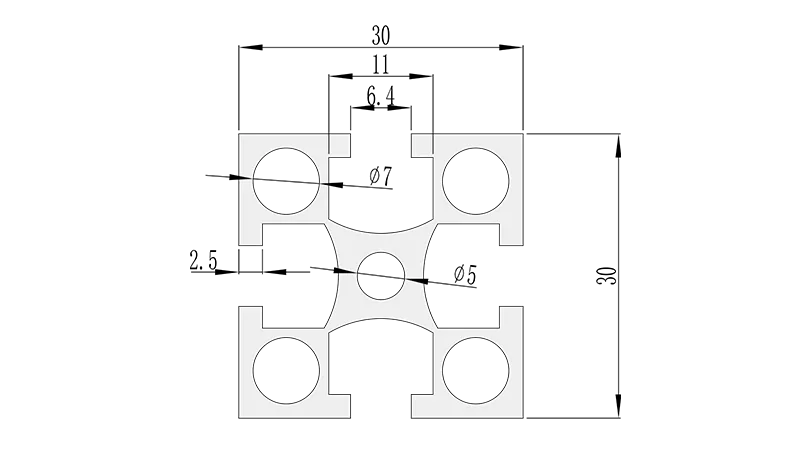
Let's start with the basics. The 3030 National Standard Profile A is a type of aluminum extrusion—meaning it's formed by pushing heated aluminum through a die to create a consistent, precise cross-section. As the name suggests, it measures 30mm by 30mm, making it a versatile middleweight in the world of aluminum profiles. But what really sets it apart is its composition and design.
First, the alloy: this profile is typically made from 6063 aluminum, a blend of aluminum, magnesium, and silicon. This mix gives it a rare combination of strength and ductility—strong enough to support heavy tools or materials, yet malleable enough to be extruded into complex shapes. Then there's the "national standard" part: it adheres to strict quality and dimensional standards, ensuring that every piece from every batch fits together perfectly. No more guesswork, no more mismatched parts—just consistency you can rely on.
But the real genius is in the design. Like most modern aluminum profiles, the 3030 features a "T-slot" along its length—a groove that runs the full length of the profile, ready to accept bolts, brackets, shelves, or any accessory you can think of. It's like having a built-in track system that turns the profile into a blank canvas for customization. No welding, no drilling, no special tools—just slide in a bracket, tighten a screw, and you're done. That simplicity is the first hint of why it's a lean dream come true.
Core Advantages: Why 3030 Aluminum Profile Outperforms the Rest
Now, let's get into the nitty-gritty: the material advantages that make the 3030 profile a standout choice for lean systems. We'll break them down into five key areas, each directly contributing to lean principles like flow, flexibility, and waste reduction.
1. Lightweight Yet Surprisingly Strong
Aluminum is famous for its strength-to-weight ratio, and the 3030 profile is no exception. Weighing in at roughly 1.4 kg per meter (depending on wall thickness), it's about 1/3 the weight of steel—yet it can support up to 150 kg per linear meter in some configurations. What does that mean for your factory floor? For starters, it's easy to handle. A single worker can carry a 3-meter length without strain, cutting down on the labor needed to assemble or reconfigure structures. When you're building a lean pipe workbench or a flow rack, that translates to faster setup times and fewer workers tied up in material handling.
But it's not just about lifting. Lighter structures mean easier repositioning. Need to shift a workbench to align with a new conveyor path? No need for a forklift—just a few people and a dolly. That flexibility to adapt on the fly is pure lean gold, turning what used to be a half-day project into a 15-minute task.
2. Corrosion Resistance: Built to Last in Tough Environments
Factories are harsh places. Oils, coolants, humidity, and even occasional spills can take a toll on metal components. Steel rusts, uncoated aluminum oxidizes—but the 3030 profile, often treated with anodizing (a process that forms a protective oxide layer on the surface), stands up to these challenges. Anodized aluminum resists corrosion, scratches, and chemical damage, meaning your lean structures won't degrade over time. That's a big deal for lean systems, where durability directly impacts long-term waste reduction. Instead of replacing rusted steel frames every few years, you're investing in a structure that will last a decade or more—saving money, reducing material waste, and avoiding the downtime that comes with frequent replacements.
3. Modular by Design: The T-Slot Advantage
Remember that T-slot we mentioned earlier? It's not just a design quirk—it's the secret to the 3030 profile's unmatched flexibility. With aluminum profile accessories like brackets, hinges, and connectors, you can attach shelves, tool holders, lighting, or even conveyor tracks anywhere along the slot, at any angle. Need to add a second shelf to your flow rack? Slide in a bracket, tighten a knob, and you're done. Want to mount a monitor arm on your workbench? Drill-free, tool-free, and reversible if you change your mind later.
This modularity is a game-changer for lean's "flexibility" principle. In traditional setups, reconfiguring a workbench might mean welding new brackets or drilling new holes—permanent changes that lock you into one layout. With the 3030 profile, nothing is permanent. It's a system that grows with your needs, reducing the waste of "overbuilding" or "underbuilding" structures that can't adapt.
4. Precision Engineered: Tight Tolerances for Seamless Assembly
Ever tried to build something with parts that don't quite fit? It's frustrating, time-consuming, and a recipe for wobbly, unreliable structures. The 3030 National Standard Profile A eliminates that headache. Thanks to strict national standards, every profile, connector, and accessory is manufactured to tight tolerances—meaning they fit together like puzzle pieces. No gaps, no misalignments, no "making it work" with extra washers or brute force. This precision speeds up assembly time (no more trial and error) and ensures that structures are stable and safe, even under heavy loads. When every component works as intended, you spend less time fixing mistakes and more time producing value—exactly what lean is all about.
5. Sustainable by Nature: Recyclable, Energy-Efficient, and Low-Waste
Lean systems and sustainability go hand in hand—both focus on reducing waste. Aluminum is one of the most recyclable materials on the planet, with nearly 75% of all aluminum ever produced still in use today. When a 3030 profile reaches the end of its life (which, let's be clear, is decades down the line), it can be melted down and recycled with minimal energy loss—unlike steel, which loses strength when recycled repeatedly. Additionally, the extrusion process itself is energy-efficient compared to steel production, and the lightweight nature of aluminum reduces transportation emissions, both from the factory to your facility and within your own plant.
For manufacturers aiming to meet sustainability goals (and let's face it, that's most of us these days), choosing the 3030 profile isn't just a lean decision—it's a green one, aligning operational efficiency with environmental responsibility.
From the Drawing Board to the Factory Floor: Real-World Applications
Enough theory—let's talk about how the 3030 profile transforms real lean systems. Here are three common applications where it truly shines:
Lean Pipe Workbench: The Heart of the Production Line
The workbench is where the magic happens—the place where operators assemble, test, or inspect products. A well-designed workbench reduces fatigue, streamlines tool access, and adapts to different tasks. With the 3030 aluminum profile, building that perfect workbench is a breeze. Want a height-adjustable surface? Use telescoping legs with T-slot locks. Need a pegboard for tools? Attach it directly to the profile with brackets. Add a LED light bar, a bin for scrap, or even a small conveyor for parts delivery—all without drilling a single hole.
Take a electronics manufacturer we worked with last year. They were using heavy wooden workbenches that were impossible to adjust. When they switched to 3030 aluminum, they cut assembly time by 40%, and operators reported less back strain from custom-height setups. Plus, when they launched a new product line with different tool requirements, they reconfigured the benches in a morning instead of building new ones from scratch. That's lean in action.
Flow Rack: Keeping Materials Moving, No Stagnation Allowed
Flow racks are the arteries of a lean system, ensuring that materials flow to the point of use exactly when needed. The 3030 profile excels here, too. Its strength supports multiple levels of shelving, while its lightweight nature makes it easy to position near assembly lines. Pair it with roller tracks (another aluminum extrusion profile application) and you've got a gravity-fed system where bins glide smoothly from the back to the front, reducing the need for workers to bend or reach.
A automotive parts supplier recently replaced their steel flow racks with 3030 aluminum versions. The result? They increased storage density by 25% (thanks to the profile's slim design) and reduced the time workers spent retrieving parts by 15 minutes per shift. The anodized finish also meant they didn't have to worry about oil from parts corroding the racks—a common issue with their old steel setup.
Conveyor Systems: Lightweight, Low-Maintenance, and Customizable
Conveyors keep production moving, but traditional steel conveyors are heavy, noisy, and hard to modify. The 3030 profile changes that. Its lightweight design reduces the load on motors, cutting energy costs. Its corrosion resistance means less downtime for maintenance. And with T-slot connectors, adding guides, sensors, or diverters is simple—no welding required. A food packaging plant we know swapped their steel conveyors for 3030 aluminum ones and saw a 20% drop in energy bills, plus they were able to add product sensors in a day to reduce jams. Win-win.
The Numbers Don't Lie: Cost-Effectiveness Over the Long Haul
We get it—aluminum can cost more upfront than steel or wood. But lean is about looking at the total cost of ownership, not just the initial price tag. Let's break down the savings:
- Assembly Time: 3030 aluminum systems assemble 30-50% faster than steel, saving labor costs from day one.
- Transportation: Lighter materials mean lower shipping fees and easier on-site movement (no forklift needed).
- Reusability: When you reconfigure instead of rebuild, you save on material costs and waste disposal.
- Maintenance: Corrosion resistance means no repainting or rust repairs, extending lifespan by 5-10 years.
To put this in perspective, check out this comparison table of 3030 Aluminum Profile A vs. traditional steel and wood for a typical workbench setup:
| Metric | 3030 Aluminum Profile A | Steel Pipe & Angle Iron | Wooden Workbench |
|---|---|---|---|
| Initial Material Cost | Higher ($350-450) | Medium ($250-350) | Lowest ($150-250) |
| Assembly Time | 2 hours | 6 hours (welding/drilling) | 4 hours (cutting/sanding) |
| Reconfiguration Time | 30 minutes | 8 hours (requires new welding) | Not reconfigurable (new build needed) |
| Estimated Lifespan | 15-20 years | 8-10 years (with rust) | 3-5 years (warping, rot) |
| Total Cost Over 10 Years* | $550 (initial + minor accessories) | $950 (initial + 2 replacements + welding labor) | $1,250 (5 replacements) |
*Estimates based on a single workbench, including material, labor, and replacement costs.
As you can see, while aluminum starts higher, it's the most cost-effective over time—especially when you factor in reusability and longevity. For lean systems, that long-term value is impossible to ignore.
Choosing Your 3030 Aluminum Profile A: What to Look for in a Supplier
Not all 3030 profiles are created equal. To get the full benefits, you need a supplier who prioritizes quality, consistency, and support. Here's what to look for:
- National Standard Compliance: Ensure the profile meets national standards for dimensions, alloy composition, and strength. Ask for certification.
- Anodizing Quality: A good anodized finish should be uniform, scratch-resistant, and at least 10 microns thick.
- Accessory Availability: The best suppliers offer a full range of aluminum profile accessories—brackets, connectors, hinges—to avoid compatibility issues.
- Technical Support: Look for suppliers who can help with design questions or custom configurations. A little guidance goes a long way.
We've seen too many manufacturers buy cheap, non-standard profiles only to find that connectors don't fit or the material bends under load. Invest in quality upfront, and you'll avoid costly do-overs later.
Final Thoughts: Aluminum 3030 Profile A—More Than a Material, a Lean Partner
At the end of the day, lean systems are about people: the workers who build, the managers who optimize, and the customers who benefit from better, faster products. The Aluminum Alloy 3030 National Standard Profile A isn't just a material—it's a tool that empowers those people to do their best work. It reduces frustration, saves time, and turns "we can't" into "we can, and we can do it better."
Whether you're building a single workbench or overhauling your entire production line, this profile offers a path to lean success that's strong, flexible, and sustainable. It's an investment in efficiency, adaptability, and the future of your factory. So why wait? Start small—replace one workbench, build one flow rack—and see the difference for yourself. We think you'll be hooked.
After all, in lean manufacturing, the goal is perfection. And with the right materials, perfection feels a lot closer.