- Company Articles
- Industry articles
- Industry standards
- Aluminum Profile 3 Way Connectors in Aerospace Manufacturing: Stringent Standards

Aluminum Profile 3 Way Connectors in Aerospace Manufacturing: Stringent Standards
Related Product
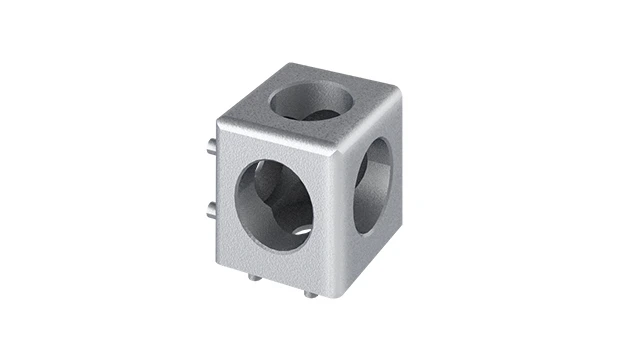
Aluminum Profile 3 Way Connector
The 3 way - squared corner connector is an external fastening method that is typically used to create a corner connection between three profiles. It is a heavy-duty connection that is simple to use and provides a polished look.
Aerospace manufacturing is a realm where precision isn't just a goal—it's a non-negotiable requirement. Every bolt, every panel, every component plays a role in ensuring that aircraft, satellites, and spacecraft perform flawlessly under extreme conditions. Yet, amid the high-tech avionics and advanced materials, there's a quiet workhorse that holds much of this industry together: aluminum profiles and their connectors. Among these, the aluminum profile 3 way connector stands out as a linchpin, enabling the creation of robust, flexible structures that power production lines, assembly stations, and material handling systems. But in aerospace, "good enough" never is. These connectors must meet standards so stringent, they're designed to withstand the same rigor as the aerospace components they help build.
Aluminum Profiles: The Backbone of Aerospace Manufacturing
Why aluminum? In aerospace, where every gram of weight impacts fuel efficiency and performance, aluminum's unique blend of lightweight strength and corrosion resistance makes it indispensable. But it's not just about the metal itself—it's how it's shaped. Aluminum extrusion profile, created by forcing heated aluminum through a die to form consistent, complex cross-sections, has revolutionized manufacturing. These profiles come in endless shapes: T-slots, channels, angles, and tubes, each tailored to specific structural needs. In aerospace facilities, they form the skeleton of workbenches, material racks, conveyor systems, and even temporary assembly jigs for aircraft parts. Their modularity means they can be reconfigured as production needs change, aligning perfectly with the lean system principles that drive efficiency in modern manufacturing.
But an aluminum profile is only as useful as its ability to connect to others. Without reliable connectors, these profiles remain just pieces of metal. This is where components like the aluminum profile 3 way connector step in—turning individual profiles into integrated, load-bearing structures that can support heavy aerospace parts, withstand constant use, and maintain precision over years of operation.
The Critical Role of Aluminum Profile 3 Way Connectors
Imagine a workbench where aerospace technicians assemble delicate avionics. The bench must be sturdy enough to hold tools and components, yet flexible enough to adapt if the assembly process changes. Or a material rack storing sensitive engine parts, where shelves need to be adjustable to fit different component sizes. In both cases, the 3 way connector is the unsung hero. As the name suggests, it joins three aluminum profiles at a single point, allowing for the creation of T-junctions, corners, or multi-directional frameworks. Unlike fixed welds, these connectors enable tool-free adjustments, making reconfiguration quick and minimizing downtime—essential in a industry where production schedules are tight and every minute counts.
But aerospace demands more than just flexibility. A 3 way connector in an aircraft component storage rack must support hundreds of kilograms without bending or slipping. A connector in a workbench used for turbine blade assembly must maintain its position with sub-millimeter precision to ensure alignment during manufacturing. And in cleanroom environments, where contamination risks are high, it must resist corrosion and harbor no crevices for dust or bacteria. These are not ordinary hardware store parts—they're engineered components, often made from high-grade aluminum alloys or even stainless steel, designed to meet the unique stresses of aerospace manufacturing.

Designing for Aerospace: What Makes a 3 Way Connector "Aerospace-Grade"?
At first glance, a 3 way connector might look simple: a small, often T-shaped or Y-shaped piece with holes or slots to fasten to profiles. But beneath that simplicity lies meticulous engineering. Let's break down the key features that set aerospace-grade connectors apart:
- Material Selection: Most aluminum profile 3 way connectors are made from aluminum alloy 6061 or 6063—alloys chosen for their high tensile strength (up to 310 MPa for 6061-T6) and excellent machinability. For environments where corrosion resistance is critical (e.g., near coastal aerospace facilities), stainless steel variants are used, adding an extra layer of durability.
- Precision Machining: The holes, threads, and contact surfaces of these connectors are machined to tight tolerances—often ±0.05mm. This ensures a snug fit with T-slot profiles, eliminating wobble that could throw off assembly precision. Even the smallest gap between a connector and profile can lead to vibration, which, over time, loosens fasteners and compromises structural integrity.
- Load Distribution: A well-designed 3 way connector doesn't just hold profiles together—it distributes weight evenly across all three connected pieces. This is achieved through reinforced stress points and contact surfaces that match the profile's T-slot geometry, preventing localized strain that could cause bending or failure.
- Compatibility: Aerospace facilities rarely use a single profile size. A 3 way connector must work seamlessly with different aluminum profile accessories, from 20x20mm mini-profiles for light-duty shelving to 80x80mm heavy-duty beams for supporting aircraft wings. This versatility reduces inventory complexity, a key advantage in lean system implementation.

Stringent Standards: Beyond "Meets Specifications"
In aerospace, standards aren't suggestions—they're legally binding requirements. The aluminum profile 3 way connector must comply with a web of regulations, starting with ISO 9001 for quality management, but escalating to aerospace-specific standards like AS9100. AS9100, developed by the International Aerospace Quality Group, builds on ISO 9001 with additional controls for risk management, configuration management, and product traceability. For a connector manufacturer, this means every batch must be traceable to raw material lots, and every production step—from extrusion to anodizing—must be documented and audited.
But what do these standards actually require for the connector itself? Let's take load capacity as an example. A standard industrial 3 way connector might be rated for 200kg static load, but in aerospace, that number doubles or triples. A connector used in a workbench for assembling landing gear components, for instance, must withstand dynamic loads (vibrations from tools, sudden impacts from dropped parts) of up to 500kg without permanent deformation. Temperature resistance is another critical factor: aerospace facilities often have controlled environments, but connectors near welding stations or heat-treating ovens must tolerate temperatures from -40°C to 120°C without losing strength.
Tolerance for corrosion is equally strict. AS9100 requires connectors to pass 1,000-hour salt spray tests (per ASTM B117) with minimal oxidation—a necessity for facilities near oceans, where salt-laden air can degrade metal over time. Even the surface finish matters: anodized connectors (a process that creates a protective oxide layer) must have a thickness of at least 10μm, with no pinholes or cracks that could allow moisture to seep in.
From Raw Material to Finished Connector: The Manufacturing Journey
Creating an aerospace-grade aluminum profile 3 way connector is a journey of precision. It starts with raw aluminum billets, which are inspected for purity (any trace of impurities like iron or copper above 0.1% can weaken the alloy). The billets are heated to 450-500°C, then extruded into rough connector shapes. Next comes CNC machining: automated mills and lathes carve out T-slot grooves, drill threaded holes, and smooth contact surfaces to those ±0.05mm tolerances. After machining, the connectors undergo surface treatment—usually anodizing, which not only enhances corrosion resistance but also adds a wear-resistant layer (hard anodizing can achieve a surface hardness of 400 HV, comparable to some steels).
But the process doesn't end there. Each connector is subjected to a battery of tests. A sample from every batch undergoes static load testing, where it's clamped to three profiles and loaded until failure to ensure it exceeds the rated capacity by at least 20%. Fatigue testing follows: the connector is cyclically loaded (simulating years of use) for 100,000 cycles to check for cracks. For stainless steel variants, a bend test ensures the material doesn't fracture when flexed to 90 degrees. Only after passing all these tests does the connector earn the right to bear the "AS9100 compliant" label.
Real-World Applications: How 3 Way Connectors Power Aerospace Production
Let's step into a typical aerospace manufacturing facility to see these connectors in action. In the wing assembly area, a large workbench E (single deck—without caster) stands, its frame built from 40x40mm aluminum profiles joined by 3 way connectors. The bench top is an aluminum honeycomb panel, lightweight but rigid enough to support the wing section during drilling and riveting. The connectors here must maintain the bench's levelness within 0.5mm/m to ensure the wing's aerodynamic profile is precise. Nearby, a material rack B (3 row and 3 floor) holds aircraft fasteners and brackets. Each shelf is supported by 3 way connectors and adjustable aluminum guide rails, allowing technicians to slide bins in and out smoothly—critical when retrieving parts for time-sensitive assembly steps.
In the avionics testing area, ESD workstations (static-sensitive electronics require anti-static surfaces) rely on 3 way connectors to secure aluminum frames and grounding strips. The connectors here are made with conductive aluminum alloys to dissipate static electricity, preventing damage to delicate circuit boards. Even the roller tracks that move components between stations use 3 way connectors to attach to the conveyor frame, ensuring the track remains aligned (any misalignment could cause jams, delaying production).
These applications highlight a key point: the aluminum profile 3 way connector isn't just a "part"—it's a bridge between the lean system goals of flexibility and the aerospace demand for reliability. By enabling quick reconfiguration without sacrificing strength, it helps facilities adapt to new aircraft models, production scales, or regulatory changes—all while keeping safety and precision at the forefront.
| Connector Type | Material | Static Load Capacity (kg) | Temperature Range (°C) | Key Aerospace Application |
|---|---|---|---|---|
| 3 Way Aluminum Profile Connector | 6061-T6 Aluminum | 500 | -50 to 150 | Wing assembly workbenches |
| 90° Aluminum Profile Connector | 6063-T5 Aluminum | 400 | -40 to 120 | ESD workstation frames |
| 45° Aluminum Profile Connector | 304 Stainless Steel | 350 | -60 to 200 | High-temperature curing racks |
| T-Joint Aluminum Connector | 7075-T6 Aluminum | 600 | -50 to 180 | Aircraft engine transport trolleys |
Aluminum Profile Accessories: Completing the System
A 3 way connector rarely works alone. It's part of an ecosystem of aluminum profile accessories that turn profiles into fully functional systems. Take caster wheels, for example: adding lockable casters to a profile frame (using caster accessories like mounting plates and bolts) transforms a static workbench into a mobile cart, ideal for moving tools between assembly stations. Aluminum guide rails, with their smooth surfaces, pair with 3 way connectors to create linear slides for drawers or sliding shelves. Even small components like swivel roller balls (1 inch or 0.5 inch) are critical—attached to profile frames via connectors, they allow for easy sliding of heavy component bins.
In aerospace, where cleanliness is paramount, plastic roller track guide rails (yellow or grey) are often used instead of metal to prevent scratching sensitive parts. These rails are mounted to profiles using roller track placon mounts, which themselves attach via 3 way connectors. The result is a conveyor system that moves components gently and quietly, reducing the risk of damage to expensive aerospace parts.
Future Trends: Innovations in Connector Technology
As aerospace manufacturing evolves, so too do the connectors that support it. One emerging trend is the use of advanced alloys, like aluminum-lithium, which offer 10% higher strength and 5% lower density than traditional 6061 alloys. This could allow connectors to support heavier loads while reducing overall system weight. Another innovation is 3D printing—while not yet mainstream for high-volume production, 3D-printed titanium connectors are being tested for specialized applications, where complex geometries (impossible with extrusion) can optimize load distribution.
Industry 4.0 is also making its mark. Smart connectors with embedded RFID tags or sensors could soon track usage, monitor load levels, and alert maintenance teams when wear exceeds safe limits. Imagine a material rack where the 3 way connectors "report" if a shelf is overloaded, preventing a potential collapse. This predictive maintenance aligns with the lean system's focus on minimizing waste—including waste from unexpected equipment failures.
Conclusion: Small Parts, Big Impact
The aluminum profile 3 way connector may not have the glamour of a jet engine or a satellite, but in the world of aerospace manufacturing, its role is irreplaceable. It's a testament to the industry's obsession with precision that even a humble connector must meet standards as rigorous as those for flight-critical components. From the extrusion press to the final load test, every step in its creation is a commitment to reliability—a commitment that ensures aerospace facilities can build the next generation of aircraft and spacecraft with confidence.
In the end, it's the sum of these small, meticulously crafted parts that makes aerospace possible. The next time you see an aircraft take flight, remember: somewhere in its journey from raw material to finished product, a simple 3 way connector played a role in bringing it to life.