
- Company Articles
- Industry articles
- Industry standards
- Aluminum Workbench A in Clean Rooms: Meeting Strict Manufacturing Standards
Step into the heart of a semiconductor fabrication plant, a pharmaceutical lab, or a medical device assembly line, and you'll encounter an environment where precision isn't just a goal—it's a necessity. Clean rooms, with their controlled air quality, strict contamination limits, and rigorous operational protocols, are the backbone of industries where even a single particle or static charge can derail production, compromise patient safety, or invalidate years of research. At the center of these high-stakes spaces lies an often-overlooked workhorse: the workbench. Not just any table, but a specialized tool designed to support critical processes while adhering to the most demanding standards. Enter the Aluminum Workbench A—a solution engineered to thrive in the unforgiving conditions of clean rooms, where every detail matters.
In this article, we'll explore why Aluminum Workbench A has become a staple in industries where excellence is non-negotiable. We'll dive into its design philosophy, the materials that make it unique (including aluminum profile and aluminum lean pipe ), its role as an esd workstation , and how it integrates features like roller track to streamline workflows. Most importantly, we'll uncover how it doesn't just meet strict manufacturing standards—it redefines them.
The Clean Room Challenge: Why Workbenches Matter More Than You Think
Clean rooms are classified by the number of particles allowed per cubic meter of air, with ISO 14644-1 standards ranging from ISO 1 (the cleanest) to ISO 9 (least stringent). For example, an ISO 5 clean room (common in semiconductor manufacturing) permits no more than 3,520 particles of 0.5μm or larger per cubic meter—comparable to the air quality in outer space. In such environments, workbenches aren't just surfaces to place tools; they're active participants in maintaining cleanliness, preventing static damage, and ensuring operational efficiency. Traditional workbenches, made of wood, steel, or plastic, often fall short in these areas, introducing risks that can have catastrophic consequences.
Consider contamination: Wood workbenches, porous by nature, harbor bacteria and trap dust in cracks, making them impossible to fully sanitize. Steel, while durable, can rust if exposed to cleaning chemicals, shedding particles that contaminate sensitive processes. Plastic workbenches may outgas volatile organic compounds (VOCs), altering air quality and reacting with delicate materials. Then there's static electricity—a silent killer in electronics manufacturing. Uncontrolled static can generate voltages up to 35,000 volts, enough to damage microchips or corrupt data in hard drives. Add to this the need for flexibility (clean room layouts evolve as processes change) and durability (workbenches must withstand daily cleaning with harsh agents), and it's clear: clean room workbenches demand a revolutionary approach.
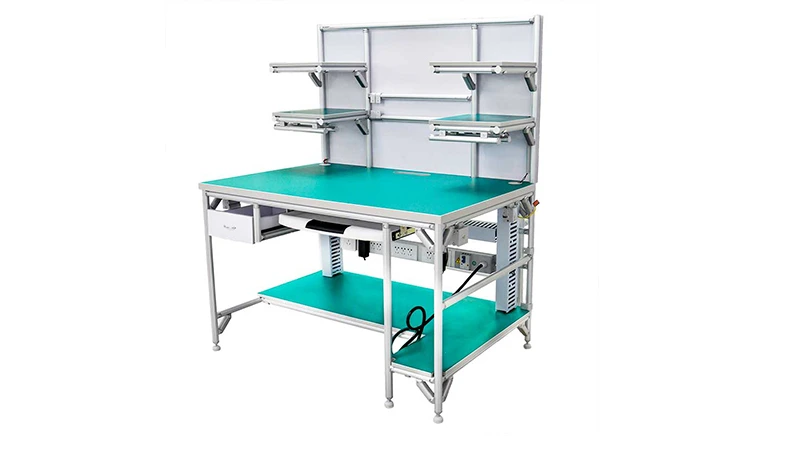
Aluminum Workbench A: A Design Built for Clean Room Excellence
Aluminum Workbench A was born from the recognition that clean room workbenches need to do more than "not cause problems"—they need to solve problems. Developed by engineers with decades of experience in lean manufacturing and clean room design, it combines three core principles: material innovation, functional precision, and compliance by design. Let's break down what makes it stand out.
Materials That Set the Standard: Aluminum Profile and Aluminum Lean Pipe
At first glance, aluminum might seem like an obvious choice for clean rooms, but not all aluminum is created equal. Aluminum Workbench A relies on high-grade aluminum profile —extruded aluminum with a precise cross-sectional design that offers unmatched strength-to-weight ratio, corrosion resistance, and adaptability. Unlike generic aluminum, the profiles used here undergo a specialized anodization process, creating a hard, non-porous surface that resists scratches, chemical damage, and particle shedding. This isn't just about durability; it's about ensuring the workbench itself never becomes a source of contamination.
Complementing the aluminum profile is aluminum lean pipe , a lightweight yet robust tubing that forms the workbench's frame and support structures. Aluminum lean pipe, unlike traditional steel pipe, is non-magnetic, non-corrosive, and free from the paint or coatings that can chip and flake in clean rooms. Its modular design allows for easy reconfiguration—critical in dynamic environments where production lines shift, and workflows evolve. Need to add a shelf, adjust the height, or integrate a tool holder? With aluminum lean pipe, it's a matter of loosening a few joints and repositioning components, no welding or specialized tools required.
But the benefits don't stop there. Aluminum's thermal conductivity ensures the workbench maintains a stable temperature, reducing condensation that could introduce moisture (another contamination risk). And unlike steel, which adds unnecessary weight, aluminum keeps the workbench lightweight enough to be moved (with proper casters) without damaging clean room floors or disrupting air flow patterns.
ESD Workstation: Protecting Sensitive Electronics from Static Damage
In industries like semiconductor manufacturing, where microchips and circuit boards are handled daily, static electricity is an invisible enemy. An esd workstation —one designed to control electrostatic discharge (ESD)—isn't just a nice-to-have; it's a regulatory requirement. Aluminum Workbench A excels here, integrating ESD protection into its core design rather than treating it as an afterthought.
The workbench's surface, made from anodized aluminum with a conductive oxide layer, maintains a surface resistance between 10⁶ and 10⁹ ohms—perfectly aligned with ANSI/ESD S20.20 standards, which require ESD-protected surfaces to dissipate static charge without generating sparks. Built-in grounding points, located at strategic intervals along the workbench's edge, allow operators to connect wrist straps, heel straps, or equipment, ensuring any static generated by personnel or tools is safely directed to ground. Even the accessories, from tool holders to monitor arms, are made from ESD-safe materials, eliminating "hot spots" where static could accumulate.
What truly sets Aluminum Workbench A apart, though, is its holistic approach to ESD control. Unlike plastic workbenches that rely on topical sprays (which wear off) or steel workbenches that conduct too well (risking rapid charge transfer), aluminum's controlled conductivity ensures static is dissipated slowly and safely, protecting even the most sensitive components—think 5nm semiconductors or implantable medical devices.
Roller Track Integration: Streamlining Workflows Without Compromising Cleanliness
Efficiency in clean rooms is a balancing act: you need to move materials quickly to meet production deadlines, but every touch, lift, or transfer increases the risk of contamination. Aluminum Workbench A addresses this with optional roller track integration—smooth, low-friction tracks built into the workbench's surface or perimeter that allow materials to glide from one station to the next with minimal human interaction.
The roller track itself is a marvel of clean room engineering. Made from food-grade plastic or anodized aluminum, its rollers are precision-machined to reduce friction, minimizing particle generation during movement. The track's design includes no crevices or gaps where dust can collect, and its smooth surface is easy to wipe down with isopropyl alcohol or hydrogen peroxide—common cleaners in pharmaceutical and biotech settings. For applications requiring even stricter control, the rollers can be coated in PTFE (Teflon), ensuring compatibility with aggressive chemicals.
Imagine a pharmaceutical lab where vials of vaccine are assembled: Aluminum Workbench A with roller track allows empty vials to glide from the filling station to the capping station, reducing the need for operators to handle each vial individually. This not only speeds up production but also cuts down on human contact—a major source of microbial contamination. In semiconductor manufacturing, PCBs can move along the roller track from inspection to testing, with each station precisely aligned to prevent jostling or misalignment. It's efficiency without compromise.

Meeting the Standards: How Aluminum Workbench A Stacks Up
Clean room operations are governed by a web of standards, from ISO 14644 for air cleanliness to ANSI/ESD S20.20 for static control, and even FDA 21 CFR Part 117 for food and pharmaceutical contact. Aluminum Workbench A isn't just designed to "pass" these standards—it's built to exceed them, giving manufacturers the confidence to focus on innovation rather than compliance.
Let's start with ISO 14644-1:2015, which sets limits for airborne particles in clean rooms. Aluminum Workbench A's materials are non-outgassing, meaning they don't release VOCs or particles into the air—critical for maintaining ISO 5 or ISO 6 air quality. Its smooth, anodized surface has a roughness average (Ra) of less than 0.8μm, ensuring dust and microbes can't adhere to it, and its modular design eliminates gaps where contaminants might hide. Even the joints, made from aluminum lean pipe connectors, are sealed to prevent particle shedding.
For ESD compliance, the workbench meets ANSI/ESD S20.20, the global benchmark for ESD control programs. This means it undergoes rigorous testing for surface resistance, charge decay, and grounding continuity, ensuring it can reliably protect components with electrostatic discharge sensitivity (ESDS) down to 100V. In industries like aerospace or defense, where components may have strict military specifications (MIL-STD), Aluminum Workbench A is often specified as a preferred solution.
Cleanability, too, is a priority. The workbench's aluminum profile and anodized surface are compatible with common clean room disinfectants, including quaternary ammonium compounds (QACs) and peracetic acid. Unlike wood, which swells when exposed to moisture, or painted steel, which chips, aluminum resists corrosion and maintains its integrity even after daily cleaning—a must for facilities operating 24/7.

Aluminum Workbench A vs. Traditional Workbenches: A Comparative Analysis
To truly appreciate Aluminum Workbench A's impact, it helps to see how it stacks up against traditional options. Below is a comparison of key metrics that matter most in clean room environments:
| Feature | Aluminum Workbench A | Steel Workbench | Wood Workbench | Plastic Workbench |
|---|---|---|---|---|
| Material | Anodized aluminum profile + aluminum lean pipe | Carbon steel (painted or stainless) | Hardwood or plywood | HDPE or PVC |
| ESD Protection | Built-in (10⁶–10⁹ ohms, ANSI/ESD S20.20 compliant) | Requires additional grounding mats (inconsistent performance) | None (insulative, generates static) | None (insulative, high static risk) |
| Particle Emission | Low (non-porous, no flaking or outgassing) | Medium (paint chips, rust particles) | High (porous, traps dust/bacteria) | Medium (may outgas VOCs over time) |
| Weight (per linear foot) | 12–15 lbs (lightweight, easy to reposition) | 25–30 lbs (heavy, requires equipment to move) | 18–22 lbs (varies by wood type) | 8–10 lbs (light but less durable) |
| Chemical Resistance | Excellent (resists acids, alcohols, disinfectants) | Good (stainless steel only; painted steel corrodes) | Poor (swells with moisture, stains easily) | Good (but prone to scratching) |
| Cleanability | Easy (smooth surface, no crevices) | Moderate (welds and joints trap debris) | Difficult (requires sanding to sanitize) | Easy (but scratches hold bacteria) |
| Lifespan (in clean room use) | 10–15 years (minimal wear, corrosion-resistant) | 5–8 years (stainless steel); 2–3 years (painted) | 1–3 years (deteriorates with cleaning) | 3–5 years (scratches, UV degradation) |
The data speaks for itself: Aluminum Workbench A outperforms traditional options in nearly every category that matters in clean rooms. Its combination of ESD protection, low particle emission, lightweight design, and chemical resistance makes it a long-term investment that reduces operational costs while ensuring compliance.
Real-World Applications: Where Aluminum Workbench A Shines
To understand the impact of Aluminum Workbench A, let's look at how it's transforming operations in three critical industries:
Semiconductor Manufacturing
In a leading semiconductor fab producing 7nm chips, even a 0.1μm particle can cause a "kill defect," rendering a $10,000 wafer useless. The facility replaced its steel workbenches with Aluminum Workbench A, citing two key benefits: reduced static-related defects (down 42% in six months) and easier reconfiguration. "We're constantly updating our processes, and with aluminum lean pipe, we can adjust the workbench layout in hours, not days," says the plant's operations manager. The roller track integration also cut material handling time by 30%, allowing the facility to meet increased demand without expanding its clean room footprint.
Pharmaceutical Packaging
A pharmaceutical company specializing in injectable drugs needed workbenches that could withstand daily cleaning with hydrogen peroxide vapor (HPV), a powerful sterilant. Traditional plastic workbenches degraded under HPV exposure, while wood warped. Aluminum Workbench A, with its anodized surface, proved impervious to HPV, maintaining its integrity after 500+ sterilization cycles. "We no longer worry about workbench contamination," notes the quality control director. "And the ESD protection has been a game-changer for handling electronic scales and filling equipment."
Medical Device Assembly
A manufacturer of pacemakers and implantable defibrillators required workbenches that could support precise manual assembly while minimizing static risk. Aluminum Workbench A's ESD surface and grounding points ensured operators didn't damage delicate electronics, while the roller track reduced part handling, cutting assembly time by 25%. "Every second counts when you're assembling life-saving devices," says the production supervisor. "Aluminum Workbench A lets us work faster without compromising safety."
Accessories: Customizing for Every Need
One size doesn't fit all in clean rooms, which is why Aluminum Workbench A is designed to be customized with a range of accessories, all engineered to meet the same strict standards as the workbench itself:
- ESD-Safe Casters: Lockable, non-marking casters with conductive rubber wheels, allowing the workbench to be moved (when needed) without generating static or scratching floors.
- Adjustable Shelving: Made from aluminum profile, these shelves attach to the workbench frame via T-slots, allowing height adjustments in 1-inch increments to accommodate tools, bins, or equipment.
- Tool Holders: Magnetic or clip-on holders that secure screwdrivers, tweezers, and other tools, reducing clutter and preventing accidental drops (a common source of contamination).
- Overhead Lighting: LED fixtures with HEPA-filtered enclosures, providing bright, shadow-free illumination without introducing particles into the clean room air.
Each accessory undergoes the same testing as the workbench itself, ensuring they don't compromise ESD protection, cleanliness, or durability.
Maintenance: Keeping Aluminum Workbench A Performing at Its Best
Even the most robust equipment needs care, and Aluminum Workbench A is designed to be low-maintenance, minimizing downtime in busy clean rooms. Key maintenance steps include:
- Daily Cleaning: Wipe the surface with a lint-free cloth and approved disinfectant (e.g., 70% isopropyl alcohol). Pay special attention to roller track rollers, removing any debris that could impede movement.
- Weekly ESD Testing: Use an ESD surface resistance meter to verify the workbench's surface resistance remains within 10⁶–10⁹ ohms. Check grounding points for corrosion or loose connections.
- Monthly Inspection: Tighten aluminum lean pipe joints (if reconfigured) and inspect roller track for wear. Lubricate rollers with food-grade silicone grease if movement becomes stiff.
With proper care, Aluminum Workbench A can last 15+ years in even the harshest clean room environments—far longer than traditional workbenches.
Conclusion: The Future of Clean Room Workbenches
In industries where precision, cleanliness, and compliance are non-negotiable, Aluminum Workbench A isn't just a tool—it's a strategic asset. By combining aluminum profile and aluminum lean pipe for durability and flexibility, integrating esd workstation features to protect sensitive components, and incorporating roller track to streamline workflows, it sets a new standard for what a clean room workbench can achieve.
As manufacturing standards grow stricter and industries like semiconductors, pharma, and medical devices push the boundaries of innovation, the need for workbenches that can keep pace will only increase. Aluminum Workbench A, with its focus on material science, functional design, and compliance, is poised to lead the way—proving that even the most basic tools can be transformed into engines of excellence.
So the next time you step into a clean room, take a closer look at the workbench. Chances are, it's an Aluminum Workbench A—quietly supporting the innovations that shape our world, one particle-free, static-safe process at a time.