- Company Articles
- Industry articles
- Industry standards
- Applications of 3030 National Standard Profile A in 3C Assembly Workstations

Applications of 3030 National Standard Profile A in 3C Assembly Workstations
Related Product
3030 National Standard Profile A
Workbench, production line, logistic rack, warehouse rack Industry: Manufacturer workshop, Automobile, Electronic, Assembling, logistic
In the fast-paced world of 3C manufacturing—where smartphones, laptops, and consumer electronics fly off production lines at breakneck speeds—every second counts. Assembly lines here aren't just about putting parts together; they're about adaptability. A single factory might switch between producing three different phone models in a week, each with unique components and assembly steps. That's where the right workstation setup becomes make or break. Enter the 3030 National Standard Profile A —a humble aluminum extrusion that's quietly revolutionizing how 3C assembly lines are built, reconfigured, and optimized.
Let's start by understanding the problem. Traditional 3C assembly workstations often rely on fixed steel structures or custom-welded frames. They're sturdy, sure, but try reconfiguring one when a new product launch requires rearranging the line. What should take hours can stretch into days, with teams cutting, welding, and repainting. And in a industry where product lifecycles shrink by the month, that downtime isn't just frustrating—it's costly. Workers end up cramped around rigid workbenches, reaching for tools that don't quite fit, or waiting for materials stuck on inflexible racks. Sound familiar? It's a scenario that's all too common in factories still using outdated setups.
What Makes 3030 National Standard Profile A Different?
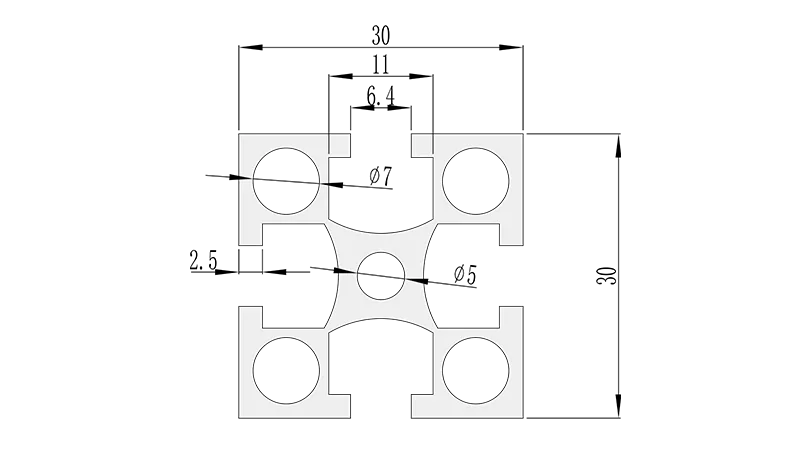
At first glance, the 3030 National Standard Profile A might look like just another aluminum bar. But this unassuming piece of aluminum extrusion profile —measuring 30mm by 30mm with a sleek, hollow design—packs a punch. Made from high-grade 6063-T5 aluminum alloy, it's lightweight yet surprisingly strong, capable of supporting up to 150kg per linear meter. Its real superpower, though, lies in its T-slot design: those continuous grooves running along its length that let you snap, bolt, or clamp on accessories without a single weld. Think of it as the Lego of industrial workstations—versatile, modular, and ready to adapt to whatever you throw at it.
Unlike heavier steel profiles, this aluminum extrusion won't rust, even in the humid environments common in electronics factories. It's also easy to clean, a must when working with sensitive components like circuit boards or microchips. And because it's aluminum, it's recyclable—good news for manufacturers aiming to shrink their carbon footprint. But what really sets it apart is how it plays well with others. Pair it with the right aluminum profile accessories , and you've got a system that can build everything from workbenches to material racks to mobile trolleys—all in a fraction of the time it takes with traditional methods.
The Building Blocks: Aluminum Profile Accessories That Bring It All Together
You wouldn't build a house with just bricks, right? The same goes for 3030 Profile A. Its magic lies in the ecosystem of aluminum profile accessories designed to work seamlessly with it. Let's break down the essentials:
| Accessory Type | Product Name (from Series) | Function | 3C Workstation Use Case |
|---|---|---|---|
| Connectors | 90° aluminum profile connector | Joins two profiles at a right angle | Reinforcing corners of workbench frames |
| Guide Rails | Aluminum guide rail A | Creates smooth pathways for sliding components | Supporting roller tracks on material racks |
| Casters | Flat swivel castor wheel with brake | Adds mobility to stationary structures | Mobile workbenches for line-side repairs |
| End Caps | 3030 aluminum profile end cap | Covers exposed profile ends, preventing debris buildup | All exposed edges on workbench surfaces |
| Gussets | Gusset alp 3030 | Strengthens joints under heavy loads | Reinforcing shelves on material rack B (3 row and 3 floor) |
Take the 90° aluminum profile connector , for example. It's a small, L-shaped bracket that slides into the T-slots of two 3030 profiles and locks in place with a hex bolt. No welding, no drilling—just a quick twist with an Allen key, and you've got a sturdy corner joint. Need to take it apart later? Just unscrew and reuse the parts. That's the kind of flexibility 3C factories crave.
Building the Perfect 3C Workstation: 3030 Profile A in Action
Workbenches: Where Precision Meets Comfort
The heart of any 3C assembly line is the workbench. This is where operators spend hours fitting tiny screws, soldering components, or testing circuit boards. It needs to be sturdy enough to hold tools and parts, adjustable to fit workers of different heights, and flexible enough to add new fixtures when a new model launches. The 3030 Profile A checks all these boxes.
Consider the workbench E (single deck-without caster) —a popular configuration in 3C factories. Built with 3030 Profile A frames, it starts as a simple tabletop supported by four vertical profiles. But with the right accessories, it transforms: add a shelf halfway up using gusset alp 3030 brackets for tool storage, mount an ESD mat on top to protect sensitive chips, or bolt on a monitor arm for assembly instructions. Need to lower the height by 10cm for shorter operators? Swap out the vertical profiles for shorter ones—no cutting, no welding, just a few bolts.
One factory in Shenzhen, which produces smartwatches, recently switched all their soldering workbenches to 3030 Profile A setups. Their old steel benches weighed over 100kg each; the new aluminum ones? Just 45kg. "Workers used to struggle moving benches for deep cleaning," says the plant manager. "Now two people can lift one and reposition it in minutes. And when we launched our new waterproof model, we added ESD-safe tool hooks and anti-static bins in under an hour. That's the difference."
Material Racks: Keeping Parts Within Reach
In 3C assembly, time wasted hunting for parts is time lost. That's why material racks need to be organized, accessible, and adaptable. The material rack B (3 row and 3 floor) —a staple in many factories—shows off the 3030 Profile A's versatility here. Imagine a rack with three vertical columns made from 3030 profiles, connected by horizontal beams at three levels. Each level uses aluminum guide rail A to support sliding bins, so operators can pull parts right to the edge without leaning over.
What if a new component is larger than the existing bins? No problem. Loosen the bolts on the horizontal beams, slide them up or down to adjust shelf height, and lock them back in. Need to add a fourth level? Just cut a few extra 3030 profiles to length (most suppliers sell pre-cut options) and bolt them in using 90° connectors. It's a far cry from traditional wooden racks, which warp under heavy loads, or steel racks that require a blowtorch to modify.
Mobile Trolleys: Flexibility on Wheels
Not everything in a 3C factory stays put. Parts need to move from storage to assembly lines, finished products to testing stations, and defective units to repair areas. That's where mobile trolleys—built with 3030 Profile A and flat swivel castor wheels—shine. These aren't your average carts, though. A well-designed trolley can carry up to 200kg of components, with adjustable shelves to fit different box sizes, and brakes to keep it steady when loading.
One laptop manufacturer in Chengdu uses these trolleys to deliver screens to their assembly line. Each trolley has a custom frame made from 3030 Profile A, with foam-lined shelves to protect delicate displays. When they switched from plastic carts to aluminum ones, they cut down on screen damage by 40%. "The aluminum absorbs shocks better," explains the logistics supervisor. "And if a shelf gets bent? We just swap out the profile section—no need to replace the whole cart."
Why 3030 Profile A Makes Sense for 3C Factories
At this point, you might be thinking: "Sure, it's flexible, but is it durable enough for daily use?" Let's address that. The 3030 National Standard Profile A isn't just about convenience—it's built to last. Its aluminum alloy construction resists dents and scratches, even in high-traffic areas. The T-slot design, reinforced with aluminum profile accessories like gussets, ensures joints stay tight even after years of adjustments. And because it's corrosion-resistant, it holds up in the humid, sometimes chemical-exposed environments of electronics manufacturing.
Cost is another factor. While aluminum extrusion profiles can cost more upfront than basic steel, the long-term savings add up. A single 3030 Profile A workstation can be reconfigured dozens of times over its lifespan, eliminating the need to buy new frames for every product launch. One estimate from a Guangzhou-based electronics manufacturer found that switching to 3030 Profile A workstations reduced their workstation-related costs by 35% over three years—mostly from lower reconfiguration and replacement expenses.
Case Study: XYZ Electronics Cuts Downtime by 70% with 3030 Profile A
XYZ Electronics, a mid-sized producer of wireless earbuds, was struggling with their old assembly line setup. Every time they introduced a new earbud model (which happened quarterly), their steel workstations and material racks took 48 hours to reconfigure. Production ground to a halt, and overtime costs skyrocketed.
In 2024, they switched to 3030 National Standard Profile A workstations and material rack B setups. The results were dramatic: reconfiguring the line now takes just 12 hours. Workers can adjust workbench heights in minutes using quick-release bolts, and material racks are modified by swapping out aluminum guide rails and shelf brackets. "We used to dread product launches," says the production manager. "Now? We look forward to them. The flexibility is game-changing."
Looking Ahead: The Future of 3030 Profile A in Smart Factories
As 3C manufacturing moves toward Industry 4.0—with IoT sensors, AI-driven quality checks, and automated guided vehicles (AGVs)—the 3030 National Standard Profile A is evolving right alongside it. Imagine workstations equipped with smart sensors that monitor vibration (to detect loose components) or temperature (to protect heat-sensitive parts). Because the T-slot design allows easy mounting of these sensors, retrofitting existing 3030 Profile A setups for smart manufacturing is a breeze.
Sustainability is another trend driving adoption. Aluminum is 100% recyclable, and using modular workstations means less waste when lines are updated. Some suppliers are even offering profiles made from recycled aluminum, cutting down on the carbon footprint of production. For 3C brands under pressure to meet ESG goals, this is a win-win.
Final Thoughts: More Than Just a Profile—A Foundation for Innovation
In the end, the 3030 National Standard Profile A is more than just a piece of aluminum. It's a tool that empowers 3C manufacturers to be agile, efficient, and creative. It turns rigid assembly lines into flexible ecosystems where workers can adapt on the fly, where downtime is minimized, and where every square meter of factory space is used to its full potential.
So the next time you pick up a smartphone or pop in a wireless earbud, take a moment to appreciate the unsung hero behind its assembly: the humble 3030 Profile A. It might not have the glamour of the latest tech, but in the fast-paced world of 3C manufacturing, it's the backbone that keeps innovation moving forward.