- Company Articles
- Industry articles
- Industry standards
- Benefits of Using 2040 National Standard Profile in Medical Device Assembly

Benefits of Using 2040 National Standard Profile in Medical Device Assembly
Related Product
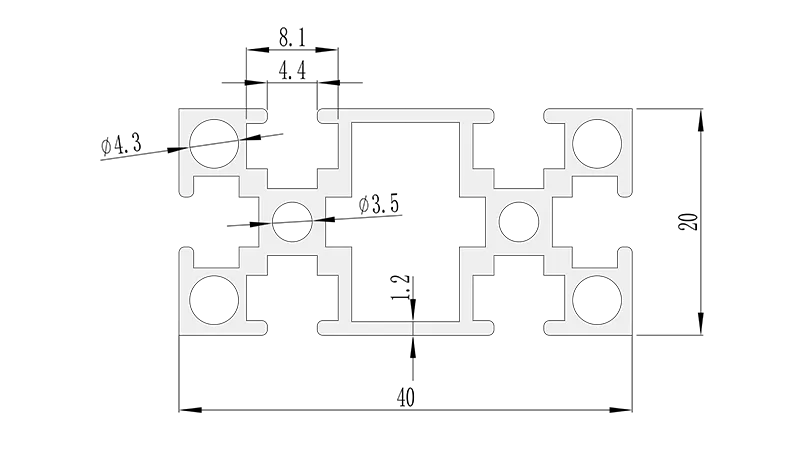
2040 National Standard Profile
45° external bending joint, used for 45° external connection of two aluminum pipes.
How a Versatile Aluminum Solution is Transforming Precision, Compliance, and Workflow in Medical Manufacturing
Introduction: The Critical Role of Assembly Infrastructure in Medical Device Manufacturing
In the world of medical device manufacturing, precision isn't just a goal—it's a necessity. Every component, from the tiniest screw in a pacemaker to the frame of a diagnostic machine, must meet exacting standards to ensure patient safety and device reliability. But behind the scenes of these life-saving products lies a less visible yet equally critical element: the infrastructure that supports their assembly. Workbenches, material racks, conveyor systems, and modular frames form the backbone of production lines, and their design directly impacts efficiency, compliance, and the ability to adapt to evolving manufacturing needs.
For decades, manufacturers relied on traditional materials like steel, wood, or generic plastic for these structures. While functional, they often fell short in key areas: steel is heavy and hard to reconfigure; wood is prone to wear and unsuitable for cleanroom environments; plastic lacks the structural integrity needed for heavy-duty use. As medical device complexity grew—with smaller, more intricate devices and stricter regulatory demands—these materials became bottlenecks, slowing down production, increasing maintenance costs, and limiting flexibility.
Enter the 2040 National Standard Profile: a lightweight, durable aluminum extrusion profile that's redefining how medical device assembly lines are built. Part of a broader family of aluminum extrusion profiles, the 2040 variant (named for its 20mm x 40mm cross-section) has emerged as a favorite among manufacturers for its unique blend of strength, versatility, and compliance-friendly features. When paired with compatible aluminum profile accessories—such as connectors, brackets, and end caps—it creates a modular system that can be customized to fit nearly any assembly need, from workbenches for delicate device assembly to material racks for organizing sterile components.
In this article, we'll explore why the 2040 National Standard Profile has become a cornerstone of modern medical device manufacturing. We'll dive into its key benefits, from modular adaptability and precision engineering to compliance with strict medical standards, and explain how it supports lean system principles to streamline workflows. Along the way, we'll share real-world examples of how manufacturers are leveraging this profile to overcome traditional challenges and build production lines that are not just efficient, but future-ready.
Understanding the 2040 National Standard Profile: What Makes It Unique?
Before delving into its benefits, let's take a closer look at what the 2040 National Standard Profile is and how it's designed. At its core, it's an aluminum extrusion profile—meaning it's created by forcing heated aluminum through a die to form a consistent cross-sectional shape. This process ensures uniform dimensions, tight tolerances, and a smooth, clean surface finish—all critical traits for medical manufacturing.
The "2040" designation refers to the profile's width and height (20mm x 40mm), but its real innovation lies in its T-slot design. Running along its length are precision-machined slots that allow aluminum profile accessories—like bolts, brackets, and connectors—to be easily attached without welding or drilling. This T-slot system is the heart of the profile's versatility: it turns static structures into dynamic, reconfigurable systems that can adapt as production needs change.
Unlike generic aluminum pipes, the 2040 National Standard Profile is engineered to meet strict national standards for material purity, structural integrity, and dimensional consistency. Its aluminum alloy composition (typically 6063-T5, a common grade for extrusions) offers an ideal balance of strength and lightweight properties—about one-third the weight of steel, yet strong enough to support heavy loads. This makes it easy to handle during installation and reconfiguration, reducing the risk of workplace injuries and minimizing downtime during line changes.
Another key feature is its surface treatment. Most 2040 profiles undergo anodization, a process that creates a protective oxide layer on the aluminum surface. This layer not only enhances corrosion resistance (critical for cleanrooms and environments where sanitization is frequent) but also creates a smooth, non-porous finish that resists bacterial growth and is easy to clean. For medical device manufacturers, this translates to better compliance with ISO 13485 and FDA regulations, which mandate strict cleanliness and contamination control in production areas.
When combined with aluminum profile accessories—such as corner brackets, hinge joints, and leveling feet—the 2040 profile becomes a building block for nearly any assembly structure. Need a workbench that can be adjusted to different heights for ergonomic comfort? Attach height-adjustable feet. Want a material rack that can expand as inventory grows? Add extension brackets. Need to integrate a conveyor system for automated part transport? Use T-slot connectors to secure the conveyor rails. The possibilities are nearly endless, and that flexibility is exactly what medical device manufacturers need in an industry where product designs and production volumes are constantly evolving.
Key Benefits of the 2040 National Standard Profile in Medical Device Assembly
The 2040 National Standard Profile isn't just a replacement for traditional materials—it's a upgrade that addresses specific pain points in medical device manufacturing. Below, we break down its most impactful benefits, supported by real-world applications and comparisons to older alternatives.
1. Modular Adaptability: Building Lines That Grow with Your Needs
In medical device manufacturing, production lines rarely stay the same for long. New device models are introduced, production volumes fluctuate, and regulatory changes may require process adjustments. Traditional structures—welded steel frames, fixed wooden workbenches—are rigid by design, making reconfiguration time-consuming and costly. A single line change could take days of downtime, involving cutting, welding, or replacing entire sections of the structure.
The 2040 National Standard Profile eliminates this rigidity through its modular design. Thanks to its T-slot system and compatible aluminum profile accessories, structures can be assembled, disassembled, and reconfigured in hours, not days. For example, a workbench used for assembling blood glucose monitors can be quickly modified with additional shelving when a new sensor module is added to the device. Or a material rack designed for storing syringes can be expanded with extra levels as production ramps up for flu season.
Real-World Example: Adaptive Workstations at a Diagnostic Device Manufacturer
A mid-sized manufacturer of diagnostic test kits recently faced a challenge: their production line for COVID-19 rapid tests needed to expand to meet surging demand, but their existing steel workbenches were too heavy to move and couldn't be extended without welding. Switching to 2040 National Standard Profile workbenches solved the problem. Using T-slot connectors and extension brackets (common aluminum profile accessories), they were able to add 10 feet to each workbench in a single shift, doubling their assembly capacity without halting production. Later, when demand stabilized and they needed to reallocate space for a new allergy test kit line, the same workbenches were disassembled and reassembled into smaller stations—saving the cost of purchasing new equipment.
This adaptability also supports lean system principles, which focus on minimizing waste and maximizing efficiency. By allowing manufacturers to quickly reconfigure lines to match current production needs, the 2040 profile reduces the waste of space, materials, and labor associated with overbuilt or underutilized structures.
2. Precision Engineering: Ensuring Consistency in Critical Assembly
Medical devices are built to microscopic tolerances—even a 0.1mm deviation in component alignment can render a device ineffective or unsafe. For assembly structures like workbenches and fixture holders, this means their own dimensions must be equally precise. Traditional materials often fall short here: wood warps over time, steel can bend under heavy loads, and plastic may creep (deform slowly) when exposed to heat or stress.
The 2040 National Standard Profile, by contrast, is engineered for precision. During extrusion, the aluminum is forced through a high-precision die, ensuring consistent cross-sectional dimensions across the entire length of the profile. Tolerances for key features like slot width and wall thickness are typically held to ±0.1mm, far tighter than what's possible with steel or wood. This consistency ensures that structures built with the profile—whether workbenches, fixture plates, or conveyor guides—maintain their alignment and stability over time, even under heavy use.
This precision is especially valuable for automated assembly systems, where robotic arms or pick-and-place machines rely on fixed reference points to position components. A 2040 profile frame used to mount a robotic gripper, for example, will maintain its position within microns, ensuring the gripper consistently picks up delicate parts like pacemaker leads without damaging them.
3. Compliance and Cleanliness: Meeting Strict Medical Standards
Medical device manufacturing is governed by some of the strictest regulations in the world, from FDA's Current Good Manufacturing Practices (cGMP) to ISO 13485's quality management requirements. A key focus of these regulations is contamination control: surfaces must be non-reactive, easy to clean, and resistant to chemicals used in sanitization.
The 2040 National Standard Profile excels here. Its anodized aluminum surface is non-porous, meaning it doesn't harbor bacteria, dust, or residue—critical for cleanroom environments where even a single particle can compromise a sterile device. Unlike wood, which can splinter and trap contaminants, or steel, which may rust if not properly coated, the anodized finish of the 2040 profile is inherently resistant to corrosion and chemical damage from disinfectants like isopropyl alcohol or hydrogen peroxide.
Additionally, the profile's smooth, seamless design eliminates crevices where dirt or debris could accumulate. Even aluminum profile accessories like connectors and end caps are designed with rounded edges and tight fits to prevent contamination traps. For manufacturers, this translates to fewer compliance violations, smoother audits, and greater confidence that their production lines are meeting the highest standards for patient safety.
4. Ergonomic Design: Supporting Worker Health and Productivity
Medical device assembly is often a labor-intensive process, requiring workers to perform repetitive tasks—like assembling small components or inspecting devices—for hours at a time. Poorly designed workstations can lead to musculoskeletal injuries, fatigue, and reduced productivity. Traditional workbenches, with fixed heights and limited adjustability, are a common culprit here, forcing workers to hunch, stretch, or twist to access tools and materials.
The 2040 National Standard Profile enables the creation of ergonomically optimized workstations that adapt to workers, not the other way around. Using height-adjustable feet (a popular aluminum profile accessory) and modular shelving, workbenches can be tailored to individual workers' heights, reducing strain on the neck, back, and shoulders. T-slot mounting also allows tools, monitors, and lighting to be positioned exactly where they're needed, minimizing reach distances and repetitive motions.
For example, a worker assembling hearing aids—who spends hours bent over a microscope—can adjust their 2040 profile workbench to a standing height, reducing lower back pressure. Another worker inspecting pacemaker leads can tilt their work surface using hinge brackets (another aluminum profile accessory) to eliminate glare and eye strain. These small adjustments add up to happier, healthier workers and lower turnover—a critical advantage in an industry facing labor shortages.
5. Cost-Effectiveness: Long-Term Savings Beyond Initial Investment
At first glance, the 2040 National Standard Profile may seem more expensive than traditional materials like wood or steel. However, its long-term cost savings far outweigh the initial investment. Let's break it down:
- Reduced Installation and Reconfiguration Costs: Assembling structures with T-slot connectors and aluminum profile accessories requires no welding, cutting, or specialized tools. This lowers labor costs during initial setup and eliminates the need for expensive contractors during reconfigurations.
- Lower Maintenance Expenses: Aluminum's corrosion resistance and durability mean structures require minimal upkeep. Unlike steel, which needs periodic painting or coating to prevent rust, or wood, which may need sanding or replacement due to wear, the 2040 profile can last decades with only occasional cleaning.
- Energy and Shipping Savings: Aluminum's lightweight properties reduce shipping costs for both the profiles and the structures built with them. It also makes structures easier to move, lowering energy use for material handling equipment like forklifts.
- Adaptability = Reduced Replacement Costs: Instead of replacing entire structures when production needs change, manufacturers can reconfigure existing 2040 profile systems, extending their lifespan and avoiding the expense of new equipment.
Over a 10-year lifespan, a 2040 profile workbench can cost up to 40% less than a comparable steel or wood structure when these factors are considered.
Comparing 2040 National Standard Profile to Traditional Materials: A Side-by-Side Analysis
To better understand the advantages of the 2040 National Standard Profile, let's compare it to common traditional materials used in medical device assembly structures. The table below highlights key features relevant to medical manufacturing, from compliance to adaptability.
| Feature | Traditional Materials (Steel/Wood) | 2040 National Standard Profile |
|---|---|---|
| Weight | Heavy (steel: ~7.8g/cm³; wood: ~0.6-0.9g/cm³ but less strong) | Lightweight (2.7g/cm³), 1/3 the weight of steel |
| Reconfigurability | Low; requires welding (steel) or cutting (wood); difficult to modify | High; T-slot system and aluminum profile accessories enable quick, tool-free adjustments |
| Compliance with Medical Standards | Steel: May rust; requires coatings. Wood: Porous, harbors contaminants; not cleanroom-friendly | Anodized surface: Non-porous, corrosion-resistant, easy to sanitize; meets ISO 13485 and FDA requirements |
| Precision Tolerances | Steel: Prone to bending under load. Wood: Warps over time; inconsistent dimensions | Tight tolerances (±0.1mm); consistent dimensions; stable under load |
| Ergonomic Flexibility | Fixed heights and configurations; limited adjustability | Height-adjustable feet, tiltable surfaces, and modular accessories enable customized ergonomics |
| Long-Term Cost (10-Year Lifespan) | Higher: Includes maintenance (painting, replacement), reconfiguration, and shipping costs | Lower: 40% savings on average due to reduced maintenance, adaptability, and lightweight shipping |
Conclusion: The Future of Medical Device Assembly is Modular, Precise, and Adaptable
As medical device manufacturers face growing pressure to innovate faster, comply with stricter regulations, and optimize costs, the infrastructure supporting production lines has never been more important. The 2040 National Standard Profile, with its modular design, precision engineering, and compliance-friendly features, is emerging as a critical tool in this effort. By leveraging its T-slot system and aluminum profile accessories, manufacturers can build workbenches, material racks, and assembly lines that adapt to changing needs, reduce downtime, and support the highest standards of patient safety.
But the 2040 profile is more than just a building material—it's a catalyst for lean system adoption, enabling manufacturers to streamline workflows, minimize waste, and respond quickly to market demands. Its lightweight, durable design supports ergonomic workplaces that prioritize worker health, while its long-term cost savings make it a smart investment for sustainable growth.
As medical technology continues to advance—with smaller, more complex devices and a greater focus on personalized medicine—the need for flexible, precise assembly infrastructure will only grow. The 2040 National Standard Profile isn't just keeping up with these changes; it's helping to drive them, proving that sometimes, the most impactful innovations in medical manufacturing aren't in the devices themselves, but in the systems that build them.