- Company Articles
- Industry articles
- Industry standards
- Castor Install Base Compliance with ISO Standards for Medical Equipment Mobility

Castor Install Base Compliance with ISO Standards for Medical Equipment Mobility
Related Product
Castor Install Base
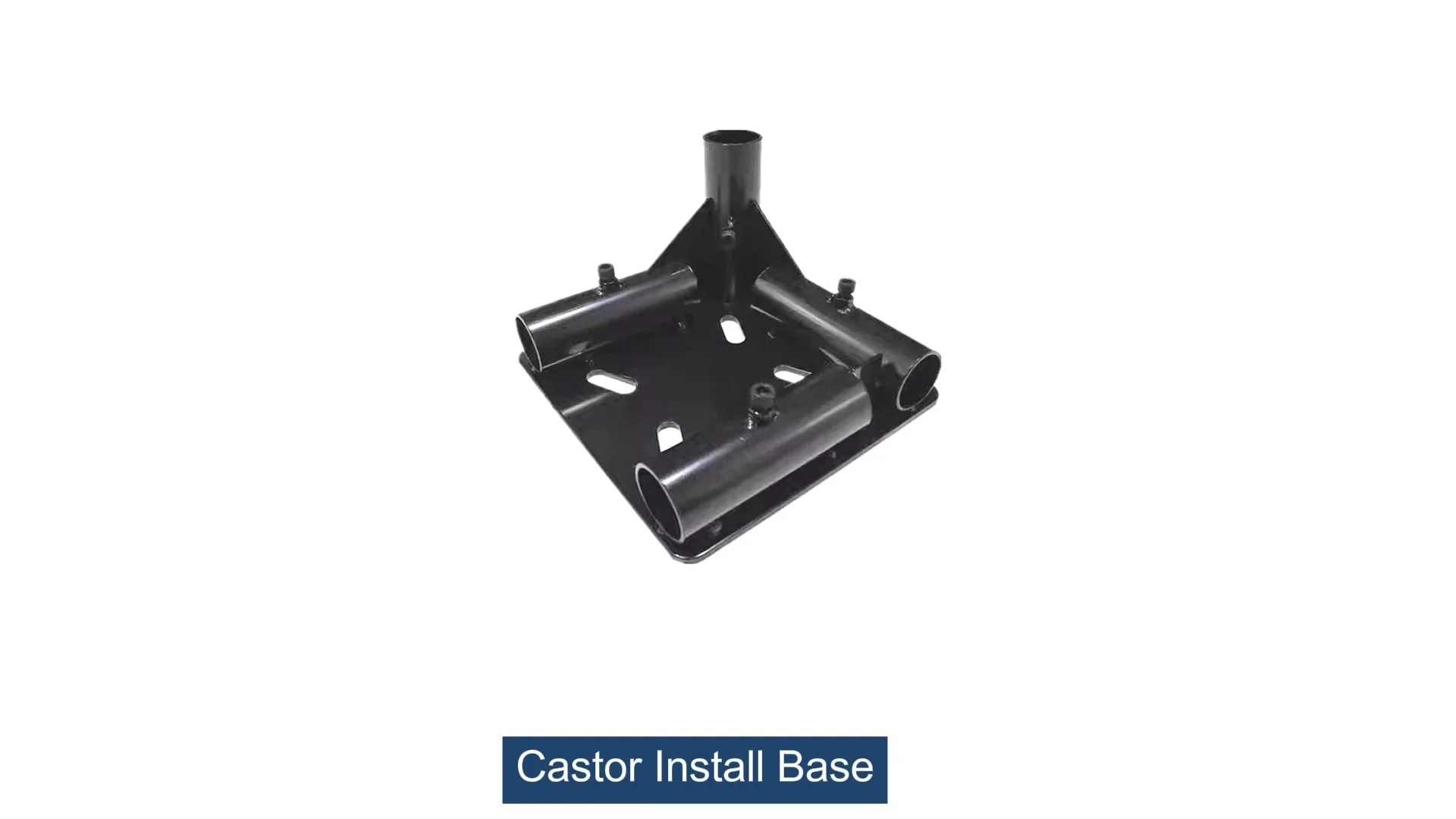
Castor install base, used for connection between pipe and castor, it can connect 4 pcs pipe by 1 pcs castor base, to make the structure strong and stable.
Walk into any modern hospital, and you'll notice a quiet but critical dance happening all day long: nurses gliding medication carts between patient rooms, lab technicians maneuvering specimen workbenches to analyze samples, and surgical teams positioning equipment with pinpoint precision. Behind every smooth roll, every stable stop, and every gentle turn lies a component so unassuming it's easy to overlook—the castor install base. Yet, this humble part is the backbone of medical equipment mobility, and its compliance with ISO standards isn't just a box to check; it's a promise of safety, reliability, and care for both patients and healthcare staff.
In the fast-paced world of healthcare, where seconds count and errors can have life-altering consequences, the last thing anyone needs is a wobbly cart, a stuck caster, or a base that fails under pressure. That's where ISO standards step in. They transform "good enough" into "trustworthy," ensuring that every castor install base—whether paired with caster and accessories, reinforced with stainless steel pipe series, or built from lightweight aluminum profile—meets rigorous benchmarks for performance. Let's dive into why this matters, how ISO compliance works, and what makes a castor install base truly ready for the demands of medical environments.
Why ISO Standards Matter in Medical Equipment Mobility
When we talk about medical equipment, "mobility" isn't just about moving from Point A to Point B. It's about doing so without jostling sensitive samples, without straining a nurse's back, and without risking a sudden stop that could endanger a patient. ISO standards act as the rulebook for this, setting global benchmarks that manufacturers, hospitals, and regulators trust.
First and foremost, ISO compliance is about patient safety. Imagine a mobile workbench in an operating room: if its castor install base is poorly designed, the bench might drift mid-procedure, disrupting the surgical field. ISO standards eliminate that risk by dictating load capacities, stability thresholds, and durability requirements. For example, ISO 13485, the international standard for medical device quality management systems, mandates that every component—including the castor install base—undergoes rigorous risk assessment to prevent harm.
Regulatory bodies like the FDA or EU's CE mark also lean heavily on ISO standards. Without compliance, a manufacturer can't legally sell their equipment in major markets. This isn't just red tape; it's a way to ensure that a castor install base made in Germany performs as reliably as one made in the U.S. when installed on a hospital cart in Japan.
Beyond safety and regulation, ISO compliance drives efficiency. Hospitals and labs invest in equipment that lasts, and ISO-certified castor install bases are built to withstand the daily grind—think hundreds of rolls down corridors, constant adjustments, and exposure to harsh cleaning chemicals. When a base is compliant, staff spend less time fixing jams or replacing parts and more time focusing on patient care.
What Exactly Is a Castor Install Base?
Let's start with the basics: A castor install base is the unsung hero that connects a caster wheel to the equipment itself. If the caster is the "foot" that rolls, the base is the "ankle" that holds it in place, distributes weight, and ensures alignment. Without a sturdy, well-designed base, even the best caster and accessories will fail—think of a wobbly shopping cart, but with stakes as high as patient health.
These bases come in all shapes and sizes, tailored to the equipment they support. A lightweight medication cart might use a compact aluminum profile base, while a heavy-duty imaging machine could rely on a reinforced frame made from stainless steel pipe series. Regardless of the design, their core job remains the same: to provide a stable platform for caster attachment, absorb shocks from uneven floors, and maintain structural integrity under load.
But it's not just about holding wheels. Modern castor install bases often integrate with other components, like adjustable leveling feet. These small but mighty parts let staff lock the equipment in place, ensuring it doesn't roll during use—critical for tasks like drawing blood or preparing medications. When paired with a compliant base, adjustable leveling feet work seamlessly: the base provides the strength to support the equipment, while the feet fine-tune stability, even on sloped hospital floors.

Key ISO Standards for Castor Install Bases
ISO standards aren't one-size-fits-all. For castor install bases in medical settings, two standards stand out: ISO 13485 and ISO 10535. Together, they cover everything from design to testing, ensuring no detail is overlooked.
ISO 13485 is the foundation. This standard outlines quality management systems for medical devices, and it applies to every component, including castor install bases. It requires manufacturers to document design processes, track materials (like whether that stainless steel pipe series meets corrosion-resistance specs), and conduct risk assessments. For example, if a base is designed for a pediatric ward, ISO 13485 would demand testing to ensure it can't pinch little fingers or tip over if a child leans on it.
ISO 10535 is more specific: it's the international standard for "Wheels and castors—Requirements for hospital applications." While it focuses on casters, it directly impacts castor install bases by dictating how casters should attach and perform. For instance, ISO 10535 requires casters to withstand 50,000 cycles of rolling without failure; the base must be strong enough to support that without cracking or bending. It also addresses noise levels—critical in hospitals, where a squeaky caster can disrupt patient rest—and chemical resistance, ensuring the base won't degrade when exposed to disinfectants.
Other standards may apply depending on the equipment. For example, ISO 60601 (for medical electrical equipment) might require the base to insulate against electrical interference, while ISO 11135 (for ethylene oxide sterilization) ensures the base can handle high-temperature sterilization without warping. The takeaway? ISO compliance is a web of interconnected requirements, and the castor install base must fit into every thread.

Designing for Compliance: What Goes Into an ISO-Ready Castor Install Base?
Creating a castor install base that meets ISO standards isn't just about using "good materials"—it's about intentional design. Let's break down the key considerations manufacturers keep in mind.
Material Matters: Stainless Steel Pipe Series vs. Aluminum Profile
The choice of material is foundational. Two of the most common options are stainless steel pipe series and aluminum profile, each with its own strengths. To help compare, here's a breakdown of their pros, cons, and ISO compliance relevance:
| Material | Key Properties | ISO Compliance Strengths | Best For | Potential Drawbacks |
|---|---|---|---|---|
| Stainless Steel Pipe Series | High tensile strength, corrosion-resistant, non-porous (easy to clean) | Excels in ISO 10535's chemical resistance and durability tests; meets ISO 13485's biocompatibility requirements (no leaching of harmful substances) | Heavy-duty equipment (e.g., MRI carts, surgical tool trolleys) | Heavier than aluminum; may increase overall equipment weight, requiring stronger casters |
| Aluminum Profile | Lightweight, high strength-to-weight ratio, customizable via T-slots for easy accessory integration | Ideal for ISO 13485's risk management (reduces strain on staff moving equipment); compatible with adjustable leveling feet for stability | Light-to-medium load equipment (e.g., medication carts, lab workbenches) | Less corrosion-resistant than stainless steel; may require anodization to meet ISO 10535's longevity standards |
Load Capacity: More Than Just "How Much Can It Hold?"
ISO standards don't just ask, "Can the base support X pounds?" They ask, "Can it support X pounds repeatedly , over years, without deforming?" A castor install base for a mobile workbench might need to hold 200 lbs of supplies daily; a surgical cart could carry 500 lbs of instruments. Manufacturers calculate "dynamic load capacity" (weight while moving) and "static load capacity" (weight when stationary) and test them to ISO 10535's cycle standards—often 50,000+ rolls—to ensure no fatigue cracks develop.
Compatibility with Caster and Accessories
A base is only as good as its connection to the caster. ISO standards demand precise tolerances here: bolt holes must align perfectly with caster mounts, and the base must distribute weight evenly across the caster's swivel mechanism. This isn't just about fit—it's about safety. A misaligned base can cause the caster to bind, leading to sudden stops or uneven wear, which violates ISO 10535's "smooth operation" requirements. Similarly, if the base is designed to work with adjustable leveling feet, the mounting points for those feet must be reinforced to prevent stripping under pressure.

Compliance Testing: Proving It Meets the Mark
ISO compliance isn't self-declared—manufacturers must prove their castor install bases meet standards through rigorous testing. Let's walk through what that looks like.
Load Testing: Pushing It to the Limit
Static load testing involves placing the maximum rated weight on the base and leaving it for hours (or days) to check for deformation. Dynamic load testing is more intense: the base is attached to a test rig that rolls it back and forth over simulated hospital floors (think bumps, cracks, and uneven tiles) for thousands of cycles. If a base made from aluminum profile starts to bend after 10,000 cycles, it fails—ISO 10535 demands it last at least 50,000.
Environmental Testing: Surviving the Hospital Grind
Hospitals are tough on equipment. Disinfectants, humidity, and temperature swings can take a toll, so ISO 13485 requires environmental testing. For stainless steel pipe series bases, this might involve salt spray tests to check corrosion resistance; for aluminum profile, it could mean exposure to harsh chemicals like bleach to ensure the finish doesn't flake off. The goal? Prove the base will look and perform like new after years of daily cleaning.
Stability and Safety Checks
Stability testing ensures the base prevents tipping. A common test involves tilting the equipment (with the base installed) to a 10° angle—if it doesn't tip, it passes. Safety checks also include "pinch point" testing: ISO 13485 requires no gaps smaller than 8mm where fingers could get caught, and edges must be rounded to prevent cuts. Even adjustable leveling feet are tested here—they must lock securely and release smoothly, without jamming.
The Real-World Benefits of ISO-Compliant Castor Install Bases
So, what does all this compliance mean for hospitals, staff, and patients? Let's get practical.
Reduced Risk of Accidents
An ISO-compliant base is a stable base. That means fewer tipped carts, fewer stuck casters, and fewer near-misses. For example, a lab workbench with a poorly designed base might drift when a technician leans on it, spilling reagents. With an ISO-certified base—reinforced with stainless steel pipe series and paired with adjustable leveling feet—it stays put, protecting both the technician and the samples.
Lower Long-Term Costs
ISO-compliant bases cost more upfront, but they pay off. A non-compliant base might need replacement every 2 years; an ISO-certified one could last 5+ years. Hospitals save on parts, labor, and downtime. Plus, avoiding regulatory fines (for using non-compliant equipment) is a huge financial win.
Staff Satisfaction and Efficiency
Nurses and technicians have enough to worry about without struggling with clunky equipment. A smooth-rolling cart with an ISO-compliant base reduces physical strain—no more heaving to get a stuck caster moving. Adjustable leveling feet that work seamlessly with the base mean less time adjusting equipment and more time with patients. In surveys, staff consistently report higher job satisfaction when using ISO-compliant tools—small wonder, when every roll feels effortless.
Case Study: How an ISO-Compliant Castor Install Base Transformed a Hospital Lab
Let's put this all into context with a real example. A mid-sized hospital in the U.S. was struggling with its mobile lab workbenches. The old workbenches had castor install bases made from generic steel, which rusted quickly despite cleaning, and their casters often jammed. Technicians complained about back pain from pushing stuck carts, and samples were occasionally spilled when the benches drifted during testing.
The hospital decided to upgrade to workbenches with ISO-compliant castor install bases. They chose a model with a frame built from stainless steel pipe series (for corrosion resistance) and adjustable leveling feet (for stability on the lab's sloped floor). The difference was immediate.
After 6 months, staff reported a 70% reduction in caster-related issues. The stainless steel base withstood daily disinfection without rusting, and the adjustable leveling feet kept the workbench steady during even the most delicate tests. Best of all, the hospital passed its next ISO 13485 audit with zero findings related to equipment mobility—a huge relief for the compliance team.
"It sounds small, but that workbench used to stress me out every day," said one lab technician. "Now, I don't even think about it. I just roll it where I need, lock the feet, and focus on the samples. That's the power of compliance—it fades into the background so we can do our jobs."
Challenges in Compliance and How to Overcome Them
ISO compliance isn't without hurdles. Let's address common challenges and how manufacturers and hospitals navigate them.
Balancing Weight and Strength
Aluminum profile is lightweight, but not as strong as stainless steel pipe series. For heavy equipment, this can be a problem—using aluminum might require a bulkier design to meet load requirements, which adds weight anyway. The solution? Advanced alloys. New aluminum-magnesium alloys offer strength closer to steel but keep weight low, making them a viable option for mid-load equipment. For ultra-heavy loads, manufacturers often combine materials: a stainless steel core with aluminum profile accents to cut weight without sacrificing strength.
Cost vs. Compliance
ISO testing and certified materials (like high-grade stainless steel) add cost. To keep prices manageable, some manufacturers offer modular designs: a base frame that can be paired with different caster and accessories, reducing production complexity. Hospitals can also save by investing in "future-proof" bases—those rated for higher loads than they currently need, avoiding the cost of upgrades later.
Integration with Legacy Equipment
Many hospitals have older equipment that isn't ISO-compliant. Retrofitting those with new castor install bases can be tricky, as older frames may not have standardized mounting holes. The fix? Universal adapter plates. These plates attach to the old frame and provide standardized mounting points for ISO-compliant bases and adjustable leveling feet, letting hospitals upgrade without replacing entire equipment.
Wrapping Up: The Unsung Hero of Medical Mobility
At the end of the day, the castor install base is more than a metal bracket—it's a commitment to safety, reliability, and care. ISO standards ensure that this small but critical component lives up to that commitment, whether it's built from stainless steel pipe series, aluminum profile, or a blend of materials. For hospitals, it means peace of mind; for staff, it means tools that work with them, not against them; and for patients, it means a safer, more efficient healthcare experience.
So the next time you see a nurse rolling a medication cart down the hall, or a technician positioning a workbench in a lab, take a moment to appreciate the castor install base. It may not grab headlines, but in the world of medical mobility, it's the quiet champion that keeps everything moving forward—one ISO-compliant roll at a time.