- Company Articles
- Industry articles
- Industry standards
- Common Mistakes to Avoid When Using 2040 National Standard Profile

Common Mistakes to Avoid When Using 2040 National Standard Profile
Related Product
2040 National Standard Profile
45° external bending joint, used for 45° external connection of two aluminum pipes.
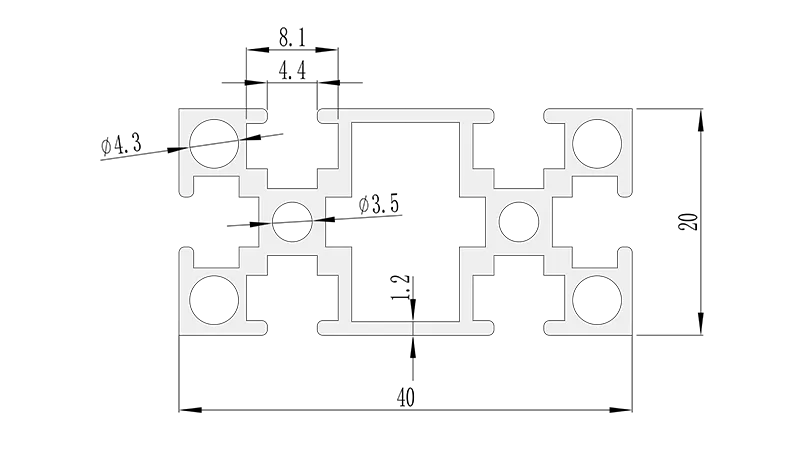
In the world of industrial and workshop design, the 2040 national standard profile has emerged as a workhorse, celebrated for its versatility, strength, and adaptability. From constructing sturdy workbenches to building efficient lean systems, this aluminum extrusion has become a go-to choice for manufacturers, DIY enthusiasts, and facility managers alike. Its 20mm x 40mm cross-section strikes a perfect balance between lightweight maneuverability and load-bearing capability, making it ideal for applications ranging from small-scale assembly stations to large-scale material handling setups. However, despite its popularity, many users fall prey to avoidable mistakes that compromise performance, safety, and longevity. In this article, we'll dive into the most common pitfalls and how to steer clear of them, ensuring your 2040 profile projects stand the test of time.
Mistake 1: Neglecting Material Compatibility with Aluminum Profile Accessories
One of the first missteps users make is underestimating the importance of matching 2040 national standard profile with compatible aluminum profile accessories . The 2040 profile's functionality hinges on its ability to integrate seamlessly with connectors, end caps, brackets, and other hardware—but not all accessories are created equal. Using mismatched or low-quality components can turn a promising project into a wobbly, inefficient mess.
Consider, for example, the difference between plastic and metal accessories. While plastic end caps or connectors might seem cost-effective for lightweight applications, they often lack the tensile strength needed to secure heavy loads. In a busy workshop, where a workbench might support tools, materials, and ongoing assemblies, plastic brackets can warp or crack under sustained pressure, leading to instability. On the flip side, using oversized metal connectors designed for larger profiles (like 3030 or 4040) on a 2040 frame can create unnecessary bulk, restrict adjustability, and even damage the profile's T-slots due to improper fitting.
Another compatibility issue arises with finish and corrosion resistance. The 2040 national standard profile is typically anodized to resist rust, but if paired with uncoated steel accessories in humid environments, galvanic corrosion can occur. This electrochemical reaction between dissimilar metals accelerates degradation, weakening joints and compromising structural integrity over time. For instance, using plain steel corner brackets on anodized aluminum profiles in a food processing facility—where moisture levels are high—can lead to unsightly rust stains and, worse, structural failure within months.
The solution? Always verify that accessories are specifically rated for 2040 profiles. Look for manufacturers that explicitly list compatibility with national standard aluminum extrusions, and prioritize anodized aluminum or stainless steel accessories for durability. When in doubt, consult the profile's technical datasheet, which often includes recommendations for compatible connectors, fasteners, and end caps. Investing in high-quality, compatible accessories might cost slightly more upfront, but it pays off in reduced maintenance and extended system lifespan.
Mistake 2: Overlooking Load Capacity in Workbench and Lean System Design
A workbench or lean system built with 2040 profiles is only as reliable as its load-bearing capacity—and yet, miscalculating this critical factor is a widespread error. The 2040 profile is robust, but it's not indestructible. Whether you're designing a benchtop for electronics assembly or a material rack for heavy components, failing to account for weight distribution and maximum load can result in sagging, bending, or even catastrophic collapse.
Let's break down the problem. The 2040 national standard profile typically has a load capacity of around 50-80 kg per linear meter when supported at both ends, depending on the wall thickness (usually 1.2mm to 2mm). However, this number drops significantly if the profile is used as a cantilever (supported at one end) or if the load is concentrated in the middle rather than distributed evenly. For example, a 1.5m-long 2040 profile supported at both ends might safely hold 60 kg, but if that same profile is used to extend 60cm beyond a support (like a shelf overhang), its capacity plummets to 20 kg or less. Ignoring this can lead to dangerous sagging, especially over time as the aluminum fatigues.
Many users also forget to factor in dynamic loads—forces exerted by moving objects, vibrations, or accidental impacts. A workbench used for hammering or machinery operation experiences more stress than one used for light assembly, requiring additional bracing or thicker profiles. Similarly, a lean system's conveyor rails, built with 2040 profiles, must account for the weight of sliding parts plus the momentum of items in motion. Underestimating these forces can cause rails to bend, disrupting workflow and creating safety hazards.
So, how do you avoid this? Start by calculating the total load your structure will bear, including static weight (tools, materials) and dynamic forces. Use online load calculators or consult engineering tables specific to 2040 aluminum profiles. When in doubt, overengineer slightly—adding cross-braces, vertical supports, or switching to a thicker-walled 2040 variant (e.g., 2mm instead of 1.2mm) can provide a safety buffer. For workbenches, opt for a frame with evenly spaced vertical supports (no more than 60cm apart) and a solid top (like aluminum honeycomb panel) to distribute weight. For lean systems, incorporate reinforced joints and periodic support brackets to prevent deflection.
Mistake 3: Incorrect Joint Installation and Tightening Techniques
The strength of any 2040 profile structure lies in its joints, but improper installation here is a recipe for disaster. With the industry's 2020 switch to aluminum corner codes and advanced connectors, there's more room than ever for error—from using the wrong joint type to over-tightening or under-tightening fasteners.
Let's start with joint selection. The 2040 national standard profile uses T-slot technology, which allows for various connection methods: internal corner codes, external brackets, floating nuts, and hinge joints, to name a few. Choosing the wrong joint for the job is a common blunder. For example, using a simple plastic corner bracket (intended for lightweight shelving) to connect two 2040 profiles in a heavy-duty workbench leg will result in wobbling, as plastic lacks the rigidity to withstand torsional forces. Similarly, relying on friction-fit floating nuts without bolts in high-vibration environments can cause joints to loosen over time, leading to structural instability.
Even when the correct joint is chosen, tightening technique matters. Over-tightening bolts can strip T-slots or crack aluminum profiles, especially in thin-walled variants. Imagine using a power drill to cinch down a M5 bolt into a 1.2mm 2040 profile—the sudden torque can deform the slot, making it impossible to reposition or replace the bolt later. Conversely, under-tightening leaves joints loose, causing the structure to shift or squeak during use. A loose joint in a conveyor rail, for instance, can misalign rollers, jamming materials and halting production.
The fix involves two key steps: selecting the right joint and tightening with precision. For load-bearing connections (like workbench legs), use metal internal corner codes or reinforced external brackets rated for 2040 profiles. For adjustable joints (like height-adjustable shelves), opt for eccentric cam locks or thumb screws that allow fine-tuning without damaging the T-slot. When tightening, use a torque wrench set to the manufacturer's recommended value (typically 3-5 Nm for M5 bolts in aluminum profiles). If a torque wrench isn't available, tighten until the bolt resists further turning, then add a quarter-turn—this ensures a secure fit without overdoing it.
Mistake 4: Ignoring ESD Requirements in Sensitive Environments
In electronics manufacturing, laboratories, and other static-sensitive environments, electrostatic discharge (ESD) can destroy components worth thousands of dollars. While the 2040 national standard profile itself is conductive, assuming it automatically makes a system ESD-safe is a critical mistake—especially when paired with non-ESD accessories like standard caster wheels or plastic end caps.
Here's why: Aluminum is a conductor, but ESD protection requires a controlled path to ground. If your 2040 profile workbench has plastic caster wheels, the entire structure can insulate, trapping static charges that discharge suddenly when a worker touches a sensitive component. Similarly, using non-ESD plastic connectors or rubber gaskets breaks the conductive chain, creating "hot spots" where static builds up. Even anodized aluminum profiles, while corrosion-resistant, have an oxide layer that can act as an insulator if not properly grounded.
Consider a scenario where a 2040 profile workbench is used for assembling circuit boards. The bench has standard caster wheels, plastic end caps, and a wooden top. As operators move around, friction between their shoes and the floor generates static, which transfers to the bench. Without a grounded path, that static can reach thousands of volts—enough to fry microchips. By the time the damage is discovered, production delays and costly rework are inevitable.
To avoid this, design ESD-compliant systems from the ground up. Start with the 2040 profile: ensure it's connected to a grounding point via a conductive strap or wire (look for profiles with pre-drilled grounding holes). Use ESD-safe accessories: conductive caster wheels with metal axles, anodized aluminum end caps, and ESD-rated brackets. For workbench tops, opt for aluminum honeycomb panels or ESD laminate, and connect them to the profile frame with conductive bolts. Finally, test the system with an ESD meter to verify surface resistance is between 10^6 and 10^9 ohms—this range ensures static dissipates slowly enough to avoid damage but quickly enough to prevent buildup.
Mistake 5: Poor Assembly Sequencing and Alignment
Rushing through assembly or ignoring alignment checks is a mistake that plagues even experienced users of 2040 national standard profile. A haphazard approach—like tightening all joints before ensuring the frame is square—can result in (distorted) structures that wobble, bind, or fail to integrate with other components. This is especially true for complex setups, such as multi-level material racks or modular lean systems, where precision is key.
Common assembly errors include: attaching horizontal rails to vertical posts before verifying the posts are plumb, installing casters without leveling the base, or skipping diagonal bracing until after the frame is fully assembled. For example, building a 2040 profile workbench without first checking that the legs are perpendicular to the top can result in a bench that rocks or leans, making it unsafe for detailed work. Similarly, assembling a conveyor rail system with misaligned rollers (due to poor frame alignment) will cause materials to jam or slide off-track.
The solution lies in a methodical assembly process. Start by laying out all components and verifying dimensions against your design. Assemble the frame in stages: first, build the base (e.g., a rectangular frame for a workbench) and check for squareness using a carpenter's square or diagonal measurements (opposite corners should be equal). Tighten joints finger-tight initially, allowing for adjustments. Next, add vertical supports, using a level to ensure they're plumb. Then, install horizontal rails and cross-braces, checking alignment again before fully tightening all bolts. Finally, add accessories like casters or shelves, and test the structure for stability—push gently from all sides to ensure no wobbling, and verify that moving parts (like conveyor rollers) operate smoothly.
A Quick Reference Table: Mistakes vs. Solutions
| Mistake | Common Cause | Recommended Fix |
|---|---|---|
| Material incompatibility with accessories | Using plastic or uncoated steel accessories with 2040 aluminum profiles | Choose anodized aluminum or stainless steel accessories rated for 2040 national standard profile; avoid mixed metals in humid environments |
| Overloading workbenches/lean systems | Assuming 2040 profiles handle unlimited weight without bracing | Calculate load capacity using engineering tables; add cross-braces and supports for heavy loads; distribute weight evenly |
| Incorrect joint installation | Using plastic brackets for load-bearing joints; over-tightening bolts | Use metal corner codes for strength; tighten bolts to 3-5 Nm with a torque wrench; avoid stripping T-slots |
| Ignoring ESD safety | Using standard caster wheels or plastic accessories in static-sensitive areas | Ground the 2040 profile; use ESD-rated caster wheels and conductive accessories; test surface resistance regularly |
| Poor assembly alignment | Rushing assembly without checking squareness or plumb | Assemble in stages; use a square/level to verify alignment; tighten joints finger-tight first, then fully after adjustments |
Conclusion: Mastering the 2040 National Standard Profile
The 2040 national standard profile is a versatile tool, but its performance depends on careful planning and execution. By avoiding these common mistakes—neglecting accessory compatibility, overloading, improper joint installation, ignoring ESD needs, and poor assembly—you can unlock its full potential. Whether you're building a simple workbench or a complex lean system, attention to detail ensures safety, efficiency, and longevity. Remember: the best projects aren't just built—they're built smart . With the right knowledge and practices, your 2040 profile creations will serve you reliably for years to come.