- Company Articles
- Industry articles
- Industry standards
- Comparing 2040 National Standard Profile with Non-Standard Alternatives

Comparing 2040 National Standard Profile with Non-Standard Alternatives
Related Product
2040 National Standard Profile
45° external bending joint, used for 45° external connection of two aluminum pipes.
In the world of industrial manufacturing, the tools and components we choose form the backbone of our productivity, efficiency, and ultimately, our success. Among these, aluminum profiles stand out as unsung heroes—quietly supporting assembly lines, workbenches, material racks, and countless other structures that keep factories running. But not all aluminum profiles are created equal. Today, we're diving deep into a critical comparison that could save your business time, money, and headaches: the 2040 National Standard Profile versus its non-standard counterparts. Whether you're setting up a new production line, upgrading existing workstations, or simply curious about optimizing your operations, understanding this distinction is key to making informed decisions.
Aluminum profiles, often called aluminum extrusion profiles , are created by forcing heated aluminum through a die to form consistent, cross-sectional shapes. Their versatility comes from their modular design—T-slots running along their length allow for easy attachment of accessories like brackets, panels, and handles, making them adaptable to almost any industrial need. But with this versatility comes choice, and not all choices are equally wise. Let's start by unpacking what makes the 2040 National Standard Profile a staple in so many facilities, then explore why non-standard alternatives exist, and finally weigh the pros and cons of each.
1. What is the 2040 National Standard Profile?
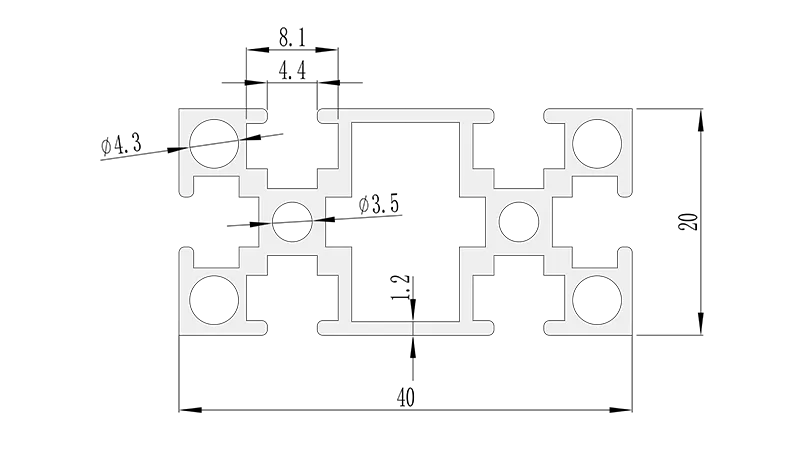
First things first: let's define our terms. The "2040 National Standard Profile" refers to a specific type of aluminum profile governed by national manufacturing standards. The numbers "2040" denote its cross-sectional dimensions: 20mm in width and 40mm in height (though exact measurements can vary slightly by region, the key is consistency within the standard). But it's not just about size—this profile is engineered to meet strict criteria for material quality, dimensional accuracy, and structural integrity, ensuring it performs reliably in industrial settings.
To understand why standards matter, consider this: when a profile is labeled "national standard," it means it adheres to guidelines set by regulatory bodies (like GB/T standards in China or similar frameworks globally). These guidelines cover everything from the aluminum alloy used (typically 6063-T5, prized for its strength, corrosion resistance, and extrudability) to the precision of the extrusion process. For example, the T-slots—the grooves that make aluminum profiles so versatile—must be uniformly spaced and sized to ensure compatibility with aluminum profile accessories like bolts, nuts, and end caps. The wall thickness, straightness, and surface finish are also tightly controlled, leaving little room for error.
The result? A profile that's not just a piece of metal, but a building block designed to work seamlessly with others. Imagine trying to assemble a puzzle where every piece is a slightly different size—frustrating, right? National standard profiles eliminate that frustration by ensuring every 2040 profile you buy, whether from Supplier A or Supplier B, will fit together perfectly. That consistency is the foundation of their popularity.
2. Key Features of the 2040 National Standard Profile
Now that we know what the 2040 National Standard Profile is, let's break down its standout features. These are the qualities that make it a go-to choice for engineers, plant managers, and manufacturers worldwide.
Dimensional Precision: The "Goldilocks" of Fit
One of the most critical features of the 2040 National Standard is its dimensional accuracy. During extrusion, the aluminum is forced through a die calibrated to within ±0.1mm of the target dimensions. That means if the standard calls for a 20mm width, you'll get 20mm—no more, no less. Why does this matter? Because in industrial setups, even a fraction of a millimeter can throw off an entire assembly. For example, if you're building a workbench with multiple vertical supports, a non-standard profile that's 0.5mm wider than expected might not align with the horizontal beams, leaving gaps or causing the structure to wobble. With the 2040 standard, you can trust that every component will slot into place, reducing assembly time and minimizing errors.
Material Quality: Strength You Can Rely On
National standard profiles are made from high-grade aluminum alloys, most commonly 6063-T5. This alloy is chosen for its ideal balance of strength, weight, and corrosion resistance. After extrusion, the profiles undergo a T5 heat treatment process—artificially aging the aluminum to enhance its mechanical properties. The result is a profile that can withstand heavy loads, resist warping under stress, and hold up to the daily wear and tear of factory environments. In contrast, many non-standard profiles use lower-grade alloys (like 1050 or 3003) that sacrifice strength for cost, making them prone to bending or deforming under even moderate weight.
Accessory Compatibility: A Universe of Possibilities
Perhaps the biggest advantage of the 2040 National Standard Profile is its compatibility with a vast ecosystem of aluminum profile accessories . From end caps that protect workers from sharp edges to brackets that secure panels, from casters that add mobility to aluminum profile fixings that lock components in place—there's an accessory for nearly every need. And because these accessories are designed to fit the standard T-slot dimensions of the 2040 profile, you never have to worry about "will this fit?" Whether you're buying from a local supplier or ordering online, the accessories are interchangeable, giving you flexibility and peace of mind.
For example, the 2040 aluminum profile end cap—a simple plastic or rubber insert that snaps into the end of the profile—isn't just a safety feature. It also prevents dust and debris from collecting inside the profile, extending its lifespan. Because the 2040 standard's dimensions are consistent, these end caps are mass-produced, affordable, and available everywhere. Try finding a custom end cap for a non-standard profile with odd T-slot spacing, and you'll quickly realize the value of standardization.
Safety Compliance: Built for the Workplace
In industrial settings, safety is non-negotiable. National standard profiles are designed with this in mind, adhering to strict safety regulations for factors like load-bearing capacity, surface finish (to prevent cuts), and structural stability. For instance, the 2040 profile's uniform wall thickness ensures that stress is distributed evenly, reducing the risk of sudden failure. This is especially critical in applications like ESD workstations, where static-sensitive electronics are handled, or heavy-duty material racks that store thousands of pounds of inventory. Non-standard profiles, lacking these certifications, can introduce hidden risks—like unexpected bending under load or sharp edges from poor finishing—that put workers and products in danger.
3. Non-Standard Alternatives: What Are They, and Why Do They Exist?
If the 2040 National Standard Profile is so great, why would anyone choose a non-standard alternative? The answer, as with many industrial decisions, often comes down to cost, convenience, or custom needs. Non-standard profiles are essentially aluminum extrusions that don't adhere to national dimensional or material standards. They might have slightly different cross-sectional dimensions (e.g., 21mm x 39mm instead of 20mm x 40mm), use lower-grade aluminum, or feature inconsistent T-slot spacing. Let's explore the scenarios where non-standard profiles might seem appealing—and the tradeoffs they bring.
The Temptation of Lower Upfront Costs
The most common driver for choosing non-standard profiles is upfront cost. Because they're often made with cheaper aluminum alloys, less precise extrusion dies, or lower-quality finishing processes, non-standard profiles can be 10-30% cheaper per meter than their standard counterparts. For small businesses or startups operating on tight budgets, this difference can seem like a lifesaver. Why spend more, the thinking goes, if the profile "looks" similar and gets the job done for now?
Custom Sizes for Unique Projects
Sometimes, a project calls for a profile with non-standard dimensions. Maybe you're building a specialized machine with unusually tight space constraints, or a one-off prototype that requires a custom cross-section. In these cases, non-standard profiles can feel like the only option—local suppliers may not stock the exact standard profile you need, and waiting for a custom standard extrusion could delay your timeline. Non-standard manufacturers, often smaller or regional, may offer faster turnaround for unique sizes.
Limited Supplier Options
In some regions, access to national standard profiles is limited. Local suppliers might only carry non-standard options, forcing businesses to choose between waiting for a distant standard profile shipment or buying what's available locally. This is especially true in remote areas or countries with less developed industrial supply chains, where "good enough" becomes the default.
While these reasons are understandable, they often overlook the long-term costs and risks of non-standard profiles. Let's now pit these two options head-to-head to see how they stack up in real-world scenarios.
4. Head-to-Head Comparison: 2040 National Standard vs. Non-Standard
To truly understand the impact of choosing standard vs. non-standard, let's compare them across key factors that matter most to manufacturers. The table below breaks down their performance, cost, and practicality, so you can see exactly where each option shines—and where it falls short.
| Factor | 2040 National Standard Profile | Non-Standard Alternatives |
|---|---|---|
| Dimensional Accuracy | Consistent within ±0.1mm of specified dimensions (e.g., 20.0mm width, 40.0mm height). T-slots are precisely spaced for universal accessory fit. | Inconsistent, often varying by ±0.3–0.5mm. T-slot spacing may deviate, leading to misalignment with standard accessories. |
| Material Quality | Made with high-grade 6063-T5 aluminum alloy, heat-treated for strength (tensile strength ~180 MPa). Resistant to corrosion and wear. | Typically uses lower-grade alloys (e.g., 1050 or recycled aluminum) with lower tensile strength (often <120 MPa). Prone to bending and corrosion over time. |
| Accessory Compatibility | Works seamlessly with all standard aluminum profile accessories (end caps, brackets, casters, etc.). Accessories are widely available and affordable. | Requires custom or modified accessories, which are expensive, hard to source, and often lead to ill-fitting connections. |
| Load-Bearing Capacity | Engineered for industrial loads: typically supports 50–80 kg per linear meter (depending on span). Minimal sagging under weight. | Load capacity is unpredictable; often supports <40 kg per linear meter. Sagging or bending common under moderate loads. |
| Long-Term Cost | Higher upfront cost, but lower total cost of ownership: minimal maintenance, no need for custom parts, and longer lifespan (10+ years). | Lower upfront cost, but hidden expenses: custom accessories, frequent replacements, and downtime from failures. Total cost often 2–3x higher over 5 years. |
| Safety Compliance | Meets national safety standards for industrial use (e.g., GB/T, ISO). Tested for structural integrity and worker safety. | Often lacks safety certifications. Risk of structural failure, sharp edges, or inadequate load support, increasing workplace accident risks. |
| Availability and Lead Time | Widely available from national and international suppliers. Lead times typically 1–3 days for standard lengths. | Availability depends on local suppliers. Custom sizes may require 2–4 weeks of lead time, delaying projects. |
This table paints a clear picture: while non-standard profiles may offer short-term savings or convenience, they introduce significant risks to long-term efficiency, safety, and cost. To bring this to life, let's look at two real-world examples of how these choices played out for manufacturers.
Example 1: The Furniture Manufacturer's Costly Mistake
A mid-sized furniture manufacturer in Guangdong decided to use non-standard profiles for their assembly line workbenches to save on upfront costs. The profiles were 20% cheaper, and the team assumed they'd be "good enough" for holding power tools and furniture parts. Six months later, the issues began: the non-standard profiles started bending under the weight of the tools, causing the workbenches to wobble. The T-slots, which were slightly narrower than standard, didn't fit the casters the manufacturer wanted to add for mobility—so they had to hire a local machinist to custom-mill new slots, adding $200 per workbench to the cost. Within a year, 30% of the workbenches needed full profile replacements due to excessive sagging. In the end, the manufacturer spent twice as much as they would have if they'd chosen the 2040 standard upfront—and lost two weeks of production during the repairs.
Example 2: The Electronics Workshop's Success with Standards
A small electronics workshop in Jiangsu specialized in assembling circuit boards for medical devices—a process requiring strict ESD (electrostatic discharge) protection. When setting up their ESD workstations, they chose the 2040 National Standard Profile. Why? Because standard profiles are designed to work seamlessly with ESD accessories like grounding clips, static-dissipative panels, and wrist-strap holders—all of which rely on precise T-slot spacing for proper installation. The workshop's manager noted, "We couldn't risk static damage to $500 circuit boards because a non-standard profile's T-slot was off by a millimeter. With the 2040 standard, every accessory clicked into place, and we've had zero ESD-related defects in three years." The initial investment in standard profiles paid off in consistent quality and peace of mind.
5. When to Choose 2040 National Standard Profile (and When Non-Standard Might Make Sense)
While the 2040 National Standard Profile is the clear winner in most scenarios, there are edge cases where non-standard alternatives might be justifiable. Let's clarify when to stick with standard and when (if ever) to consider non-standard.
Choose 2040 National Standard When:
- You need consistency across multiple projects or production lines. If you're building 10 identical workbenches or outfitting a factory with uniform material racks, standard profiles ensure every unit performs the same.
- Safety and compliance are non-negotiable. Industries like aerospace, automotive, or medical manufacturing can't afford structural failures. Standard profiles meet safety standards, reducing liability.
- Long-term durability matters. If your setup will be in use for 5+ years, the standard profile's higher quality will save you from frequent replacements.
- You rely on off-the-shelf accessories. From casters to conveyor tracks, standard profiles work with the accessories you already have or can easily buy.
Consider Non-Standard Only If:
- It's a one-off, low-load prototype. If you're testing a design and don't need the structure to last, non-standard might suffice for a short-term experiment.
- Custom dimensions are legally or physically required. In extremely rare cases, a project's unique constraints might make standard profiles impossible to use—and you've budgeted for custom accessories.
- You're certain the profile will never need modification or expansion. If the structure is permanent, low-stress, and you'll never need to add accessories, non-standard could work (but proceed with caution).
Even in these "non-standard" scenarios, proceed with eyes open. Ask yourself: What happens if this prototype becomes a full production line? Will I regret not using standard profiles then? More often than not, the answer is yes.
6. Common Misconceptions About Non-Standard Profiles
To wrap up, let's debunk some persistent myths about non-standard profiles that keep businesses from making the best choice. Understanding these misconceptions can help you avoid costly mistakes.
"Non-standard is always cheaper."
As we saw in the furniture manufacturer example, "cheaper upfront" rarely translates to "cheaper overall." The hidden costs of custom accessories, repairs, and downtime often erase the initial savings. One study by the China Association of Machinery Manufacturers found that manufacturers using non-standard profiles for critical structures faced 2.3x higher maintenance costs over five years compared to those using standard profiles.
"Standard profiles are too rigid—non-standard offers more flexibility."
This couldn't be further from the truth. The 2040 National Standard Profile's modular design, combined with its compatibility with thousands of aluminum profile accessories , makes it incredibly flexible. Need to add a shelf? Snap on a bracket. Want to make it mobile? Add casters. Non-standard profiles, with their limited accessory options, are the ones that box you in.
"All profiles are the same—you can't tell the difference."
Walk into a factory using non-standard profiles, and you'll notice the difference quickly: workbenches that wobble, material racks that sag, and workers struggling to attach accessories. Over time, the structural inconsistencies lead to inefficiencies and frustration. Standard profiles, by contrast, create a sense of "invisible reliability"—they just work, day in and day out.
7. Conclusion: Invest in Reliability, Invest in the Future
At the end of the day, the choice between 2040 National Standard Profile and non-standard alternatives boils down to this: Are you building for the short term or the long term? For businesses that prioritize efficiency, safety, and cost-effectiveness over time, the answer is clear. The 2040 National Standard Profile isn't just a component—it's an investment in your operations, your team, and your bottom line.
Aluminum profiles may not be the most glamorous part of your factory, but they're foundational. They support your workers, protect your products, and keep your production lines moving. By choosing the 2040 standard, you're choosing consistency, compatibility, and peace of mind. And in manufacturing, where every minute of downtime costs money, that's priceless.
So the next time you're shopping for aluminum profiles, remember: the cheapest option isn't always the best. Ask about standards, material quality, and accessory compatibility. Your future self—and your balance sheet—will thank you.