- Company Articles
- Industry articles
- Industry standards
- Compatibility of 3060 National Standard Profile A with Internal Rotating Aluminum Joints

Compatibility of 3060 National Standard Profile A with Internal Rotating Aluminum Joints
Related Product
3060 National Standard Profile A
Workbench, production line, logistic rack, warehouse rack Industry: Manufacturer workshop, Automobile, Electronic, Assembling, logistic
Imagine walking into a busy manufacturing facility: conveyor belts hum, workers assemble components with focused precision, and every inch of space feels intentional. But behind that seamless flow lies a hidden challenge—ensuring every piece of equipment works in harmony. When a workbench wobbles because its frame joints don't quite fit the aluminum profile, or a material rack jams because the connection points are misaligned, efficiency grinds to a halt. This is where compatibility between structural components becomes the unsung hero of lean manufacturing. Today, we're diving into one such critical pairing: the 3060 National Standard Profile A and Internal Rotating Aluminum Joints. Let's explore why their compatibility matters, how they work together, and the real-world impact they have on creating smoother, more adaptable workspaces.
What Makes 3060 National Standard Profile A a Workhorse in Lean Systems?
Before we jump into compatibility, let's get to know the first star of our story: the 3060 National Standard Profile A. If you've ever stood at a well-designed workbench or passed a sturdy material rack on a factory floor, chances are you've seen an aluminum profile like this in action. But what sets this particular profile apart?
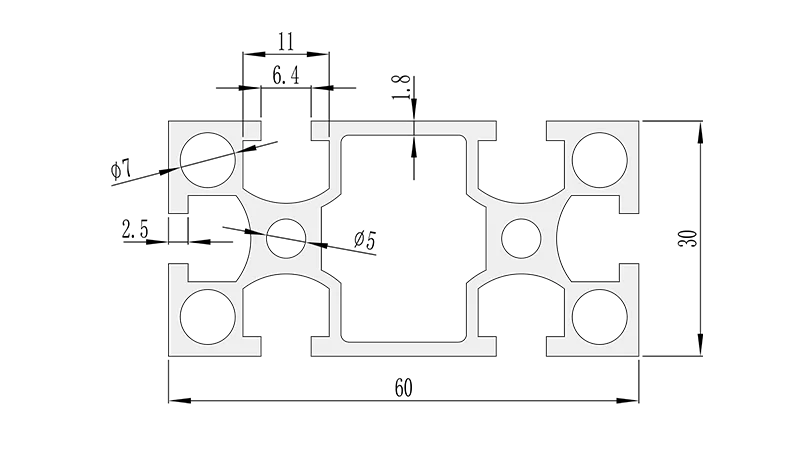
First, its dimensions. The "3060" refers to its width and height—30mm by 60mm—making it a versatile middleweight in the world of aluminum extrusion profiles. Not too bulky to limit flexibility, yet robust enough to support moderate to heavy loads. This balance is key for lean systems, where equipment needs to be both durable and adaptable.
Then there's its material: high-grade aluminum. Aluminum brings two critical benefits to the table: lightweight construction and resistance to corrosion. In a manufacturing environment where equipment is often moved, cleaned, or exposed to varying temperatures, these traits are non-negotiable. A rusted or overly heavy profile would quickly become a liability, but aluminum keeps things light enough for easy reconfiguration while standing up to daily wear and tear.
But the real genius of the 3060 National Standard Profile A lies in its T-slot design. Run your hand along its length, and you'll notice evenly spaced slots running the full length of the profile. These slots aren't just for show—they're the gateway to customization. They allow accessories like brackets, shelves, and yes, joints, to be attached anywhere along the profile with simple bolts or screws, no drilling required. This T-slot system is the backbone of modularity, a core principle of lean manufacturing that minimizes waste and maximizes adaptability.
National standardization is another cornerstone. "National Standard" means this profile adheres to strict size and quality guidelines, ensuring consistency across manufacturers. When a factory orders 3060 Profile A from different suppliers, they can trust that each piece will fit together perfectly—a far cry from the frustration of mismatched, non-standard components that derail projects and waste time.
Common uses? You'll find this profile in everything from workbenches (like the aptly named Workbench E, a single-deck setup without casters) to Material Rack B, a 3-row, 3-floor storage solution that relies on sturdy profiles to hold heavy inventory. It's also a staple in conveyor systems, where its rigidity keeps roller tracks aligned, and in turnover trolleys, where its lightweight nature makes manual movement a breeze.
Internal Rotating Aluminum Joints: The Flexible Connectors You Didn't Know You Needed
Now, let's meet the second half of our dynamic duo: the Internal Rotating Aluminum Joint. If the 3060 Profile A is the backbone of a structure, think of these joints as the elbows and wrists—they add movement and flexibility, turning rigid frames into adaptable systems.
At first glance, an internal rotating joint might look like a simple metal connector, but its design is surprisingly clever. Unlike fixed joints that lock profiles into a static angle, these joints feature a rotating mechanism inside their housing. This allows one connected profile to pivot relative to another, often up to 180 degrees, while still maintaining a secure hold. Picture a workbench shelf that can tilt to angle tools toward a worker, or a material rack arm that swings out to load items from multiple directions—all without needing to disassemble and rebuild the entire structure.
Material matters here, too. These joints are made from aluminum, just like the 3060 Profile A. This isn't a coincidence. Using the same material ensures compatibility in more ways than one: aluminum-on-aluminum contact reduces galvanic corrosion (a problem when dissimilar metals meet), and the similar thermal expansion rates mean the joint and profile expand and contract together in temperature changes, preventing loosening over time.
Load capacity is another critical feature. While they're designed for movement, internal rotating joints don't skimp on strength. A well-engineered joint can support anywhere from 50kg to 200kg, depending on size and design—enough to hold tools, parts bins, or even small machinery. This strength comes from precision machining: the rotating components are often reinforced with steel pins or bushings, and the outer housing is thick enough to distribute weight evenly across the profile's T-slots.
Installation is surprisingly straightforward. Most internal rotating joints slide into the T-slot of the 3060 Profile A and secure with a setscrew or bolt. Once tight, the rotating part of the joint can be adjusted to the desired angle and locked in place with another screw. This "adjust and lock" process takes minutes, making on-the-fly reconfigurations possible even during a busy shift.
Compare this to fixed joints, which require precise alignment during assembly and often need to be completely removed to change angles. In a lean system where downtime equals lost productivity, that difference is a game-changer. Internal rotating joints turn "we need to rebuild this workstation" into "let's just pivot the shelf"—saving hours of work and keeping the assembly line moving.
The Compatibility Checklist: Why These Two Work So Well Together
So, we've covered what the 3060 National Standard Profile A and Internal Rotating Aluminum Joints are individually. But why do they play so nicely together? Compatibility isn't just about "fitting"—it's about working in harmony to enhance performance, durability, and usability. Let's break down the key factors that make this pairing a match made in lean manufacturing heaven.
1. Physical Fit: T-Slot Geometry and Joint Dimensions
The first test of compatibility is simple: do they physically connect? The 3060 Profile A's T-slots are standardized to a specific width and depth (typically 8mm or 10mm, depending on the national standard), and internal rotating aluminum joints are engineered to match these dimensions exactly. The joint's connecting tabs or bolts slide smoothly into the T-slot, with no gaps or wiggling. This precise fit ensures that the joint doesn't shift under load, a common issue with generic joints that are "close enough" but not tailored to the profile.
Even the corners of the 3060 Profile A matter. National standard profiles have consistent rounded or square edges, and internal rotating joints are designed to hug these edges, distributing stress evenly. A joint that doesn't account for edge shape might crack or loosen over time, but this pair? They fit like puzzle pieces.
2. Load-Bearing Harmony
A joint is only as good as its ability to support weight without failing, and here, the 3060 Profile A and internal rotating joint shine as a team. The profile's 30x60mm cross-section provides ample surface area for the joint to attach, spreading the load across multiple T-slot points. Meanwhile, the joint's aluminum housing and steel-reinforced rotating components are rated to handle the same weight ranges as the profile itself—typically 100-150kg per linear meter for the profile, and 50-100kg per joint. This balance means neither component is overworked; the profile carries the weight, and the joint distributes it, preventing weak points.
For example, consider a Material Rack B (3 rows, 3 floors) built with 3060 profiles and internal rotating joints. Each shelf might hold 80kg of parts. The profiles support the vertical load, while the joints connect the horizontal and vertical members, rotating slightly to adjust for uneven weight distribution without bending or breaking. In contrast, a mismatched pair—say, a heavy-duty joint on a flimsy profile—would lead to the profile buckling, even if the joint itself held.
3. Rotational Freedom Without Compromise
The internal rotating joint's claim to fame is its movement, but that movement mustn't compromise stability. Here's where the 3060 Profile A's rigidity comes into play. Aluminum extrusion profiles are inherently stiff, so when the joint rotates, the profile doesn't flex or twist, keeping the structure stable. Imagine a workbench arm with a rotating joint: as a worker swings it to access tools, the 3060 profile stays rock-solid, while the joint moves smoothly. This is a far cry from using a rotating joint on a thin, flexible profile, which would wobble and make precise work impossible.
The joint's rotation range is also calibrated to work with the profile's dimensions. Most internal rotating joints offer 180 degrees of rotation, but they're designed to stop short of angles that would stress the profile's T-slots. For instance, rotating beyond 90 degrees might pull the joint's bolts against the slot edges, but the joint's internal stops prevent this, protecting both the joint and the profile.
4. Material Synergy
We touched on this earlier, but it's worth repeating: aluminum-on-aluminum is a compatibility win. Both the 3060 Profile A and internal rotating joint are made from corrosion-resistant aluminum alloys, so they're equally resistant to moisture, oils, and chemicals common in manufacturing environments. This shared resistance means they age at the same rate—no rusted steel joint eating away at an aluminum profile, or vice versa. It also simplifies maintenance: a quick wipe with a damp cloth keeps both components clean and functional for years.
5. Compatibility with Aluminum Profile Accessories
No component works in isolation, and this pair plays well with others, too. Aluminum profile accessories like Aluminum Guide Rail A, Roller Track Placon Mounts, and even plastic roller track guide rails (yellow or grey) are all designed to fit the 3060 Profile A's T-slots. When combined with internal rotating joints, these accessories unlock even more possibilities. For example, a conveyor system might use 3060 profiles as the frame, internal rotating joints to angle the roller tracks, and Aluminum Guide Rail B to keep items centered. Every piece connects seamlessly, turning individual components into a cohesive system.
Compatibility Comparison Table: Internal Rotating Joint vs. Other Joint Types with 3060 Profile A
| Joint Type | Physical Fit with 3060 Profile A | Max Load Capacity | Rotational Range | Best For |
|---|---|---|---|---|
| Internal Rotating Aluminum Joint | Perfect (tailored to T-slot dimensions) | 50-100kg | 0-180° (stops at stress-free angles) | Adjustable workbenches, swinging material racks, ergonomic tool holders |
| Fixed 90° Steel Joint | Good (standard T-slot fit, but heavier) | 100-150kg | 0° (fixed) | Static structures, heavy machinery bases |
| Plastic Universal Joint | Poor (one-size-fits-all, gaps in T-slot) | 20-30kg | 0-360° (uncontrolled rotation) | Light-duty, temporary setups |
| Welded Steel Joint | Custom (requires cutting/welding) | 200+kg | 0° (fixed) | Permanent, high-load structures (no reconfiguration) |
As the table shows, while other joints have their uses, the internal rotating aluminum joint stands out for its perfect fit, balanced load capacity, and functional rotation—all tailored to work with the 3060 National Standard Profile A.
Real-World Applications: Where This Pair Shines
Theory is great, but let's talk about how this compatibility translates to real results on the factory floor. From workbenches to assembly lines, the 3060 National Standard Profile A and internal rotating aluminum joints are solving problems and boosting efficiency in ways that matter to workers and managers alike.
Workbenches: Ergonomics at Your Fingertips
Take Workbench E, a single-deck setup without casters—a common sight in electronics assembly or small-part manufacturing. Traditionally, workbench shelves and tool holders are fixed, forcing workers to stretch or twist to reach items. But with 3060 profiles as the frame and internal rotating joints, shelves can pivot. A worker assembling circuit boards might swing a parts bin toward them for easy access, then rotate it back to free up space. The joint locks securely in any position, so the shelf stays put when needed, and moves smoothly when not. This isn't just about convenience; it reduces repetitive strain injuries and speeds up tasks by cutting down on reach time.
Material Racks: Adapting to Changing Needs
Material Rack B (3 rows, 3 floors) is another prime example. In a dynamic factory, the size and shape of parts can change weekly—one week, small boxes; the next, larger components. Fixed shelves would require the entire rack to be rebuilt, but with internal rotating joints, shelves can be angled to accommodate taller items or even flipped up to create extra vertical space. The 3060 profiles provide the strength to hold the weight, while the joints make reconfiguration a 10-minute task instead of a half-day project.
Conveyor Systems: Smoothing the Flow
Conveyors rely on precise alignment to keep items moving—even a slight angle can cause jams. 3060 profiles form the conveyor frame, and internal rotating joints allow the roller tracks to be (fine-tuned) for (slope) or curvature. For example, a plastic roller track guide rail (yellow) might need to angle 5 degrees to help items glide downhill. The joint adjusts easily, and the profile's rigidity keeps the track stable, ensuring a consistent flow. This adaptability is crucial in lean systems, where optimizing workflow often means tweaking angles and heights on the fly.
Case Study: Automotive Parts Plant Cuts Downtime by 40% with Compatible Components
A mid-sized automotive parts manufacturer was struggling with frequent line stoppages. Their old assembly workstations used mismatched steel profiles and plastic joints that loosened under vibration, leading to wobbly tool holders and misaligned conveyor tracks. Workers spent 2-3 hours per week just tightening joints or rebuilding shelves.
The solution? They switched to 3060 National Standard Profile A frames with internal rotating aluminum joints. Within a month, the results were clear: joints stayed tight, reconfiguring workstations to handle new part sizes took 30 minutes instead of 3 hours, and conveyor jams dropped by 60%. "We used to have a guy whose whole job was fixing wobbling shelves," said the plant manager. "Now, he's building new workstations instead—because these joints and profiles just… work."
The Bottom Line: Why Compatibility Drives Lean Success
At the end of the day, compatibility between the 3060 National Standard Profile A and Internal Rotating Aluminum Joints isn't just a technical detail—it's a cornerstone of lean manufacturing. Lean systems thrive on efficiency, adaptability, and waste reduction, and this pair delivers on all three:
- Efficiency: No more time wasted on ill-fitting parts or constant repairs. This compatibility means faster assembly, fewer breakdowns, and smoother workflows.
- Adaptability: Internal rotating joints turn static structures into dynamic tools that evolve with your needs. Need to reconfigure a workbench? Adjust a conveyor angle? It's done in minutes, not days.
- Waste Reduction: Standardized, compatible components mean less scrap (no more cutting down ill-fitting profiles), fewer replacement parts, and lower labor costs for maintenance and reconfiguration.
For manufacturers, warehouses, or any facility aiming to streamline operations, the message is clear: don't overlook the power of compatible components. The 3060 National Standard Profile A and Internal Rotating Aluminum Joints aren't just parts—they're partners in creating a workspace that works with you, not against you. And in the world of lean manufacturing, that partnership is worth its weight in aluminum (and then some).