- Company Articles
- Industry articles
- Industry standards
- Consumer Electronics Assembly: 4040r EU Standard Aluminum Profile Applications

Consumer Electronics Assembly: 4040r EU Standard Aluminum Profile Applications
Related Product
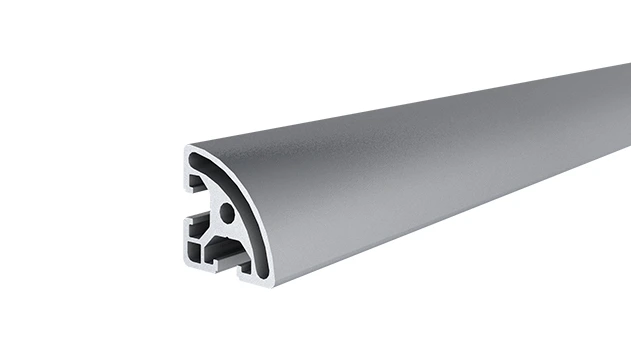
4040R EU Standard Aluminum Profile
4040R is a 4.00x4.00 CM fractional 40 series square extrusion T-slot profile with two side open T-slots, each side with 4.00cm face,the other side is round face. The profile has align-a-grooves to assist in aligning connecting profiles.
How modular aluminum profiles are revolutionizing flexible manufacturing in the fast-paced tech industry
The Need for Flexibility in Consumer Electronics Assembly
Walk into any modern consumer electronics factory, and you'll notice a quiet revolution happening on the assembly floor. Smartphones, laptops, wearables, and smart home devices are no longer built on rigid, one-size-fits-all production lines. Today's tech giants—think Apple, Samsung, or emerging brands in the IoT space—face a unique challenge: product lifecycles that shrink by the month. A smartphone model launched this year might be obsolete in 18 months, and a new wearable could require a completely different assembly process than its predecessor.
This rapid pace of innovation demands assembly lines that can pivot quickly. Traditional setups, often built with welded steel or fixed wooden structures, simply can't keep up. They're expensive to modify, time-consuming to reconfigure, and prone to becoming obsolete the moment a new product design hits the drawing board. So, what's the solution? More and more manufacturers are turning to modular building systems, and at the heart of this shift lies the 4040r EU standard aluminum profile .
But why aluminum? And why the 4040r specifically? Let's start with the basics. Aluminum profiles—extruded pieces of aluminum alloy with T-shaped slots running along their length—have been around for decades, but their adoption in electronics assembly has surged in recent years. They're lightweight yet surprisingly strong, resistant to corrosion, and, most importantly, infinitely customizable. The "4040r" designation refers to a profile that's 40mm wide, 40mm tall, and features rounded (hence the "r") corners—a design choice that enhances safety (no sharp edges for workers) and gives the profile a sleek, modern look.
In this article, we'll dive into how the 4040r aluminum profile is transforming consumer electronics assembly. We'll explore its key features, real-world applications in workbenches and conveyor systems, the role of aluminum profile accessories in maximizing its potential, and how it aligns with lean system principles. Whether you're a production manager looking to upgrade your line or simply curious about the behind-the-scenes of your favorite gadgets, this is your guide to the unsung hero of flexible manufacturing.
What Makes the 4040r Aluminum Profile a Game-Changer?
To understand why the 4040r has become a staple in electronics assembly, let's break down its core features. It's not just about being "aluminum"—it's about how every detail of its design addresses the unique needs of modern production lines.
1. The EU Standard: Consistency Across Borders
First, the "EU standard" label matters. In an industry where supply chains span continents, consistency is critical. A 4040r profile from a supplier in Germany should fit seamlessly with accessories from a manufacturer in China. The EU standard ensures uniform dimensions, slot sizes, and tolerances, so you never have to worry about compatibility issues when sourcing parts. This standardization is a lifesaver for global manufacturers with factories in multiple countries—no more redesigning workstations for each location.
2. T-Slot Design: The Secret to Modularity
The real magic of the 4040r lies in its T-slots—those grooves running along each side of the profile. These slots act as a universal interface for aluminum profile accessories : brackets, connectors, shelves, tool holders, and even cable management clips. Unlike traditional bolted or welded systems, T-slot connections require no drilling or welding. You simply slide a nut into the slot, align your accessory, and tighten a screw. Need to move a shelf up by 5cm? Loosen the screws, adjust, and retighten. Done in 2 minutes, not 2 hours.
For electronics assembly, where workstations often need to accommodate different component sizes (e.g., assembling a 13-inch laptop vs. a 15-inch model), this adjustability is invaluable. An assembler working on a smartwatch might need their tools closer to the bench surface, while someone building a tablet could benefit from a higher shelf for component bins. With T-slots, these tweaks are effortless.
3. Strength and Lightweight: The Perfect Balance
Consumer electronics assembly involves handling delicate components, but that doesn't mean the assembly equipment itself can be flimsy. The 4040r is typically made from aluminum alloy 6063-T5, a material known for its excellent strength-to-weight ratio. A 1-meter length of 4040r weighs around 1.5kg—light enough for two workers to carry and reposition, but strong enough to support up to 200kg per linear meter (depending on the setup). That's more than enough for most electronics assembly tasks: think holding a workbench top with tools, a conveyor section carrying circuit boards, or a material rack stacked with component boxes.
Compare that to steel profiles, which might offer similar strength but at twice the weight. Lighter equipment means easier reconfiguration and reduced strain on workers, which in turn lowers the risk of workplace injuries—a win for both productivity and safety.
4. Rounded Corners: Safety First
The "r" in 4040r stands for "rounded," and this small detail makes a big difference on the factory floor. Sharp corners on steel or wooden structures are a hazard—workers rushing to meet production targets can easily bump into them, leading to cuts or bruises. Rounded corners reduce this risk, aligning with OSHA and EU safety standards. They also give the profile a cleaner, more professional look, which matters in facilities that often host client or investor tours.

4040r in Action: Key Applications in Electronics Assembly
Now that we understand the "why" behind the 4040r, let's look at the "how." How do manufacturers actually use these profiles to build the assembly lines that churn out our favorite devices? Let's explore three critical applications: workbenches, conveyor systems, and material racks.
1. Workbenches: The Heart of the Assembly Line
Every electronics assembly line revolves around workbenches—where the actual building happens. A typical workstation might involve an assembler attaching a screen to a laptop chassis, soldering components onto a circuit board, or testing a finished device. These tasks demand workbenches that are ergonomic, customizable, and durable—exactly what the 4040r delivers.
Take, for example, a workbench designed for smartphone assembly. Using 4040r profiles as the frame, manufacturers can build a bench with adjustable height (thanks to telescopic profile sections and locking pins), integrated LED task lighting (mounted via T-slot brackets), and tool holders that keep screwdrivers, tweezers, and anti-static wristbands within arm's reach. Add an ESD (electrostatic discharge) mat on top—secured with T-slot clamps—and you've got a workstation that protects sensitive components from static damage.
What if the next smartphone model is slightly thicker, requiring the assembler to sit higher? No problem. Loosen the height-adjustment bolts, raise the bench by 10cm, and retighten. No need to replace the entire bench. This flexibility is why companies like Foxconn, a major electronics manufacturer, have standardized on 4040r-based workbenches across many of their facilities.
2. Conveyor Systems: Moving Components with Precision
Once components are assembled, they need to move from one station to the next—from PCB soldering to quality control, for example. Conveyor systems built with 4040r profiles offer the same modularity as workbenches but for material transport.
Imagine a roller conveyor section used to move laptop cases. The frame is built with 4040r profiles, and plastic roller track guide rails (yellow or grey, depending on the factory's color-coding system) are snapped into the T-slots. The rollers themselves can be adjusted for spacing—critical for handling different case sizes. If the next laptop model has a wider chassis, simply reposition the rollers using the T-slots. No need to buy a new conveyor section.
Even more complex systems, like belt conveyors for small components (e.g., microchips or camera modules), can be built with 4040r. The profile's rigidity ensures the belt runs smoothly, while accessories like motor mounts (attached via T-slots) allow for easy integration of drive systems. And because aluminum is lightweight, these conveyors can be mounted on casters (another T-slot accessory) for quick repositioning when the line layout changes.
3. Material Racks: Organizing Components Efficiently
Behind every assembly line is a stockroom of components—resistors, capacitors, screens, batteries—all needing to be organized for quick access. Material racks built with 4040r profiles are a far cry from static steel shelving. They're adjustable, mobile, and tailored to the specific needs of the line.
Consider a material rack for circuit boards. Using 4040r uprights and horizontal beams, manufacturers can add shelves with swivel roller balls (1-inch or 0.5-inch, depending on board size) to allow easy sliding of components. The shelves can be spaced to fit different PCB dimensions—6-inch boards on the top shelf, 10-inch on the bottom. Add lockable casters, and the entire rack can be rolled directly to the assembly bench when stock runs low, eliminating time wasted walking to the stockroom.
One electronics manufacturer in Vietnam reported a 30% reduction in component retrieval time after switching to 4040r-based material racks. Workers no longer had to bend or stretch to reach parts; the racks were adjusted to their height, and components slid effortlessly onto the bench.
The Role of Aluminum Profile Accessories: Turning Profiles into Systems
A 4040r profile on its own is just a piece of aluminum. It's the aluminum profile accessories that transform it into a complete system. Think of the profile as a blank canvas; accessories are the paint, brushes, and tools that bring it to life. Let's explore some of the most essential ones.
Connectors: The Glue That Holds It All Together
Connectors are the backbone of any modular system, and aluminum profiles have a connector for every angle. Need to join two profiles at a right angle? Use a 90° aluminum profile connector, which slides into the T-slots and tightens with a hex key. For a 45° angle (useful for sloped chutes), there's a 45° connector. Even 135° connectors exist for corner sections that aren't quite 90°.
One of the most innovative connectors is the internal rotary aluminum joint, which allows two profiles to pivot relative to each other. Imagine a workbench with a fold-down side shelf—when not in use, it folds up to save space; when needed, it rotates down to provide extra surface area. This joint makes that possible, all without welding or complex hinges.
End Caps and Seal Covers: Finishing Touches with Purpose
End caps are small plastic or aluminum pieces that snap into the ends of profiles. They might seem trivial, but they serve two key roles: safety and aesthetics. Uncapped profile ends have sharp edges (even on rounded 4040r models) that can catch on clothing or skin. End caps eliminate this risk. They also prevent dust, debris, or small components from falling into the T-slots, which could jam accessories later.
T-slot rubber seal covers are another unsung hero. These flexible strips press into the T-slots, protecting them from dirt and making the profile easier to clean. In electronics assembly, where cleanliness is critical (even a speck of dust can ruin a camera lens), seal covers are a must-have.
Casters and Leveling Feet: Mobility and Stability
Many 4040r-based systems—like mobile workbenches or material racks—need to be both mobile and stable. Enter casters and leveling feet. Lockable caster wheels (mounted via T-slot brackets) allow workers to roll a workstation to a new location, then lock the wheels to keep it steady during use. Leveling feet, which screw into the bottom of profiles, ensure the system stays stable even on uneven factory floors—critical for precision tasks like soldering.
One manufacturer we spoke to uses a combination: mobile racks with casters for daily use, and leveling feet that can be lowered to lift the casters off the ground during long production runs. This gives the best of both worlds: mobility when needed, stability when working.
Comparing 4040r to Other Profiles: Why Size Matters
The 4040r isn't the only aluminum profile on the market. So why do so many electronics manufacturers choose it over smaller profiles (like the 3030) or larger ones (like the 4080)? The answer lies in its "goldilocks" size—big enough to handle most tasks, small enough to stay lightweight and flexible. Let's break it down with a comparison table:
| Profile Type | Dimensions (WxH) | Typical Load Capacity (per linear meter) | Best For | Accessory Compatibility |
|---|---|---|---|---|
| 3030 EU Standard | 30mm x 30mm | 100-150kg | Light-duty tasks: small component storage, desktop organizers | Limited—smaller T-slots mean fewer accessory options |
| 4040r EU Standard | 40mm x 40mm (rounded corners) | 150-200kg | Medium-duty tasks: workbenches, conveyors, material racks | Excellent—most EU-standard accessories fit |
| 4080 EU Standard | 40mm x 80mm | 250-300kg | Heavy-duty tasks: industrial machinery frames, large equipment stands | Excellent, but heavier and more expensive |
For electronics assembly, the 4040r hits the sweet spot. It's strong enough to support workbenches and conveyors but not so large that it adds unnecessary weight or cost. The 3030, while cheaper, often lacks the load capacity for full-size workbenches, and its smaller T-slots limit the types of accessories that can be attached. The 4080, on the other hand, is overkill for most electronics tasks—you wouldn't need a 300kg capacity for a workbench holding a 1kg laptop.
Another advantage of the 4040r is its widespread availability. Since it's one of the most popular EU-standard profiles, accessories are easy to find and competitively priced. This availability reduces lead times—a critical factor when you need to reconfigure a line in days, not weeks.
Aligning with Lean Systems: Reducing Waste, Boosting Efficiency
Lean manufacturing—a philosophy focused on eliminating waste (muda) and maximizing value—has become a cornerstone of modern electronics production. The 4040r aluminum profile aligns perfectly with lean principles, making it a favorite among manufacturers striving for efficiency.
Eliminating Waste in Time and Resources
One of the biggest wastes in manufacturing is "waiting" — waiting for a new workbench to be built, waiting for a conveyor to be modified, waiting for tools to be repositioned. The 4040r reduces this waste by allowing rapid reconfiguration. For example, when a new product launch requires a change in the assembly sequence, production teams can disassemble old workstations and rebuild new ones in hours, not days. This aligns with the lean principle of "quick changeover," minimizing downtime between production runs.
There's also waste in excess inventory—like storing extra steel frames or custom wooden benches "just in case." With 4040r, manufacturers can standardize on a few profile lengths and accessories, then build what they need on demand. No more stockpiling unused equipment.
Empowering Workers with "Kaizen" (Continuous Improvement)
Lean isn't just about processes—it's about people. Kaizen, the practice of continuous improvement, encourages workers to suggest small, incremental changes to their workstations. With 4040r, these suggestions can be implemented quickly. For example, an assembler might notice that their tool holder is too far away; with T-slot accessories, the holder can be repositioned in minutes. This empowerment boosts morale and leads to a more engaged, productive workforce.
A Japanese electronics manufacturer we visited takes this a step further: they hold monthly "kaizen workshops" where workers and engineers collaborate to redesign workstations using 4040r profiles. The result? A 20% increase in productivity over two years, driven entirely by small, worker-led improvements.
The Future of 4040r in Electronics Assembly
As consumer electronics continue to evolve—with foldable screens, AI-powered devices, and smaller, more complex components—the demand for flexible assembly systems will only grow. The 4040r aluminum profile is poised to play an even bigger role in this future, thanks to ongoing innovations in materials and accessories.
One trend to watch is the integration of smart technology. Imagine 4040r profiles with built-in sensors that monitor vibration (to detect equipment issues early) or RFID tags that track which accessories are used where (to optimize inventory). Some manufacturers are already experimenting with "smart workbenches" that use T-slot-mounted cameras to guide assemblers through complex tasks, reducing errors.
Another trend is sustainability. Aluminum is 100% recyclable, and the modular nature of 4040r systems means profiles can be reused across multiple product lines, reducing waste. As electronics companies face pressure to reduce their carbon footprints, the sustainability of aluminum profiles will become an even bigger selling point.
Finally, customization will reach new heights. With 3D printing becoming more accessible, we may soon see custom T-slot accessories printed on-demand, allowing manufacturers to create one-of-a-kind parts for unique assembly tasks—all while keeping the 4040r profile as the foundation.
Conclusion: The 4040r—More Than Just a Profile
At first glance, the 4040r EU standard aluminum profile might seem like a simple piece of metal. But in reality, it's a catalyst for change in the fast-paced world of consumer electronics assembly. It's the reason manufacturers can launch new products in months instead of years, the reason workers can customize their workstations to fit their needs, and the reason lean principles like waste reduction and continuous improvement are easier to implement than ever.
Whether you're building a smartphone, a smartwatch, or the next big IoT device, the 4040r offers something no rigid system can: the freedom to adapt. And in an industry where change is the only constant, that freedom is priceless.
So the next time you unbox a new gadget, take a moment to appreciate the assembly line that built it. Chances are, somewhere along the way, a 4040r aluminum profile played a role in bringing that device to life.