- Company Articles
- Industry articles
- Industry standards
- Consumer Electronics Production: 3060 National Standard Profile A Workstations

Consumer Electronics Production: 3060 National Standard Profile A Workstations
Related Product
3060 National Standard Profile A
Workbench, production line, logistic rack, warehouse rack Industry: Manufacturer workshop, Automobile, Electronic, Assembling, logistic
Walk into any consumer electronics factory today, and you'll be met with a symphony of precision: robotic arms assembling tiny circuit boards, workers testing sleek smartphones, and conveyor belts gliding components from station to station. Behind this orchestration lies a critical, often overlooked hero: the workstation. It's more than just a table or a shelf—it's the backbone of production, dictating how efficiently teams work, how safely components move, and how quickly lines can adapt to new models or design changes. In an industry where milliseconds matter and product cycles shrink by the month, the right workstation isn't a luxury; it's a necessity. That's where the 3060 National Standard Profile A comes in. This unassuming aluminum extrusion has quietly revolutionized how consumer electronics manufacturers build, adapt, and optimize their workspaces. Let's dive into why it's become the go-to choice for forward-thinking production floors.
The Problem with Outdated Workstations: Why "Good Enough" No Longer Cuts It
Before we talk about solutions, let's acknowledge the headaches old-fashioned workstations bring. Many factories still rely on fixed, welded steel frames or generic wooden tables. These might seem sturdy, but they're rigid—like trying to fit a square peg into a round hole when production needs shift. Imagine launching a new tablet model that requires extra shelving for larger components, or needing to reconfigure a line to accommodate a sudden surge in demand for wireless earbuds. With fixed workstations, that means calling in welders, buying new furniture, or wasting hours disassembling and rebuilding from scratch. Time is money, and in consumer electronics, downtime can cost tens of thousands of dollars per hour.
Then there's weight and flexibility. Steel workstations are heavy, making them hard to move even for minor adjustments. Wooden surfaces scratch easily, harboring dust that can damage sensitive electronics. And don't get started on compatibility—accessories like tool holders, ESD mats, or roller tracks often require custom drilling or adhesives, turning simple upgrades into day-long projects. For a sector that thrives on innovation, these limitations are a bottleneck.
Enter modular aluminum profiles. Lightweight, strong, and infinitely customizable, they've been a game-changer. But not all profiles are created equal. Smaller profiles (like the 2020 series) lack the load capacity for heavy equipment, while larger ones (like 4080) can be overkill for delicate assembly tasks. The 3060 National Standard Profile A hits that sweet spot—offering the strength to support tools and components, the flexibility to reconfigure on the fly, and the compatibility with accessories that turns a basic frame into a fully optimized workstation.
What Is 3060 National Standard Profile A? Breaking Down the Basics
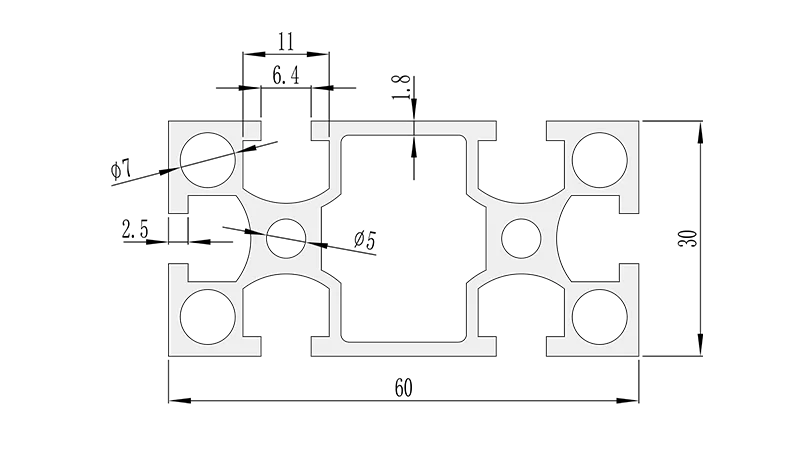
At its core, the 3060 National Standard Profile A is an aluminum extrusion—a long, hollow beam with a specific cross-sectional shape. The "3060" refers to its dimensions: 30mm in width and 60mm in height. But numbers only tell part of the story. What makes this profile special is its T-slot design—longitudinal grooves running along its length that allow accessories to slide in and lock into place without drilling or welding. Think of it like a Lego brick for adults, but with industrial-grade strength.
Made from high-grade aluminum alloy (typically 6063-T5), it's surprisingly lightweight—about a third the weight of steel—yet incredibly strong. A single 3-meter length can support up to 200kg when properly mounted, making it ideal for holding everything from circuit board testers to bins of small components. Its smooth, anodized surface resists corrosion and scratches, keeping workspaces clean and professional-looking even after years of heavy use. And because it's aluminum, it's naturally conductive, which is a huge plus for ESD (electrostatic discharge) protection—a must in electronics production, where static can fry sensitive microchips.
But the real magic is in its standardization. The "National Standard" part means it's designed to work seamlessly with a vast ecosystem of aluminum profile accessories—from end caps that protect workers from sharp edges to corner brackets that let you build 90-degree angles in seconds. No more hunting for custom parts or worrying about compatibility. It's like building with a universal toolkit, where every piece fits exactly as it should.
3060 vs. the Rest: Why This Profile Stands Out in a Crowded Market
To understand why 3060 National Standard Profile A has become a favorite, let's compare it to other common profiles. The table below breaks down key factors like load capacity, flexibility, and typical use cases:
| Profile Type | Dimensions (WxH) | Max Load Capacity (per meter) | Flexibility (Accessory Compatibility) | Common Use Cases |
|---|---|---|---|---|
| 2020 National Standard | 20mm x 20mm | 50-80kg | High (small accessories) | Light-duty shelving, display racks, small tool holders |
| 3060 National Standard Profile A | 30mm x 60mm | 150-200kg | Very High (all standard accessories) | Workstations, material racks, assembly lines, testing stations |
| 4040 National Standard | 40mm x 40mm | 120-180kg | High (wider T-slots for larger accessories) | Heavy-duty shelving, machine guards, industrial workbenches |
| 4080 EU Standard | 40mm x 80mm | 250-300kg | High (EU-specific accessories) | Large assembly lines, automotive parts, heavy machinery |
As you can see, 3060 Profile A strikes a balance that's perfect for consumer electronics. It's stronger than the tiny 2020 profiles (which are great for light tasks but can't handle the weight of a soldering station plus a day's worth of components) but more nimble than the bulky 4080. Its 30x60mm dimensions provide enough surface area for mounting tools and accessories without taking up excessive floor space—critical in factories where every square meter is optimized for flow.
Another key advantage is its focus on lean manufacturing principles. In consumer electronics, "lean" isn't just a buzzword; it's a way of life. It means minimizing waste, maximizing efficiency, and empowering workers to improve their own processes. 3060 Profile A embodies this: its modular design lets teams add or remove shelves, adjust heights, or reposition roller tracks in minutes, not days. No more waiting for maintenance—line workers can make tweaks themselves, keeping production moving and morale high.
Building a Better Workstation: Key Components of a 3060 Profile Setup
A 3060 National Standard Profile A workstation isn't just the profile itself—it's the ecosystem of parts that turn it into a fully functional hub. Let's walk through the essential components and how they come together.
1. The Frame: Strong, Light, and Ready to Adapt
The frame is the skeleton of your workstation, typically built from 3060 profiles cut to length and connected with lean pipe joints. These joints are the unsung heroes here—they're designed to lock profiles together securely with just a hex key, no welding required. Want to raise the workstation height by 10cm? Loosen the joints, adjust, and retighten. Need to add a side shelf for tools? Slide a new profile into a T-slot, secure with a joint, and you're done. It's like building with giant Meccano, but for grown-ups who need their creations to support 100kg of circuit boards.
What's great about lean pipe joints is their versatility. You can find 90-degree joints for corners, T-joints for branching off, or even swivel joints that let sections rotate—perfect for adjustable monitor arms or tilting work surfaces. And because they're standardized, you can mix and match brands without worrying about compatibility. It's this flexibility that makes 3060 frames so popular for prototyping lines, where setups change weekly.
2. The Workbench Surface: Where Precision Meets Protection
The top of the workstation is where the magic happens—literally. Workers spend hours here, assembling, testing, and inspecting components. So the surface needs to be flat, durable, and ESD-safe. Many manufacturers opt for aluminum honeycomb panels topped with an ESD laminate. The honeycomb design keeps weight down while adding rigidity, and the laminate prevents static buildup—critical when handling microchips or PCBs. For heavier tasks, like mounting testing equipment, a solid aluminum plate might be better. Either way, the 3060 frame's T-slots make attaching the surface a breeze: just use bolts or clips that slide into the slots, no drilling needed.
Ergonomics matter too. A good workstation surface can be adjusted for height (thanks to those lean pipe joints), so workers can stand or sit without straining their backs. Some setups even include tilting surfaces for tasks that require a better angle, like soldering tiny components. When your team is comfortable, they're more focused—and fewer mistakes mean fewer costly reworks.
3. Roller Tracks: Keeping Components Flowing Smoothly
Material flow is the lifeblood of any production line. You don't want workers wasting time walking to fetch parts or bending down to grab bins from the floor. That's where roller tracks come in. These simple yet effective additions turn a static workstation into a dynamic part of the production flow. 3060 profiles are ideal for mounting roller tracks because their T-slots provide a secure, adjustable base. You can attach tracks along the back of the workstation for incoming components, or along the side for finished products to glide to the next station.
Roller tracks come in all flavors: plastic wheels for lightweight items like phone cases, steel wheels for heavier circuit board trays, or even ball transfers for omnidirectional movement (great for rotating products during inspection). And because they're mounted to the 3060 frame, you can adjust their height or angle in minutes. Need to speed up flow? Tilt the track slightly. Handling delicate screens? Switch to softer plastic wheels. It's customization at its finest.
4. Aluminum Profile Accessories: The Extras That Make the Difference
If the frame is the skeleton and the surface is the skin, aluminum profile accessories are the muscles and organs—they bring the workstation to life. Let's list a few must-haves:
- End caps: These plastic or rubber caps snap onto the ends of profiles, covering sharp edges and preventing dust from getting inside. Safety first, always.
- Cable management clips: Electronics production means wires—lots of them. These clips slide into T-slots, keeping power cords, USB cables, and testing leads organized and out of the way.
- Tool holders: From screwdriver racks to soldering iron holsters, these accessories keep tools within arm's reach, reducing time spent searching drawers.
- ESD wrist strap anchors: A small but critical detail—these metal anchors let workers connect their anti-static wrist straps directly to the workstation, grounding static charge before it damages components.
- Shelving brackets: Add extra storage above or below the work surface with these simple brackets. Perfect for keeping frequently used parts or documentation handy.
The best part? You can mix and match these accessories as needs change. A workstation that starts as a simple assembly table can evolve into a full testing station with added shelves, tool holders, and ESD mats—all without replacing the frame.
Real-World Impact: How 3060 Profile Workstations Transformed a Smartphone Factory
Case Study: XYZ Electronics Cuts Downtime by 35% with 3060 Profile A
Let's put all this theory into practice with a hypothetical (but realistic) example. XYZ Electronics is a mid-sized manufacturer producing budget smartphones. A year ago, their production line was struggling: workstations were fixed steel frames, reconfiguring for new models took 2-3 days, and workers complained about back pain from awkwardly positioned tools. Their scrap rate was 8%—well above the industry average of 5%—and downtime due to workstation adjustments cost them $20,000 per month.
Then they switched to 3060 National Standard Profile A workstations. Here's what happened:
- Faster reconfigurations: When launching a new phone model with a larger battery, XYZ needed to add extra shelving for battery trays. With the old steel frames, this would have required welding new brackets (2 days). With 3060 profiles and lean pipe joints, the team did it in 4 hours—saving 44 hours of downtime.
- Improved ergonomics: Adjustable-height work surfaces reduced worker complaints by 60%. Happier workers meant more focus: scrap rates dropped to 5.5% in the first month.
- Better material flow: Adding roller tracks to connect workstations cut down on walking time. Workers now spend 15 fewer minutes per shift fetching parts—adding up to 625 extra production hours per month across 50 workers.
- Lower maintenance costs: Aluminum profiles resist corrosion, and damaged accessories (like a broken roller wheel) can be replaced in 10 minutes. Annual maintenance costs dropped from $8,000 to $2,500.
After six months, XYZ calculated their ROI: the initial investment in 3060 workstations ($50,000) was recouped through reduced downtime, lower scrap rates, and increased productivity. Today, they're expanding the rollout to their tablet production line.
Beyond the Factory Floor: Sustainability and the Future of Workstations
Consumer electronics isn't just about speed and efficiency—it's also about sustainability. Aluminum is 100% recyclable, and recycling it uses 95% less energy than producing new aluminum. When a 3060 profile workstation reaches the end of its life (which, with proper care, could be 10+ years), the aluminum can be melted down and reused. Compare that to wooden workstations (which rot or warp) or steel (which rusts and is energy-intensive to recycle). It's a small step, but in an industry under pressure to reduce its carbon footprint, every bit counts.
Looking ahead, the future of 3060 National Standard Profile A workstations is bright. As factories adopt more automation, these profiles will play a key role in integrating robots and cobots (collaborative robots). Imagine a 3060 frame with a mounted robotic arm that can be repositioned in minutes to assist with different tasks. Or smart workstations with sensors (powered via T-slot-mounted USB hubs) that track productivity metrics in real time. The modularity of 3060 profiles makes it easy to add these technologies without rebuilding from scratch.
There's also a trend toward "human-centric" factories—spaces designed around worker well-being. 3060 workstations support this with adjustable heights, integrated lighting (via T-slot LED strips), and even built-in charging stations for personal devices. Happy, healthy workers are more productive, and in a tight labor market, that's a competitive advantage.
Why 3060 National Standard Profile A Is More Than a Workstation—It's a Strategy
At the end of the day, choosing a workstation isn't just about buying furniture. It's about choosing a strategy for growth, adaptability, and worker empowerment. 3060 National Standard Profile A workstations embody that strategy. They're not just tools—they're partners in production, evolving with your needs and helping you stay ahead in a fast-paced industry.
Whether you're producing smartphones, smartwatches, or the next big IoT device, the right workstation can turn chaos into order, downtime into productivity, and frustration into innovation. And in consumer electronics, where the next breakthrough is always just around the corner, that's the edge you need.
So the next time you unbox a new gadget, take a moment to appreciate the unsung hero that helped build it. Chances are, it was assembled on a 3060 National Standard Profile A workstation—quietly, reliably, and ready for whatever comes next.