- Company Articles
- Industry articles
- Industry standards
- Cost-Saving Benefits of 2040 EU Standard Aluminum Profile in Modular Systems

Cost-Saving Benefits of 2040 EU Standard Aluminum Profile in Modular Systems
Related Product
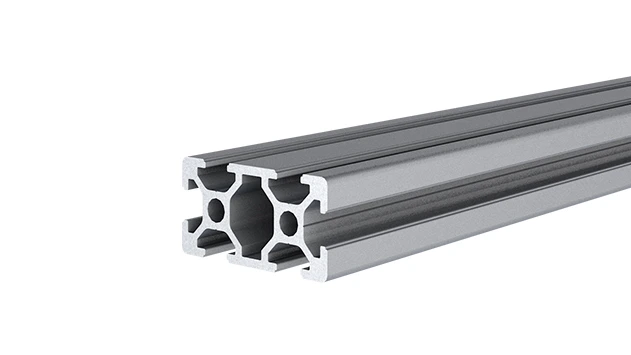
2040 EU Standard Aluminum Profile
2040 is a 2.00 x 4.00CM fractional 20 series square extrusion T-slot profile with four open T-slots, two side with 2.00cm face, the other side with 4.00cm face. The profile has align-a-grooves to assist in aligning connecting profiles.
Walk into any manufacturing facility, warehouse, or workshop, and you'll likely spot the same challenge: rigid, one-size-fits-all equipment that fights against efficiency. A workbench that's too tall for a new team member. A material rack that can't adapt when product sizes change. A production line that requires a complete overhaul just to tweak a single step. For small businesses and large factories alike, these inefficiencies aren't just frustrating—they're expensive. Time wasted rearranging heavy steel frames, money spent on custom modifications, and the constant fear of obsolescence when industry needs shift. But what if there was a building block that could grow, change, and adapt with your business? Enter the 2040 EU Standard Aluminum Profile. This unassuming component is quietly becoming the backbone of cost-effective modular systems, and once you understand its benefits, it's easy to see why.
What Makes 2040 EU Standard Aluminum Profile Special?
Before diving into cost savings, let's clarify what we're talking about. The "2040" in its name refers to its dimensions: 20mm in width and 40mm in height. It's part of the EU standard aluminum extrusion profile family, meaning it's manufactured to strict European specifications for consistency, strength, and compatibility. Unlike generic aluminum pipes, this profile features a T-slot design—longitudinal grooves running along its length—that lets you slide, bolt, or clamp accessories into place without welding or drilling. Think of it as a grown-up version of building blocks, but for industrial use.
What truly sets it apart, though, is its versatility. Pair it with aluminum profile accessories—joints, brackets, casters, or roller tracks—and you can build almost anything: workbenches, material racks, flow racks, turnover trolleys, even simple conveyors. And because it's EU standard, parts from different suppliers fit together seamlessly. No more worrying if a joint from Brand A will work with a profile from Brand B. That compatibility alone eliminates a hidden cost: vendor lock-in.
Cost-Saving Benefit 1: Durability That Outlasts Traditional Materials
Let's start with the upfront investment. At first glance, 2040 aluminum profile might seem pricier than wood or basic steel. A 1-meter length of 2040 EU standard profile costs around $15–$25, compared to $5–$10 for a wooden 2x4 or $8–$12 for a plain steel pipe. But here's the catch: durability. Wood warps with moisture, cracks under heavy weight, and needs replacement every 3–5 years. Steel rusts unless regularly painted or coated, and even then, it's prone to corrosion in humid or industrial environments. The 2040 aluminum profile? It's naturally resistant to rust and corrosion. Its anodized finish (a common EU standard treatment) adds an extra layer of protection, meaning it can last 10–15 years in even harsh conditions—sometimes longer with basic care.
Consider a small workshop using wooden workbenches. They replace each bench every 4 years at $200 apiece. Over 12 years, that's 3 replacements per bench, totaling $600. A 2040 aluminum profile workbench, costing $300 upfront, would still be functional after 12 years—no replacements needed. The math speaks for itself: $600 (wood) vs. $300 (aluminum). And that's just the bench itself; factor in the cost of disposing old wooden benches (landfill fees) or repairing rusted steel (sandblasting, repainting), and aluminum pulls even further ahead.

Cost-Saving Benefit 2: Modularity That Eliminates "Tear and replace" Cycles
The biggest hidden cost in manufacturing setups isn't the initial purchase—it's reconfiguration. Businesses evolve: product lines change, order volumes spike, or new lean system principles demand a more efficient layout. With rigid systems (wooden shelves, welded steel frames), adapting means tearing everything down and starting over. That's expensive. For example, a traditional steel material rack might cost $800 to build, but if you need to add a shelf or adjust its height a year later, you're looking at hiring a welder for $100/hour to modify it—or worse, buying a whole new rack for $800.
2040 aluminum profile eliminates this. Its modular design lets you reconfigure on the fly with aluminum profile accessories. Need to add a shelf to your workbench? Slide in a new bracket and bolt it down—no welding, no special tools. Want to turn that workbench into a mobile trolley? Swap out the fixed feet for caster wheels and caster accessories. Need to extend a flow rack to handle longer products? Add a few more profile sections and roller track connectors. Each of these adjustments costs a fraction of a new system. A set of caster wheels might be $40; a new bracket, $15. Compare that to $800 for a new trolley or $1,200 for a custom steel rack.
| Scenario | Traditional Steel System | 2040 Aluminum Profile System | 5-Year Savings |
|---|---|---|---|
| Initial system cost (workbench + material rack) | $1,500 | $1,800 (higher upfront) | -$300 |
| Reconfiguration 1: Add 2 shelves to rack (Year 2) | $400 (welder + new steel parts) | $60 (2 brackets + shelf boards) | $340 |
| Reconfiguration 2: Convert workbench to mobile trolley (Year 3) | $600 (new trolley + dispose old bench) | $50 (caster wheels + mounting plates) | $550 |
| Reconfiguration 3: Extend rack length by 3ft (Year 4) | $700 (new rack section + installation) | $120 (3 profile sections + connectors) | $580 |
| Total 5-Year Cost | $3,200 | $2,030 | $1,170 |
As the table shows, even with a higher initial investment, the aluminum system saves over $1,000 in just five years—all because you're modifying, not replacing. For businesses that adapt frequently (which, let's face it, is most in today's market), this modularity is a game-changer.
Cost-Saving Benefit 3: Labor Savings That Add Up Fast
Installation and assembly labor is another often-overlooked cost. Traditional steel systems require skilled workers—welders, fabricators—to cut, shape, and join materials. A single steel workbench might take two days to build, costing $800+ in labor ($50/hour for a skilled welder). Wooden systems are faster but still need carpenters to cut, sand, and assemble, adding $300–$500 in labor per project.
2040 aluminum profile? It's designed for "anyone, anywhere" assembly. With basic tools—an Allen wrench, a rubber mallet, maybe a drill—your existing team can build a workbench in under 2 hours. No welding, no specialized training. Let's break it down: A team of two factory workers (paid $25/hour) assembles a 2040 aluminum profile workbench in 3 hours. Labor cost: 2 workers x 3 hours x $25 = $150. Compare that to a steel workbench requiring 16 hours of a welder's time ($50/hour) = $800. The aluminum option saves $650 in labor alone—for one workbench. Multiply that by 10 workbenches, and you're looking at $6,500 in labor savings. That's enough to cover the cost of the profiles and accessories for the entire project.
And it's not just initial assembly. When you reconfigure later, you don't need to call in specialists. Your team can swap out parts themselves, saving on service calls or contractor fees. Over time, this self-sufficiency becomes a huge cost driver—especially for small businesses without dedicated maintenance teams.
Cost-Saving Benefit 4: Low Maintenance and Repair Costs
"Set it and forget it" might sound like a cliché, but it applies perfectly to 2040 aluminum profile. Unlike steel, it doesn't need repainting or rust treatments. Unlike wood, it won't attract pests or rot from spills. The only maintenance required is occasional tightening of bolts (if they loosen from vibration) and wiping down with a damp cloth to remove dust. Even then, you're talking 10 minutes of work per month, max.
When parts do wear out—and let's be real, even the best systems have parts that fail—it's easy and cheap to fix. A worn caster wheel? replace it for $15 instead of buying a new trolley. A cracked joint? Swap it out for $8 instead of welding a new steel bracket. With traditional systems, a single broken part can render the entire system useless. With aluminum profile, parts are modular and replaceable individually. This "replace one, save the rest" approach slashes repair costs dramatically.
Take a warehouse using steel flow racks. A rusted roller track means replacing the entire rack section ($300). With an aluminum profile flow rack, you just replace the roller track and accessories ($40). Over five years, if you have 5 such repairs, that's $1,500 (steel) vs. $200 (aluminum)—a $1,300 savings.
Cost-Saving Benefit 5: Sustainability = Long-Term Financial Gains
Sustainability isn't just good for the planet—it's good for your bottom line. Aluminum is 100% recyclable, and recycling it uses 95% less energy than producing new aluminum. At the end of its life, your 2040 aluminum profile system won't end up in a landfill; you can sell it to a scrapyard for $0.50–$1 per kilogram. That's not a huge sum, but it offsets disposal costs (which can be $50–$100 per ton for steel or wood).
Beyond recycling, aluminum extrusion profile is produced with minimal waste. The extrusion process (shaping aluminum through a die) creates little scrap, and EU standards mandate efficient manufacturing practices, so suppliers often pass those material savings on to buyers. Plus, modular systems reduce overbuying: you only purchase the parts you need now, and add more later. No more stockpiling extra steel or wood "just in case."
Some regions even offer tax incentives or grants for businesses using sustainable materials. While this varies by location, it's an added bonus that can turn "sustainable" into "profitable." For example, a manufacturer in the EU might qualify for a 5% tax credit on equipment made with recycled aluminum—another layer of savings.
Real-World Impact: How a Small Manufacturer Saved $24,000 in 3 Years
Let's put this all together with a real example. Precision Parts Co., a small electronics manufacturer with 30 employees, was struggling with outdated wooden workbenches and steel racks. Their production line was rigid, and reconfiguring for new products took weeks and cost thousands. In 2021, they switched to 2040 EU standard aluminum profile systems, investing $12,000 in profiles, workbenches, material racks, and aluminum profile accessories. Here's how they fared over three years:
- Labor savings: Assembling 10 workbenches in-house instead of hiring welders saved $5,000.
- Reconfiguration savings: Adjusting racks and workbenches for 3 new product lines cost $800 in accessories vs. $9,000 in new steel systems—saving $8,200.
- Maintenance savings: No more replacing warped wooden benches or repainting steel racks—saving $3,800.
- Efficiency gains: Faster setup times reduced production delays, boosting output by 12%—adding $7,000 in annual revenue.
Total savings after three years? $24,000—double their initial investment. "We thought the upfront cost was steep, but it paid for itself in the first year," says their operations manager. "Now, when a customer orders a new product, we reconfigure the line in a day instead of a month. The aluminum profiles didn't just save us money—they made us more competitive."
Why Wait? The Savings Start Now
The 2040 EU standard aluminum profile isn't just a material—it's a strategic investment in your business's flexibility and profitability. Its durability cuts replacement costs, its modularity eliminates "tear and replace" cycles, its ease of assembly slashes labor bills, and its low maintenance keeps long-term expenses in check. Whether you're a small workshop or a large factory, the numbers don't lie: the sooner you switch, the sooner you start saving.
And with EU standard compatibility, you're never locked into one supplier. You can mix and match profiles and aluminum profile accessories from different vendors, ensuring you always get the best price. So why stick with rigid, costly systems that hold your business back? Upgrade to 2040 aluminum profile, and start building a setup that grows with you—without growing your budget.