- Company Articles
- Industry articles
- Industry standards
- Dimensions of 3060 National Standard Profile A: Length, Thickness & Tolerance Guide

Dimensions of 3060 National Standard Profile A: Length, Thickness & Tolerance Guide
Related Product
3060 National Standard Profile A
Workbench, production line, logistic rack, warehouse rack Industry: Manufacturer workshop, Automobile, Electronic, Assembling, logistic
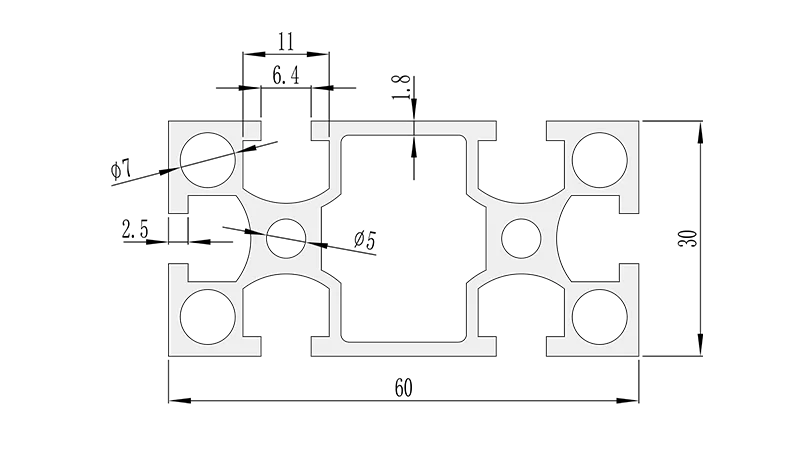
If you've ever walked through a manufacturing plant, a warehouse, or even a modern workshop, you've probably seen them—those sleek, modular metal structures that form workbenches, material racks, and production lines. Chances are, many of those structures are built using aluminum profiles, and among the most versatile and widely used is the 3060 National Standard Profile A. Whether you're setting up a lean system for efficient production or building a custom workstation, understanding the dimensions of this profile is key to ensuring your project is sturdy, precise, and built to last. In this guide, we'll dive deep into the length, thickness, and tolerance specifications of the 3060 National Standard Profile A, breaking down why each detail matters and how it impacts real-world applications.
What Is the 3060 National Standard Profile A, Anyway?
Before we get into the nitty-gritty of dimensions, let's start with the basics. The 3060 National Standard Profile A is a type of aluminum extrusion profile—a product of the aluminum extrusion process, where raw aluminum is pushed through a die to create a specific cross-sectional shape. The "3060" in its name refers to its dimensions: 30 millimeters in width and 60 millimeters in height. The "National Standard" label means it adheres to strict size and quality guidelines set by national regulatory bodies, ensuring consistency across manufacturers. This standardization is a big deal because it means no matter which supplier you buy from, the profile will fit with compatible aluminum profile accessories and other standard components—no guesswork, no mismatched parts.
But why has this particular profile become a staple in industries ranging from automotive to electronics? Its popularity boils down to balance. At 30mm x 60mm, it's compact enough for tight spaces but robust enough to handle moderate loads, making it ideal for everything from lightweight workbenches to mid-duty material racks. Unlike non-standard or custom profiles, which can be expensive and hard to replace, the 3060 National Standard Profile A is widely available, cost-effective, and backed by a ecosystem of accessories—think connectors, end caps, and brackets—that make assembly a breeze. For anyone building a lean system, where efficiency and adaptability are priorities, this profile is a go-to choice.
Length Specifications: How Long Can It Be (and Why Does It Matter)?
Let's start with length—the most straightforward dimension, but one that can make or break your project. The 3060 National Standard Profile A is typically manufactured in standard lengths, but custom cutting is also common. Let's break down the options:
Standard Lengths: The Go-To Options
In most cases, you'll find 3060 National Standard Profile A sold in standard lengths of 4 meters (about 13 feet) or 6 meters (around 20 feet). These lengths are industry favorites because they balance two key factors: transportation and usability. A 6-meter profile, for example, is long enough to build large structures like multi-tier material racks but short enough to fit on standard trucks without requiring special shipping. For smaller projects, 4-meter lengths are easier to handle and cut, reducing waste from excess material.
But why these specific lengths? They're not arbitrary. National standards often align with common manufacturing and logistics practices. For instance, 6 meters is a standard length for many building materials, so suppliers can optimize their extrusion and shipping processes by sticking to this size. This efficiency translates to lower costs for buyers, making the 3060 profile more accessible for small businesses and large factories alike.
Custom Lengths: Tailoring to Your Project
Of course, not every project fits neatly into 4m or 6m sections. Maybe you need a 1.2m piece for a small workstation or a 5.5m length for a custom conveyor frame. Most suppliers offer custom cutting services, allowing you to order profiles cut to your exact specifications. This is a game-changer for minimizing waste—no more buying a 6m profile and throwing away 2m of excess—and for ensuring your structure fits perfectly in tight spaces, like a workshop with limited floor area.
But there's a catch: custom lengths often come with minimum order quantities or additional cutting fees, so it's worth planning your project carefully. If you're building multiple identical structures, ordering a few extra standard lengths and cutting them yourself (with the right tools, of course) might be more cost-effective. On the flip side, for one-off projects or precision-critical builds, paying for custom cutting ensures every piece is exactly the length you need, reducing the risk of errors during assembly.
Measuring Length: Precision from End to End
When we talk about length, we're referring to the distance from one end of the profile to the other, measured along its central axis. But how do manufacturers ensure this measurement is accurate? Most use automated cutting machines with laser or encoder-based length sensors, which can measure and cut with remarkable precision. For standard lengths, the tolerance (the allowable deviation from the target length) is typically ±0.5mm per meter. That means a 6m profile could be as short as 5.997m or as long as 6.003m—negligible for most projects, but crucial for applications where multiple profiles need to align perfectly, like the rails of a conveyor system.
Why does this tolerance matter? Imagine building a material rack B (a common design with 3 rows and 3 floors) using 3060 profiles. If the vertical supports are even 1mm too short, the horizontal shelves might sit unevenly, causing materials to slide or the rack to wobble. Over time, this misalignment could stress the joints and reduce the rack's lifespan. Tight length tolerance ensures all components work together seamlessly, keeping your structure stable and reliable.
Thickness: Wall, Flange, and the Strength Behind the Profile
Length determines how long your profile is, but thickness determines how strong it is. When we talk about the thickness of the 3060 National Standard Profile A, we're referring to two key measurements: wall thickness (the thickness of the aluminum "walls" that form the profile's shape) and flange thickness (the thickness of the flat edges, or flanges, that run along the profile's length). Both play a critical role in the profile's load capacity, rigidity, and overall performance.
Wall Thickness: The Backbone of Strength
The wall thickness of the 3060 National Standard Profile A is one of its most important specifications. Common wall thicknesses for this profile are 1.5mm and 2.0mm, though some suppliers offer thicker options (up to 3.0mm) for heavy-duty applications. So, what's the difference between 1.5mm and 2.0mm? A lot, when it comes to load capacity.
Let's put it in perspective: A 3060 profile with 1.5mm walls is lightweight and ideal for structures that don't need to support heavy loads, like a basic workbench or a small turnover trolley. It's easy to handle and assemble, making it a favorite for DIY projects or temporary setups. On the other hand, a 2.0mm wall thickness adds significant strength without a huge increase in weight. This makes it better suited for permanent structures, like material racks that hold heavy tools or production line frames that need to withstand constant use.
The material grade also affects strength. Most 3060 profiles are made from 6063-T5 aluminum, a heat-treated alloy known for its excellent combination of strength, corrosion resistance, and machinability. This alloy ensures that even a 1.5mm wall can support more weight than you might expect—often up to 50kg per linear meter for static loads. For dynamic loads (like materials sliding on a roller track), the thickness becomes even more important, as thinner walls can flex or bend over time, leading to instability.
Flange Thickness: More Than Just Edges
While wall thickness gets most of the attention, flange thickness is another key detail. The "flanges" are the flat, outer edges of the profile's cross-section. In the 3060 National Standard Profile A, these flanges are typically thicker than the walls—often 2.0mm or more. Why? Because flanges are where most accessories attach. Whether you're using T-slot nuts to mount a shelf or brackets to connect two profiles at a 90° angle, the flange needs to be thick enough to withstand the stress of drilling, cutting, or clamping without deforming.
For example, if you're building a workbench with a wooden top, you'll likely drill holes through the flanges to secure the top. A thin flange might crack or strip the threads, leading to a wobbly workbench. A thicker flange, however, provides more material for screws or bolts to grip, ensuring a secure connection. This is why national standards specify minimum flange thickness—they're not just about consistency; they're about safety and functionality.
Tolerance Standards: Why "Close Enough" Isn't Good Enough
If length and thickness are the "what" of the 3060 profile, tolerance is the "how precise." Tolerance refers to the allowable variation in a dimension—how much a profile can differ from the ideal size and still be considered "within spec." For the 3060 National Standard Profile A, tight tolerances are non-negotiable, and for good reason: when you're building a modular structure, every millimeter counts.
Dimensional Tolerance: Keeping Width and Height in Check
The 3060 profile is supposed to be 30mm wide and 60mm tall, but in reality, no manufacturing process is perfect. National standards define how much variation is acceptable. For example, the width might have a tolerance of ±0.2mm, meaning a "30mm" profile could measure anywhere from 29.8mm to 30.2mm. Similarly, the height might have a tolerance of ±0.3mm. These numbers seem small, but they're critical for compatibility with aluminum profile accessories.
Consider this: If you buy a 30mm-wide profile that's actually 30.3mm, and a connector designed for 30mm profiles, the connector might not fit. Or if it does, it could be too tight, damaging the profile, or too loose, leading to a wobbly joint. In a lean system, where production lines need to run smoothly, a loose joint in a material rack could cause parts to jam, slowing down the entire workflow. Tight dimensional tolerances ensure that every component—profiles, connectors, end caps—works together seamlessly, reducing assembly time and minimizing errors.
Straightness Tolerance: Avoiding the "Bend" in Your Plans
Imagine unboxing a 6m profile only to find it's slightly curved. Not a big deal, right? Wrong. A bent profile can throw off your entire structure. If you're building a conveyor track, even a 1mm bend over 1m can cause products to slide unevenly or get stuck. That's why straightness tolerance is a key specification. National standards typically require the 3060 profile to have a straightness tolerance of ≤1mm per meter, meaning over a 6m length, the total deviation from straight can't exceed 6mm.
How do manufacturers ensure this? During extrusion, the aluminum is cooled and straightened using specialized rollers. After extrusion, profiles are inspected using laser straightness testers to check for bends or twists. If a profile is out of spec, it's either rejected or sent back for rework. This level of precision might seem excessive, but in applications like automated assembly lines, where robots rely on consistent positioning, even a small bend can lead to costly mistakes.
Surface Tolerance: More Than Just Looks
Tolerance isn't just about size and straightness—it also applies to the profile's surface. National standards define acceptable levels of scratches, dents, and color variation. For example, a profile might have a tolerance of "no scratches deeper than 0.1mm" or "uniform color with no visible streaks." While surface defects might seem like a cosmetic issue, they can affect performance. A deep scratch, for instance, could weaken the profile, making it more prone to bending under load. In industries like electronics, where ESD (electrostatic discharge) protection is critical, a damaged surface might also compromise the profile's ability to dissipate static electricity.
Putting It All Together: Real-World Applications
Now that we've covered length, thickness, and tolerance, let's talk about how these specs translate to real projects. The 3060 National Standard Profile A is a workhorse, used in everything from simple workbenches to complex lean systems. Here are a few examples of how its dimensions make it the right choice:
Workbenches: Sturdy, Customizable, and Space-Saving
Workbenches are the backbone of any workshop, and the 3060 profile is ideal for building them. Its 30mm x 60mm cross-section provides a stable base, while its lightweight nature makes it easy to move (if you add casters). For a basic workbench like "Workbench E (Single Deck-Without Caster)," a 1.5mm wall thickness is usually sufficient, as the deck supports tools and parts but not heavy machinery. The standard 4m length can be cut into 1.2m sections for the legs and 1.8m sections for the frame, ensuring the bench fits comfortably in a 2m x 1m space.
Tolerance plays a role here too. If the leg profiles are slightly different in length, the bench might wobble. If the flanges are too thin, attaching the deck could weaken them. By sticking to national standards, you ensure the bench is level, sturdy, and built to last.
Material Racks: Organizing Heavy Loads Safely
Material racks, like "Material Rack B (3 Row and 3 Floor)," need to support multiple layers of parts or tools. For this, a 2.0mm wall thickness is often preferred, as it can handle the weight of stacked materials without bending. The 60mm height provides ample space for attaching shelves, while the 30mm width keeps the rack from being too bulky. Custom lengths allow you to design the rack to fit your specific storage needs—say, 1.5m per shelf to hold standard-sized bins.
Tight straightness tolerance is crucial here. If the vertical supports are bent, the shelves might tilt, causing materials to slide off. And dimensional tolerance ensures that the shelf brackets fit snugly into the T-slots, preventing shelves from sagging over time.
Lean Systems: Efficiency Through Modularity
Lean systems are all about minimizing waste and maximizing efficiency, and the 3060 profile is a cornerstone of this philosophy. Its modular design allows you to quickly reconfigure production lines as needs change. For example, if you need to add a new workstation, you can cut 3060 profiles to length, connect them with standard joints, and have the station up and running in hours, not days. The profile's compatibility with accessories like roller tracks and casters makes it easy to integrate conveyors or mobile trolleys, keeping materials moving smoothly through the production process.
In a lean system, downtime is the enemy. By using 3060 National Standard Profile A, you reduce the risk of assembly errors and part mismatches, ensuring your system stays up and running. And because the profile is widely available, replacing a damaged section is quick and easy—no waiting for custom parts.
Comparison: How 3060 Stacks Up Against Other Profiles
To truly appreciate the 3060 National Standard Profile A, it helps to see how it compares to other common aluminum profiles. Let's take a look at a few popular options:
| Profile Type | Width x Height (mm) | Standard Length (m) | Typical Wall Thickness (mm) | Key Application |
|---|---|---|---|---|
| 2020 National Standard | 20 x 20 | 4, 6 | 1.0–1.5 | Light-duty structures (small shelves, electronics enclosures) |
| 3030 National Standard | 30 x 30 | 4, 6 | 1.5–2.0 | Medium-duty workbenches, small material racks |
| 3060 National Standard Profile A | 30 x 60 | 4, 6 | 1.5–2.0 | Lean systems, medium-to-heavy material racks, conveyor frames |
| 4040 National Standard | 40 x 40 | 4, 6 | 2.0–3.0 | Heavy-duty workbenches, industrial machinery frames |
| 4080 National Standard | 40 x 80 | 4, 6 | 2.5–3.0 | Large conveyor systems, heavy material storage |
As you can see, the 3060 profile fills a sweet spot between smaller profiles like the 3030 and larger ones like the 4040. It offers more vertical space (60mm height) than the 3030, making it better for attaching multiple accessories or supporting deeper shelves, but it's not as bulky as the 4040, which saves space in tight workshops. For most mid-sized projects, the 3060 profile provides the perfect balance of strength, size, and cost.
Tips for Working with 3060 National Standard Profile A
Now that you understand the dimensions, here are a few practical tips to ensure your project goes smoothly:
- Measure Twice, Cut Once: Even with tight tolerances, always measure your profiles before cutting. A small mistake here can throw off your entire structure.
- Use the Right Tools: Aluminum is soft, so use sharp, high-speed steel blades for cutting. For drilling, use lubricant to prevent overheating and ensure clean holes.
- Check Tolerances Before Assembly: If you're ordering from a new supplier, ask for a sample first to verify that the profile's dimensions are within spec. This can save you from costly returns later.
- Don't Overload: Remember the wall thickness! A 1.5mm profile isn't meant to support the same weight as a 2.0mm one. Check load capacity charts provided by your supplier.
- Invest in Quality Accessories: Cheap connectors or brackets can undo the benefits of a high-quality profile. Stick to reputable brands that match national standards.
Final Thoughts: Why Dimensions Matter for Your Project
At the end of the day, the length, thickness, and tolerance of the 3060 National Standard Profile A aren't just numbers on a spec sheet—they're the foundation of a successful project. Whether you're building a simple workbench or a complex lean system, these dimensions determine how strong, precise, and reliable your structure will be. By choosing a national standard profile, you're not just buying aluminum—you're buying consistency, compatibility, and peace of mind.
So the next time you're planning a project, take a moment to consider the 3060 National Standard Profile A. Its balanced dimensions, tight tolerances, and compatibility with aluminum profile accessories make it a versatile choice that can adapt to almost any need. And if you're ever in doubt, remember: when it comes to aluminum profiles, the details matter. Get the dimensions right, and the rest will follow.