- Company Articles
- Industry articles
- Industry standards
- Fabrication Process of 3060 National Standard Profile A: Extrusion to Finishing

Fabrication Process of 3060 National Standard Profile A: Extrusion to Finishing
Related Product
3060 National Standard Profile A
Workbench, production line, logistic rack, warehouse rack Industry: Manufacturer workshop, Automobile, Electronic, Assembling, logistic
Introduction: The Backbone of Modern Manufacturing
Walk into any factory, warehouse, or assembly line today, and you'll likely spot a silent workhorse holding everything together: aluminum extrusion profiles. These unassuming pieces of metal—with their precise T-slots, smooth edges, and modular design—are the unsung heroes of lean manufacturing, material handling, and workspace organization. Among them, the
3060 National Standard Profile A
stands out as a versatile champion, trusted by manufacturers for its balance of strength, flexibility, and compatibility with a wide range of
aluminum profile accessories
. From workbenches that withstand daily tool impacts to material racks that keep production lines flowing, this profile is more than just metal; it's a building block for efficiency. But have you ever wondered how this essential component goes from raw aluminum to a finished product ready to assemble? Let's take a journey through its fabrication process—from the heat of the extrusion press to the final touches of surface treatment—and discover the craftsmanship that makes 3060 Profile A a cornerstone of modern industry.
Step 1: Designing for Purpose—Where Precision Begins
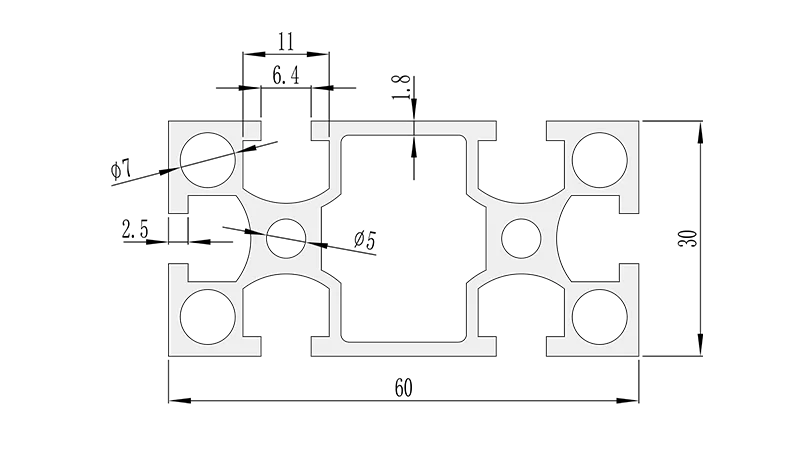
Before a single ounce of aluminum is melted, the journey starts at the drawing board. The 3060 National Standard Profile A isn't just "shaped" randomly; it's engineered with a specific mission. Engineers collaborate closely with manufacturers to define its dimensions (30mm width, 60mm height—hence "3060"), wall thickness, T-slot size, and load-bearing capacity. Using advanced CAD software, they model the profile's cross-section, ensuring the T-slots align perfectly with standard
aluminum profile accessories
like connectors, brackets, and
aluminum profile end caps
.
Why does this matter? Imagine building a bookshelf where the screws don't fit the pre-drilled holes—that's what happens when a profile's design is off. For the 3060 Profile A, precision is non-negotiable. The T-slots, for example, must be wide enough to accommodate bolts and nuts but narrow enough to hold accessories securely. The walls need to be thick enough to support heavy loads (like a fully stocked material rack) but not so thick that they add unnecessary weight. Every curve, slot, and edge is tested virtually for stress resistance, ensuring the profile can handle real-world demands. By the end of this phase, the design isn't just a blueprint—it's a promise of reliability.
Step 2: Raw Material Preparation—From Billet to Beauty
With the design locked in, it's time to source the star of the show: aluminum. Not all aluminum is created equal, though. For the 3060 Profile A, manufacturers typically use 6063 aluminum alloy—a popular choice for extrusions because of its excellent formability and corrosion resistance. This alloy is melted in large furnaces, where impurities are carefully removed to ensure purity. Once molten, the aluminum is cast into cylindrical ingots called "billets," each about 6 meters long and 150mm in diameter—roughly the size of a large tree trunk.
But before these billets can be extruded, they undergo homogenization: a heat treatment process that heats the billet to around 570°C (1058°F) and holds it there for several hours. Why? Think of a loaf of bread with unevenly mixed dough—some parts are dense, others are airy. Homogenization "mixes" the aluminum's internal structure, ensuring uniform grain size and reducing defects during extrusion. After cooling, the billets are cut into shorter lengths (usually 1-2 meters) to fit into the extrusion press, and their surfaces are cleaned to remove oxides—because even a tiny speck of dirt can ruin the final profile's finish. This step is all about setting the stage: giving the aluminum the right properties to transform into the 3060 Profile A we know.
Step 3: Extrusion—The Heart of the Process
If there's one step that defines aluminum extrusion, it's this: the extrusion press. Picture a giant vice that can squeeze metal into any shape—and you're close. Here's how it works: A billet is preheated to around 480°C (896°F)—hot enough to make the aluminum malleable but not molten. It's then loaded into the press, where a hydraulic ram (with force measured in thousands of tons) pushes the billet through a custom die. The die is a steel mold with a cross-section identical to the 3060 Profile A—T-slots, edges, and all. As the billet is forced through the die, it takes on the die's shape, emerging as a long, continuous profile.
This moment is nothing short of remarkable. The aluminum, once a solid cylinder, flows like soft clay, filling every nook and cranny of the die. Operators monitor the process closely, adjusting the press speed and temperature to ensure the profile doesn't crack or warp. For the 3060 Profile A, the die is especially critical. Its T-slots must be sharp and precise, so the profile can later accept
aluminum profile accessories
without wobbling. After extrusion, the hot profile is guided onto a cooling table, where fans or water sprays bring it down to room temperature. What emerges is a rough "log" of the 3060 Profile A—long, straight, and full of potential.
Step 4: Heat Treatment—Strengthening the Profile
Freshly extruded aluminum is strong, but not strong enough for the demands of industrial use. That's where heat treatment comes in. The 3060 Profile A undergoes a three-step process to boost its mechanical properties: solution annealing, quenching, and aging.
First, solution annealing: The profile is reheated to 520°C (968°F) and held there for an hour. This dissolves any hard precipitates in the aluminum's structure, making it more uniform. Next, quenching: The profile is rapidly cooled in water, "trapping" the dissolved elements in the metal's crystal structure and making it supersaturated. At this point, the aluminum is soft—too soft for heavy loads. The final step, aging, fixes that. The profile is heated again, but to a lower temperature (around 170°C/338°F), and held for 8-12 hours. This allows the trapped elements to form tiny, uniform precipitates that strengthen the metal without making it brittle. The result? A profile that can support up to 500kg per meter—more than enough for a fully loaded workbench or a rack stacked with tools. Heat treatment isn't just about strength, though; it also improves the profile's fatigue resistance, ensuring it lasts for years in busy factories.
Step 5: Surface Finishing—Protection Meets Aesthetics
A strong profile is essential, but no one wants to work with a rough, corroded eyesore. That's why surface finishing is a make-or-break step for the 3060 Profile A. Most profiles undergo anodizing—a process that creates a protective oxide layer on the aluminum's surface. Here's how it works: The profile is submerged in an electrolytic bath (usually sulfuric acid) and becomes the anode in an electrical circuit. When current flows, oxygen ions react with the aluminum, forming a hard, porous oxide layer about 5-20 micrometers thick. This layer is then sealed with hot water or a chemical sealant, making it resistant to scratches, corrosion, and UV rays. Anodized profiles come in natural silver, but they can also be dyed black, blue, or gold for a custom look—perfect for brands that want their workspaces to reflect their identity.
Some manufacturers opt for powder coating instead, where dry powder is electrostatically applied to the profile and cured in an oven, forming a durable, glossy finish. Whichever method is used, the goal is the same: to protect the profile from the wear and tear of factory life, from oil spills to constant handling. And let's not forget the little details, like adding
aluminum profile rubber strip
to the edges. These soft, flexible strips snap into the T-slots or along the profile's edges, preventing scratches on tools, reducing noise when accessories are attached, and even protecting workers from sharp edges. It's these small touches that turn a functional profile into a user-friendly one.
Step 6: Cutting and Precision Machining—Ready for Assembly
After finishing, the 3060 Profile A is still a long log—usually 6 meters or more. To be useful, it needs to be cut into specific lengths for assembly. This is where precision machining takes center stage. Manufacturers use high-speed saws with diamond-tipped blades to cut the profile to exact measurements—whether it's 1.2 meters for a workbench leg or 2.5 meters for a material rack beam. The saws are computer-controlled, ensuring cuts are straight to within 0.1mm—critical for proper alignment when assembling with accessories.
For some applications, the profile may need additional machining, like drilling holes for custom brackets or tapping threads for bolts. CNC machines handle these tasks with pinpoint accuracy, ensuring every modification is consistent across batches. After cutting, the ends of the profile are deburred—smoothing any rough edges left by the saw. This isn't just for safety; it also ensures that
aluminum profile end caps
fit snugly. These small, often-overlooked accessories snap onto the profile's ends, preventing dust, debris, or small parts from getting stuck in the T-slots and giving the finished assembly a clean, professional look. By the end of this step, the profile is no longer a raw material—it's a component ready to be part of something bigger.
Step 7: Accessories Integration—The Power of Modularity
What makes the 3060 National Standard Profile A truly special is its compatibility with
aluminum profile accessories
. Without these, the profile is just a piece of metal; with them, it becomes a building block for endless configurations. Let's take a closer look at some key accessories and how they work with the profile:
| Accessory Type | Function | How It Works with 3060 Profile A |
|---|---|---|
| Aluminum Profile End Cap | Covers exposed ends to prevent debris buildup and enhance safety. | Snaps into the profile's ends, held in place by friction; available in plastic or aluminum to match the profile's finish. |
| 90° Aluminum Profile Connector | Joins two profiles at a right angle (e.g., workbench legs to the tabletop). | Slides into the T-slots of both profiles; secured with bolts and nuts for a rigid connection. |
| Aluminum Profile Rubber Strip | Reduces noise, prevents scratches, and protects edges. | Presses into the T-slot or along the profile's edge; flexible material conforms to the profile's shape. |
| 3-Way Aluminum Connector | Connects three profiles in different directions (e.g., corner supports for a shelf). | Features multiple T-slot interfaces; allows profiles to meet at 90° or 135° angles with minimal play. |
| Adjustable Foot Base | Levels the profile on uneven floors, preventing wobbling. | Threads into a T-slot nut inside the profile; the base can be rotated to raise or lower the profile as needed. |
The beauty of these accessories is their simplicity. Unlike welding or drilling, which require specialized skills, assembling with 3060 Profile A and its accessories is as easy as sliding a connector into a T-slot and tightening a bolt. This modularity is why manufacturers love it: if a production line needs to be reconfigured, the profile can be disassembled and reused, reducing waste and saving time. It's lean manufacturing in action.
Step 8: Quality Control—Ensuring Perfection, Every Time
Even with all these steps, no process is perfect. That's why quality control (QC) is the final gatekeeper before the 3060 Profile A reaches customers. Every batch undergoes rigorous testing to ensure it meets national standards. First, dimensional checks: calipers and gauges measure the profile's width, height, wall thickness, and T-slot dimensions to ensure they're within 0.1mm of the design specs. A profile that's too narrow won't fit accessories; one that's too wide will be weak.
Next, mechanical testing: samples are pulled until they break to check tensile strength, and hardness tests (like the Brinell test) ensure the heat treatment worked. Surface quality is inspected under bright lights to spot scratches, dents, or uneven anodizing. Even the
aluminum profile end caps
are tested—engineers try to pull them off to ensure they're secure, and check that the
aluminum profile rubber strip
doesn't peel or crack under flexing.
Perhaps most importantly, the profile is assembled into a simple structure (like a small shelf) to test its real-world performance. If it wobbles, creaks, or fails under load, the batch is rejected. QC isn't just about catching defects; it's about building trust. When a manufacturer orders 3060 Profile A, they know they're getting a product that's been tested, retested, and proven ready for the demands of their facility.
Applications: From Factory Floors to Workspaces
Now that we've followed the 3060 Profile A from billet to finished product, let's see where it shines in the real world. In electronics factories, it's used to build ESD workstations, where its anodized surface and ESD-compliant accessories protect sensitive components from static damage. In automotive plants, it forms material racks that hold heavy parts like engines and transmissions, thanks to its high load capacity. Warehouses rely on it for conveyor systems, where its T-slots easily attach to roller tracks and guides. And in workshops, it's the backbone of custom workbenches—fitted with tool holders, shelves, and even LED lights, all secured with
aluminum profile accessories
.
One of the most inspiring things about this profile is its adaptability. A small startup might use it to build a simple assembly table on a tight budget, while a Fortune 500 company could integrate it into a fully automated production line. No matter the scale, the 3060 Profile A delivers consistency, reliability, and the freedom to innovate. It's not just a product; it's a partner in progress.
Conclusion: Craftsmanship in Every Millimeter
The next time you walk past a factory workbench or a neatly organized material rack, take a moment to look closer. Chances are, you're seeing the result of thousands of steps: precise design, careful material selection, intense heat, and meticulous finishing. The
3060 National Standard Profile A
is more than just a piece of aluminum—it's a testament to the craftsmanship and innovation that drive modern manufacturing. From its extrusion under tons of pressure to its final assembly with
aluminum profile accessories
like end caps and rubber strips, every detail is engineered to make work easier, safer, and more efficient.
In a world that demands speed and flexibility, this profile stands as a reminder that great things are built one step at a time. So whether you're a manufacturer looking to optimize your production line or a hobbyist building a garage workspace, remember: the 3060 Profile A isn't just a part. It's a promise—of strength, versatility, and endless possibility.