- Company Articles
- Industry articles
- Industry standards
- Flexible Production Lines: 2040 National Standard Profile's Role in Rapid Reconfiguration

Flexible Production Lines: 2040 National Standard Profile's Role in Rapid Reconfiguration
Related Product
2040 National Standard Profile
45° external bending joint, used for 45° external connection of two aluminum pipes.
In today's manufacturing landscape, where consumer demands shift overnight and product lifecycles shrink faster than ever, the phrase "adapt or perish" isn't just a cliché—it's a daily reality. Picture this: a small electronics factory that spent six weeks reconfiguring its production line last year to accommodate a new smartphone model, only to lose market share because a competitor launched a similar device two weeks earlier. Or a automotive parts supplier that had to scrap an entire welded steel workstation because a client suddenly changed their component specs. These scenarios aren't outliers; they're the norm for manufacturers stuck with rigid, inflexible setups.
The solution? Flexible production lines that can pivot quickly, without draining time, money, or resources. And at the center of this flexibility revolution is a component that's quietly becoming the backbone of modern workshops: the 2040 National Standard Profile. This unassuming aluminum extrusion might not grab headlines, but ask any plant manager who's made the switch, and they'll tell you—it's a game-changer. Let's dive into why, and how this profile, paired with the right aluminum profile accessories, is redefining what "lean system" really means on the factory floor.
The Problem with "Set It and Forget It" Production Lines
For decades, manufacturing relied on heavy, fixed infrastructure. Welded steel frames, bolted-down conveyor belts, and custom-built workbenches were the norm. They were durable, sure—but that durability came at a cost: rigidity. When a production line needed to change—whether to accommodate a new product, scale up output, or even just rearrange workflow for better efficiency—managers faced a nightmare. Reconfiguration meant hiring welders, ordering custom parts, and halting production for weeks. The math was simple: more downtime = lost revenue, missed deadlines, and frustrated teams.
Take workbenches, for example. A traditional wooden or steel workbench is built to last, but try adjusting its height for a taller operator, adding a shelf for new tools, or repositioning it to align with a new material flow path. It's not just difficult—it's often impossible without starting from scratch. The same goes for material handling systems like roller tracks. Fixed steel roller tracks might move parts efficiently, but if your new product is three inches wider, suddenly those tracks are obsolete.
Then there's the human element. Rigid setups force operators into one-size-fits-all workflows, leading to ergonomic issues, fatigue, and even errors. When employees can't adjust their workspace to fit their needs, productivity suffers. And in an era where skilled labor is scarce, keeping teams happy and efficient isn't just a nice-to-have—it's critical.
Enter the 2040 National Standard Profile: Small Size, Big Impact
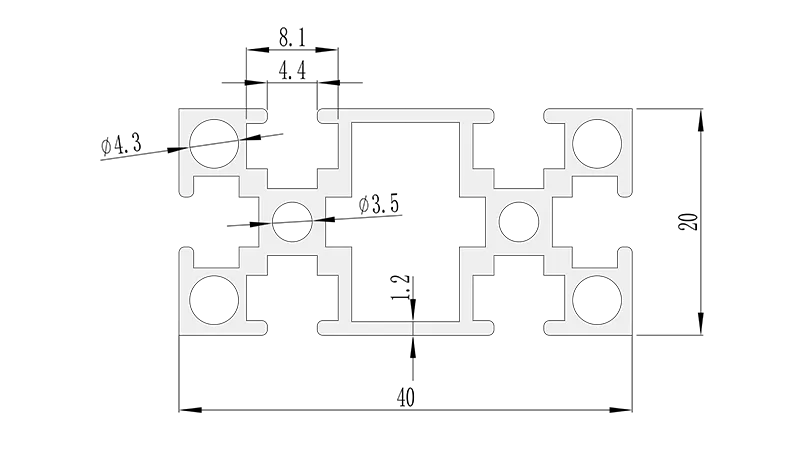
So, what makes the 2040 National Standard Profile different? Let's start with the basics. This aluminum extrusion measures 20mm in width and 40mm in height—compact enough to fit into tight spaces but sturdy enough to support heavy loads. Its defining feature? The T-slot design running along its length, which acts like a built-in "connection hub" for accessories. Unlike traditional steel, which requires welding or drilling, the 2040 profile lets you attach, detach, and reattach components in minutes using simple fasteners and aluminum profile accessories.
Think of it as the manufacturing equivalent of building blocks for adults. Need a taller shelf? Slide a bracket into the T-slot and tighten a screw. Want to angle a roller track for better part flow? Swap out a 90° aluminum profile connector for a 45° one. The profile itself is lightweight—aluminum weighs roughly a third of steel—so even large structures like workbenches or material racks can be moved by a small team, no forklift needed. But don't let the weight fool you: aluminum's inherent strength, combined with the profile's engineered shape, means it can handle the daily grind of factory work, from heavy tool storage to constant part movement on roller tracks.
Another unsung benefit? Corrosion resistance. Unlike steel, aluminum doesn't rust, making the 2040 profile ideal for environments where moisture or chemicals are present—think food processing, pharmaceutical manufacturing, or even outdoor assembly areas. And because it's recyclable, it aligns with the growing push for sustainable manufacturing practices. No more scrapping entire steel structures; old profiles can be melted down and repurposed, cutting down on waste.
Aluminum Profile Accessories: The "Flexibility Multipliers"
A 2040 profile alone is just a piece of metal. What turns it into a flexible production powerhouse is the ecosystem of aluminum profile accessories designed to work with it. These aren't your average nuts and bolts—they're precision-engineered components that turn "maybe" into "absolutely." Let's break down a few game-changers:
Connectors: The backbone of reconfiguration. 90° aluminum profile connectors let you join profiles at right angles for sturdy frames, while 45° connectors add angled support for sloped roller tracks or ergonomic workbench edges. Even 135° connectors exist for corner joints that need extra strength. Best of all, they're tool-free (or require just a hex key), so swapping them out takes minutes, not hours.
End Caps & Rubber Strips: Small details, big impact. T-slot rubber seal covers slide into the profile's slots to protect wires, prevent dust buildup, and even reduce noise—critical in busy workshops. End caps, like the 2020 aluminum profile end cap (a close cousin to the 2040's design), give finished structures a clean look and prevent sharp edges, keeping operators safe.
Workbench Add-Ons: From shelf brackets to tool hooks, these accessories transform bare profiles into fully functional workstations. Need an ESD (electrostatic discharge) surface for electronics assembly? Attach an ESD-compatible tabletop using profile brackets. Want to add a lamp or monitor arm? Slide a mounting bracket into the T-slot and secure it—no drilling required.
Roller Track Components: For material flow, roller track placon mounts are indispensable. These brackets attach directly to 2040 profiles, letting you mount roller tracks at any height or angle. Whether you need a gravity-fed track for small parts or a motorized conveyor for heavier items, the mounts ensure a secure, stable connection that can be repositioned in minutes if your workflow changes.
The beauty of these accessories is their universality. A connector that works with a 2040 profile today will work with the same profile next year, even if you're building something completely different. This standardization cuts down on inventory costs—no more stockpiling custom parts—and makes training teams a breeze. New operators can learn to assemble or reconfigure structures in hours, not days.
2040 Profile + Lean System: A Match Made in Manufacturing Heaven
Lean manufacturing has been around for decades, but its core principles—eliminating waste, continuous improvement, and maximizing value—are more relevant than ever. The problem? Traditional lean initiatives often stall because the physical infrastructure can't keep up with the "continuous improvement" part. You can map a perfect value stream on paper, but if your production line takes a month to adjust, that "improvement" becomes a bottleneck.
This is where the 2040 National Standard Profile shines. It's not just a tool for building—it's a tool for evolving . Let's take a common lean goal: reducing changeover time. With a 2040-based line, reconfiguring a workstation to switch from Product A to Product B might take two hours instead of two weeks. How? Because you're not rebuilding—you're rearranging. Swap out a roller track section, adjust the workbench height, and reposition tool holders using aluminum profile accessories. The line is back up and running before the old setup would have even been disassembled.
Another lean principle: 5S (Sort, Set in Order, Shine, Standardize, Sustain). A messy, disorganized workspace is a waste of time and energy. 2040 profiles, paired with custom shelves, bins, and tool holders, make "Set in Order" a breeze. Every tool has a designated spot, every part has a home, and because the setup is flexible, it's easy to adjust as needs change. No more "that's where we've always put it"—now, it's "that's where it works best today."
Even "Sustain" becomes easier. When employees can tweak their workstations themselves—without waiting for maintenance or outside contractors—they take ownership. A operator who notices a better way to arrange their roller track can make that change in 15 minutes, then share the improvement with the team. This bottom-up innovation is the heart of lean, and the 2040 profile makes it possible.
Real-World Impact: From Workbench to Roller Track
Let's ground this in a real example. Consider a mid-sized automotive parts manufacturer we'll call "AutoFlex." A year ago, AutoFlex's production line for brake components was typical: welded steel workbenches, fixed roller tracks, and custom-built material racks. When a major client requested a new brake caliper design with a 10% larger housing, the team faced a dilemma: spend $50,000 and six weeks reconfiguring the line, or risk losing the client. They chose a third option: switching to 2040 National Standard Profiles.
First, they replaced their steel workbenches with 2040-based stations. Using adjustable height legs and aluminum honeycomb panels for the work surface, they could now adjust each bench to fit operators of different heights—reducing ergonomic complaints by 30% in the first month. Then, they swapped out fixed roller tracks for 2040-mounted roller tracks with placon mounts. When the new caliper design arrived, the team repositioned the tracks by loosening a few bolts, adding 45° connectors to angle the flow, and adjusting the height—all in two days. Total cost? $12,000, and zero production downtime (they reconfigured during a weekend shift).
But the benefits didn't stop there. A few months later, when demand spiked, AutoFlex needed to add a second shift. Instead of building new workstations, they disassembled unused material racks (built with 2040 profiles, of course) and repurposed the parts to create three new workbenches. The total time? One day. The client was so impressed by AutoFlex's agility that they increased their order by 20%.
This isn't an isolated case. From electronics assembly to food packaging, manufacturers are reporting similar results: 50-70% reductions in reconfiguration time, 30-40% lower costs for adjustments, and happier, more productive teams. And it all starts with that simple aluminum extrusion: the 2040 National Standard Profile.
Traditional vs. 2040-Based Production Lines: A Side-by-Side Comparison
| Aspect | Traditional Fixed Setup | 2040 National Standard Profile Setup |
|---|---|---|
| Reconfiguration Time | 4-6 weeks (requires welding, custom parts) | 1-3 days (tool-free with aluminum profile accessories) |
| Cost to Reconfigure | $20,000-$50,000+ (new materials, labor) | $2,000-$8,000 (reusable profiles/accessories) |
| Flexibility | Low (fixed dimensions, hard to modify) | High (adjust heights, angles, layouts on-demand) |
| Ergonomics | Limited (one-size-fits-all workbenches) | High (adjustable heights, custom tool placement) |
| Sustainability | Low (steel structures often scrapped) | High (aluminum recyclable, parts reusable) |
| Operator Engagement | Low (no ownership over workspace) | High (employees can tweak setups independently) |
The Future of Flexible Manufacturing
As manufacturing continues to evolve—with trends like mass customization, Industry 4.0, and reshoring gaining steam—the demand for flexibility will only grow. The 2040 National Standard Profile isn't just keeping up; it's leading the charge. Imagine a factory where production lines adjust automatically based on real-time data from IoT sensors, with 2040 profiles and smart aluminum profile accessories that reposition themselves at the push of a button. Or where small-batch production runs are just as cost-effective as mass production, thanks to lines that reconfigure in hours.
Even now, innovators are pushing the envelope. Some manufacturers are combining 2040 profiles with 3D-printed custom accessories for hyper-specific needs. Others are integrating them with collaborative robots (cobots), using the T-slots to mount robot arms at optimal heights. The possibilities are endless—and it all starts with a simple, versatile profile.
For plant managers and manufacturers still on the fence, the question isn't "Can we afford to switch?" It's "Can we afford not to?" In a world where the next disruption is always around the corner, flexibility isn't a luxury. It's the foundation of survival. And with the 2040 National Standard Profile, paired with the right aluminum profile accessories, that flexibility is finally within reach—no welding degree required.
So, the next time you walk through a factory, take a closer look at the workbenches, the roller tracks, the material racks. Chances are, if they're light, modular, and look like they could be rearranged in a afternoon, you're looking at the future of manufacturing. And at the heart of it all? That unassuming 2040 National Standard Profile—quietly, steadily, changing the game.