- Company Articles
- Industry articles
- Industry standards
- Flexible Workstations: 2020 National Standard Profile Modularity Advantages

Flexible Workstations: 2020 National Standard Profile Modularity Advantages
Related Product
2020 National Standard Profile
45° external bending joint, used for 45° external connection of two aluminum pipes.
Walk into any modern manufacturing facility, warehouse, or assembly line, and you'll notice a common thread: the need to adapt. Production schedules shift, product designs evolve, and customer demands fluctuate—often overnight. For operations managers, this constant state of change can feel like a never-ending puzzle. The workstations that worked perfectly for last quarter's orders might be too rigid for today's needs, and replacing them outright would drain budgets and disrupt workflows. This is where modular workstations, built around components like the 2020 National Standard Profile, step in as a practical, forward-thinking solution. More than just a set of metal rails and brackets, these systems are designed to grow, change, and evolve with your business—turning the challenge of adaptability into a competitive advantage.
What Is the 2020 National Standard Profile, Anyway?
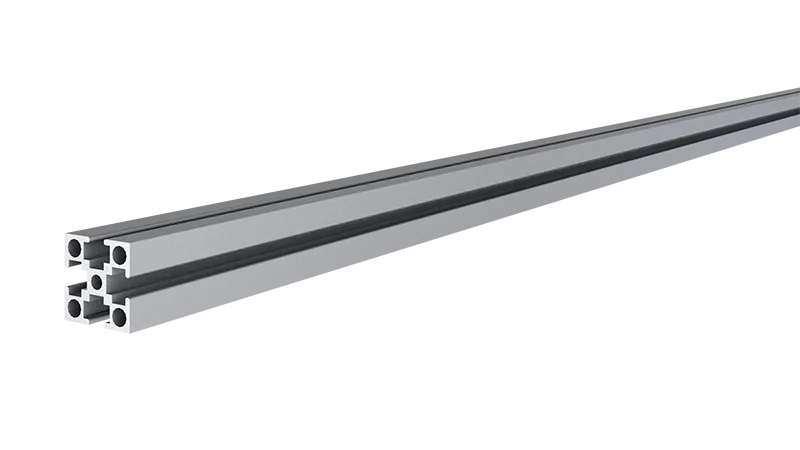
Before diving into its modularity advantages, let's clarify what the 2020 National Standard Profile actually is. At its core, it's a standardized aluminum extrusion with a cross-section measuring 20mm by 20mm—compact enough to fit into tight spaces but sturdy enough to support daily operational demands. What sets it apart is its T-slot design: long, continuous grooves running along its length that allow for easy attachment of accessories like brackets, shelves, and panels. Think of it as a building block for workstations, but with the flexibility of a set of Legos for adults.
This profile isn't just a random piece of metal, though. The "national standard" label ensures consistency in dimensions, material quality, and compatibility across manufacturers. That means if you buy 2020 profile rails from one supplier and aluminum profile accessories from another, they'll fit together seamlessly. No more guessing if a bracket will align with a slot or if a joint will secure properly—standardization takes the guesswork out of the equation.
Modularity: The Heart of the 2020 Profile Advantage
Modularity, in this context, refers to the ability to break down a workstation into individual components that can be rearranged, added to, or repurposed as needed. It's the opposite of the "one-and-done" approach of traditional workstations. With the 2020 National Standard Profile, modularity isn't an afterthought—it's baked into the design from the start.
1. Adaptable Design: From Workbench to Material Rack (and Back Again)
Consider a basic workstation setup: a simple workbench with a flat surface, built using 2020 profile rails and a plywood top. Today, it's used for assembling small electronics. But next month, your team needs a material rack to store incoming components. Instead of buying a new rack, you can disassemble the workbench, reconfigure the 2020 rails into vertical supports, and add shelves using aluminum profile accessories like angle brackets and shelf pins. In an hour, that workbench becomes a 3-tier material rack. A few weeks later, when the electronics assembly line is back, you can revert it—no tools beyond an Allen wrench required.
This adaptability extends to more complex setups, too. Need to add a roller track to a workstation to slide components from one station to the next? The T-slots on the 2020 profile make it easy to mount roller track brackets directly to the rails. Want to raise the height of a workbench to accommodate standing workers? Swap out the short support legs for longer ones—no welding, no cutting, just unscrewing and reattaching.
2. Cost-Efficiency: Invest Once, Reuse Forever
Let's talk numbers. A traditional welded steel workstation might cost $500 upfront. If your production needs change in six months, you'll either have to pay a welder $200 to modify it (if possible) or buy a new one for another $500. Over three years, that could add up to thousands in replacement costs. With a modular workstation built from 2020 National Standard Profile, the initial investment might be slightly higher—say $600—but the ability to reuse components means you'll rarely need to buy new parts. That material rack you built from the old workbench? It cost $0 in new materials. Need a taller shelf? Just buy a few extra 2020 rails and brackets for $50 instead of a whole new rack.
Maintenance costs drop, too. If a traditional workstation's wooden top gets damaged, you might have to replace the entire bench. With a modular setup, you can swap out just the top panel for $30. Aluminum profile accessories like end caps or corner brackets are cheap and widely available, so a broken part doesn't mean a dead workstation—just a quick trip to the parts bin.
3. Scalability: Grow Without Starting Over
Small businesses and startups know this pain: you start with a single workstation, then hire two more employees and need two more benches. Six months later, you land a big client and need to expand the assembly line by five stations. Traditional workstations force you to buy each new unit separately, and they rarely match perfectly—different heights, slightly varying widths, creating a disjointed workflow. With the 2020 profile, scalability is simple. Buy extra rails and accessories as you grow, and each new workstation will match the existing ones exactly. Need to connect them into a full production line? Use aluminum profile connectors to link the 2020 rails together, creating a seamless, uniform setup.
This scalability isn't just about adding more workstations, either. It's about expanding existing ones. A basic workbench can grow into a multi-tiered station with tool holders, monitor mounts, and even integrated lighting—all by adding components to the existing 2020 frame.
4. Ergonomic Flexibility: Workstations That Fit Your Team
Ergonomics—designing workspaces to fit the people using them—isn't just a buzzword. Poor ergonomics leads to worker fatigue, reduced productivity, and even injuries. Traditional workstations often come in "standard" heights that don't account for the fact that workers come in all shapes and sizes. The 2020 National Standard Profile changes that. Since the rails are modular, you can adjust the height of a workbench in minutes by swapping out leg components. Need a standing desk for a taller employee? Add longer rails. Prefer a seated setup for precision work? Shorten the legs. You can even create hybrid workstations with adjustable sections, allowing workers to switch between sitting and standing throughout the day.

Real-World Impact: A Case Study
From Rigid to Responsive: How a Small Electronics Firm Cut Costs by 40%
Take the example of GreenTech Electronics, a family-owned manufacturer of solar panel components with 15 employees. Three years ago, their production floor was filled with traditional workstations: wooden benches with fixed shelves, welded steel material racks, and a handful of second-hand conveyor belts that rarely aligned with their needs. When a new client ordered a custom solar inverter, they needed to reconfigure their line to accommodate larger circuit boards. The process took two weeks—they had to hire a welder to modify the racks, buy new workbenches, and dispose of the old ones. The total cost? Over $8,000.
Today, GreenTech has replaced all their traditional setups with 2020 National Standard Profile workstations. When a similar client order came in last quarter, they reconfigured their existing workstations in a single day. They disassembled two material racks, used the 2020 rails to build longer workbench surfaces, and added roller track to connect the stations for smoother material flow. Total cost? $300 for extra brackets and a few new rails. "We used to dread order changes," says Maria, GreenTech's operations manager. "Now, we see them as just another puzzle to solve with our modular setup. It's saved us time, money, and a lot of stress."
Traditional vs. Modular: A Side-by-Side Comparison
| Feature | Traditional Workstations | 2020 National Standard Profile Workstations |
|---|---|---|
| Setup Time | 2–4 hours per workstation (requires tools/welding) | 30–60 minutes per workstation (Allen wrench only) |
| Customization | Limited; requires cutting/welding to modify | Unlimited; reconfigure components in minutes |
| Cost Over 3 Years | High (replacement/modification costs add up) | 40–50% lower (reuse components, minimal new parts) |
| Scalability | Difficult; new workstations rarely match existing ones | Easy; add components to grow incrementally |
| Ergonomics | Fixed height/design; one-size-fits-all | Adjustable height/layout; fits diverse worker needs |
| Waste | High (old workstations end up in landfills) | Low (components repurposed or recycled) |
Why the 2020 Profile Stands Out Among Modular Options
There are other modular profiles on the market, of course—3030, 4040, and even larger sizes. So why choose the 2020 National Standard Profile? Its strength lies in its balance of size and versatility. At 20x20mm, it's compact enough to build lightweight, mobile workstations (like rolling carts for material transport) but strong enough to support up to 50kg per linear meter when properly braced. For small to medium-duty applications—electronics assembly, packaging, light manufacturing—it's the sweet spot between overkill and underperformance.
Another key advantage is the sheer availability of aluminum profile accessories. From basic corner brackets to specialized components like roller track guides and caster mounts, there's an accessory for nearly every need. Need to add a shelf? Use a T-slot nut and bolt to attach a bracket. Want to mount a monitor? Slide a panel bracket into the T-slot and tighten. The ecosystem of accessories means you're never limited by what you can imagine—you can build it.
Integrating with Lean Systems: More Than Just a Workstation
For businesses focused on lean manufacturing—reducing waste, improving efficiency, and streamlining workflows—the 2020 National Standard Profile is more than just a workstation component; it's a lean system enabler. Lean principles like 5S (Sort, Set in Order, Shine, Standardize, Sustain) thrive on organization and visual management, both of which are easier to achieve with modular setups. For example, a 2020 profile material rack can be labeled and color-coded to separate tools from raw materials, making it easier for workers to find what they need. Roller track, integrated into the workstation, ensures materials flow smoothly from one step to the next, reducing bottlenecks and unnecessary movement.
Continuous improvement, another lean pillar, is also simplified with modular workstations. If a team identifies a better way to arrange their workbench, they can test the new layout the same day. No waiting for approvals or contractors—just grab some brackets and start rearranging. Over time, these small adjustments add up to big gains in efficiency.
The Future of Workstations: Why Modularity Matters
As manufacturing and warehousing continue to evolve—with shorter product lifecycles, custom orders, and the rise of small-batch production—the need for flexible workspaces will only grow. Traditional workstations, with their inflexibility and high costs, are ill-equipped to keep up. The 2020 National Standard Profile, with its modular design, standardized components, and focus on adaptability, offers a future-proof solution. It's not just about building workstations; it's about building a workspace that can grow, change, and thrive alongside your business.
At the end of the day, the true advantage of the 2020 National Standard Profile isn't the metal itself—it's the freedom it provides. Freedom to adapt to new orders, freedom to scale without breaking the bank, and freedom to design a workspace that works for your team, not against them. In a world where change is the only constant, that freedom is invaluable.