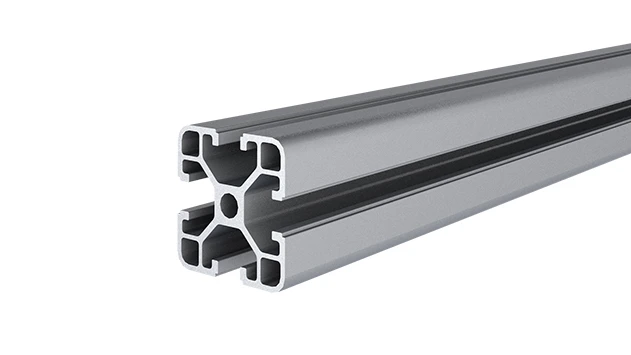
Enough theory—let's talk real-world applications. Walk into a factory that's embraced the 4040B EU Standard Aluminum Profile, and you'll see it everywhere. It's not just a "one trick pony"; it's the Swiss Army knife of factory design. Here are a few ways it's making an impact:
1. Workbenches That Adapt as Fast as Your Workflow
Workbenches are the heart of any production line. They're where assembly happens, where tools live, where workers spend most of their shifts. Traditional workbenches are static: a flat top, some drawers, maybe a shelf. If a worker needs a monitor arm, or a tool holder, or a bin for scraps, they're out of luck unless they drill a hole or zip-tie it on. The 4040B changes that.
Take the "Workbench E (single deck-without caster)" as an example. Built with 4040B profiles, it starts as a simple frame, but its T-slots let you add accessories on the fly: a keyboard tray that slides out, a LED light bar overhead, a pegboard for tools, or even a small conveyor track to feed parts directly onto the deck. When the production line switches to a new product, you don't need a new workbench—just reposition the accessories. One electronics manufacturer we worked with reported cutting setup time for new product lines by 40% after switching to these modular workbenches. "It used to take a day to reconfigure a bench," their production manager told us. "Now, two workers can do it in an hour."
2. Roller Tracks That Keep Materials Flowing (Without the Headaches)
Material flow is the lifeblood of manufacturing. When parts get stuck in transit, when a conveyor jams, or when a rack is too far from the assembly line, everything slows down. That's why roller tracks—those systems of wheels that let bins and pallets glide smoothly from one station to another—are so critical. And the 4040B profile is making them smarter, more flexible, and easier to maintain.
Traditional roller tracks are often fixed in place, bolted to the floor or walls. If you need to reroute the flow (say, to reduce bottlenecks at a popular workstation), you're looking at a construction project. With 4040B profiles, though, roller tracks become modular. You can mount them on a frame built from 4040B, adjust the height, angle, or length in minutes, and even add curves or switches using specialized connectors. One automotive parts plant we visited used 4040B-based roller tracks to create a "U-shaped" assembly line that reduced walking time for workers by 25%. When they needed to expand production, they simply added more track sections—no concrete cutting, no welding, no downtime.
And let's not forget the accessories. Plastic roller track guide rails (in yellow or grey, depending on the application) snap into the T-slots of the 4040B profile, keeping bins aligned as they roll. Swivel roller balls (1 inch, 0.5 inch—take your pick) can be embedded into workbench tops, turning a flat surface into a mini-conveyor for small parts. It's these small, modular touches that add up to big efficiency gains.
3. Lean Systems That Actually Live Up to the Hype
Lean manufacturing has been around for decades, but it's often easier said than done. The idea—eliminate waste, optimize flow, empower workers—sounds great on paper. But in practice, rigid tools and fixed layouts make it hard to implement. The 4040B profile solves that by making lean principles tangible.
Take "5S" (Sort, Set in Order, Shine, Standardize, Sustain), a cornerstone of lean. To "Set in Order," you need tools and materials to be exactly where workers need them, when they need them. With 4040B-based material racks (like "Material Rack B (3 row and 3 floor)"), you can adjust shelf heights to fit different bin sizes, add dividers to separate parts, or even mount labels directly into the T-slots. No more searching for tools in overcrowded shelves; everything has a place, and the rack itself can be reorganized whenever the workflow changes.
Or consider "kaizen" (continuous improvement). Workers on the floor often have the best ideas for how to make processes better, but they're rarely given the tools to act on them. With 4040B profiles, that changes. A team might suggest adding a small shelf to a workbench to reduce reaching, or angling a roller track to cut down on bending. Instead of waiting for management approval and a maintenance crew, they can grab a few profiles, some joints, and build the solution themselves. It's empowerment in action—and it's why factories using 4040B profiles report 30% more employee-driven improvement ideas than those stuck with traditional setups.