- Company Articles
- Industry articles
- Industry News
- Future of Manufacturing: Innovations in Aluminum Workbench C Design

Future of Manufacturing: Innovations in Aluminum Workbench C Design
Related Product
Aluminum Workbench C
aluminum-tube-workbench-is-more-flexible-and-durable,-compared-with-traditional-pe/abs-coated-steel-tube.-it-is-easy-to-assemble,-anti-corrosion,-rust-protection,-and-recycle-use-after-disassemble.
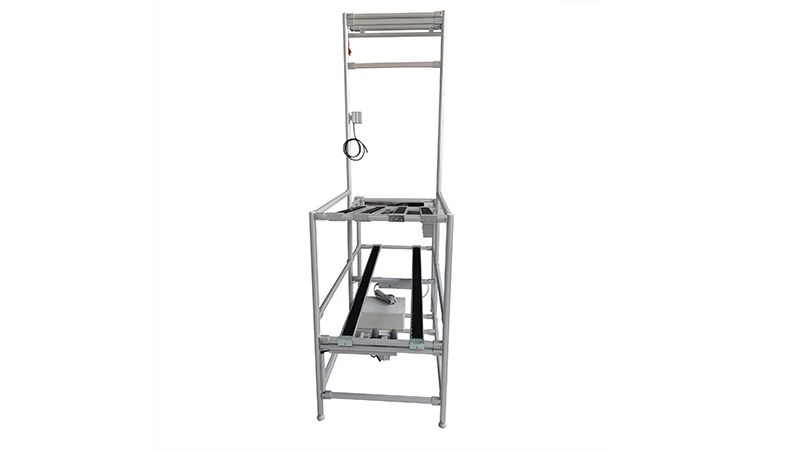
Walk into any modern factory, and you'll notice a quiet revolution happening at the heart of production lines: the workbench. For decades, these humble stations have been the unsung heroes of manufacturing—where components are assembled, quality is checked, and ideas take tangible form. But as manufacturing evolves, driven by demands for speed, flexibility, and sustainability, the workbench is no longer just a table with a surface. It's a dynamic, adaptive tool that shapes how work gets done. Enter Aluminum Workbench C—a design that's redefining what a workbench can be, and in turn, reshaping the future of manufacturing.
Gone are the days of clunky, one-size-fits-all steel workbenches bolted to the floor, or rickety wooden tables that warp under heavy tools. Today's manufacturers need workbenches that keep up with rapid product cycles, support lean principles, and prioritize the well-being of workers. Aluminum Workbench C isn't just a step forward; it's a leap into a future where every element of the production line is optimized for efficiency, adaptability, and human-centric design. Let's dive into the innovations that make this workbench a game-changer.
1. The Material Revolution: Why Aluminum Extrusion Profile Leads the Way
At the core of Aluminum Workbench C's innovation is its material: aluminum extrusion profile. To understand why this matters, let's take a quick trip back to manufacturing's material history. Early workbenches were often wood—affordable but prone to wear, moisture damage, and limited weight capacity. Then came steel, which offered strength but at a cost: weight. A standard steel workbench could weigh 300 pounds or more, making reconfiguration a Herculean task requiring forklifts and extra labor. When production lines needed to pivot (say, from assembling smartphones to tablets), moving or modifying these behemoths ate into valuable time and resources.
Aluminum extrusion profile changes the equation. Here's how it works: heated aluminum billets are forced through a die, shaping them into precise, consistent cross-sections—think of it like squeezing playdough through a cookie cutter, but with metal. The result? Lightweight yet incredibly strong beams that form the skeleton of Aluminum Workbench C. This process isn't new, but recent advancements in extrusion technology have made these profiles more durable, versatile, and cost-effective than ever.
The benefits of aluminum extrusion profile for workbenches are hard to overstate. First, weight: Aluminum is about one-third the density of steel, so even a fully loaded Aluminum Workbench C weighs half as much as its steel counterpart. This means two workers can reposition it in minutes, no forklift needed. Second, strength: Modern aluminum alloys, reinforced through extrusion, can handle heavy loads—up to 500 pounds on a single shelf—without bending or warping. Third, corrosion resistance: Unlike steel, aluminum naturally forms a protective oxide layer, so it holds up in humid factories or environments with oils and chemicals, reducing maintenance costs.
But perhaps the biggest advantage is precision. Aluminum extrusion profiles are manufactured to tight tolerances—often within 0.1mm—ensuring that every component of the workbench fits together seamlessly. This precision is key for modularity, which we'll explore next. For now, suffice it to say: the shift to aluminum extrusion profile isn't just about swapping one material for another. It's about unlocking a new level of design flexibility that old materials couldn't support.
2. Modularity and Customization: Aluminum Profile Accessories as the Building Blocks
If aluminum extrusion profile is the skeleton of Aluminum Workbench C, then aluminum profile accessories are the joints, muscles, and nerves that bring it to life. Traditional workbenches were static by design: a fixed surface, maybe a shelf or two, and that was it. If a team needed a tool rail, extra storage, or a taller bench for a new task, they'd either have to buy a whole new bench or hire a welder to modify the old one—both expensive and time-consuming.
Aluminum Workbench C flips this script with a modular design powered by aluminum profile accessories. These small, specialized components—think connectors, brackets, end caps, and tool holders—turn the workbench into a customizable system that adapts to changing needs. Let's break down how this works in practice.
Imagine a electronics manufacturer that produces both smartwatches and fitness trackers. Smartwatch assembly requires tiny components and precise tools, so the team needs a low-profile workbench with integrated magnifying lamps and anti-static mats. Fitness trackers, on the other hand, have larger batteries and require more storage for parts bins. With Aluminum Workbench C, the same base frame can be reconfigured in hours using aluminum profile accessories. Swap out the flat surface for a tilting one, add a vertical tool rail with hooks, and attach stackable bins using bracket connectors—no welding, no drilling, no hassle.
The secret lies in the T-slot design of the aluminum extrusion profiles. These slots run along the length of the profiles, allowing accessories to be slid into place and secured with bolts or clips. Need to add a monitor arm for digital work instructions? Slide a bracket into the T-slot, tighten a screw, and it's ready. Want to lower the work surface by 6 inches for a shorter worker? Adjust the telescopic legs (another accessory) and lock them in place. This level of customization isn't just convenient—it's transformative for production lines that need to pivot quickly.
Aluminum profile accessories also future-proof the workbench. As new tools or processes are introduced, manufacturers don't need to replace the entire bench—just add or swap accessories. A 2023 survey by the Manufacturing Technology Insights found that companies using modular workbenches reported 35% faster reconfiguration times compared to static models, and 28% lower costs for adapting to new products. That's a competitive edge in an industry where time-to-market can make or break a product.
| Feature | Traditional Steel Workbench | Aluminum Workbench C (with Aluminum Profile Accessories) |
|---|---|---|
| Weight (empty) | 250–350 lbs | 80–120 lbs |
| Reconfiguration Time | 4–6 hours (requires tools/welders) | 30–60 minutes (tool-free with accessories) |
| Customization Options | Limited (fixed shelves, surface) | Unlimited (tool rails, bins, lighting, adjustable height) |
| Maintenance Costs | High (rust, warping, repainting) | Low (corrosion-resistant, replaceable accessories) |

3. Lean System Integration: Making Every Square Inch Count
In the world of manufacturing, "lean" isn't just a buzzword—it's a philosophy centered on eliminating waste, streamlining workflows, and maximizing value. From Toyota's original 5S methodology (Sort, Set in Order, Shine, Standardize, Sustain) to modern continuous improvement practices, lean systems rely on tools and environments that support efficiency. Aluminum Workbench C isn't just compatible with lean principles; it's designed to embody them.
Let's start with "Set in Order"—one of the 5S pillars, which emphasizes organizing tools and materials so they're easy to find and use. Traditional workbenches often became cluttered because there was no dedicated space for tools: screwdrivers rolled off the edge, bins piled up, and cables tangled into a mess. Aluminum Workbench C addresses this with aluminum profile accessories like tool hooks, magnetic strips, and modular bin holders that attach directly to the profile. Everything has a place, and workers spend less time searching and more time producing.
Then there's waste reduction. In lean terms, "waste" includes overproduction, waiting, and unnecessary movement. Aluminum Workbench C minimizes movement waste by allowing teams to design the workbench around the task, not the other way around. For example, in an assembly line where workers rotate between stations, the bench can be configured with adjustable heights and tool placement to match each worker's reach, reducing stretching and bending. In a study by the Lean Enterprise Institute, a automotive parts manufacturer reported a 15% reduction in "walk time" (time spent moving around the bench) after switching to Aluminum Workbench C, translating to 2 extra units assembled per worker per shift.
Another lean principle is "flow"—ensuring that materials and information move smoothly through the production process. Aluminum Workbench C supports flow with integrated features like roller tracks (yes, those are aluminum profile accessories too!) that let parts glide from one station to the next, reducing the need for manual carrying. Or, for smaller components, swivel roller balls embedded in the work surface allow workers to slide assemblies without lifting, cutting down on fatigue and errors.
Perhaps most importantly, Aluminum Workbench C adapts to "pull" systems, where production is driven by customer demand rather than forecasts. In a pull system, production lines need to scale up or down quickly, and workbenches that can't keep up become bottlenecks. With its lightweight frame and modular accessories, Aluminum Workbench C can be added to a line in hours when demand spikes, or reconfigured into a smaller setup when demand dips. This agility is why lean consultants often cite modular workbenches as a "low-hanging fruit" for factories looking to implement lean systems.

4. Ergonomics: Putting People at the Center of Production
For too long, manufacturing workbenches were designed with machines in mind, not the people operating them. The result? Fatigue, repetitive strain injuries, and high turnover—all of which hurt productivity and morale. Aluminum Workbench C flips this paradigm by prioritizing ergonomics, recognizing that a comfortable worker is a more productive, engaged worker.
Ergonomics starts with adjustability, and Aluminum Workbench C delivers in spades. Thanks to its aluminum extrusion profile legs, which can be fitted with telescopic or crank-adjustable mechanisms (another aluminum profile accessory), the work surface height can be tweaked from 28 inches (for seated work) to 42 inches (for standing work) in seconds. This is a game-changer for teams with workers of different heights, or for tasks that require both sitting and standing (like quality inspection, where standing might help with visibility, but sitting reduces fatigue during long checks).
But adjustability goes beyond height. The work surface itself can be tilted—using hinge accessories—to reduce glare from overhead lights or to angle parts for easier assembly. Edge lips prevent tools from rolling off, while anti-fatigue mats (secured to the base via profile clips) cushion feet during long standing shifts. Even cable management is ergonomic: Aluminum profile accessories like cable trays and clips keep wires organized and off the floor, reducing trip hazards and keeping the workspace clean.
The impact of these features is measurable. The Occupational Safety and Health Administration (OSHA) estimates that ergonomic interventions reduce musculoskeletal disorders (MSDs) by 25–50% in manufacturing settings. For Aluminum Workbench C users, this translates to fewer sick days, lower workers' compensation claims, and higher job satisfaction. A 2024 case study from a medical device manufacturer found that after rolling out Aluminum Workbench C, reports of wrist and back pain dropped by 40%, and employee retention in assembly roles improved by 22%—a critical metric in today's tight labor market.
Ergonomics also ties back to lean systems: a worker who isn't fatigued is more focused, makes fewer mistakes, and contributes to a culture of quality. It's a win-win: better for people, better for production.

5. Sustainability: Building for a Greener Tomorrow
Sustainability isn't just a trend in manufacturing—it's a business imperative. Consumers, regulators, and investors are demanding greener practices, and factories are under pressure to reduce their carbon footprints. Aluminum Workbench C aligns with this shift, offering environmental benefits that traditional workbenches can't match.
Aluminum is one of the most sustainable metals on the planet, and that starts with its recyclability. Unlike plastic or wood, aluminum can be recycled infinitely without losing quality. In fact, recycling aluminum uses just 5% of the energy required to produce new aluminum from bauxite ore. For manufacturers aiming for circular economy goals, this is a huge advantage: at the end of its lifespan, Aluminum Workbench C can be disassembled, its profiles melted down, and turned into new profiles or other aluminum products—no waste, no landfill.
The extrusion process itself is also more eco-friendly than other manufacturing methods. Extrusion uses less energy than casting or forging, and modern extrusion plants often run on renewable energy. Additionally, aluminum extrusion profiles are produced with minimal material waste—scrap from the extrusion process is recycled on-site, further reducing environmental impact.
Then there's longevity. Aluminum Workbench C is built to last. Its corrosion resistance means it won't rust or degrade, even in harsh factory conditions, so it stays in service for 10–15 years—twice as long as a typical steel workbench. Fewer replacements mean less demand for raw materials and fewer emissions from manufacturing new benches. When accessories wear out (say, a roller track gets damaged), they can be swapped out individually, rather than replacing the entire bench—another win for waste reduction.
For manufacturers chasing LEED certification or carbon neutrality goals, these benefits add up. A 2023 report by the Aluminum Association found that companies using aluminum workbenches reduced their "furniture and fixtures" carbon footprint by 30% compared to those using steel or wood. And as more governments implement carbon taxes or green incentives, Aluminum Workbench C isn't just a sustainable choice—it's a smart financial one.
6. The Road Ahead: What's Next for Aluminum Workbench C?
Aluminum Workbench C is already transforming manufacturing, but the innovation doesn't stop here. As technology advances, we can expect even more exciting developments in its design and functionality. Here are a few trends to watch:
Smart Workbenches: IoT Integration
Imagine a workbench that "knows" when it's running low on tools, or alerts maintenance when a roller track is jamming. That's the future of smart manufacturing, and Aluminum Workbench C is primed for integration with IoT (Internet of Things) sensors. Tiny, low-power sensors—attached via aluminum profile accessories—can monitor everything from tool usage (to prevent loss) to vibration (to detect loose connections). Data from these sensors can be fed into factory management systems, enabling predictive maintenance and real-time workflow optimization.
AI-Driven Customization
Designing a workbench today still requires human input: a production manager decides on the layout, selects accessories, and configures the bench. Tomorrow, AI could take the guesswork out. By analyzing production data (task types, worker heights, tool usage), AI algorithms could recommend optimal bench configurations, even generating 3D models that workers can tweak before assembly. This would make customization faster and more precise, ensuring every workbench is tailored to its specific role.
Biodegradable and Recycled Accessories
While aluminum extrusion profiles are already sustainable, manufacturers are exploring even greener options for accessories. Companies like GreenLine Manufacturing are developing biodegradable plastic brackets and recycled aluminum connectors, further reducing the workbench's environmental impact. These innovations could make Aluminum Workbench C a zero-waste product by 2030.
Cobot Collaboration
Collaborative robots (cobots) are becoming common on factory floors, working alongside humans to handle repetitive or heavy tasks. Aluminum Workbench C is being designed to integrate seamlessly with cobots: profile accessories like mounting plates and cable management systems allow cobots to be attached directly to the bench, creating a unified human-robot workspace. This collaboration could boost productivity by 40% or more, as cobots handle lifting while humans focus on precision assembly.
Conclusion: Workbenches Reimagined—The Future is Already Here
Aluminum Workbench C isn't just a tool. It's a symbol of how manufacturing is evolving—prioritizing flexibility, sustainability, and people. By combining the strength and precision of aluminum extrusion profile with the adaptability of aluminum profile accessories, it's solving old problems (static workbenches, wasted time, worker fatigue) while opening new doors (lean integration, smart manufacturing, circular economy practices).
For manufacturers, the message is clear: the future of production isn't just about big machines or high-tech software. It's about rethinking the fundamentals—the tools we use every day. Aluminum Workbench C proves that even the most basic elements of a factory can drive innovation. As one production supervisor I spoke with put it: "We used to think of workbenches as 'just furniture.' Now? They're the backbone of our lean system, our sustainability goals, and our team's success. Aluminum Workbench C didn't just change our benches—it changed how we work."
So, as we look to the future of manufacturing, let's not overlook the workbench. Because in the end, it's not just where products are made—it's where the future is built.