- Company Articles
- Industry articles
- Industry standards
- Future Trends: 3060 National Standard Profile A in Smart Manufacturing Systems

Future Trends: 3060 National Standard Profile A in Smart Manufacturing Systems
Related Product
3060 National Standard Profile A
Workbench, production line, logistic rack, warehouse rack Industry: Manufacturer workshop, Automobile, Electronic, Assembling, logistic
Introduction: The Changing Face of Manufacturing
Walk into any modern factory today, and you'll notice a stark difference from the rigid, one-size-fits-all production lines of the past. Smart manufacturing isn't just about robots and software—it's about building systems that can adapt as quickly as market demands change. At the heart of this transformation is flexible infrastructure: the physical backbone that supports everything from assembly workbenches to material transport. And if there's one component quietly revolutionizing this backbone, it's the 3060 National Standard Profile A . This unassuming aluminum extrusion profile is more than just a piece of metal; it's the building block of factories that can pivot, grow, and innovate without skipping a beat.
What Exactly Is 3060 National Standard Profile A?
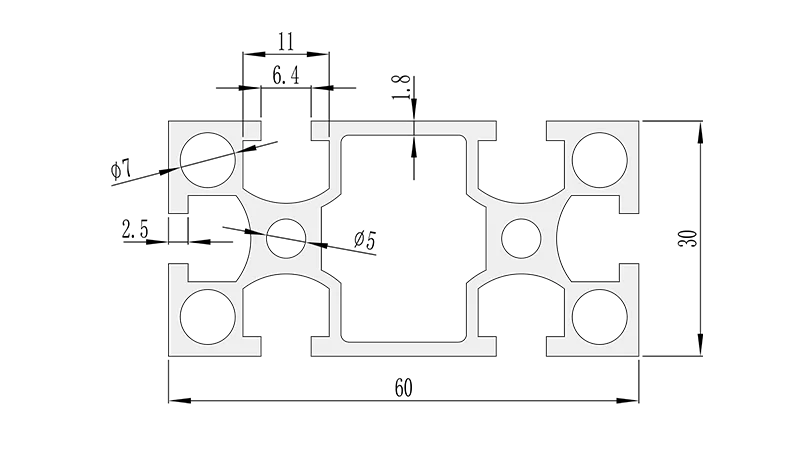
Let's start with the basics. The 3060 National Standard Profile A is a type of aluminum extrusion profile —meaning it's shaped by forcing heated aluminum through a precision mold, resulting in a consistent, high-strength structure. The "3060" refers to its dimensions: 30mm in width and 60mm in height, a sweet spot that balances load-bearing capacity with versatility. Unlike generic aluminum pipes, this profile follows national standards, ensuring compatibility with a wide range of aluminum profile accessories —think connectors, brackets, and end caps—from any reputable supplier.
What makes it stand out? Look closely, and you'll notice its T-slot design—longitudinal grooves running along its length. These slots act like built-in attachment points, letting you snap on components without welding or drilling. Imagine building with a set of high-tech Legos, but for factories. A maintenance manager once told me, "With 3060 profiles, reconfiguring a workbench takes 20 minutes instead of 2 days. No more waiting for the welding crew." That's the flexibility we're talking about.
Why Smart Factories Are Falling for It: Key Advantages
Smart manufacturing thrives on adaptability, and 3060 profiles deliver that in spades. Let's break down the perks:
- Lightweight but Tough: Aluminum is 30% lighter than steel, making installation and reconfiguration a one-person job. Yet, thanks to the extrusion process, 3060 profiles can handle heavy loads—up to 500kg per meter in some setups. A automotive parts plant I visited replaced steel workbenches with 3060-based ones; their material handlers reported 40% less fatigue during daily tasks.
- Zero Downtime Reconfigurations: Traditional setups require cutting, welding, or drilling—all of which halt production. With T-slots and aluminum profile accessories like quick-connect joints, you can disassemble a material rack in the morning and reassemble it as a conveyor guide by afternoon. One electronics manufacturer used this to shift from producing smartphones to tablets in 48 hours during a supply chain crunch.
- Built for the Long Haul: Aluminum resists corrosion, so even in humid or dusty factory environments, 3060 profiles won't rust. Unlike wood, they don't warp or splinter, and unlike generic steel, they won't require repainting every year. A food packaging plant has been using the same 3060-based flow racks for 8 years—still looking as good as new.
- Sustainability Cred: Aluminum is 100% recyclable, and recycling it uses 95% less energy than producing new aluminum. For factories aiming for net-zero goals, this is a no-brainer. Plus, modular designs mean less waste—you can repurpose components instead of scrapping entire setups when needs change.
From Workbenches to Warehouses: Real-World Applications
3060 profiles aren't just a one-trick pony. They're showing up everywhere in smart factories:
Workbenches & Assembly Stations
The workbench is the factory worker's desk, and 3060 profiles make it smarter. Add a shelf here, a tool holder there, or even integrate ESD (anti-static) panels for electronics assembly—all without modifying the core structure. A medical device manufacturer I spoke with uses 3060-based workbenches with adjustable heights, reducing ergonomic injuries by 25% in six months.
Material Racks & Flow Systems
Ever walked through a factory and seen chaotic piles of parts? 3060 profiles fix that with organized material rack B (3 row and 3 floor) setups. Pair them with roller track accessories, and you've got gravity-fed flow racks that move materials smoothly to the assembly line. A beverage bottling plant replaced their old wooden racks with 3060-based systems; now, stock checks take 30 minutes instead of 2 hours, and they've cut down on misplaced inventory by 60%.
Conveyors & Automated Guiding
Even conveyor systems are getting a 3060 upgrade. Use aluminum guide rail A or plastic roller track guide rail yellow accessories to create custom paths for products. One automotive plant used 3060 profiles to build a temporary conveyor around a broken machine, keeping production running until repairs were done. "We saved $100k in downtime," their operations manager told me.
How Does It Stack Up? A Comparative Look
Still not convinced? Let's see how 3060 National Standard Profile A compares to traditional factory infrastructure materials:
| Feature | 3060 National Standard Profile A | Traditional Steel | Wooden Racks/Workbenches | Non-Standard Aluminum Profiles |
|---|---|---|---|---|
| Weight (per meter) | 1.8kg | 5.2kg | 3.5kg (varies) | 2.1kg (unstandardized) |
| Assembly Time (simple rack) | 30 minutes | 4 hours (welding required) | 2 hours (screws, glue) | 1.5 hours (incompatible parts) |
| Reconfigurability | Full (no tools needed) | Limited (requires cutting/welding) | Low (prone to damage when disassembled) | Partial (depends on supplier parts) |
| Lifespan (industrial use) | ||||
| Sustainability |
Lean Systems Love It: More Than Just a Profile, It's a Philosophy
Smart manufacturing and lean system principles go hand in hand—eliminating waste, optimizing flow, and continuous improvement. 3060 profiles aren't just tools; they're enablers of lean thinking. Here's how:
Take "waste reduction," a cornerstone of lean. Traditional setups often lead to overproduction (making more than needed) or excess inventory (storing unused parts). With 3060 profiles, you can build turnover trolley and rack systems that adjust to real-time demand. A clothing manufacturer used this to reduce their warehouse footprint by 30%—they no longer needed extra space for "just in case" storage.
Then there's "respect for people." Clunky, heavy equipment leads to workplace injuries. 3060's lightweight design reduces strain, while adjustable workbenches let employees customize their stations. A furniture factory reported a 50% drop in back injuries after switching to 3060-based workstations—proof that flexible infrastructure isn't just good for production, it's good for people.
What's Next? The Future of 3060 Profiles in Smart Factories
The story doesn't end here. As smart manufacturing evolves, 3060 National Standard Profile A is poised to play an even bigger role:
IoT and Smart Integration
Imagine sensors embedded in the T-slots, tracking equipment usage or monitoring inventory levels in real time. Some lean profile supplier are already testing "smart joints" with built-in RFID tags, letting factories track which components are used where. It's not science fiction—this tech could be mainstream in 3-5 years.
Hyper-Modular Factories
Factories of the future might reconfigure daily based on orders. 3060 profiles, paired with AI-driven layout planning, could enable "plug-and-play" production lines. A contract manufacturer I work with is experimenting with this—they can switch from making laptop parts to drone components overnight, all thanks to modular 3060 setups.
Sustainability 2.0
With stricter (environmental regulations), factories will demand greener materials. 3060 profiles, made from recycled aluminum, are already ahead. Some suppliers now offer "closed-loop" programs—taking back old profiles to recycle into new ones. It's circular manufacturing at its best.
Overcoming the Hurdles: Cost, Adoption, and Support
Let's be real: switching to 3060 profiles isn't without challenges. The upfront cost is higher than wood or generic steel. But think long-term: a 3060 workbench might cost 2x more initially, but it lasts 5x longer and saves on reconfiguration costs. One plant calculated their ROI at just 8 months.
Another barrier? Finding the right lean profile supplier . Not all suppliers carry the full range of aluminum profile accessories , which can limit flexibility. Look for suppliers with national standard certifications and a track record in industrial applications. Ask for case studies—any reputable supplier will have stories of how their profiles transformed other factories.
Wrapping Up: The Backbone of Tomorrow's Factories
Smart manufacturing isn't about robots or software alone—it's about building factories that can think, adapt, and grow. 3060 National Standard Profile A isn't just a material; it's a mindset shift. It's about ditching rigid, one-time setups for infrastructure that evolves with your business.
Whether you're running a small workshop or a sprawling production plant, the message is clear: flexibility wins. And in the world of flexible manufacturing, 3060 profiles are leading the charge. As one factory manager put it, "We don't just build products here—we build systems that build the future." With 3060 National Standard Profile A, that future looks more adaptable, sustainable, and human-centered than ever.