- Company Articles
- Industry articles
- Industry standards
- Future Trends in 4040D EU Standard Aluminum Profiles: Innovations in Extrusion Technology

Future Trends in 4040D EU Standard Aluminum Profiles: Innovations in Extrusion Technology
Related Product
4040D EU Standard Aluminum Profile
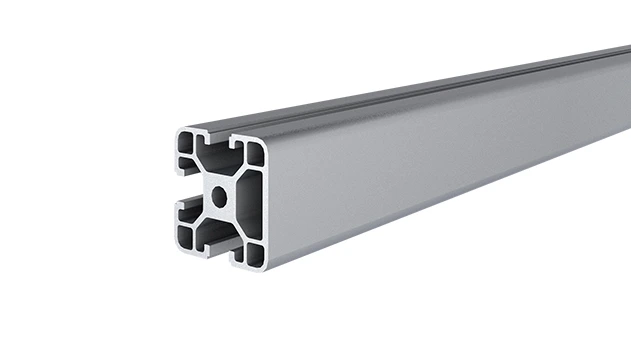
4040D is a 4.00x4.00 CM fractional 40 series square extrusion T-slot profile with two side open T-slots, two side with closed face, each side with 4.00cm face. The profile has align-a-grooves to assist in aligning connecting profiles.
Walk into any modern factory, warehouse, or tech facility, and you'll likely spot them: sleek, silver structures holding up workbenches, guiding conveyor belts, or forming the backbone of assembly lines. These are aluminum profiles—the unsung heroes of industrial design. Among them, the 4040D EU standard aluminum profile stands out as a reliable workhorse, trusted for its strength, versatility, and compliance with strict European quality norms. But in an era of rapid technological change, even the most dependable components must evolve. Today, we're diving into the future of 4040D profiles, exploring how innovations in extrusion technology, materials, and design are reshaping their role in manufacturing, logistics, and beyond.
From automotive plants streamlining production to electronics manufacturers chasing precision, the demand for smarter, more efficient aluminum solutions is growing. The 4040D profile, with its 40x40mm cross-section and standardized T-slot design, has long been a favorite for building modular systems. But as industries embrace leaner operations, sustainability goals, and customization, extrusion technology is stepping up to deliver profiles that are lighter, stronger, more adaptable, and kinder to the planet. Let's unpack the trends driving this evolution.
1. The Extrusion Revolution: From Batch Production to Precision Engineering
Extrusion—the process of pushing heated aluminum billets through a die to create uniform profiles—has been around for over a century. But the way we extrude 4040D profiles today bears little resemblance to the methods of even a decade ago. Traditional extrusion was often a trade-off: speed sacrificed precision, or strength came with excess weight. Modern technology, however, is erasing those compromises.
One of the most impactful shifts is the rise of precision extrusion , enabled by computer numerical control (CNC) systems and advanced die design. Today's extrusion presses can maintain tolerances as tight as ±0.1mm for 4040D profiles, critical for industries like aerospace and medical device manufacturing where even minor deviations can compromise performance. This precision also reduces post-extrusion machining, cutting down on waste and production time.
Another game-changer is isothermal extrusion , a technique that keeps the aluminum billet at a consistent temperature throughout the process. Unlike traditional hot extrusion, where temperature fluctuations can cause uneven material flow, isothermal extrusion ensures the 4040D profile has uniform grain structure—boosting strength and durability. For manufacturers using 4040D in heavy-load applications, like material racks or workbenches, this means profiles that can withstand repeated use without warping or weakening.
Comparing Extrusion Techniques for 4040D Profiles
| Extrusion Technique | Temperature Control | Precision (Tolerance) | Material Waste | Best For |
|---|---|---|---|---|
| Traditional Hot Extrusion | Variable (±10°C) | ±0.3mm | Higher (5-8%) | Low-cost, high-volume basic profiles |
| Isothermal Extrusion | Consistent (±1°C) | ±0.1mm | Lower (2-3%) | High-precision 4040D profiles for aerospace/electronics |
| Continuous Extrusion | Stable via friction heating | ±0.2mm | Lowest (1-2%) | Long-length 4040D profiles for conveyor systems |
Continuous extrusion is also gaining traction for 4040D production. Unlike batch extrusion, which requires stopping to reload billets, continuous extrusion feeds aluminum wire into a rotating die, producing profiles non-stop. This not only increases output by up to 30% but also minimizes "butt ends"—the scrap generated when billets are switched out. For suppliers, this translates to lower costs; for customers, it means more consistent quality across longer profile lengths, ideal for large-scale projects like automated warehouses.
2. Material Science: Stronger, Lighter, Greener Alloys
The 4040D profile's performance starts with its material: aluminum alloys. Historically, 6000-series alloys (like 6063) have been the go-to for extrusion, prized for their balance of strength, formability, and corrosion resistance. But as industries demand more from their profiles—think electric vehicle (EV) factories needing lighter structures or marine applications requiring enhanced rust protection—alloy innovation is accelerating.
One emerging trend is the development of high-strength, low-weight alloys tailored for 4040D profiles. By tweaking the mix of magnesium, silicon, and copper, metallurgists are creating alloys that offer 15-20% higher tensile strength than traditional 6063, while remaining lightweight. This is a boon for lean systems, where reducing the weight of workbenches, trolleys, and racks makes them easier to reconfigure—key for adapting to changing production needs. Imagine a 4040D-based assembly line that can be rearranged by a single worker, instead of a team, thanks to lighter yet stronger profiles.
Sustainability is another driver. The EU's strict environmental regulations are pushing manufacturers to use more recycled aluminum. Modern 4040D profiles now often contain 70-80% recycled content, without sacrificing quality. Recycled aluminum requires just 5% of the energy needed to produce primary aluminum, cutting carbon footprints dramatically. Some suppliers are even experimenting with "green extrusion"—powering presses with renewable energy and capturing waste heat to further reduce emissions. For companies aiming for net-zero, choosing 4040D profiles with high recycled content is becoming a no-brainer.
Corrosion resistance is also getting a upgrade. New surface treatments, like anodizing with eco-friendly electrolytes or ceramic coatings, are extending the lifespan of 4040D profiles in harsh environments. A food processing plant using 4040D workbenches, for example, can now rely on profiles that withstand daily washdowns with corrosive sanitizers, reducing replacement costs over time.

3. Design for Adaptability: Modularity and Integration with Aluminum Profile Accessories
The 4040D profile's T-slot design—those linear grooves running along its length—has always made it modular. But future designs are taking modularity to new heights, focusing on seamless integration with aluminum profile accessories and even smart technologies.
Today's accessories are more sophisticated than ever. Think quick-connect joints that snap into T-slots without tools, allowing workers to assemble a 4040D workbench in minutes instead of hours. Or adjustable end caps with built-in cable management, turning a basic profile into a hub for power tools and sensors. Suppliers are also developing "plug-and-play" accessories: LED light strips that clip into T-slots for workbench illumination, or RFID tags embedded in connectors to track inventory in warehouses. These innovations make 4040D profiles not just structural components, but part of connected, intelligent systems.
Customization is another focus. While standardization is key to the 4040D's EU appeal, industries increasingly need profiles tailored to unique needs. Advanced extrusion dies, designed using 3D printing, allow for custom T-slot configurations, (special-shaped) edges, or integrated channels for wiring. A robotics company, for instance, might order 4040D profiles with extra-deep T-slots to accommodate larger fasteners for mounting heavy robotic arms. This level of customization, once cost-prohibitive for small batches, is now feasible thanks to digital die design and short-run extrusion capabilities.
Ergonomics is also shaping design. Modern 4040D workbenches, for example, are being built with adjustable heights and curved edges to reduce worker fatigue. Some profiles even feature textured surfaces or color-coded slots to guide assembly—red slots for power cables, blue for data lines—minimizing errors on the factory floor. These small design tweaks, enabled by precise extrusion, make a big difference in day-to-day usability.
4. Powering Lean Systems: 4040D Profiles as the Backbone of Efficient Manufacturing
Lean manufacturing—eliminating waste, streamlining processes, and maximizing value—has become a mantra across industries. And 4040D profiles are emerging as a cornerstone of lean systems. Their modularity, strength, and adaptability make them ideal for building the flexible, responsive infrastructure lean demands.
Take material flow, for example. In a traditional factory, moving parts from one station to another might involve fixed conveyor belts or manual lifting—both prone to bottlenecks. A 4040D-based flow rack, however, can be customized with roller tracks and adjustable shelves, letting materials glide smoothly to workers exactly when needed. Since 4040D profiles are easy to reconfigure, the rack can be modified in hours if production lines change—no need for expensive new equipment. This agility is why automotive giants like Volkswagen and BMW are replacing rigid steel structures with 4040D-based lean systems.
Aluminum workbenches built with 4040D profiles are another lean staple. These workbenches can be outfitted with tool holders, monitor arms, and storage bins—all attached via T-slots—keeping everything within arm's reach. When a new product line is introduced, the bench can be reorganized in minutes: add a shelf here, relocate a tool holder there. This reduces setup time between shifts and cuts down on worker movement, a key source of waste in lean philosophy.
The rise of "cellular manufacturing"—small, self-contained production units focused on specific tasks—is also boosting demand for 4040D profiles. Each cell might need its own workbench, material rack, and testing station, all of which can be built quickly using 4040D components. If a cell needs to expand or shrink, the profiles can be disassembled and reused elsewhere, minimizing waste. For startups and small OEMs, this affordability and flexibility are game-changing, allowing them to scale operations without huge capital investments.
5. The Road Ahead: Smart Extrusion and Industry 4.0 Integration
Looking ahead, the future of 4040D EU standard aluminum profiles is not just about better extrusion—it's about smarter extrusion. Industry 4.0, with its focus on data-driven manufacturing, is set to transform how profiles are designed, produced, and used.
Digital twins are one example. Before a single billet is extruded, engineers can create a virtual model of the 4040D profile, simulating how it will perform under stress, how it interacts with accessories, and even how it will degrade over time. This reduces the need for physical prototypes, speeding up development cycles. For customers, it means more accurate quotes and faster delivery times.
In-line sensors during extrusion are also becoming common. These sensors monitor temperature, pressure, and profile dimensions in real time, sending data to AI systems that adjust the process on the fly. If a 4040D profile starts to deviate from specs, the system can tweak the press speed or die temperature before defects occur. This "predictive extrusion" reduces scrap rates and ensures every profile meets EU standards, critical for industries like medical devices where compliance is non-negotiable.
Even the profiles themselves may soon get smart. Imagine 4040D profiles embedded with tiny RFID chips or QR codes that store data about their batch, installation date, and maintenance history. A quick scan with a smartphone could tell a technician when a profile was manufactured, what alloy it's made of, and whether it's due for inspection. In large facilities, this would simplify inventory management and predictive maintenance, preventing unexpected failures.
Finally, as the world shifts to renewable energy and EVs, 4040D profiles will play a role there too. Solar panel frames, battery manufacturing lines, and EV charging station structures are all areas where 4040D's strength, light weight, and sustainability make it an ideal choice. With extrusion technology continuing to advance, we can expect to see even more specialized 4040D variants, like profiles optimized for heat dissipation in battery factories or UV resistance for outdoor solar installations.
Conclusion: The 4040D Profile—Evolving to Build the Future
The 4040D EU standard aluminum profile has come a long way from its humble beginnings as a basic structural component. Today, it's a symbol of innovation: a product shaped by advances in extrusion technology, material science, and design thinking. As industries demand more efficient, sustainable, and adaptable solutions, the 4040D profile is rising to the challenge—stronger, lighter, smarter, and greener than ever.
From precision extrusion techniques that minimize waste to modular designs that integrate seamlessly with aluminum profile accessories, the future of 4040D profiles is about empowering manufacturers to do more with less. Whether it's a small workshop building custom workbenches or a multinational automaker streamlining production, the 4040D profile is proving that even the most reliable tools can evolve—one extrusion at a time.
So the next time you see a 4040D profile in a factory or warehouse, take a closer look. It's not just a piece of aluminum—it's a testament to how technology, sustainability, and creativity are coming together to build a more efficient, flexible, and connected world. And that's a future worth extruding.