- Company Articles
- Industry articles
- Industry News
- Future Trends in Swivel Stem Caster Wheels: Smart & Connected Solutions for Industry 4.0

Future Trends in Swivel Stem Caster Wheels: Smart & Connected Solutions for Industry 4.0
Related Product
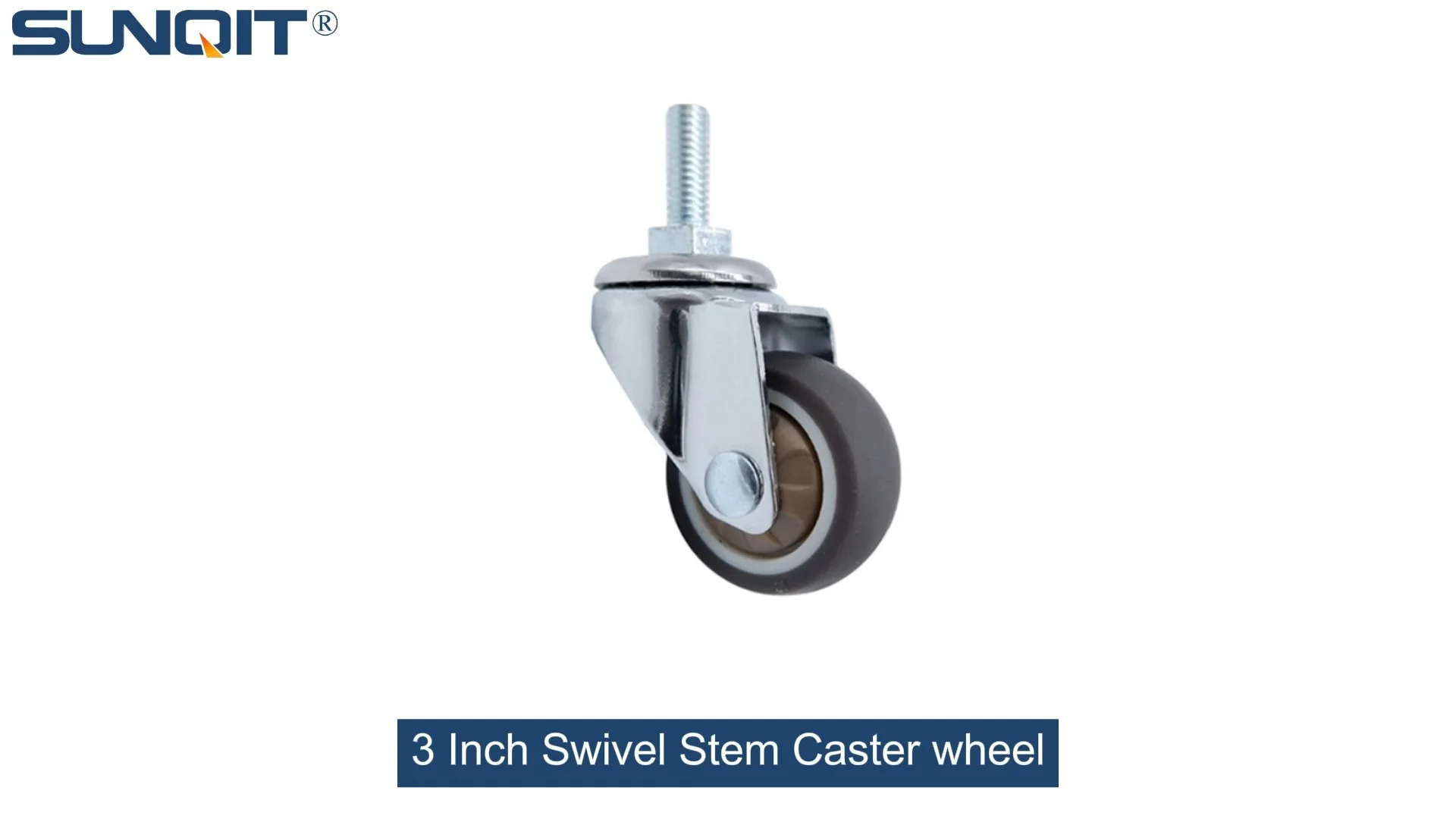
Swivel Stem Caster wheel
360 Degree Swivel Stem Caster. Threaded-post mount design, castors diameter 3 inch.Each swivel caster wheels loading 70KGS. Heavy enough and widely suit for carts, chairs, cabinet, flow rack, workbench, turnover rolley.
Walk into any modern factory, warehouse, or manufacturing plant, and you'll notice a silent workhorse keeping operations moving: the swivel stem caster wheel. These unassuming components—mounted under workbenches, material racks, and turnover trolleys—bear the weight of production, literally and figuratively. For decades, they've been defined by simplicity: a wheel, a stem, and a swivel joint, designed to roll and turn with basic human effort. But as Industry 4.0 reshapes manufacturing with IoT, AI, and real-time data, even the humble caster is getting a high-tech makeover. Today, we're not just talking about wheels that move—we're talking about wheels that communicate , adapt , and optimize . Let's dive into how swivel stem caster wheels are evolving from passive tools to active participants in smart factories, and why this matters for anyone invested in lean systems, aluminum profiles, or efficient material handling.
From Basic to Brilliant: The Limitations of Traditional Casters
To appreciate the future, let's first acknowledge the present. Traditional swivel stem caster wheels, while reliable, come with inherent frustrations. Think about the warehouse manager who spends hours troubleshooting a stuck trolley—only to find a worn caster bearing. Or the production line supervisor who notices uneven wear on workbench casters, leading to wobbly surfaces and potential product defects. Even the "swivel stem caster wheel with brake" (a staple in safety-focused environments) relies on manual engagement, leaving room for human error: a forgotten brake could mean a trolley rolling into a high-traffic area, risking accidents.
Then there's the data gap. Traditional casters don't track usage, load capacity, or maintenance needs. A facility might replace casters on a fixed schedule, wasting money on parts that still have life left—or worse, delay replacement until a breakdown occurs, halting production. In lean systems, where efficiency and waste reduction are paramount, these inefficiencies stick out like a sore thumb. "We were running a lean operation, but our casters were stuck in the Stone Age," recalls Maria Gonzalez, a plant manager at a mid-sized electronics manufacturer. "We'd spend 10% of our maintenance budget on unexpected caster repairs, and that's not counting the downtime. It felt like we were fighting a losing battle against friction—both literal and operational."
| Feature | Traditional Swivel Stem Casters | Smart Swivel Stem Casters |
|---|---|---|
| Data Collection | No built-in tracking; relies on manual inspection | Real-time data on load, speed, temperature, and wear |
| Braking System | Manual engagement; prone to human error | Automatic braking via sensors or remote control |
| Maintenance Alerts | Reactive (breakdowns trigger repairs) | Proactive (predictive maintenance notifications) |
| Integration with Systems | Isolated; no connectivity to factory software | IoT-enabled; syncs with ERP, MES, and lean management tools |
Smart Features Reshaping the Swivel Stem Caster
So, what does a "smart" swivel stem caster wheel look like? It starts with sensors—tiny, durable devices embedded directly into the caster housing or wheel hub. These sensors monitor everything from rotational speed and vibration to temperature and load distribution. Pair that with a microprocessor and wireless connectivity (Bluetooth, Wi-Fi, or LPWAN), and suddenly, your caster isn't just rolling—it's reporting . "We installed smart casters on our material racks last year, and the first thing we noticed was how much we'd been overloading them," says Raj Patel, operations director at a automotive parts supplier. "A sensor flagged that one rack was carrying 30% more than its rated capacity. We adjusted the load, and within a month, caster wear dropped by 40%. That's data we never had access to before."
But sensors are just the beginning. The "swivel stem caster wheel with brake" is getting a upgrade too. Imagine a caster that automatically engages its brake when it detects an obstacle, or when the trolley stops at a workstation—no foot pedal required. Some models even sync with employee badges: when a worker approaches a workbench, the casters lock in place; when they walk away, the brakes release, allowing the trolley to move to the next station. This isn't just convenience—it's safety. At a food packaging plant in Ohio, this feature reduced "trolley drift" incidents by 75%, according to plant safety officer Lisa Chen. "We used to have near-misses weekly—trolleys rolling into conveyor belts or workers' feet. Now, the casters act like a co-pilot, preventing accidents before they happen."
Caster accessories are evolving too. Think of tiny IoT modules that clip onto existing casters (for facilities hesitant to replace their entire fleet) or solar-powered sensors that eliminate the need for battery changes. These accessories turn legacy equipment into smart assets, bridging the gap between old and new. "We didn't have the budget to replace all 500 casters in our warehouse," says Mike Torres, logistics manager at a beverage distributor. "Instead, we added sensor kits—about $30 per caster—and suddenly, we could track every trolley's location, speed, and maintenance needs. It was a game-changer for our lean system."

Playing Well with Others: Integration with Lean Systems and Aluminum Profiles
Smart casters don't exist in a vacuum—they're part of a larger ecosystem of lean manufacturing tools. Lean systems thrive on efficiency, waste reduction, and continuous improvement, and smart casters fit right in. For example, real-time data from casters can highlight bottlenecks: if a trolley on a roller track is consistently moving slower than others, it might signal a problem with the track, the load, or the caster itself. This allows teams to address issues before they disrupt the entire workflow.
Aluminum profiles are another key player here. Lightweight, durable, and infinitely customizable, aluminum profiles are the backbone of modern workbenches, material racks, and conveyor systems. When paired with smart casters, they create a flexible, data-driven workspace. "Our assembly line uses aluminum profile workbenches with smart casters," explains Jamie Liu, manufacturing engineer at a medical device company. "The casters connect to our MES system, so we know exactly where each bench is at all times. If a production order changes, we can reconfigure the line in minutes—no more manually moving heavy workbenches. The aluminum profiles keep the structure rigid, while the casters add mobility and intelligence. It's like having a factory that can rearrange itself."
This integration also extends to maintenance. Aluminum profile accessories like diagnostic ports or cable management clips make it easy to install and power caster sensors. At a electronics plant in Texas, technicians use magnetic charging pads embedded in aluminum workbench legs to keep caster batteries topped up. "No more crawling under workbenches to change batteries," laughs maintenance supervisor Carlos Mendez. "The aluminum profiles act as both structure and infrastructure, making our smart caster setup seamless."

What's Next? The Road Ahead for Smart Casters
The future of swivel stem caster wheels is about more than sensors—it's about intelligence . AI-powered casters that learn from patterns: a caster that notices it's slower on humid days and adjusts its lubrication automatically, or one that predicts when a bearing will fail based on months of usage data. Imagine a warehouse where every caster communicates with every other caster, coordinating movement to avoid traffic jams—like a flock of birds, moving in perfect harmony.
Sustainability is also a big trend. Manufacturers are experimenting with recycled materials for caster wheels and energy-harvesting sensors that generate power from the wheel's rotation. "Why replace a battery when the wheel itself can charge the sensor?" asks Dr. Elena Kim, a materials scientist at a leading caster manufacturer. "We're testing prototypes that convert kinetic energy into electricity. It's early days, but the potential is huge for reducing waste and lowering costs."
Then there's the rise of "digital twins"—virtual replicas of physical systems. A factory could create a digital twin of its entire material handling setup, with smart casters feeding real-time data into the model. Engineers could test new workflows, simulate load changes, or predict maintenance needs—all without disrupting production. "We used a digital twin to optimize our roller track layout," says Raj Patel, the automotive parts supplier we met earlier. "By inputting caster speed and load data, the model showed us that rearranging two tracks would cut material delivery time by 22%. We made the change, and the results matched the simulation exactly. That's the power of connected casters—they turn guesswork into certainty."

Real-World Impact: Stories from the Factory Floor
Let's ground this in reality with a few case studies. Take GreenWave Logistics, a third-party logistics provider in California. They installed smart swivel stem casters on 200 of their heaviest turnover trolleys, each equipped with load sensors and GPS. Within six months, they reduced damaged goods by 35% (thanks to overload alerts) and cut fuel costs by 18% (by optimizing trolley routes). "One of our clients ships fragile electronics," says GreenWave CEO Sarah Johnson. "Before smart casters, we'd have 5-10 damaged packages per week. Now, if a trolley exceeds the safe load, the casters send an alert, and the driver adjusts the load. It's saved us hundreds of thousands in replacement costs."
Or consider PrecisionWorks, a contract manufacturer specializing in aerospace parts. They integrated smart casters with their aluminum profile workbenches and lean system, creating a "self-diagnosing" production line. If a caster on a workbench detects unusual vibration, it triggers a maintenance alert. "Last month, a caster sensor flagged a loose bearing on a critical assembly bench," says plant manager Tom Reeves. "We fixed it during a scheduled break, avoiding what could have been a 4-hour production halt. In aerospace, downtime costs $10,000 per hour—so that $30 sensor just saved us $40,000. It's ROI you can measure."
The Bottom Line: Small Wheels, Big Impact
Swivel stem caster wheels may be small, but their role in Industry 4.0 is huge. They're the connective tissue between physical and digital systems, turning ordinary equipment into smart assets. As manufacturing becomes more automated, data-driven, and flexible, the demand for smart casters will only grow. Whether you're a plant manager looking to cut costs, a safety officer aiming to reduce accidents, or an engineer designing the factory of the future, these wheels are worth your attention.
So, the next time you walk through a factory, take a moment to look down. That swivel stem caster wheel under the trolley? It might just be the most underrated tech in the room. And in the years to come, it'll be doing a lot more than just rolling—it'll be thinking, communicating, and helping build a smarter, more efficient world.