- Company Articles
- Industry articles
- Industry standards
- Home Appliance Production Lines: 3060 National Standard Profile A Workstations

Home Appliance Production Lines: 3060 National Standard Profile A Workstations
Related Product
3060 National Standard Profile A
Workbench, production line, logistic rack, warehouse rack Industry: Manufacturer workshop, Automobile, Electronic, Assembling, logistic
Walk into any modern home appliance factory, and you'll notice a quiet revolution unfolding on the production floor. Where once bulky, fixed workbenches dominated the space—slowing down assembly, limiting flexibility, and leaving workers straining to reach tools or materials—there's now a new star: the 3060 National Standard Profile A workstation. These sleek, modular setups aren't just pieces of equipment; they're the backbone of efficient, adaptable, and worker-centric manufacturing. In an industry where product cycles shrink, customization demands grow, and every second counts, the right workstation can mean the difference between meeting tight deadlines and falling behind. Let's dive into why the 3060 National Standard Profile A has become the go-to choice for home appliance producers, and how it's reshaping the way we build everything from refrigerators to microwaves.
The Problem with "One-Size-Fits-All" Workstations
Traditional production line workstations were built for a different era—one where a single appliance model might stay in production for years. Back then, a heavy steel workbench bolted to the floor made sense. It was sturdy, predictable, and required little maintenance. But today? Home appliance factories are dynamic environments. A manufacturer might produce a compact fridge for urban apartments in the morning, switch to a large-capacity freezer in the afternoon, and prototype a smart oven by the end of the week. Rigid workstations simply can't keep up.
Consider the typical pain points: A worker assembling a small blender needs a lower work surface to avoid hunching, while someone building a washing machine drum requires extra height to maneuver heavy parts. A fixed bench forces compromises, leading to ergonomic strain and slower assembly times. Then there's the issue of tool and material storage. As appliances add more features—think touchscreens, IoT sensors, or energy-efficient components—workers need quick access to a wider range of parts. A static workstation with limited shelf space turns every reach into a wasted step.
And let's not forget about reconfiguration. When a factory rolls out a new appliance model, the production line often needs a complete overhaul. Traditional workstations? They're either impossible to modify or require a team of engineers and hours of downtime to adjust. For a industry where time is money, that's a costly problem. Enter the 3060 National Standard Profile A workstation—a solution designed to solve exactly these challenges.
What Makes the 3060 National Standard Profile A Special?
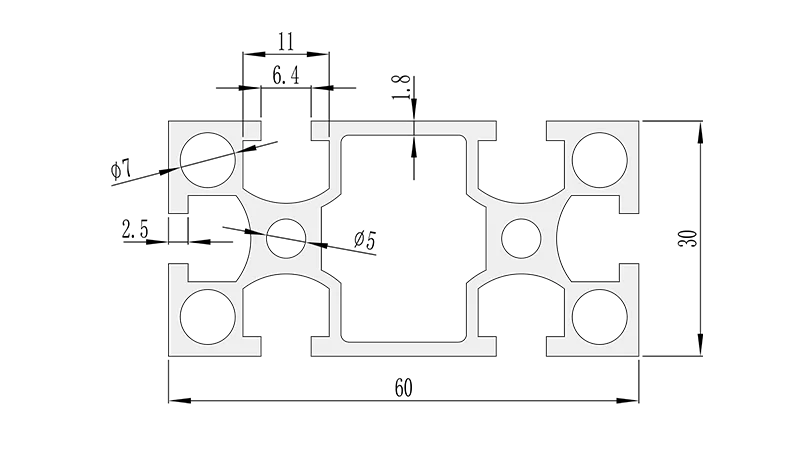
At first glance, the 3060 National Standard Profile A might look like just another aluminum frame. But its magic lies in two key traits: modularity and standardization. Let's break that down. The "3060" refers to its dimensions—30mm in width and 60mm in height—making it sturdy enough to support heavy appliance parts (like a dishwasher door or a refrigerator compressor) while remaining lightweight. The "National Standard" label ensures compatibility: no matter which supplier you buy from, accessories like joints, brackets, or shelves will fit seamlessly. This standardization eliminates the headache of mismatched parts, a common frustration with off-brand or proprietary systems.
But the real game-changer is its T-slot design. Run your hand along the profile, and you'll feel evenly spaced grooves running the length of the aluminum extrusion. These slots act as universal connection points, allowing workers to attach almost any accessory—from tool hooks and monitor mounts to roller tracks and storage bins—in seconds. No drilling, no welding, no complicated tools. Just a few screws or clamps, and the workstation transforms to fit the task at hand. It's like building with industrial-grade Legos, but for grown-ups who need their creations to withstand the rigors of a factory floor.
Building Blocks: Aluminum Profile Accessories That Bring It All Together
A workstation is only as good as its accessories, and the 3060 National Standard Profile A shines here. Let's walk through the essential add-ons that turn a basic aluminum frame into a fully functional production hub:
- Joints and Connectors: These are the "glue" of the system. From 90° aluminum profile connectors for right-angle corners to 135° brackets for angled shelves, these (accessories) let you build everything from a simple single-level workbench to a multi-tiered assembly station. The best part? They're tool-free in many cases—just twist, lock, and you're done.
- Workbench Tops: Choose from aluminum honeycomb panels for lightweight durability or anti-static surfaces for handling sensitive electronics (like the control boards in smart ovens). Many tops are reversible, with a smooth side for assembly and a grooved side for draining liquids during cleaning.
- Roller Tracks: Imagine sliding a heavy microwave door across the workstation without lifting a finger. That's what roller tracks do. Made from durable plastic or aluminum, these tracks mount directly to the T-slots, creating a gravity-fed pathway for parts. For home appliance assembly, where workers often pass components from one station to the next, roller tracks cut down on lifting injuries and speed up workflow.
- Storage Solutions: Drawers, bins, and shelves attach effortlessly to the profile, keeping screws, wires, and small parts within arm's reach. Magnetic strips for tools, pegboards for frequently used items, and even overhead racks for bulky components—all customizable to the team's needs.
- Ergonomic Add-Ons: Height-adjustable feet let workers set the bench to their ideal level, reducing back strain. Monitor mounts hold digital work instructions, so assemblers don't have to flip through paper manuals. Footrests and anti-fatigue mats complete the setup, ensuring comfort during long shifts.
The beauty of these aluminum profile accessories is their versatility. A workstation built for assembling toasters can, with a few tweaks, be reconfigured for blenders by swapping out the roller track for a smaller parts bin or adjusting the shelf height. This adaptability is a lifesaver for factories producing multiple appliance lines.
Lean System Integration: Waste Less, Produce More
Home appliance manufacturers live and die by lean principles—eliminating waste, optimizing flow, and continuous improvement. The 3060 National Standard Profile A workstation isn't just compatible with lean systems; it's designed to enable them. Let's see how:
Waste Reduction: In lean terms, "waste" includes unnecessary movement, waiting, and overprocessing. A cluttered, fixed workstation forces workers to walk to a distant shelf for a tool (movement waste) or wait for a colleague to free up a shared workspace (waiting waste). The 3060 workstation cuts this by keeping everything needed for the task within arm's reach. Roller tracks, for example, ensure materials flow directly to the assembler, eliminating the need to fetch parts from a separate storage area.
5S Friendly: The 5S methodology—Sort, Set in Order, Shine, Standardize, Sustain—thrives on organization. With the 3060's modular storage, every tool has a designated spot (Set in Order), and the easy-to-clean aluminum surfaces make "Shine" (cleaning) a breeze. Standardization is built in too: since all workstations use the same profile and accessories, every station on the line looks and functions consistently, reducing training time for new workers.
Continuous Improvement: Lean isn't a one-and-done process; it's about constantly tweaking workflows for better efficiency. The 3060 workstation makes experimentation easy. Want to test a new assembly sequence? Rearrange the roller track or add a shelf in minutes. Notice workers straining to reach a bin? Lower it with a quick adjustment to the brackets. These small, iterative changes add up to big gains over time.
Real-World Impact: A Case Study
Let's put this in context with a real example. A mid-sized home appliance manufacturer in Guangdong recently switched its refrigerator assembly line to 3060 National Standard Profile A workstations. Here's what happened before and after:
| Metric | Before (Traditional Steel Workstations) | After (3060 Profile A Workstations) |
|---|---|---|
| Assembly Time per Unit | 45 minutes | 32 minutes (-29%) |
| Worker Fatigue Complaints | 12 per month | 2 per month (-83%) |
| Reconfiguration Time for New Model | 8 hours | 1 hour (-87.5%) |
| Tool/Material Retrieval Time per Shift | 45 minutes | 15 minutes (-67%) |
| Overall Equipment Effectiveness (OEE) | 68% | 85% (+17%) |
The results speak for themselves. By reducing assembly time and fatigue, the factory increased daily output by 15% without adding extra shifts. When they launched a new energy-efficient refrigerator model, reconfiguring the line took just an hour instead of a full day, allowing them to hit the market two weeks earlier than competitors. And workers? They reported feeling more in control of their workspace, with one assembler noting, "I used to spend half my time walking to get screws or bending to reach tools. Now everything's right here. It's like the workstation was built for me."
Why Aluminum? The Material Behind the Magic
You might be wondering: Why aluminum? Why not stick with steel, which has been the industry standard for decades? The answer lies in aluminum's unique blend of strength, weight, and durability—qualities that make it perfect for factory workstations.
First, weight. Aluminum is about 30% lighter than steel, which means workers can reposition the workstation (with the help of casters, another handy accessory) without heavy machinery. Need to shift the line to make space for a new machine? Two people can move a 3060 workstation in minutes. Steel workbenches, by contrast, often require forklifts, adding downtime and safety risks.
Then there's corrosion resistance. Home appliance factories aren't always the cleanest environments—oils, lubricants, and cleaning agents can splash onto work surfaces. Aluminum's natural oxide layer prevents rust, ensuring the workstation looks and functions like new for years. Steel, unless heavily coated, can start to corrode, weakening joints and creating rough edges that damage parts.
Cost is another factor. While aluminum profiles might have a slightly higher upfront cost than steel, their modularity and longevity make them more cost-effective over time. A steel workstation that becomes obsolete in two years (because the factory switches to a new appliance model) is a sunk cost. A 3060 Profile A workstation, though? It can be disassembled, reconfigured, and reused indefinitely. Plus, aluminum is 100% recyclable, aligning with the growing focus on sustainable manufacturing.
Beyond the Workbench: Roller Tracks and the Flow of Production
No discussion of 3060 Profile A workstations is complete without highlighting roller tracks—those unassuming yet critical components that keep materials moving. In home appliance assembly, parts rarely stay in one place. A refrigerator door might start at the welding station, move to painting, then to insulation, and finally to the final assembly line. Roller tracks turn this journey into a smooth, gravity-powered glide.
Imagine a section of the line where workers install hinges on oven doors. The doors arrive on a roller track from the previous station, sliding gently into position. Once the hinges are attached, the worker pushes the door onto another track, which sends it to the next team. No lifting, no carrying, no wasted motion. For heavier parts, like washing machine drums, motorized roller tracks (easily integrated with the 3060 profile) take the effort out of transport.
But roller tracks aren't just about moving parts—they're about visual management. Many factories color-code tracks (yellow for incoming parts, grey for outgoing, as seen with plastic roller track guide rails) to prevent mix-ups. They also use stoppers and sensors to ensure parts stop exactly where the worker needs them, reducing errors. It's these small, thoughtful details that make the 3060 system so effective.
Customization: Build a Workstation That Fits Your Needs
One of the biggest myths about modular systems is that "modular" means "one-size-fits-most." Not with the 3060 National Standard Profile A. These workstations are infinitely customizable, down to the smallest detail. Let's design one together for a hypothetical scenario: a factory assembling smart air conditioners, which require delicate circuit boards, heavy compressors, and a variety of small sensors.
- Base Structure: A 3060 Profile A frame with adjustable height feet (to accommodate workers of different heights) and locking casters (so it stays put during assembly but can be moved for cleaning).
- Work Surface: An anti-static aluminum honeycomb top to protect circuit boards from electrostatic damage.
- Upper Shelves: Two levels of shelves above the work surface, using 90° aluminum profile connectors. The top shelf holds a monitor displaying digital assembly instructions; the lower shelf has bins for sensors and small wires, labeled with color-coded tags.
- Left Side: A vertical roller track (using aluminum guide rail B) for incoming compressor units, which slide down to waist height for easy installation.
- Right Side: A set of drawers with dividers for screws, nuts, and washers, plus a magnetic strip for screwdrivers and pliers.
- Back Panel: A pegboard attached to the 3060 profile, holding larger tools like wire strippers and torque wrenches. A small LED light bar (powered via a USB port mounted on the profile) illuminates the workspace.
This isn't just a workstation—it's a custom-built command center for the task at hand. And if the factory switches to assembling dehumidifiers next quarter? They can remove the roller track, swap the anti-static top for a standard aluminum one, and add a bin for water tanks. The core frame remains, saving time and money.
The Future of Home Appliance Manufacturing
As home appliances become smarter, more energy-efficient, and more customizable, the factories that build them need tools that can keep pace. The 3060 National Standard Profile A workstation isn't just a trend—it's a glimpse into the future of manufacturing: flexible, worker-focused, and relentlessly efficient. It's about moving beyond the idea of workstations as "furniture" and seeing them as strategic assets that drive productivity and innovation.
In the end, though, the true measure of a workstation's success isn't in its aluminum profiles or roller tracks—it's in the people who use it. When workers feel empowered, comfortable, and efficient, they build better products. And in a world where consumers demand quality and reliability, that's the competitive edge no factory can afford to ignore.
So, whether you're upgrading an existing line or building a new factory from the ground up, the 3060 National Standard Profile A workstation deserves a spot at the heart of your operation. It's not just about assembling appliances—it's about assembling a better way to work.