- Company Articles
- Industry articles
- Industry standards
- Home Appliance Production Lines: 4040r EU Standard Aluminum Profile Integration

Home Appliance Production Lines: 4040r EU Standard Aluminum Profile Integration
Related Product
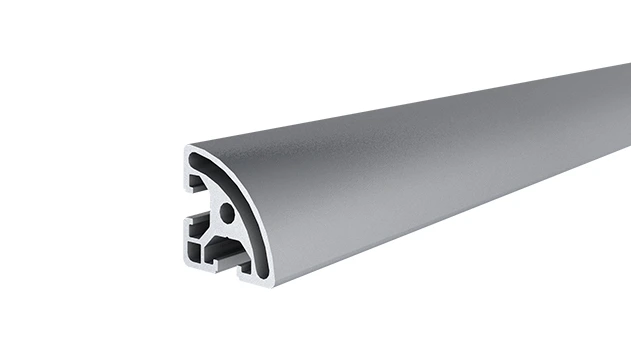
4040R EU Standard Aluminum Profile
4040R is a 4.00x4.00 CM fractional 40 series square extrusion T-slot profile with two side open T-slots, each side with 4.00cm face,the other side is round face. The profile has align-a-grooves to assist in aligning connecting profiles.
Walk into any home appliance factory today, and you'll notice a quiet revolution unfolding on the production floor. Lines that once felt rigid and unchanging—tied to fixed machinery and permanent workstations—are now shifting, adapting, and evolving. New fridge models roll out faster, smart oven features get updated quarterly, and consumer demand for customization grows by the day. For manufacturers, this pace isn't just a challenge; it's a call to rethink how production lines are built. Enter the 4040r EU Standard Aluminum Profile: a humble yet transformative building block that's redefining flexibility, efficiency, and lean manufacturing in the home appliance industry. In this article, we'll explore how this unassuming aluminum extrusion, paired with the right accessories and a focus on lean systems, is becoming the backbone of modern production lines—one that empowers teams to work smarter, adapt quicker, and build better appliances.
What Makes 4040r EU Standard Aluminum Profile a Game-Changer?
Before diving into integration, let's get to know the star of the show: the 4040r EU Standard Aluminum Profile. At first glance, it might look like just another metal bar—40mm by 40mm in cross-section, with a smooth, silver finish. But beneath that simplicity lies decades of engineering and a commitment to European manufacturing standards that set it apart. Unlike generic aluminum extrusions, the "EU Standard" label isn't just a marketing term here. It means the 4040r adheres to strict guidelines for material purity (typically 6063-T5 aluminum alloy, known for its strength and corrosion resistance), dimensional accuracy (so every piece fits with the next), and load-bearing capacity (tested to handle the daily grind of production lines). For home appliance manufacturers, this consistency is non-negotiable. When you're building thousands of units daily, the last thing you need is a wobbly workstation or a conveyor frame that bends under the weight of oven parts.
But what truly makes the 4040r special is its T-slot design. Run your hand along its length, and you'll feel evenly spaced grooves (or "slots") that run the full length of the profile. These slots aren't just for show—they're the secret to its versatility. They let you attach accessories, brackets, panels, and tools anywhere along the profile, without drilling or welding. Need to add a shelf to a workbench? Slide a bracket into the T-slot and tighten a bolt. Want to reposition a light above an assembly station? Loosen a few screws, adjust, and retighten. In a industry where production lines need to reconfigure for new appliance models in days (not weeks), this flexibility is a game-changer. Compare that to traditional steel frames, which require cutting, welding, and repainting every time you need to make a change—wasting time, labor, and materials. The 4040r turns "permanent" into "temporary" and "fixed" into "adaptable."
Another key advantage is weight. Aluminum is about 30% lighter than steel, which might not sound like much until you multiply it by hundreds of profiles on a production line. Lighter frames mean easier installation (no need for heavy machinery to move sections), lower shipping costs for pre-assembled components, and—perhaps most importantly—ergonomic benefits for workers. A lighter workstation is easier to adjust to different heights, reducing strain on backs and shoulders during long shifts. For home appliance assembly, where tasks like fitting door hinges or wiring control panels require precision, comfortable workstations directly translate to fewer errors and happier teams.
Aluminum Profile Accessories: The Unsung Heroes of Versatility
If the 4040r profile is the backbone of a production line, then aluminum profile accessories are the joints, muscles, and connective tissue that bring it to life. Walk into a supplier's catalog, and you'll find hundreds of these small but mighty components—from connectors that lock profiles at 90-degree angles to end caps that smooth out sharp edges. Each accessory is designed to work seamlessly with the 4040r's T-slot system, turning a collection of aluminum bars into a fully functional workstation, conveyor, or material rack. Let's break down a few must-have accessories and how they empower home appliance production lines.
Connectors: Building Without Welds
Imagine trying to build a table with just wooden planks and no screws—you'd end up with a wobbly mess. The same goes for aluminum profiles: without the right connectors, even the strongest 4040r pieces won't hold together. The 90° aluminum profile connector is a perfect example. Shaped like a small L, it slides into the T-slots of two perpendicular 4040r profiles, locking them in place with a hex bolt. What's impressive is how secure this connection is: when tightened, the connector creates friction between the profile and the slot, making the joint rigid enough to support heavy loads (think stacks of microwave boxes or a conveyor carrying washing machine drums). And because there's no welding, you can disassemble and reuse the connector elsewhere—ideal for prototype lines or temporary workstations during product launches.
For more complex setups, there's the three-way aluminum profile connector, which lets you join three profiles at once (great for building corner shelves or triangular support structures). Or the gusset alp 4040, a small triangular bracket that reinforces right-angle joints, adding extra stability for high-vibration areas (like near a stamping machine for metal appliance parts). These accessories don't just save time—they turn anyone on the production floor into a "builder." With basic tools (a hex key and a rubber mallet), a team can assemble a new workstation in under an hour, no prior engineering experience needed.
Finishing Touches: From Safety to Functionality
Not all accessories are about structural support—some are about making the production line safer, cleaner, and more functional. Take the T-slot rubber seal cover, for example. These flexible strips press into the T-slots, filling the grooves to prevent dust, debris, or small parts (like screws or washers) from getting stuck. In a home appliance factory, where a single misplaced screw could jam a conveyor or scratch a stainless steel fridge door, this small addition saves hours of maintenance and reduces defect rates. Similarly, 4040 aluminum profile end caps snap onto the ends of profiles, covering sharp edges and giving the line a polished, professional look—important for visitor tours or employee morale (a messy line feels chaotic; a clean one feels organized).
Then there are the "little helpers" like adjustable leveling feet. Screw these into the bottom of a 4040r frame, and you can tweak the height by turning a dial—perfect for uneven factory floors or for aligning workstations with conveyors. No more shimming with pieces of wood or metal; just a quick adjustment to ensure everything is level and stable. For assembly tasks that require precision (like installing glass oven doors), a level workstation isn't a luxury—it's a necessity.
| Accessory Type | Function | Why It Matters for Home Appliance Lines |
|---|---|---|
| 90° Aluminum Profile Connector | Joins two profiles at a right angle without welding | Enables quick assembly of workbench frames and conveyor supports |
| Gusset Alp 4040 | Reinforces right-angle joints for extra stability | Prevents wobbling in high-load areas (e.g., stacking dryer parts) |
| T-slot Rubber Seal Cover | Fills T-slots to block debris and small parts | Reduces maintenance and prevents defects from misplaced components |
| 4040 Aluminum Profile End Cap | Covers sharp profile ends | Improves safety and gives lines a clean, professional appearance |
| Adjustable Leveling Feet | Tweaks height to level frames on uneven floors | Ensures precision in assembly tasks and aligns conveyors smoothly |

Lean Systems: How 4040r Aligns with the Future of Manufacturing
In the world of home appliance production, "lean manufacturing" isn't just a buzzword—it's a survival strategy. Lean principles, born from Toyota's production system decades ago, focus on eliminating waste (whether it's time, materials, or motion) and creating value for the customer. Today, with consumers demanding faster innovation and lower prices, lean has never been more critical. The 4040r EU Standard Aluminum Profile isn't just a building material here; it's a lean enabler. Let's see how it aligns with core lean concepts and transforms production lines into lean powerhouses.
Waste Reduction: From Overproduction to Excess Inventory
One of the biggest wastes in manufacturing is overproduction—building more parts than needed, leading to excess inventory that clogs up warehouses and ties up capital. The 4040r helps combat this by making it easy to scale production lines up or down. For example, during peak seasons (like holiday shopping), a manufacturer might need to add a third shift for microwave assembly. With traditional steel frames, that would mean ordering custom-built workstations, waiting weeks for delivery, and spending days installing them. With 4040r, the team can assemble temporary workstations in a day using pre-stocked profiles and accessories, then disassemble and store them when demand drops. No excess inventory of permanent fixtures, no wasted space storing unused equipment—just the right amount of capacity, exactly when needed.
Another lean target is "motion waste"—the unnecessary movement of workers or materials. Picture a traditional assembly line where parts are stored on shelves 10 feet away from the workstation. Workers spend hours walking back and forth, grabbing screws, brackets, or control panels. With 4040r, manufacturers can build custom material racks (like the "material rack b (3 row and 3 floor)" from supplier catalogs) that attach directly to workstations. Using 4040r frames and roller track (another key accessory), parts can slide right to the assembler's hands, reducing walking time by 50% or more. It's a small change, but multiplied across 20 workstations and 8-hour shifts, it adds up to hundreds of hours saved annually.
Flexibility: The Heart of Lean Adaptability
Lean isn't just about cutting waste—it's about adapting to change. Home appliance manufacturers know this all too well: a new energy efficiency standard might require redesigning a fridge's compressor, or a viral social media trend could spike demand for pastel-colored blenders. In these cases, production lines need to pivot quickly. The 4040r's modular design makes this possible. Let's say a team needs to reconfigure a conveyor line to accommodate a larger oven model. With traditional steel conveyors, this would involve cutting the frame, rewelding sections, and replacing motors—days of downtime. With 4040r, they can loosen the 90° aluminum profile connectors, adjust the frame length, add new roller track sections (using roller track placon mount connectors), and have the line running again in hours. The same flexibility applies to workstations: if a new dishwasher model is taller, workers can adjust the height of their 4040r workbench by swapping out leg profiles or adding extension brackets—no need for a completely new workstation.
This adaptability also supports "mixed-model production," where multiple appliance models are built on the same line. For example, a factory might produce both compact and full-size washing machines on one line. With 4040r, tool holders, part bins, and even computer monitors can be quickly repositioned to suit each model. A worker assembling a compact washer can have the control panel bracket holder at waist height, while the next station (building a full-size model) has it adjusted 6 inches higher—all with a few turns of a hex key. This level of customization would be impossible with fixed steel workstations, where one size fits all (poorly).
Real-World Applications: 4040r in Action on the Production Floor
Theory is one thing, but seeing the 4040r in action is where its impact truly shines. Let's take a walk through a hypothetical (but realistic) home appliance factory and see how this profile integrates into key areas of the production line—from assembly workbenches to conveyor systems—making operations smoother, safer, and more efficient.
Workbenches: Where Precision Meets Comfort
The assembly workstation is where the magic happens. It's where workers fit circuit boards into oven control panels, attach hinges to fridge doors, and test the buttons on smart washing machines. For these tasks, precision and comfort are everything. A typical 4040r workbench (like the "aluminum workbench e (single deck-without caster)" from supplier lists) starts with a frame of 4040r profiles, connected by 90° and three-way connectors. The top is often an aluminum honeycomb panel—lightweight but rigid, with a non-slip surface to keep parts from sliding. Underneath, adjustable shelves (held in place by T-slot brackets) store tools and spare parts, while a small LED light (mounted via a clamp in the T-slot) illuminates the workspace.
What makes this workbench lean? For starters, it's ergonomic. The height can be adjusted using telescoping 4040r legs and leveling feet, so a 5'2" worker and a 6'1" worker can both find a comfortable position. The T-slots let the team add accessories like tool hooks, cable management clips, or even a small monitor arm for displaying assembly instructions. And when the appliance model changes—say, a new dishwasher with a different control layout—the team can reposition the shelves, add a new tool holder, or even swap the honeycomb top for an ESD (electrostatic discharge) surface (critical for handling circuit boards) in under an hour. No more waiting for a custom-built bench; the 4040r bench evolves with the job.
Conveyors: Keeping the Flow Moving
A production line is only as efficient as its material flow. Conveyors are the arteries that carry appliance parts from one station to the next, and the 4040r is proving to be the ideal framework for building them. Take a roller conveyor, for example. The frame is built from 4040r profiles, with roller track (like the "40 steel roller track yellow wheel" or "38 aluminum roller track black esd") mounted to the T-slots using placon mount brackets. The rollers, spaced evenly along the track, let parts glide smoothly—whether it's a plastic dryer drum or a metal oven door. What's great is that the conveyor can be built to any length, with curves (using 135° aluminum profile connectors) or inclines (using adjustable legs) to navigate around factory obstacles.
For smaller parts (like control knobs or gaskets), a "swivel roller balls 1 inch" conveyor (a flat bed covered in small, rotating balls) is often used. Built on a 4040r frame, this conveyor lets workers slide parts in any direction, making it easy to pass components between stations. And because the 4040r frame is lightweight, the entire conveyor can be mounted on casters (using castor installation base accessories), so it can be moved out of the way during deep cleaning or reconfigured for a new production layout.
Material Racks: Organized Storage, Easy Access
A cluttered factory floor is a breeding ground for waste—lost parts, tripping hazards, and frustrated workers. 4040r material racks solve this by turning chaos into order. A typical rack (think "rack f" or "rack d" from supplier catalogs) uses vertical 4040r posts connected by horizontal beams, with adjustable shelves held in place by T-slot brackets. The shelves can be spaced to fit different part sizes—tall enough for fridge doors on the bottom, short enough for small motor components on the top. For even better organization, some racks add dividers (made from smaller aluminum profiles) to separate parts by model or color.
But the real innovation is in how these racks integrate with the rest of the line. A rack placed next to a conveyor can have a sloped shelf (using 30° fixed lean pipe joints) that feeds parts directly onto the roller track, eliminating the need for workers to carry boxes. Or, for heavy items like washing machine tubs, a rack with "stainless steel swivel roller balls 1 inch" on the shelves lets workers slide tubs onto a pallet jack with minimal effort. It's storage that doesn't just hold parts—it feeds the production line.
The Future of Home Appliance Production: Why 4040r is Here to Stay
As home appliances become smarter, more connected, and more customizable, the production lines that build them will need to keep pace. The 4040r EU Standard Aluminum Profile isn't just a trend; it's a foundation for the future. Here's why:
First, sustainability. Aluminum is 100% recyclable, and the 4040r's modular design means profiles can be reused indefinitely. When a production line is retired, the 4040r pieces can be disassembled, cleaned, and reassembled into a new line—reducing waste and lowering the carbon footprint. For manufacturers aiming to meet net-zero goals, this is a significant advantage over steel frames, which often end up in landfills after use.
Second, Industry 4.0 integration. The T-slot design of 4040r makes it easy to mount sensors, cameras, and IoT devices. Imagine a workbench with a built-in sensor that tracks how many parts are used per hour, or a conveyor with a camera (mounted via a 4040r bracket) that checks for defects in real time. As factories become "smart," the 4040r will serve as the physical backbone that connects these digital tools to the production process.
Finally, scalability. Whether a manufacturer is a small startup building niche appliances or a global giant producing millions of units, the 4040r scales to fit. Start with a single workbench, add a conveyor as demand grows, and expand to a full line—all using the same profiles and accessories. There's no need to invest in new tooling or learn new assembly methods; the 4040r grows with the business.
In the end, the 4040r EU Standard Aluminum Profile is more than just a building material. It's a mindset—one that says production lines don't have to be rigid, wasteful, or outdated. They can be flexible, efficient, and human-centered. For home appliance manufacturers, that mindset isn't just good for the bottom line; it's good for the workers who build the appliances, the consumers who use them, and the planet we all share. So the next time you unbox a new fridge or fire up your smart oven, take a moment to appreciate the quiet revolution happening behind the scenes—one 4040r profile at a time.