- Company Articles
- Industry articles
- Industry standards
- How 2020 National Standard Profile Reduces Assembly Time in Consumer Electronics

How 2020 National Standard Profile Reduces Assembly Time in Consumer Electronics
Related Product
2020 National Standard Profile
45° external bending joint, used for 45° external connection of two aluminum pipes.
In the fast-paced world of consumer electronics, where new smartphones, laptops, and wearables hit the market every few months, assembly line efficiency isn't just a goal—it's a survival imperative. Manufacturers are under constant pressure to cut production cycles, meet skyrocketing demand, and adapt to frequent design changes. Yet, one of the biggest bottlenecks they face? The time it takes to set up, reconfigure, and maintain the physical infrastructure that powers their assembly lines. Enter the 2020 national standard profile: a seemingly unassuming aluminum extrusion that's quietly revolutionizing how consumer electronics get built. In this article, we'll explore how this innovative material, paired with the right aluminum profile accessories, is slashing assembly time, boosting flexibility, and helping factories stay ahead in an industry where every second counts.
The Assembly Time Crisis in Consumer Electronics
To understand why the 2020 national standard profile matters, let's first step onto a typical consumer electronics assembly floor. Picture a line where workers assemble smartwatch components: tiny circuit boards, delicate screens, and precision-engineered casings. Each step relies on specialized workbenches, material racks, and roller tracks to move parts from station to station. Now, imagine the chaos when the next model launches—with a slimmer design, new ports, or a rearranged internal layout. Suddenly, the old workbenches are too tall, the roller tracks too narrow, and the material racks can't hold the new component trays.
Traditionally, fixing this meant weeks of downtime. Workers would have to weld new steel frames, drill custom holes for shelves, or replace entire sections of roller track. Each adjustment required skilled labor, specialized tools, and endless measurements. For a factory churning out 10,000 units a day, even a 48-hour delay could cost millions in lost revenue. Worse, rigid infrastructure often led to "workarounds"—workers jury-rigging solutions with tape, zip ties, or makeshift shelves—that slowed down production and increased error rates.
The root of the problem? Most assembly line infrastructure was built with permanence in mind. Steel pipes, fixed wooden workbenches, and welded roller tracks were durable but inflexible. They worked for one product, but not the next. In an industry where product lifecycles now average 12–18 months, this rigidity became a liability. Manufacturers needed something that could keep up—something modular, easy to adjust, and quick to install. That's where the 2020 national standard profile comes in.
What Is the 2020 National Standard Profile?
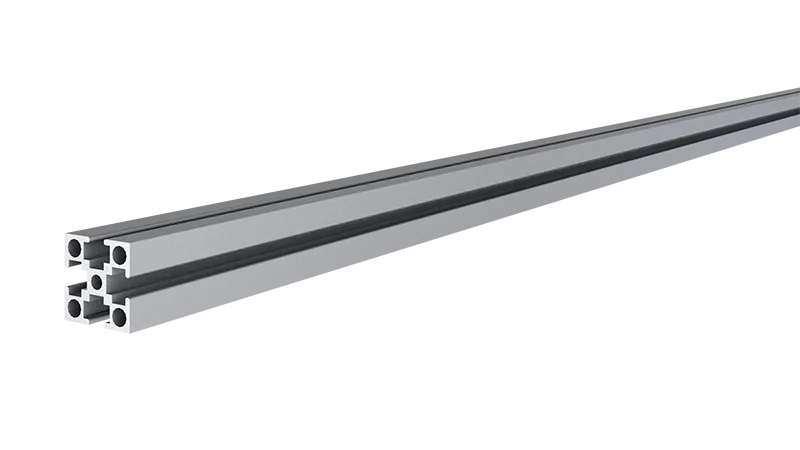
At its core, the 2020 national standard profile is a lightweight aluminum extrusion with a specific cross-sectional design: 20mm by 20mm (hence the "2020" name), featuring T-shaped slots along its length. These slots aren't just for show—they're the secret to its flexibility. Unlike smooth steel pipes or solid wooden beams, the T-slots allow aluminum profile accessories like connectors, end caps, and brackets to snap into place without welding, drilling, or glue. Think of it as a grown-up version of building blocks, but for factories.
But why aluminum? Aluminum offers the perfect balance of strength and weight. It's 30% lighter than steel, making it easy for workers to handle without heavy machinery, yet strong enough to support the weight of circuit boards, screens, and tools. It's also corrosion-resistant, which is critical in electronics manufacturing where dust, moisture, and static electricity are constant threats. And because it's an extrusion—formed by pushing molten aluminum through a die—the 2020 profile can be produced in consistent lengths (from 1 meter to 6 meters) with near-perfect precision, ensuring compatibility across accessories.
The "national standard" label is equally important. In the past, aluminum profiles came in a hodgepodge of sizes and slot designs, meaning a bracket from one supplier might not fit a pipe from another. The 2020 national standard profile eliminates that headache by standardizing dimensions, slot spacing, and accessory compatibility. Today, any manufacturer using this profile can source aluminum profile accessories—whether end caps, 90° connectors, or tool holders—from dozens of suppliers and trust they'll work seamlessly together.

How 2020 Profile Cuts Assembly Time: The Features That Matter
The 2020 national standard profile isn't just a better pipe—it's a system designed to reduce friction at every step of the assembly process. Let's break down its key features and how they translate to faster setup and reconfiguration.
Tool-Free Assembly with Aluminum Profile Accessories
The biggest time-saver? No more tools. Traditional workbenches might require a drill, wrench, and level to attach a single shelf. With the 2020 profile, workers can slide an aluminum profile accessory like a T-bolt into the T-slot, twist a knob, and secure a shelf in 30 seconds. End caps snap on to cover sharp edges, and 45° or 90° connectors lock profiles together with a simple lever. Even complex structures—like a multi-tiered material rack—can be built by a single worker in under an hour, compared to half a day with steel.
Consider the 2020 national standard profile's internal straight aluminum joint, a small but mighty accessory. This joint lets workers connect two profiles end-to-end with zero gap, creating longer beams without welding. In a traditional setup, welding two steel pipes would take 20 minutes (plus cooling time) and require a certified welder. With the internal straight joint? 30 seconds, and any worker can do it.
Modular Workbenches: From Concept to Use in Hours
Workbenches are the heart of assembly lines, and here the 2020 profile shines brightest. A standard workbench built with 2020 profiles can be customized for height (adjustable feet), width (add or remove crossbars), and accessories (tool hooks, monitor mounts, ESD mats) in minutes. For example, a workbench E (single deck, without caster)—a common model in electronics factories—typically takes 2–3 hours to assemble with traditional materials. With 2020 profiles and pre-cut aluminum pipes, two workers can build it in 45 minutes. Need to lower the height by 10cm for shorter workers? Loosen the joint knobs, adjust, and retighten—done in 5 minutes.
But it's not just new workbenches. When a product design changes, workers can reconfigure existing workbenches on the fly. Add a shelf for new testing equipment? Snap on a bracket. Install a side rail to hold cable organizers? Slide in a T-slot nut and bolt. No more waiting for the maintenance crew—assembly line workers can make adjustments themselves, keeping production rolling.
Roller Tracks That Keep Up with Changing Parts
Material flow is another critical area where time gets wasted. Roller tracks—used to slide component trays, PCBs, or finished products between stations—often become bottlenecks when parts change size or weight. A traditional steel roller track with fixed spacing might jam if a tray is 2mm wider than expected. With 2020 national standard profile-based roller tracks, this problem disappears.
Aluminum roller track guide rails (like aluminum guide rail A or B) are designed to slot directly into the T-slots of 2020 profiles. Workers can adjust the spacing between rails by sliding them along the profile, no drilling required. Need to switch from 1-inch swivel roller balls to 0.5-inch for smaller trays? Pop out the old balls and snap in the new ones—no tools, no downtime. Even the plastic roller track guide rails (available in yellow or grey) can be replaced in minutes if they wear out, unlike steel tracks that need to be cut and rewelded.
For example, a factory switching from assembling 7-inch tablets to 10-inch tablets might need wider roller tracks. With traditional steel tracks, this would involve removing the old track, cutting new steel rails, and reinstalling—taking 8 hours. With 2020 profile-based tracks? Loosen the rail brackets, slide them apart, and retighten. Total time: 20 minutes. The track is back up, and parts are flowing again.
Traditional vs. 2020 Profile: A Time-Saving Comparison
| Assembly Task | Traditional Method (Steel/Wood) | 2020 National Standard Profile | Time Saved |
|---|---|---|---|
| Building a basic workbench (4ft x 2ft) | 4–6 hours (welding, drilling, painting) | 45 minutes (tool-free assembly with accessories) | 85–90% |
| Reconfiguring roller track width for new parts | 8 hours (cutting, welding, testing) | 20 minutes (sliding rails, adjusting brackets) | 96% |
| Adding a shelf to an existing workbench | 2 hours (measuring, drilling, securing with bolts) | 5 minutes (snapping on brackets, sliding shelf into place) | 96% |
| Replacing a damaged roller track section | 3 hours (removing welded sections, installing new steel) | 15 minutes (unscrewing old rail, sliding in new one) | 92% |
| Setting up a new material rack (3 rows x 3 floors) | 2 days (welding frames, installing shelves, painting) | 3 hours (assembling with aluminum joints and profiles) | 87.5% |
Beyond Time: Lean System Integration and Long-Term Savings
The 2020 national standard profile isn't just about speed—it's about building a lean system that eliminates waste across the board. Lean manufacturing, a philosophy focused on minimizing non-value-added activities (like waiting, overproduction, or excess inventory), aligns perfectly with the profile's flexibility. Here's how:
Just-In-Time (JIT) Adaptability: In lean systems, materials arrive exactly when needed, reducing inventory costs. But JIT relies on agile material handling. With 2020 profile-based roller tracks and turnover trolleys, factories can adjust material flow paths in real time. If a supplier delivers parts earlier than expected, workers can quickly reconfigure a material rack B (3 row and 3 floor) to store the surplus, avoiding cluttered workspaces.
Kaizen-Ready Infrastructure: Kaizen, or continuous improvement, encourages workers to suggest small, daily changes to boost efficiency. With 2020 profiles, those suggestions can be tested immediately. A worker noticing that tools are always out of reach can add a tool hook to their workbench in 2 minutes. If it works, the change can be rolled out to the entire line the same day—no waiting for management approval or maintenance.
Reduced Maintenance Costs: Aluminum is naturally resistant to rust and corrosion, unlike steel, which needs regular painting or coating. The 2020 national standard profile's smooth finish also makes it easier to clean, reducing downtime for maintenance. And because aluminum profile accessories are standardized, replacement parts are cheap and readily available—no more custom-ordering welded brackets or waiting for specialized machining.
Real-World Impact: A Case Study
Let's put this into perspective with a real example. A mid-sized consumer electronics manufacturer in Guangdong, China, specializing in wireless earbuds, recently switched 70% of its assembly line infrastructure to 2020 national standard profile. Before the switch, their average setup time for a new product line was 14 days. After? Just 3 days. Here's how the numbers broke down:
- Workbench reconfiguration: From 8 hours per workbench to 45 minutes. With 20 workbenches per line, this saved 126 hours (5.25 days).
- Roller track adjustments: From 6 hours per track section to 15 minutes. With 10 track sections, this saved 57.5 hours (2.4 days).
- Material rack setup: From 2 days per rack to 3 hours. With 5 racks, this saved 85 hours (3.5 days).
Total time saved: ~11 days per new product line. For a factory launching 6 new earbud models a year, that's 66 extra days of production—translating to 660,000 additional units and $12 million in increased revenue. Plus, worker satisfaction scores rose by 35%, as employees no longer felt constrained by rigid infrastructure and could focus on building quality products instead of fixing workbenches.
The Future of Assembly: Why 2020 Profile Is Here to Stay
As consumer electronics continue to evolve—with foldable screens, AI-powered devices, and IoT integration—assembly lines will need to become even more agile. The 2020 national standard profile isn't a temporary fix; it's a foundation for the future. Its compatibility with emerging technologies (like collaborative robots that can adjust workbench heights autonomously) and its scalability (from small startups to massive OEMs) make it a long-term investment.
Moreover, as sustainability becomes a priority, aluminum's recyclability adds another layer of value. Unlike steel, which loses strength when recycled, aluminum can be melted down and reused indefinitely without quality loss. Factories using 2020 profiles can reduce their carbon footprint by recycling old components when reconfiguring lines, aligning with global sustainability goals.
Conclusion: Time Is the New Currency—And 2020 Profile Prints It
In consumer electronics, where innovation moves at the speed of light, assembly time is the new currency. The 2020 national standard profile, with its tool-free assembly, modular design, and seamless integration with aluminum profile accessories, workbenches, and roller tracks, is helping manufacturers mint that currency faster than ever. It's not just about building products—it's about building the ability to adapt, iterate, and thrive in an industry where the only constant is change.
So the next time you unbox a new smartphone or pair of wireless earbuds, take a moment to appreciate the invisible hero behind its creation: a humble 20mm x 20mm aluminum profile, quietly revolutionizing how we build the future.