- Company Articles
- Industry articles
- Industry standards
- How 2020 National Standard Profile Supports Industry 4.0 Smart Manufacturing

How 2020 National Standard Profile Supports Industry 4.0 Smart Manufacturing
Related Product
2020 National Standard Profile
45° external bending joint, used for 45° external connection of two aluminum pipes.
In the era of Industry 4.0, where smart factories hum with interconnected machines, data-driven decisions, and adaptive production lines, one question looms large for manufacturers: How do we build the flexible, resilient foundation that powers this new era of manufacturing? The answer, for forward-thinking plants around the world, increasingly points to a deceptively simple component: the 2020 National Standard Profile. More than just a length of aluminum extrusion, this unassuming building block is quietly revolutionizing how factories design, build, and reimagine their production systems. Let's dive into why this profile has become the backbone of smart manufacturing—and how it's helping businesses thrive in an age of constant change.
Industry 4.0: The Rise of the Adaptive Factory
First, let's ground ourselves in what Industry 4.0 really means for the average manufacturer. It's not just about robots or fancy software (though those help). At its core, Industry 4.0 is about agility . Today's customers demand customization: a phone with a unique case, a car with personalized features, medical devices tailored to specific patient needs. To meet this, factories can no longer rely on rigid, one-size-fits-all production lines built for mass manufacturing. Instead, they need systems that can pivot quickly—switching from producing 100 units of Product A to 10 units of Product B in hours, not weeks.
Add to that the pressure of global competition, supply chain disruptions, and the need to integrate new technologies like collaborative robots (cobots), IoT sensors, and AI-driven quality checks, and it's clear: the factories of tomorrow must be adaptable by design . This is where traditional manufacturing setups—think welded steel workbenches, fixed conveyor belts, and custom-built storage racks—fall short. They're durable, sure, but reconfiguring them takes time, money, and skilled labor. Welding, cutting, and repainting aren't just slow; they disrupt production, turning "quick adjustments" into multi-day projects.
Enter the 2020 National Standard Profile. This aluminum extrusion profile, with its standardized dimensions and modular design, is changing the game. It's not just a material—it's a system that empowers manufacturers to build production lines that grow, shrink, and transform as their needs do.
What Is 2020 National Standard Profile, Anyway?
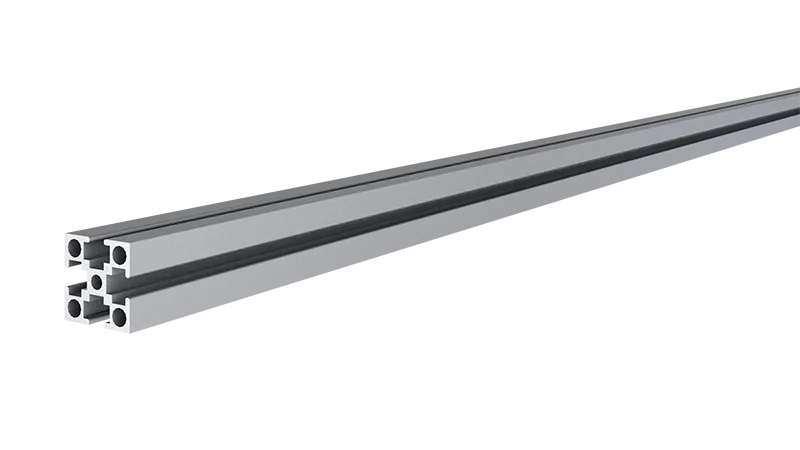
Let's start with the basics. The 2020 National Standard Profile is a type of aluminum extrusion profile—a long, hollow beam made by forcing aluminum alloy through a die to create a specific cross-sectional shape. The "2020" refers to its dimensions: typically 20mm in width and 20mm in height, making it compact but surprisingly strong. What really sets it apart, though, is its T-slot design . Running along its length are grooves (or "slots") that allow accessories—like brackets, connectors, panels, and even sensors—to be attached without welding, drilling, or specialized tools. It's like building with industrial-grade Legos, but for factories.
Compare this to older materials. Welded steel is strong but heavy and inflexible. Wood is cheap but prone to wear and chemical damage. Plastic is lightweight but lacks the structural integrity for heavy-duty tasks. Aluminum extrusion profiles, including the 2020 standard, hit the sweet spot: they're lightweight (about 1/3 the weight of steel), corrosion-resistant (thanks to aluminum's natural oxide layer), and infinitely customizable. And because they're standardized, parts from different suppliers work together seamlessly—no more worrying about mismatched sizes or proprietary connectors.
But why "national standard"? In many countries, including China, standardized profiles like the 2020 series are governed by national regulations that ensure consistency in dimensions, material quality, and performance. This standardization is critical for manufacturers: it means they can source 2020 profiles and accessories from multiple suppliers, reducing supply chain risks, and ensures that components from last year's workstation will still fit with this year's upgrades.

The Lean Connection: 2020 Profiles and the Art of Streamlined Manufacturing
Industry 4.0 and lean manufacturing go hand in hand. Lean principles—eliminating waste, optimizing workflow, and empowering workers—are even more critical in a world of small-batch production and frequent changeovers. The 2020 National Standard Profile isn't just flexible; it's lean by design .
Consider waste, for example. Traditional setups often result in "overproduction" waste: if a line is fixed, you might keep making more units than needed just to avoid the hassle of reconfiguring. With 2020 profiles, reconfiguring a workstation to produce a smaller batch takes minutes, not days. Workers can add a new shelf, adjust a conveyor angle, or mount a cobot arm using simple hand tools, meaning you only produce what's needed, when it's needed.
Then there's "motion waste"—the time workers spend walking to retrieve tools or materials. A well-designed workbench built with 2020 profiles can be customized to keep everything within arm's reach: tool holders attached via T-slot brackets, material bins on roller tracks (another 2020-compatible accessory), and even integrated lighting to reduce eye strain. It's not just about saving time; it's about making work easier and more efficient for the people on the factory floor.
Real-World Example: A Small Electronics Manufacturer's Lean Transformation
Take "TechFlow," a hypothetical (but representative) electronics manufacturer producing circuit boards for smart home devices. A few years ago, their production line was a maze of welded steel workbenches and fixed conveyor belts. When a customer ordered a new board design, they'd have to shut down production for 3–4 days to reposition workstations, weld new brackets, and reroute conveyors. Waste was high, and employee morale suffered from the constant disruptions.
Then they switched to 2020 National Standard Profiles. Today, their workstations are modular: each bench is built from 2020 aluminum extrusion profiles, with accessories like adjustable shelves, ESD (electrostatic discharge) mats (critical for electronics), and tool hooks that can be moved in seconds. When a new order comes in, the team uses a digital layout tool to plan the new setup, then spends 2 hours reconfiguring the line instead of 3 days. Downtime is down 90%, and they've cut material waste by 30% by producing smaller, more precise batches. "It's like night and day," says their production manager. "We used to dread change orders; now we see them as opportunities to show off how fast we can adapt."
Building Blocks of the Smart Workstation: 2020 Profiles in Action
Let's get concrete. How exactly do manufacturers use 2020 National Standard Profiles to build these adaptive systems? Let's break down three key applications:
1. Custom Workstations: Where Humans and Machines Collaborate
The workbench is the heart of any production line, and 2020 profiles are revolutionizing how these workhorses are designed. Unlike traditional wooden or steel benches, which are fixed in size and shape, a 2020 profile workbench can be tailored to the task at hand—and the worker using it.
For example, a cobot work cell (where a human and robot work side by side) might need a bench that's 1.2 meters long, with a cutout for the cobot's arm, a shelf for a computer monitor, and ESD protection to prevent static damage to sensitive components. Using 2020 profiles, this bench can be assembled in hours: aluminum extrusion rails form the frame, aluminum profile accessories like corner brackets and panel mounts secure the work surface, and casters (another 2020-compatible accessory) make it easy to move if the cell needs to be relocated.
Ergonomics matter too. Workers come in different heights, and repetitive strain injuries are a real risk. With 2020 profiles, legs can be adjusted using height-adjustable feet (yet another accessory), and the work surface can be tilted or raised/lowered to match the worker's posture. It's not just about productivity—it's about creating a workspace that's comfortable and safe, reducing turnover and absenteeism.
2. Material Handling: From Static Racks to Dynamic Flow Systems
Getting materials to the right place at the right time is the lifeblood of manufacturing. Traditional storage racks and fixed conveyor systems often create bottlenecks: if a part is needed on Line B instead of Line A, workers might have to carry it across the factory, wasting time and energy.
2020 National Standard Profiles solve this with modular material flow systems . For example, roller tracks—another key accessory—can be mounted to 2020 profile frames to create gravity-fed flow racks. These racks let materials "flow" to the workstation as needed, reducing the need for manual lifting. And because the racks are built with 2020 profiles, they can be expanded (add more levels) or repositioned (mount casters) as production needs change.
Take a car parts manufacturer that produces brake components. Their old system used static steel racks: parts were stored on shelves, and workers had to climb ladders to reach the top bins. Now, they've replaced those racks with 2020 profile flow racks: each rack has 3 rows and 3 floors (sound familiar?), with roller tracks that let bins slide down to the picking level as lower bins are emptied. No more ladders, no more wasted motion—and because the racks are built with aluminum extrusion profiles, they're lightweight enough to be moved when the production line shifts.
3. Testing and Quality Control Stations: Integrating Smart Tools
Quality control is non-negotiable in manufacturing, and Industry 4.0 is bringing new tools to the table: cameras, sensors, and AI-powered inspection systems that can detect defects in milliseconds. But these tools need a stable, flexible platform to operate from—and 2020 profiles deliver.
Imagine a testing station for smartphone screens. The station needs to hold the screen in place, rotate it for multi-angle camera checks, and connect to a computer that analyzes the data. With 2020 profiles, the frame can be built to exact specifications, with brackets to mount the rotation motor, slots to run cables (keeping them organized and out of the way), and adjustable arms to position the cameras. If the next model of phone has a larger screen? No problem—just extend the frame with additional 2020 profile sections and reposition the brackets. The station evolves with the product.
Aluminum Profile Accessories: The Glue That Holds It All Together
Let's not overlook the unsung heroes of the 2020 profile system: the accessories. Without the right connectors, brackets, and fasteners, even the best aluminum extrusion profile is just a piece of metal. Aluminum profile accessories turn 2020 profiles into a versatile building system, and their standardized design is what makes the whole thing work.
Consider the humble joint. Traditional setups might require welding two steel beams at a 90-degree angle—a permanent, time-consuming process. With 2020 profiles, you can use a 90-degree aluminum profile connector: a small, lightweight piece that slides into the T-slots of two profiles and tightens with a hex key. No welding, no sparks, no waiting for paint to dry. Need to change the angle later? Just loosen the key, reposition, and retighten. It's that simple.
Other accessories include panel mounts (to attach work surfaces or screens), hinge brackets (for fold-down shelves), and even sensor mounts (to attach IoT devices like temperature or vibration sensors). Because these accessories are standardized, manufacturers can mix and match from different suppliers, ensuring they always have the parts they need—no more waiting for a custom-made bracket.
One particularly clever accessory is the caster wheel . Mount casters to a 2020 profile frame, and suddenly a stationary workbench becomes a mobile cart. Need to move a workstation to a different part of the factory for maintenance? Just unlock the casters and roll it—no forklift required. It's this kind of flexibility that turns a static factory into a dynamic, responsive space.
Traditional vs. 2020 Profile-Based Manufacturing Setups: A Comparison
| Metric | Traditional Setups (Welded Steel/Wood) | 2020 National Standard Profile Setups |
|---|---|---|
| Reconfiguration Time | 3–5 days (requires welding, cutting, repainting) | 1–2 hours (tools: hex key, wrench) |
| Cost to Adapt | High (labor, materials, downtime) | Low (reusable profiles, minimal labor) |
| Weight | Heavy (difficult to move without equipment) | Lightweight (can be moved by 1–2 workers with casters) |
| Sustainability | Low (difficult to recycle; often discarded when obsolete) | High (aluminum is 100% recyclable; profiles can be reused indefinitely) |
| Customization | Limited (fixed design; changes require complete rebuild) | Unlimited (mix/match profiles and accessories for any layout) |
| Integration with New Tech | Challenging (drilling/welding required to mount sensors/robots) | Seamless (T-slots allow easy attachment of IoT devices, cobots, etc.) |
Overcoming the Hurdle: Why Some Manufacturers Hesitate (and Why They Shouldn't)
We'd be remiss not to address the elephant in the room: cost. At first glance, 2020 National Standard Profiles and aluminum extrusion profile systems can seem more expensive than traditional materials like welded steel or wood. After all, aluminum isn't the cheapest metal, and buying a set of accessories (connectors, brackets, casters) adds to the upfront cost.
But here's the thing: it's an investment, not an expense . Let's do the math. A traditional welded steel workbench might cost $500 to build, but if you need to reconfigure it 6 months later, you'll spend another $300 on labor and materials (welding, cutting, painting). A 2020 profile workbench might cost $800 upfront, but reconfiguring it costs $0 in materials (you reuse the profiles) and $50 in labor (an hour of a worker's time). Over two years, if you reconfigure just 3 times, the 2020 setup is already cheaper. And that's not counting the savings from reduced downtime, lower waste, and increased productivity.
Another concern is perceived complexity . "Do we need special training to use these profiles?" some manufacturers ask. The answer is no. Most 2020 profile systems are designed to be user-friendly: accessories attach with common tools (hex keys, wrenches), and many suppliers offer free design tools or templates to help plan layouts. In fact, many factories report that their existing maintenance teams can master the basics in a single day.
Future-Proofing Your Factory: 2020 Profiles and the Next Frontier of Industry 4.0
As we look ahead, the role of 2020 National Standard Profiles in Industry 4.0 will only grow. Here are three trends to watch:
1. Digital Twins and Virtual Design : Imagine designing a new production line in a virtual world before building it in real life. That's what digital twins—virtual replicas of physical systems—enable. 2020 profiles are perfect for this because their standardized dimensions make them easy to model in 3D software. Manufacturers can test different layouts virtually, identify bottlenecks, and tweak designs before a single profile is cut. This reduces trial-and-error and speeds up time to market.
2. Circular Manufacturing : Sustainability isn't just a buzzword; it's a business imperative. Aluminum is 100% recyclable, and 2020 profiles are built to last. When a workstation is no longer needed, the profiles can be disassembled, cleaned, and reused to build something new. This reduces waste and aligns with global efforts to create circular economies—where materials are kept in use for as long as possible.
3. Global Supply Chain Resilience : With national standards in place, 2020 profiles are available from suppliers around the world. This reduces reliance on a single source, making manufacturers more resilient to supply chain disruptions. If one supplier is delayed, you can source profiles from another—knowing they'll fit with your existing accessories.
Conclusion: The 2020 Profile—More Than Metal, It's a Mindset
At the end of the day, the 2020 National Standard Profile is more than just a piece of aluminum extrusion. It's a symbol of a new way of thinking about manufacturing: one that embraces change, values flexibility, and puts people at the center. In an age where the only constant is change, the factories that thrive will be those that can adapt quickly, efficiently, and cost-effectively.
Whether you're a small contract manufacturer or a large automotive plant, the message is clear: to compete in Industry 4.0, you need a foundation that can keep up. The 2020 National Standard Profile, with its modular design, standardized accessories, and lean principles, isn't just a tool—it's a partner in innovation. It's the difference between struggling to keep up with change and leading the charge.
So, the next time you walk through a factory, take a closer look at the workbenches, the racks, the conveyor systems. Chances are, if it's agile, adaptable, and built to last, it's built with 2020 National Standard Profiles. And that's not just good manufacturing—that's smart manufacturing.