- Company Articles
- Industry articles
- Industry standards
- How 2040 National Standard Profile Enhances Reusability in Lean Production

How 2040 National Standard Profile Enhances Reusability in Lean Production
Related Product
2040 National Standard Profile
45° external bending joint, used for 45° external connection of two aluminum pipes.
Exploring modularity, adaptability, and waste reduction through aluminum innovation
The Frustration of Fixed Systems: A Factory Manager's Dilemma
It's a Tuesday morning at PrecisionWorks Electronics, and Maria, the production manager, is staring at a line of workstations that once felt cutting-edge. Today, they feel like anchors. Last month, the company launched a new smartphone model, and the assembly process requires longer workbenches with integrated tool racks—something the current steel-framed stations can't accommodate. "We spent $40,000 on these workstations two years ago," she sighs, running a hand over a chipped corner. "Now we need to either modify them with welders (which will take a week) or buy new ones (which will cost another $35,000). Either way, we're wasting time and money."
Maria's frustration is familiar to anyone in manufacturing: rigid, one-size-fits-all equipment that can't keep up with evolving production needs. In lean production—where the goal is to minimize waste (muda) and maximize value—this kind of inflexibility is the enemy. But what if there was a way to build workstations, material racks, and even conveyor systems that adapt as quickly as your production lines do? Enter the 2040 National Standard Profile, a but revolutionary component that's quietly transforming how factories approach reusability.
What Is the 2040 National Standard Profile?
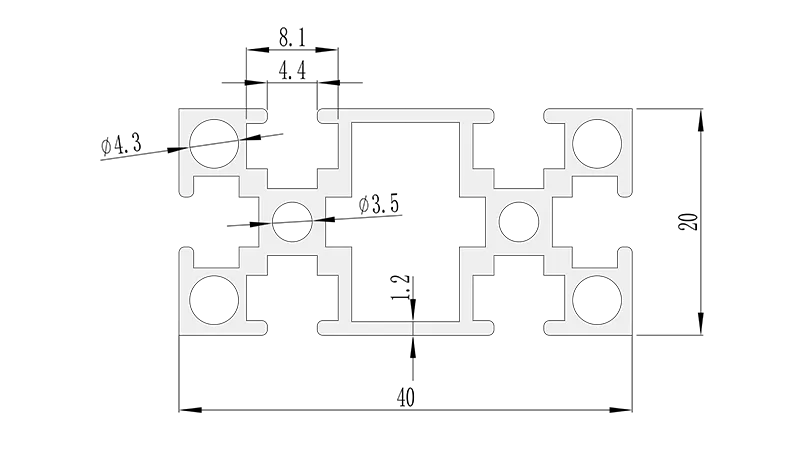
At first glance, the 2040 National Standard Profile looks like a simple piece of aluminum—sleek, silver, and unassuming. But its design holds the key to solving Maria's problem. Let's break it down: "2040" refers to its dimensions (20mm in width, 40mm in height), while "National Standard" means it adheres to uniform sizing guidelines, ensuring compatibility across manufacturers. Made from aluminum extrusion profile—a process where aluminum is forced through a die to create consistent, precision shapes—this profile is built for modularity.
The most critical feature? Its T-slot design. Running along the length of the profile are grooves (or "slots") shaped like a "T," which act as universal attachment points. Slide a bolt into the slot, tighten it, and you've secured a bracket, a shelf, a lamp, or almost any accessory. No welding, no drilling, no specialized tools. It's like building with industrial-scale Legos, but sturdier and infinitely more versatile.
Quick Fact:
Aluminum extrusion profile isn't new—car parts, window frames, and even bicycle frames have used it for decades. But the 2040 National Standard Profile takes this technology a step further by prioritizing interoperability. Its slots and dimensions align with a vast ecosystem of aluminum profile accessories, from brackets to casters, making it easy to mix, match, and reconfigure.
Reusability 101: Why Lean Production Needs Adaptable Tools
Before diving into how the 2040 profile enhances reusability, let's clarify what "reusability" means in lean production. It's not just about recycling old materials (though that matters). In this context, reusability is about designing tools and systems that can be repurposed, modified, or reconfigured for new tasks without significant overhaul. A workstation that assembles smartphones today should, with minimal effort, assemble smartwatches tomorrow. A material rack that holds circuit boards this month should hold batteries next month. When equipment can't do this, it becomes waste—either literal (scrapped metal) or operational (delays, lost productivity).
Traditional solutions often fail here. Steel workbenches are durable but require welding to modify. Wood is cheap but prone to wear and can't support heavy loads. Plastic is lightweight but lacks strength. The 2040 National Standard Profile, by contrast, is engineered to bridge this gap. Let's explore its key features that make reusability not just possible, but practical.
3 Key Features of 2040 Profile That Drive Reusability
1. Modularity: Build, Dismantle, Rebuild—No Welding Required
The T-slot design is the 2040 profile's superpower. Unlike steel, which requires heat and skill to modify, aluminum profile accessories (think brackets, hinges, and even panels) attach to the slots with simple bolts and nuts. Need to add a shelf to a workbench? Slide a bracket into the slot, tighten the bolt, and you're done. Want to shorten the workbench? Loosen the bolts, remove a section, and reattach the ends. This modularity means components aren't "permanently" fixed—they're temporarily connected, ready to be rearranged.
Consider a scenario: A electronics plant switches from producing small sensors to larger IoT devices. With traditional steel workstations, this would require cutting the frames and rewelding new sections. With 2040 profiles, workers can disconnect the existing bench sections, add two extra 2040 profile lengths, and reattach the accessories—all in under an hour, using basic hand tools. The original sections? They can be stored and reused later when the plant cycles back to sensor production.
2. Durability: Aluminum That Lasts (and Lasts)
Reusability only matters if the material can withstand multiple cycles of disassembly and reassembly. Aluminum is naturally corrosion-resistant (thanks to its oxide layer), and the 2040 profile's extrusion process strengthens it further. Unlike wood, which warps or rots, or plastic, which cracks under stress, aluminum holds up to heavy use, repeated adjustments, and even occasional bumps from forklifts.
A study by the Lean Manufacturing Institute found that aluminum extrusion systems like the 2040 profile have an average lifespan of 10–15 years—three times longer than traditional steel workstations. Over that time, they can be repurposed dozens of times, drastically reducing the need for replacements.
3. Compatibility: A Ecosystem of Accessories, Not Just a Profile
A profile is only as useful as the accessories it works with. The 2040 National Standard Profile is part of a vast ecosystem of aluminum profile accessories—casters for mobility, roller tracks for material flow, even LED light brackets for workbench illumination. These accessories are designed to fit the T-slots seamlessly, so you're never stuck hunting for custom parts.
Take casters, for example: A workbench without wheels (like the "Workbench E (Single Deck-Without Caster)" in many catalogs) can be upgraded by adding caster brackets to its 2040 legs. Later, if you need the bench to stay stationary, swap the casters for adjustable feet—no drilling, no modifications to the profile itself. This ecosystem turns a single profile into a foundation for endless configurations.
From Workbench to Warehouse: Real-World Reusability in Action
To see the 2040 profile's impact, let's walk through three common factory setups and how reusability transforms them. These examples aren't hypothetical—they're based on case studies from manufacturers that have adopted the technology.
Case 1: The Adaptive Workbench
At a automotive parts supplier in Guangzhou, workers once used fixed steel workbenches for assembling brake components. When the company shifted to electric vehicle (EV) parts, which are bulkier, the workbenches were too short. With 2040 profiles, they built new workstations by combining 2040 and 2020 National Standard Profiles (the latter for lighter sections). Six months later, when a client ordered smaller EV sensors, they disassembled 30% of the bench length, reusing the removed 2040 sections to build a new inspection station. "We didn't throw away a single piece of aluminum," says the plant manager. "We just rearranged it."
Case 2: The Modular Material Rack
A pharmaceutical packaging plant needed racks to hold plastic bottles of varying sizes—from 50ml vials to 500ml jars. Traditional wooden racks warped under the weight of glass bottles, and steel racks were too rigid to adjust. They switched to 2040 profile racks with adjustable dividers (using aluminum profile accessories like sliding brackets). When a new 250ml bottle size was introduced, workers simply loosened the brackets, slid the dividers to the new width, and tightened them—no tools beyond a hex key. The same racks now handle three bottle sizes, and the dividers can be moved again if needed.
Case 3: The Reconfigurable Conveyor System
A food packaging company faced a seasonal challenge: during the holidays, they needed longer conveyor lines to handle increased demand; in slow months, shorter lines to save space. With traditional belt conveyors, this meant storing extra sections (wasting floor space) or renting equipment (wasting money). They replaced the system with 2040 profile frames and roller tracks (another aluminum accessory). Now, adding or removing conveyor sections takes two workers 30 minutes—no bolts, no welding, just slotting the roller tracks into the T-slots. The "extra" sections are stored vertically on a 2040 profile rack, taking up minimal space until next season.
The Numbers Speak: Comparing Traditional vs. 2040 Profile Systems
Still skeptical? Let's put reusability into concrete terms. The table below compares a traditional steel workstation with a 2040 profile workstation over a 5-year lifecycle, based on data from the Manufacturing Technology Insights Report 2024.
| Metric | Traditional Steel Workstation | 2040 National Standard Profile Workstation |
|---|---|---|
| Initial Cost | $1,200 (fixed size, welded) | $1,500 (modular, expandable) |
| Time to Reconfigure | 72 hours (requires welding, painting) | 2 hours (hand tools only) |
| Number of Reconfigurations Possible | 1–2 (welding weakens steel over time) | Unlimited (no structural damage from adjustments) |
| Replacement Cost After 5 Years | $1,200 (must replace entire unit) | $300 (replace worn accessories only) |
| Total Lifecycle Cost | $2,400 (initial + replacement) | $1,800 (initial + minor accessories) |
| Waste Generated | 150kg (scrapped steel, paint waste) | 5kg (only worn plastic accessories) |
The 2040 profile's higher initial cost is offset by its ability to adapt, reducing long-term expenses and waste. For Maria at PrecisionWorks, this would mean avoiding that $35,000 workstation replacement—instead, reusing the existing 2040 components to build the longer workbenches needed for the new smartphone line.
Beyond the Factory Floor: How Reusability Strengthens Lean Systems
Reusability isn't just about saving money on equipment. It's about strengthening the entire lean system by:
- Reducing Lead Times: When you can reconfigure a workstation in hours instead of days, you launch new products faster.
- Empowering Teams: Frontline workers—who know the production process best—can adjust tools without waiting for maintenance. This fosters a culture of continuous improvement (kaizen), a core lean principle.
- Minimizing Inventory: Instead of stocking multiple sizes of fixed racks, you stock a few 2040 profiles and accessories, trusting they'll adapt to future needs.
- Supporting Sustainability: Aluminum is 100% recyclable, but reusing it (rather than recycling) saves even more energy. The EPA estimates that reusing aluminum requires 95% less energy than producing new aluminum from ore.
"We used to see equipment as 'disposable'—buy it, use it, replace it. Now, with 2040 profiles, we see it as an investment that grows with us. That mindset shift alone has cut our waste by 30%." — Li Wei, Operations Director, Eastern Electronics
The Future of Reusability: What's Next for 2040 Profile and Lean Production?
As manufacturing continues to shift toward customization (think "batch size 1" production) and rapid product cycles, reusability will only grow more critical. The 2040 National Standard Profile is already evolving to meet this demand. Manufacturers are developing new aluminum profile accessories, like smart sensors that attach to T-slots to monitor workstation usage, and lightweight carbon-fiber composites that pair with aluminum for even more durability.
There's also a push for "digital twins"—3D models of 2040-based systems that let managers simulate reconfigurations before making physical changes. Imagine Maria at PrecisionWorks using a tablet to drag-and-drop 2040 profile sections on a screen, seeing how the new workstation will look, and then sending the design directly to the shop floor. This kind of digital-physical integration will make reusability faster and more precise than ever.
But perhaps the biggest opportunity is cultural. For decades, manufacturing has prioritized "permanence" in equipment—buying something that "lasts forever." The 2040 profile challenges that: it's not about lasting forever; it's about being useful forever, in new ways. As more factories adopt this mindset, we'll move closer to a truly lean future—one where waste is minimized, adaptability is maximized, and every component has a second (and third, and fourth) life.
Final Thoughts: From Frustration to Freedom
Maria never did weld those steel workstations. Six months after her initial frustration, PrecisionWorks invested in 2040 National Standard Profile systems. Today, the new smartphone line is up and running, with workstations that adjust as the assembly process improves. The old steel stations? They're being scrapped, but Maria doesn't mind—she knows the 2040 profiles will outlive the next five product launches, at least.
Reusability in lean production isn't a buzzword. It's a practical solution to a universal problem: how to do more with less. The 2040 National Standard Profile, with its modular design, durable aluminum build, and ecosystem of accessories, isn't just a tool—it's a philosophy. It says, "Let's build systems that grow with us, not against us." And in a world where change is the only constant, that's a philosophy worth investing in.