- Company Articles
- Industry articles
- Industry standards
- How 2040 National Standard Profile Supports Continuous Improvement in Production

How 2040 National Standard Profile Supports Continuous Improvement in Production
Related Product
2040 National Standard Profile
45° external bending joint, used for 45° external connection of two aluminum pipes.
Introduction: The Pursuit of Continuous Improvement in Modern Manufacturing
In today's fast-paced manufacturing landscape, the ability to adapt, optimize, and evolve isn't just a competitive advantage—it's a survival skill. Production lines face relentless pressure to reduce waste, enhance efficiency, and meet ever-changing customer demands. At the heart of this challenge lies the concept of continuous improvement: a mindset that encourages small, incremental changes to drive long-term growth. Yet, even the best intentions can stumble when supported by rigid, outdated tools and infrastructure. This is where the right equipment becomes a game-changer—and why the 2040 National Standard Profile has emerged as a silent hero for manufacturers committed to progress.
Imagine a production floor where workbenches can be reconfigured in hours, not days; where material flow racks adjust seamlessly to new product sizes; and where every component—from conveyor tracks to tool holders—works in harmony to minimize downtime. This isn't a distant vision—it's the reality made possible by modular aluminum profiles, and the 2040 National Standard Profile stands at the forefront of this revolution. Designed with precision, flexibility, and adaptability in mind, it's more than just a piece of metal. It's a foundation for building production systems that grow, learn, and improve alongside your business.
In this article, we'll explore how the 2040 National Standard Profile empowers continuous improvement, from its core design features to its real-world applications. We'll dive into how it integrates with lean systems, enhances workflow efficiency, and why it's become a go-to choice for manufacturers aiming to stay ahead in an unpredictable market. Whether you're managing a small workshop or a large-scale production facility, understanding the role of this versatile profile could be the first step toward unlocking your team's full potential.
What is the 2040 National Standard Profile?
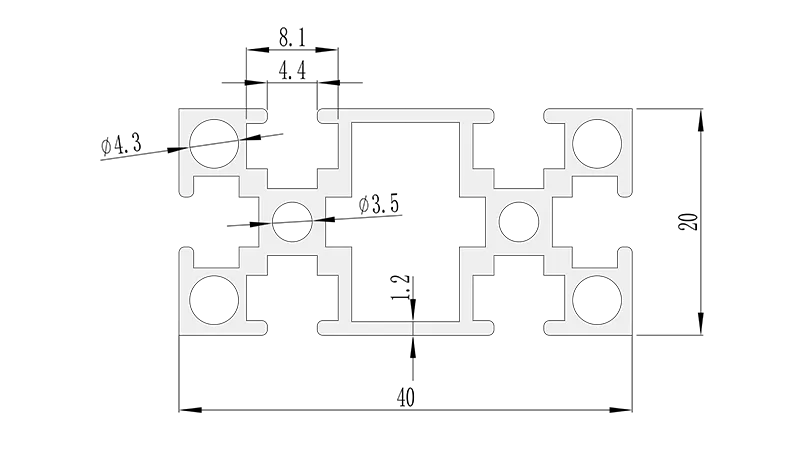
Before we explore its impact, let's start with the basics: What exactly is the 2040 National Standard Profile? At its core, it's a type of aluminum extrusion—meaning it's formed by pushing heated aluminum through a die to create a consistent, cross-sectional shape. The "2040" designation refers to its dimensions: 20 millimeters in width and 40 millimeters in height, making it a medium-sized profile ideal for a wide range of applications. What sets it apart, however, is its adherence to national standards, ensuring uniformity, compatibility, and reliability across manufacturers and suppliers.
Unlike generic aluminum bars or rigid steel frames, the 2040 National Standard Profile features a T-slot design—a series of grooves running along its length that allow for easy attachment of accessories, brackets, and components. These slots act as built-in connection points, eliminating the need for welding, drilling, or complex fasteners. This seemingly simple feature is the key to its flexibility: with the right aluminum profile accessories, the profile can be transformed into almost any structure your production line needs, from workbenches and flow racks to machine guards and material trolleys.
Material-wise, aluminum was a deliberate choice. It strikes a perfect balance between strength and weight: strong enough to support heavy tools and materials, yet lightweight enough to make reconfiguration a one-person job. It's also corrosion-resistant, ensuring longevity even in harsh factory environments, and its smooth, clean finish contributes to a safer, more organized workspace. For manufacturers prioritizing sustainability, aluminum is fully recyclable, aligning with modern eco-friendly production goals.
Key Features Driving Continuous Improvement
Continuous improvement thrives on adaptability. A production system that can't change quickly becomes a bottleneck, trapping teams in inefficient workflows and stifling innovation. The 2040 National Standard Profile addresses this head-on with features designed to make change not just possible, but easy. Let's break down the critical attributes that make it a catalyst for progress.
Modularity: Build, Break, Rebuild—No Expertise Required
Traditional production setups often rely on custom-built steel structures or fixed workbenches. When a new product line is introduced or a workflow is optimized, these structures become obstacles. Modifying them requires skilled labor, specialized tools, and downtime—all of which eat into productivity. The 2040 profile, by contrast, is inherently modular. Its T-slot design and compatible aluminum profile accessories (like 90° aluminum profile connectors, end caps, and brackets) allow teams to assemble, disassemble, and reassemble structures in minutes. Need to add a shelf to a workbench? Slide a bracket into the T-slot and secure it with a bolt. Want to shorten a flow rack to fit a new space? Simply disconnect the sections and reattach. This modularity turns "permanent" infrastructure into a flexible toolkit, letting teams experiment with layouts and processes without fear of wasted time or resources.
Precision and Consistency: Eliminating Variability in Workflows
In manufacturing, consistency is king. Even small variations in workstation height, material placement, or tool access can lead to errors, fatigue, and inefficiency. The 2040 National Standard Profile, produced to strict national standards, ensures every piece is identical in size, slot placement, and strength. This uniformity means that when you replicate a workbench or flow rack, you get exact duplicates—no guesswork, no mismatched parts. For example, if your team designs an optimal assembly workstation using 2040 profiles, you can roll out identical setups across the factory, ensuring every operator has the same ergonomic support and tool access. This reduces training time, minimizes errors, and creates a baseline for measuring improvement: if one workstation outperforms others, the difference is due to process, not infrastructure.
Strength-to-Weight Ratio: Durability Without the Bulk
A common misconception is that "flexible" equals "flimsy." The 2040 profile shatters this myth. Aluminum's inherent strength, combined with the profile's engineered cross-section, allows it to support significant weight—up to 150 kg per linear meter in many configurations. This means it can handle heavy tools, raw materials, and finished products without bending or warping. Yet, unlike steel, it remains lightweight. A typical 2040 profile workbench, for instance, can be moved by two people without the need for forklifts or cranes. This portability is a boon for continuous improvement: if a workflow analysis reveals that a workbench would be more efficient on the other side of the line, it can be relocated in an hour, not a day. The result? Less downtime, more experimentation, and faster implementation of proven optimizations.
Applications in Production: From Workbench to Flow Rack
The true test of any tool is how well it solves real-world problems. The 2040 National Standard Profile excels here, with applications that span the entire production lifecycle. Let's explore two critical areas where it drives continuous improvement: workbenches and flow racks.
Workbenches: Ergonomic, Customizable, and Always Evolving
The workbench is the heart of any assembly or packaging operation. An ill-designed workbench leads to operator fatigue, slow cycle times, and even injuries—all barriers to continuous improvement. The 2040 profile transforms this space into a tailored, adaptable workstation. Here's how:
- Ergonomic Adjustability: With height-adjustable legs (another aluminum profile accessory), workbenches can be set to fit operators of all sizes, reducing strain on backs and shoulders. T-slot mounting allows tools, monitors, and bins to be positioned at eye or waist level, minimizing reaching and bending.
- Tool Integration: From power strips to tool holders, everything can be mounted directly to the profile. No more searching for misplaced tools—they're always within arm's reach, cutting down on "walking around" waste (a key target in lean systems).
- ESD Compatibility: For electronics manufacturers, static electricity is a constant threat. The 2040 profile can be paired with ESD-safe accessories (like conductive end caps or anti-slip mats) to create ESD workstations that protect sensitive components, reducing defects and rework.
Perhaps most importantly, as workflows improve, the workbench improves with them. If a new tool is introduced, it's added in minutes. If a process step is eliminated, the excess components are removed, decluttering the space. This adaptability ensures the workbench never becomes outdated.
Flow Racks: Streamlining Material Flow for Lean Efficiency
In lean manufacturing, material flow is everything. A smooth, uninterrupted flow reduces wait times, minimizes handling, and ensures materials arrive exactly when needed (a principle known as "just-in-time"). Flow racks—structures that use gravity or rollers to move materials from storage to the production line—are critical to this, and the 2040 profile elevates their performance.
Traditional flow racks are often fixed in size, limiting the types of materials they can handle. With the 2040 profile, flow racks become adjustable. Using roller track placon mount for aluminum profile flat (a type of bracket that secures roller tracks to the profile), teams can modify the angle of the rack to control material speed, add or remove lanes to match production demand, or adjust shelf heights to fit larger or smaller containers. For example, if a new product requires wider bins, simply reposition the aluminum guide rails to create more space—no cutting or welding required.
This flexibility also supports kanban systems, a cornerstone of lean systems. Kanban relies on visual signals to trigger material replenishment, and flow racks built with 2040 profiles make these signals clearer. Colored dividers (attached via T-slot brackets) can separate materials by production stage, while labeled bins slide smoothly along roller tracks, ensuring operators always know what's in stock and what needs to be reordered. The result? Less overstock, reduced inventory costs, and a production line that responds quickly to demand changes.
Integration with Lean Systems: Aligning with the Principles of Waste Reduction
Continuous improvement and lean manufacturing are two sides of the same coin. Lean systems focus on eliminating waste (or "muda") in all forms—from overproduction and waiting to unnecessary movement and defects. The 2040 National Standard Profile isn't just a tool for building structures; it's a tool for building leaner systems. Let's see how it aligns with key lean principles.
5S Methodology: Sort, Set in Order, Shine, Standardize, Sustain
The 5S methodology is all about creating a clean, organized workspace that reduces waste and improves efficiency. The 2040 profile supports every step:
- Sort: Modular storage solutions (built with 2040 profiles and aluminum profile accessories) help separate essential tools from unnecessary clutter, ensuring only what's needed is on the production floor.
- Set in Order: T-slot mounting allows tools and materials to be placed in fixed, labeled positions—no more "hunting" for items. For example, a workbench can have dedicated slots for screwdrivers, wrenches, and bins, each secured via brackets.
- Shine: Aluminum's smooth surface is easy to clean, and modular structures can be disassembled for deep cleaning, preventing dust and debris buildup.
- Standardize: Uniform 2040 profile workstations ensure every operator has the same setup, making training consistent and reducing errors.
- Sustain: Because the system is easy to maintain and adjust, teams are more likely to keep it organized long-term. No one wants to revert to chaos when order is so simple to maintain.
Kaizen Events: Rapid Improvement with Minimal Disruption
Kaizen events—short, focused workshops where teams collaborate to solve specific efficiency problems—are a hallmark of continuous improvement. These events thrive on quick action: identify a problem, test a solution, implement it, and measure results. The 2040 profile is perfect for this, as it allows teams to prototype new workflows in hours. For example, if a kaizen team identifies that material handling is causing delays, they can assemble a temporary turnover trolley using 2040 profiles, test it on the floor, and refine it on the spot. If it works, they can build permanent versions; if not, they disassemble it and try again—no wasted materials, no extended downtime.
Aluminum Profile Accessories: The Secret to Endless Customization
A profile is only as good as the accessories that bring it to life. The 2040 National Standard Profile's versatility hinges on a wide range of aluminum profile accessories—components designed to extend its functionality and adapt it to specific needs. These accessories turn a simple aluminum extrusion into a complete production system, and their availability is what makes the profile so indispensable for continuous improvement.
Let's explore some of the most impactful accessories and how they enhance the profile's utility:
Connectors: The Glue That Holds It All Together
Connectors are the foundation of modularity. The 90° aluminum profile connector, for example, allows two profiles to be joined at a right angle—essential for building workbench frames or flow rack corners. For more complex angles, there are 45° and 135° connectors, while straight connectors link profiles end-to-end to create longer structures. What's remarkable is that these connectors require no special tools: most use a simple bolt and nut system that tightens within the T-slot, creating a secure, rattle-free joint. This means even non-technical staff can assemble structures with confidence.
End Caps and Covers: Safety and Cleanliness
Raw aluminum profiles have exposed ends that can be sharp, posing a safety risk. End caps—plastic or aluminum covers that snap onto the profile's ends—eliminate this hazard, creating a smooth, safe edge. They also prevent dust, debris, and liquids from entering the T-slots, keeping the profile clean and functional over time. For facilities with strict hygiene standards (like food processing or pharmaceuticals), specialized end caps with gaskets can even create a waterproof seal.
Brackets and Mounts: Attaching Everything from Tools to Monitors
Brackets are the workhorses of customization. Tool brackets secure drills, screwdrivers, and pneumatic tools to workbenches, keeping them within reach. Monitor mounts attach screens to profile frames, displaying work instructions or production metrics without cluttering the workspace. For heavier items, like small machines or conveyor systems, heavy-duty angle brackets distribute weight evenly, ensuring stability. The beauty of these brackets is their adjustability: most can slide along the T-slot to find the perfect position, then lock in place with a simple twist of a bolt.
Roller Tracks and Guides: Making Material Flow Effortless
For flow racks, assembly lines, or conveyor systems, roller tracks are essential. These tracks—often paired with roller track placon mount for aluminum profile high (brackets that raise the track to the desired height)—allow materials to glide smoothly from one workstation to the next. The 2040 profile's T-slots make it easy to mount these tracks at varying angles, controlling the speed of material flow. For example, a steeper angle might be used for lightweight boxes, while a shallower angle slows heavier containers, preventing jams.
Traditional vs. 2040 Profile: A Comparative Look at Efficiency
To truly appreciate the impact of the 2040 National Standard Profile, it helps to compare it with traditional production setups. Let's examine how it stacks up against common alternatives in key areas critical to continuous improvement.
| Aspect | Traditional Steel Workbench/Flow Rack | 2040 National Standard Profile Setup |
|---|---|---|
| Reconfiguration Time | Days (requires welding, drilling, or custom fabrication) | Hours (modular assembly with hand tools) |
| Customization Flexibility | Limited (fixed dimensions; hard to add/remove components) | Unlimited (T-slot design accepts endless accessories) |
| Weight | Heavy (requires machinery to move/modify) | Lightweight (easily moved by 1-2 people) |
| Cost Over Time | High (frequent replacement of fixed structures) | Low (reusable components; adapts to changing needs) |
| Ergonomic Adaptability | Fixed height/ layout (leads to operator fatigue) | Adjustable height/ tool placement (reduces strain) |
| Waste Generation | High (scrap metal from modifications; short lifespan) | Low (recyclable aluminum; components reused) |
The table tells a clear story: traditional setups are rigid, time-consuming, and costly in the long run, while 2040 profile systems are agile, adaptable, and designed for continuous improvement. Every hour saved on reconfiguration, every dollar saved on replacement structures, and every injury prevented by ergonomic design adds up to significant gains in productivity and morale.
Real-World Impact: How Manufacturers Are Using 2040 Profiles to Improve
Theory is powerful, but real-world results speak loudest. Across industries, manufacturers are leveraging the 2040 National Standard Profile to transform their production lines and drive continuous improvement. Let's look at a few examples that highlight its versatility and impact.
Electronics Manufacturer: Reducing Changeover Time by 70%
A mid-sized electronics company producing circuit boards was struggling with frequent product changes. Each new board required a different assembly setup, and their fixed steel workbenches took 8 hours to reconfigure—eating into production time and delaying orders. They switched to workbenches built with 2040 profiles and aluminum profile accessories. Now, when a new product is introduced, operators use quick-release brackets to swap out tool holders, adjust shelf heights, and reposition ESD mats. Changeover time dropped to 2 hours, and the team estimates they've increased annual production capacity by 15%—all without adding new equipment.
Automotive Supplier: Streamlining Material Flow with Lean Flow Racks
An automotive parts supplier was drowning in inventory waste. Their traditional static shelving forced them to stockpile parts to avoid stockouts, tying up capital and taking up valuable floor space. They replaced the shelving with flow racks built using 2040 profiles, roller tracks, and adjustable aluminum guide rails. The racks, integrated with a kanban system, now deliver parts directly to the assembly line as needed. By adjusting the rack angles and lane widths, they reduced inventory levels by 30% and freed up 2,000 square feet of floor space—space now used for a new production cell that increased output by 20%.
Medical Device Maker: Enhancing Safety and Compliance
A medical device manufacturer faced strict regulatory requirements for clean, ergonomic workspaces. Their old wooden workbenches were hard to sanitize and prone to splintering, risking contamination of sensitive devices. They transitioned to 2040 profile workbenches with aluminum honeycomb panels (non-porous, easy-to-clean surfaces) and ESD accessories. The modular design allowed them to add built-in UV sterilization lights and HEPA filters (mounted via T-slot brackets), ensuring compliance with medical standards. Worker satisfaction also improved: adjustable heights reduced reported back pain by 40%, and tool organization cut "search time" waste by 25%.
Conclusion: Building a Foundation for Never-Ending Improvement
Continuous improvement isn't a destination—it's a journey. It requires tools that don't just support today's workflows but enable tomorrow's innovations. The 2040 National Standard Profile is more than a tool; it's a partner in that journey. Its modularity, precision, and adaptability empower teams to experiment, learn, and grow, turning small, incremental changes into lasting success.
From workbenches that adjust to every operator's needs to flow racks that adapt to shifting demand, from kaizen events that prototype solutions in hours to lean systems that eliminate waste at every turn, the 2040 profile is the backbone of modern, efficient production. It doesn't just solve today's problems—it prevents tomorrow's by making change easy, affordable, and accessible to everyone on the floor.
For manufacturers ready to embrace continuous improvement, the message is clear: invest in infrastructure that invests in you. The 2040 National Standard Profile isn't just a purchase—it's a commitment to progress, a statement that your team deserves the best tools to do their best work, and a promise that your production line will never stop getting better.
So, the next time you look at your production floor, ask: Is your infrastructure holding you back, or propelling you forward? With the 2040 National Standard Profile, the answer can be the latter—today, tomorrow, and for every improvement yet to come.