- Company Articles
- Industry articles
- Industry standards
- How 2040 National Standard Profile Supports Just-In-Time (JIT) Production

How 2040 National Standard Profile Supports Just-In-Time (JIT) Production
Related Product
2040 National Standard Profile
45° external bending joint, used for 45° external connection of two aluminum pipes.
In today's fast-paced manufacturing world, where customer demands shift overnight and production lines need to pivot at a moment's notice, Just-In-Time (JIT) production has become more than just a buzzword—it's a survival strategy. At its core, JIT is about trimming waste, streamlining workflows, and ensuring that every part, tool, and process serves a clear, immediate purpose. But here's the catch: JIT can only thrive if your production infrastructure is as agile as your goals. Rigid, one-size-fits-all workbenches, clunky material racks, and inflexible conveyor systems? They're the antithesis of JIT. They slow you down, create bottlenecks, and turn "just in time" into "just too late." That's where the 2040 national standard profile comes in. This unassuming aluminum extrusion has quietly revolutionized how manufacturers build, adapt, and optimize their production spaces—making it a cornerstone of modern lean systems. Let's dive into how this simple yet powerful component is changing the game for JIT-focused facilities.
Understanding JIT's Greatest Challenge: Rigidity
Before we talk about the 2040 national standard profile, let's first unpack why traditional production setups often fail JIT. Imagine a factory floor built around fixed steel workbenches. These benches are sturdy, sure, but they're welded in place. If your product line changes—say, you need to add a new assembly step or reposition tools to reduce operator movement—you're looking at hours (or days) of cutting, welding, and reconfiguring. That's downtime, and in JIT, downtime is waste. Then there are material racks: heavy, bolted-to-the-floor structures that can't be adjusted to accommodate taller boxes or narrower components without a complete overhaul. Even something as basic as a conveyor system might require custom parts or specialized labor to modify, leaving you stuck with a setup that can't keep up with shifting production schedules.
JIT demands responsiveness . It requires that your workspace can evolve as quickly as your production needs. You might need to scale up a line for a sudden order surge, then scale it back the next week. You might need to rearrange workstations to group similar tasks, or add new storage solutions for a new component. Traditional infrastructure wasn't designed for this. It's built for stability, not speed. And that's where the 2040 national standard profile flips the script.
What Is the 2040 National Standard Profile? A Quick Primer
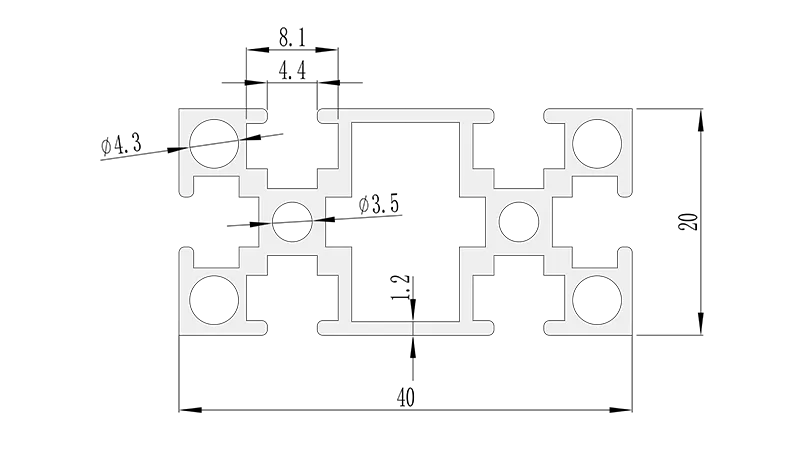
Let's start with the basics: the 2040 national standard profile is an aluminum extrusion with a cross-sectional dimension of 20mm by 40mm. At first glance, it might look like just another metal bar, but its real magic lies in its design. Unlike solid steel or generic aluminum pipes, this profile features a T-slot along its length—a groove that runs the entire extrusion, allowing accessories like brackets, connectors, and panels to slide in and lock into place with simple bolts. No welding, no drilling, no special tools. Just slide, tighten, and you're done.
But why 20mm by 40mm? That dimension isn't arbitrary. It strikes a perfect balance between strength and versatility. It's lightweight enough to be maneuvered by a single operator (critical for quick reconfigurations) but strong enough to support heavy loads—think toolboxes, assembly fixtures, or even small machinery. And because it's a "national standard" profile, it's compatible with a wide range of aluminum profile accessories, from corner brackets to shelf supports, making it easy to source and integrate into existing systems.
Aluminum, as a material, is also a JIT dream. It's corrosion-resistant, so it holds up in busy, sometimes messy production environments. It's non-conductive, which is a plus for electronics manufacturing. And it's recyclable, aligning with the sustainability goals that many modern factories prioritize. But the real star here is the T-slot design. It turns the 2040 profile from a static component into a building block for endless possibilities.
Flexibility: The Foundation of JIT, Built Into Every T-Slot
From Fixed Workbenches to Adaptive Workstations
Let's zoom in on one of the most critical areas of any production line: the workbench. In a traditional setup, a workbench is a permanent fixture. Its height is fixed, its shelves are bolted on, and if you need to add a tool rail or a parts bin, you're either drilling holes (and ruining the bench for future use) or kludging together a solution with zip ties and duct tape. That's not JIT—that's chaos.
Now picture a workbench built with 2040 national standard profiles. The frame is assembled using aluminum profile accessories like 90° connectors and corner brackets, which slide into the T-slots and tighten with a hex key. The tabletop? It's a lightweight aluminum honeycomb panel that locks into place with panel mounts. Need to raise the bench by 6 inches to reduce operator strain? Swap out the leg profiles for longer ones—no cutting, no welding. Want to add a shelf above the bench for tools? Slide shelf brackets into the T-slots, adjust the height, and lock them down. Tomorrow, if you need to move that shelf to the side to make room for a new fixture? Just loosen the bolts, reposition, and tighten. Done in 5 minutes, not 5 hours.
This kind of flexibility directly addresses one of JIT's biggest enemies: motion waste. When workbenches are tailored to the operator's needs—height, tool placement, parts accessibility—operators spend less time reaching, bending, or walking to grab tools. Every second saved adds up. A study by the Lean Enterprise Institute found that manufacturers using modular workbenches reduced operator motion by up to 30%, translating to faster assembly times and fewer errors. That's JIT in action: making the most of every movement, because in JIT, time is the most valuable resource.
Flow Racks That Keep Pace with Production
Material handling is another JIT battleground. In a traditional setup, flow racks (those sloped racks that let materials slide down to the pick point) are often custom-built for specific part sizes. If you switch to a larger component, the rack becomes useless. You either build a new one (wasting time and money) or cram the new parts in, leading to jams, damage, or slow pick times.
2040 national standard profile flow racks solve this with modularity. The rack's frame is built from 2040 profiles, with adjustable crossbars that can be moved up or down to change shelf height. The roller tracks—critical for smooth material flow—are mounted using roller track placon mounts, which slide into the T-slots and can be positioned anywhere along the profile. Need to widen the track for bigger boxes? Loosen the mounts, slide them apart, and retighten. Using smaller parts next month? Slide the mounts closer together. Even the roller wheels themselves can be swapped out—plastic for light parts, steel for heavier loads—without replacing the entire rack.
Take, for example, a consumer electronics manufacturer that produces both smartphones and tablets. Smartphones are small, so their flow racks have narrow tracks and lightweight rollers. Tablets are larger, requiring wider tracks and sturdier wheels. With 2040 profile racks, the line supervisor can reconfigure the racks overnight: adjust the crossbars, swap the rollers, and be ready for tablet production by morning. No custom fabrication, no downtime. That's the agility JIT demands—adapting to product changes without skipping a beat.
Modularity: Reducing Waste Through Reusability
Waste reduction is the heart of JIT, and one of the most insidious forms of waste is obsolescence —equipment or infrastructure that becomes useless when production needs change. Traditional steel racks, fixed workbenches, and custom conveyor systems are all prone to obsolescence. They're built for a specific purpose, and when that purpose shifts, they end up in the scrapyard (or, worse, cluttering up the factory floor).
The 2040 national standard profile fights obsolescence through modularity. Every component—the profiles, the connectors, the accessories—is designed to be reused. Let's say you have a workbench that's no longer needed for assembly. Instead of throwing it away, you can disassemble it: remove the tabletop, take apart the frame, and reuse the 2040 profiles and aluminum profile accessories to build a material cart. Or a tool rack. Or a small conveyor support structure. The possibilities are limited only by your needs.
This reusability has a direct impact on cost and sustainability. A case study from a automotive parts supplier found that by switching to 2040 profile systems, they reduced their annual equipment waste by 45%. Instead of buying new racks every time their product line changed, they repurposed existing components. Over three years, that translated to $120,000 in savings on new equipment. For JIT, which focuses on minimizing inventory (including inventory of unused equipment), this is a game-changer. You're not just saving money—you're reducing the "inventory waste" of idle infrastructure.
| Feature | Traditional Steel Infrastructure | 2040 National Standard Profile Systems |
|---|---|---|
| Reconfiguration Time | Hours to days (requires welding/cutting) | Minutes to hours (tool-free adjustments with T-slot accessories) |
| Reusability | Low (often welded or drilled, hard to repurpose) | High (components can be disassembled and reused for new structures) |
| Motion Waste Reduction | Minimal (fixed setups don't adapt to operator needs) | Significant (adjustable workbenches/racks reduce operator movement by 20-30%) |
| Cost Over Time | High (frequent replacement due to obsolescence) | Low (reusable components reduce need for new equipment) |
| Compatibility with JIT | Poor (rigid setups can't keep up with changing demands) | Excellent (agile, adaptable, minimizes waste) |
Supporting Lean Systems: Beyond the Workbench
JIT isn't just about individual workstations or racks—it's about the entire ecosystem of production, what we call a "lean system." A lean system is a network of interconnected processes, where every part works in harmony to eliminate waste. The 2040 national standard profile excels here because it doesn't just solve one problem; it integrates into the entire system.
Conveyors That Adapt to Product Flows
Conveyor systems are the arteries of a production line, and in JIT, they need to carry materials exactly where they're needed, exactly when they're needed. Traditional belt conveyors are often fixed in place, with custom lengths and angles. If you need to reroute a conveyor to bypass a bottleneck or connect a new workstation, you're looking at a major project. 2040 profile conveyors, on the other hand, are built with modular roller tracks that mount directly to 2040 frames. The track sections are linked with roller track connectors, which slide into the T-slots and lock in place. Need to add a 90° turn? Attach a corner roller track section using swivel connectors. Need to raise the conveyor by a foot? Swap out the support legs. It's conveyor design on the fly—perfect for JIT lines that need to adapt to shifting product flows.
Turnover Trolleys That Multitask
Turnover trolleys—those carts used to move materials between workstations—are another area where 2040 profiles shine. Traditional steel trolleys are heavy, hard to maneuver, and often too big (or too small) for the task at hand. A 2040 profile trolley, though, is lightweight (aluminum weighs 1/3 of steel) and customizable. Using caster accessories (like swivel casters with brakes), you can build a trolley that glides smoothly over factory floors. The shelves are adjustable, so you can carry small parts bins one day and larger assemblies the next. And when the trolley isn't needed for material transport? Disassemble it and reuse the profiles to build a temporary workbench for a special project. In JIT, nothing sits idle—and 2040 profiles ensure that.
Real-World Impact: A Case Study
Let's look at a concrete example of how 2040 national standard profiles transformed a JIT operation. A mid-sized automotive parts manufacturer in Michigan was struggling with frequent product changes. Their production line built fuel injectors for two car models, but when a third model was added, their fixed workbenches and flow racks couldn't keep up. Changeover times spiked from 2 hours to 8 hours, leading to missed delivery deadlines and overtime costs.
The solution? They replaced their steel workbenches with 2040 profile workstations and their custom flow racks with modular 2040-based racks. The results were staggering: Changeover time dropped to 45 minutes (a 90% reduction) because operators could reconfigure workbenches and racks themselves using basic tools. Motion waste decreased by 25%, as workstations were adjusted to each operator's height and reach. And because the 2040 profiles were reusable, they repurposed 80% of their old rack components for the new line, saving $40,000 in new equipment costs. Within six months, the manufacturer cut lead times by 30% and reduced inventory holding costs by 15%—all because their infrastructure could finally keep pace with their JIT goals.
Why Aluminum? The Material Science Behind the Magic
You might be wondering: Why aluminum? Couldn't steel profiles with T-slots work just as well? While steel is stronger, it's also heavier and more prone to corrosion. Aluminum, on the other hand, offers the perfect balance of strength, weight, and durability for JIT environments. The 2040 national standard profile is made from 6063-T5 aluminum alloy, which is lightweight (about 2.7g/cm³) but strong enough to support up to 500kg per linear meter when properly braced. That means you can build sturdy workbenches and racks without the bulk of steel, making reconfigurations easier (no need for a forklift to move a heavy frame).
Aluminum is also naturally corrosion-resistant, thanks to its oxide layer, which protects it from moisture and chemicals—critical in factories where spills or humidity are common. And because it's an extrusion, the 2040 profile has consistent dimensions and T-slot spacing, ensuring compatibility with all aluminum profile accessories. Whether you buy brackets from one supplier or another, they'll slide into the T-slots and lock securely. This standardization eliminates the "parts mismatch" headaches that plague custom steel setups, where a bracket from Supplier A might not fit a frame from Supplier B.
Looking Ahead: 2040 Profiles and the Future of JIT
As manufacturing continues to evolve—with shorter product lifecycles, higher customization demands, and the rise of small-batch production—JIT will only become more critical. And the 2040 national standard profile will be right there with it, adapting and evolving alongside new technologies. Imagine integrating IoT sensors into 2040 profile workbenches to track tool usage and predict maintenance needs. Or 3D-printed aluminum profile accessories that allow for even more custom configurations. The possibilities are endless, but the core value remains the same: flexibility, reusability, and a relentless focus on eliminating waste.
At the end of the day, JIT isn't just about making products "just in time." It's about building a production system that's always in time—for today's orders, tomorrow's changes, and next year's innovations. The 2040 national standard profile doesn't just support that system; it makes it possible. It's a reminder that sometimes, the most powerful tools in manufacturing aren't the high-tech robots or fancy software. They're the humble building blocks that let you adapt, improvise, and keep moving forward—one T-slot at a time.