- Company Articles
- Industry articles
- Industry standards
- How 2040 National Standard Profile Supports Modular Conveyor Systems

How 2040 National Standard Profile Supports Modular Conveyor Systems
Related Product
2040 National Standard Profile
45° external bending joint, used for 45° external connection of two aluminum pipes.
In the fast-paced world of manufacturing, where every second counts and adaptability is key, the backbone of efficient operations often lies in the unsung heroes of production lines: conveyor systems. But not just any conveyor systems—modular ones. These dynamic setups promise flexibility, scalability, and cost-effectiveness, allowing businesses to pivot quickly as product demands shift. Yet, for all their promise, modular conveyors are only as strong as their building blocks. Enter the 2040 National Standard Profile, a workhorse of aluminum extrusion profile design that has quietly become the cornerstone of modern modular conveyor systems. In this article, we'll dive into how this unassuming component transforms rigid production lines into agile, future-ready operations, and why manufacturers across industries are turning to it as their go-to solution.
The Basics: What is the 2040 National Standard Profile?
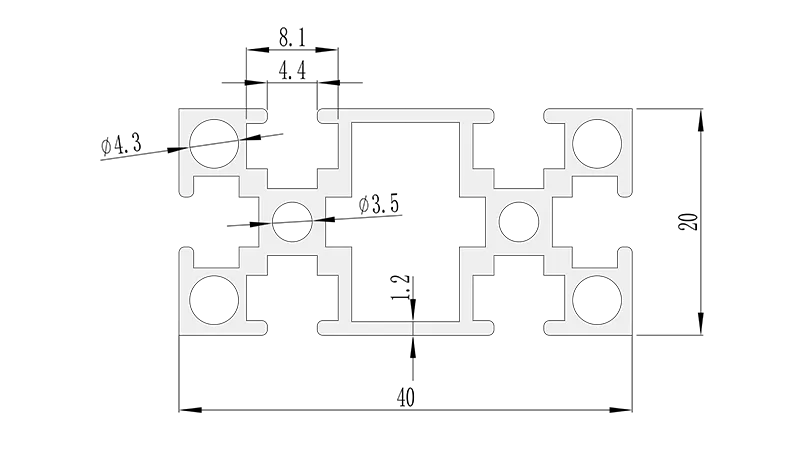
Before we explore its role in conveyors, let's get to know the 2040 National Standard Profile. At first glance, it might look like just another aluminum bar, but its design is a masterclass in functional engineering. Part of the broader family of aluminum extrusion profiles—manufactured by forcing heated aluminum through a die to create consistent, precision shapes—the 2040 profile gets its name from its cross-section dimensions: 20mm in width and 40mm in height. This specific sizing isn't arbitrary; it strikes a deliberate balance between strength, weight, and versatility, making it ideal for applications where both structural integrity and maneuverability matter.
What truly sets the 2040 profile apart, though, is its T-slot design. Running along its length are grooves (or "slots") that act as built-in connection points. These slots allow for quick, tool-free attachment of aluminum profile accessories—think brackets, connectors, or even roller track components—without the need for welding or drilling. It's this feature that turns a simple aluminum bar into a modular powerhouse, capable of evolving with the needs of a production line.
The Backbone of Modular Conveyors: 2040 Profile's Core Role
Modular conveyor systems thrive on two principles: standardization and flexibility . They need components that work together seamlessly (standardization) but can also be rearranged, extended, or repurposed (flexibility). The 2040 National Standard Profile excels at both, serving as the structural backbone that holds everything together—literally and figuratively.
Supporting Roller Tracks: Smooth Material Flow Starts Here
At the heart of any conveyor system is the movement of materials, and roller tracks are the unsung heroes of that movement. These tracks, lined with rotating wheels, allow products to glide from one workstation to the next with minimal friction. But roller tracks need a stable frame to sit on, and that's where the 2040 profile shines. Its 20x40mm cross-section provides just the right amount of rigidity to support the weight of goods (from small electronic components to heavier mechanical parts) without bending or warping over time. Meanwhile, its lightweight aluminum construction ensures the entire conveyor setup isn't overly cumbersome, making it easy to reposition if needed.
The T-slots in the 2040 profile are particularly critical here. Roller track connectors, which link individual track segments together, slide directly into these slots and lock in place with simple fasteners. This means installing or replacing a roller track section takes minutes, not hours. For example, if a manufacturer needs to widen a conveyor lane to accommodate larger boxes, they can quickly add an extra 2040 profile rail parallel to the existing one, attach new roller track sections via the T-slots, and have the system up and running in no time.
Customization with Aluminum Profile Accessories: Building Your Ideal Line
No two production lines are identical, and modular conveyors need to adapt to unique workflows. The 2040 profile's compatibility with aluminum profile accessories makes this customization possible. Let's say a food packaging plant wants to add a quality control station along their conveyor. Using angle brackets (a common aluminum profile accessory), they can mount a workbench directly onto the 2040 profile frame of the conveyor. The workbench, positioned at a comfortable height, gives inspectors a stable surface to check products as they pass by—all without disrupting the conveyor's flow. Later, if the plant switches to a new product that requires a different inspection setup, they can detach the workbench, reposition the brackets, and have a fresh configuration in under an hour.
Other accessories, like end stops or guide rails, further enhance functionality. A electronics manufacturer, for instance, might use plastic guide rails (another accessory) attached to 2040 profiles to keep small circuit boards centered on the roller track, preventing jams and ensuring consistent movement. The possibilities are nearly endless, limited only by the needs of the operation.
Why 2040 Stands Out: A Comparison with Other Profiles
To truly appreciate the 2040 National Standard Profile, it helps to see how it stacks up against other common aluminum extrusion profiles. Below is a comparison of the 2040 with two popular alternatives: the 3030 (30x30mm) and 4040 (40x40mm) profiles, focusing on key factors that matter for modular conveyors.
| Profile Type | Cross-Section (mm) | Weight per Meter (kg) | Max Load Capacity (kg/m)* | Best For |
|---|---|---|---|---|
| 2040 National Standard Profile | 20x40 | 1.2–1.5 | 50–80 | Light-to-medium load conveyors, compact workstations, tight spaces |
| 3030 National Standard Profile | 30x30 | 1.8–2.2 | 80–120 | Heavier loads, standalone structures (e.g., material racks) |
| 4040 National Standard Profile | 40x40 | 2.5–3.0 | 120–200 | Industrial-scale conveyors, high-weight applications |
*Approximate values; actual capacity depends on installation (e.g., support spacing, accessory type).
As the table shows, the 2040 profile hits a sweet spot for many modular conveyor systems. It's lighter than the 3030 and 4040, making it easier to handle during setup or reconfiguration, yet it still supports enough weight for most small-to-medium manufacturing needs. For context, a typical 2040-based conveyor can comfortably move boxes weighing up to 15kg each—perfect for industries like cosmetics, electronics, or small parts assembly. If a line needs to handle heavier loads (e.g., automotive components), manufacturers can pair 2040 profiles with 3030 or 4040 supports, leveraging the modularity to mix and match as needed.
Real-World Impact: How Manufacturers Benefit
To put this in perspective, let's look at a hypothetical (but realistic) example: a small furniture manufacturer producing wooden chairs. Their original conveyor system was a fixed, belt-driven setup that worked well for standard chairs but struggled when the company introduced a new line of ergonomic chairs with larger, bulkier frames. The fixed conveyor couldn't accommodate the wider chairs, and modifying it would require expensive welding and downtime.
Enter the 2040 National Standard Profile. The manufacturer replaced their old frame with 2040 profiles and roller tracks. Using aluminum profile accessories like corner brackets and extension rails, they widened the conveyor by 10cm—just enough for the new chairs. They also added adjustable guide rails to keep the chairs aligned, ensuring smooth movement. The entire (reconfiguration) took two days instead of the projected two weeks, and the total cost was 60% less than building a new fixed conveyor. Six months later, when they launched a smaller "kid-sized" chair line, they simply narrowed the conveyor by removing a section of 2040 profile and roller track—no extra tools, no extra cost.
This story highlights the 2040 profile's biggest advantage: it turns "permanent" infrastructure into "temporary" building blocks. Manufacturers aren't locked into a single layout; they can evolve with market trends, seasonal demands, or new product launches without overhauling their entire production line.
Durability and Sustainability: A Long-Term Investment
Beyond flexibility, the 2040 profile offers long-term value through durability and sustainability. Aluminum is naturally resistant to corrosion, so even in factories with high humidity (like food processing plants) or exposure to oils (like shops), the profiles won't rust or degrade easily. This longevity means fewer replacements over time, reducing maintenance costs.
Sustainability is another plus. Aluminum is 100% recyclable, and because the 2040 profile is modular, components can be reused repeatedly. A manufacturer that upgrades to a larger conveyor system, for example, can repurpose their old 2040 profiles to build material racks or workbenches instead of sending them to a landfill. This not only cuts waste but also lowers the cost of future projects.
The Future of Modular Conveyors: 2040 Profile at the Forefront
As manufacturing continues to trend toward smaller batch sizes, faster turnaround times, and customization, the demand for modular systems will only grow. The 2040 National Standard Profile is poised to lead this charge. Its combination of strength, flexibility, and cost-effectiveness makes it the ideal partner for businesses looking to stay competitive in a rapidly changing market.
Looking ahead, we'll likely see even more innovation around 2040-based systems. Imagine conveyor lines that can be reconfigured remotely via smart accessories, or profiles with integrated sensors (mounted via T-slots) that monitor speed and load in real time. Whatever the future holds, the 2040 profile will remain a critical foundation—quietly supporting the next generation of manufacturing.
Conclusion: More Than a Profile, a Catalyst for Change
The 2040 National Standard Profile may not grab headlines, but its impact on modular conveyor systems is undeniable. By providing a standardized, flexible, and durable framework, it empowers manufacturers to build conveyor lines that adapt, grow, and evolve with their business. Whether it's supporting roller tracks for smooth material flow, integrating workbenches for on-the-go assembly, or enabling quick reconfigurations with aluminum profile accessories, the 2040 profile is more than just a component—it's a catalyst for operational change.
For businesses still relying on rigid, fixed conveyor systems, the message is clear: modularity isn't a luxury; it's a necessity. And at the heart of that modularity? The unassuming 2040 National Standard Profile—proving that sometimes, the smallest building blocks can build the biggest futures.