- Company Articles
- Industry articles
- Industry standards
- How 4080B EU Standard Aluminum Profile Supports Continuous Improvement in Manufacturing

How 4080B EU Standard Aluminum Profile Supports Continuous Improvement in Manufacturing
Related Product
4080B EU Standard Aluminum Profile
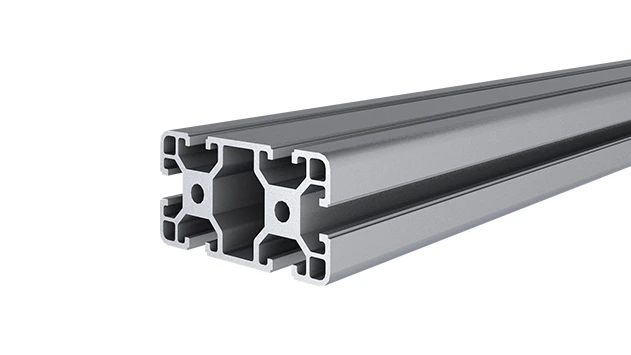
4080B is a 4.00x8.00 CM fractional 40 series square extrusion T-slot profile with two side open T-slots, each side with 4.00cm face, two side with 8.00cm face. The profile has align-a-grooves to assist in aligning connecting profiles.
The Challenge of Stagnation in Modern Manufacturing
Walk into any manufacturing facility today, and you'll likely hear the same buzzwords: agility, efficiency, adaptability. These aren't just industry jargon—they're survival skills. In a world where consumer demands shift overnight, production runs get shorter, and new technologies emerge faster than ever, the ability to continuously improve processes isn't a luxury; it's a necessity. Yet for many manufacturers, the very infrastructure they rely on—rigid, custom-built workstations, fixed material flow systems, and one-size-fits-none production lines—has become a barrier to progress.
Consider this: A mid-sized electronics manufacturer recently faced a dilemma. Their production line, built with welded steel frames and bolted-down workbenches, was designed for a single product. When a new client requested a modified version with additional components, the team spent weeks reconfiguring the line—cutting metal, rewelding frames, and retrofitting tool holders. The result? Delayed deadlines, increased labor costs, and a production floor littered with leftover materials from the old setup. This isn't an isolated incident. Across industries, manufacturers are stuck in a cycle of "build, break, rebuild" because their physical infrastructure can't keep up with the pace of change.
The root of the problem? Inflexibility. Traditional manufacturing setups are often designed as permanent solutions, optimized for a specific task at a specific time. But continuous improvement—whether through kaizen events, 5S implementations, or process reengineering—requires infrastructure that can evolve alongside your workflow. It needs to be modular, adaptable, and easy to reconfigure without sacrificing strength or safety. This is where the 4080B EU Standard Aluminum Profile enters the picture.
Meet the 4080B EU Standard Aluminum Profile: More Than Just a "Pipe"
At first glance, the 4080B might look like any other industrial aluminum extrusion. But beneath its sleek, silver surface lies a design philosophy that aligns perfectly with the goals of continuous improvement. Let's break it down: The "4080" refers to its dimensions—40mm in width and 80mm in height—while "EU Standard" guarantees compliance with strict European quality and safety regulations. This isn't just a matter of meeting specs; it means consistency. Whether you source from one supplier or ten, 4080B profiles will fit together seamlessly, eliminating the headache of mismatched components.
But the real magic is in the details. As an aluminum extrusion profile, the 4080B is crafted through a process that pushes aluminum alloy through a die, creating a uniform cross-section with built-in T-slots. These T-slots run the length of the profile, acting as universal attachment points for a vast array of aluminum profile accessories—connectors, brackets, shelves, tool holders, and more. Unlike traditional steel frames, which require drilling, welding, or specialized tools to modify, the 4080B lets you add, remove, or reposition components in minutes using nothing more than a hex key.
Lightweight yet surprisingly strong, the 4080B strikes a rare balance that's critical for manufacturing environments. Aluminum's natural resistance to corrosion means it holds up in harsh conditions, from dusty warehouses to humid assembly areas, without the need for constant maintenance. And because it's recyclable, it aligns with the growing focus on sustainability—a key pillar of modern continuous improvement strategies that aim to reduce waste across the entire value chain.

Modularity: The Foundation of Continuous Improvement
Continuous improvement thrives on iteration. It's about testing a new workflow, gathering data, making adjustments, and repeating the process. For this to work, your infrastructure can't be a fixed variable. It needs to be a flexible tool that adapts to your experiments. The 4080B's modular design makes this possible in ways traditional materials simply can't match.
Take workbenches, for example. A standard workbench built with 4080B profiles isn't just a table—it's a blank canvas. Need to raise the height by 10cm to improve ergonomics for taller workers? Swap out the leg brackets. Want to add a shelf for tools or a monitor arm for digital work instructions? Slide aluminum profile accessories into the T-slots and tighten a screw. Even more complex modifications, like integrating a conveyor or a static-dissipative surface for electronics assembly, become straightforward because the 4080B's T-slots eliminate the need for custom fabrication.
This modularity extends beyond individual workstations to entire production lines. Imagine a facility that produces both small-batch custom parts and high-volume standard components. With 4080B-based flow racks, the team can reconfigure material pathways in hours, not days. One week, the racks might be set up for sequential part feeding in a linear assembly line; the next, they can be rearranged into a U-shape to support cellular manufacturing, reducing worker movement and cutting down on lead times. The key is that nothing goes to waste—components from the old setup are reused in the new one, minimizing material waste and keeping costs in check.
Perhaps the most powerful aspect of this modularity is its impact on employee engagement. Continuous improvement isn't just about processes; it's about empowering frontline workers to identify inefficiencies and propose solutions. When employees see that their ideas—like adjusting a workbench height or rearranging a flow rack—can be implemented quickly with minimal hassle, they're more likely to participate. This creates a culture of ownership, where everyone feels invested in making the operation better. And in manufacturing, a engaged workforce is often the difference between stagnation and breakthrough.
From Parts to Process: How 4080B Integrates with Lean Systems
Lean manufacturing is all about eliminating waste—whether it's time, materials, or movement. But lean systems rely on physical infrastructure that supports these goals. A disorganized workstation with tools scattered across the bench creates waste in the form of search time; a poorly designed flow rack that requires workers to bend or reach awkwardly wastes energy and increases the risk of injury. The 4080B doesn't just support lean systems—it enhances them by providing a structure that's inherently aligned with lean principles.
Let's dive into flow racks, a staple of lean material handling. A well-designed flow rack ensures that parts move smoothly from storage to assembly, following the "first in, first out" (FIFO) principle and reducing the risk of stockouts or overstocking. Traditional flow racks, often made from wood or fixed steel, are limited by their fixed dimensions and roller spacing. If a new part is larger or smaller than the rack was designed for, you're stuck with either modifying the rack (and risking damage) or building a new one.
A 4080B-based flow rack, by contrast, adapts to your parts, not the other way around. Aluminum profile accessories like adjustable roller tracks and side guides let you customize the width, height, and angle of the rack to match the size and weight of your components. Need to add dividers to separate different part types? Slide them into the T-slots. Want to incline the rack slightly to improve gravity flow? Adjust the leg brackets. The result is a material handling system that reduces waste by ensuring parts are always where they need to be, when they need to be there—without the inefficiencies of one-size-fits-all infrastructure.
5S, the lean methodology focused on workplace organization (Sort, Set in Order, Shine, Standardize, Sustain), is another area where the 4080B shines. "Set in Order"—the step where tools and materials are arranged for easy access—becomes trivial with 4080B workstations. Magnetic tool holders, pegboards, and custom bins can all be mounted directly to the profile's T-slots, ensuring everything has a designated place. And because the setup is so easy to adjust, standardizing these arrangements across shifts or departments is simple. When new tools are introduced or processes change, updating the workstation takes minutes, helping maintain the "Sustain" phase of 5S over the long term.
The Numbers Behind the Improvement: Cost, Time, and Sustainability
Continuous improvement isn't just about making processes better—it's about making them better while keeping costs under control. At first glance, 4080B aluminum profiles might seem more expensive than traditional materials like steel or wood. But a closer look reveals that the long-term savings far outweigh the initial investment. Let's break down the numbers.
Consider reconfiguration costs. A traditional steel workstation might cost $500 to build, but reconfiguring it for a new process could cost another $300 in labor and materials (cutting, welding, painting). A 4080B workstation, while initially costing $700, can be reconfigured for $50 in parts (new brackets, connectors) and an hour of labor. Over three reconfigurations—the average for many manufacturers— the 4080B setup is already cheaper. And because aluminum profile accessories are reusable, each subsequent reconfiguration costs even less.
Time savings are equally significant. A manufacturing plant that switches to 4080B-based infrastructure typically reduces setup and reconfiguration time by 70-80%. For example, a team tasked with rearranging a production cell might spend 40 hours with traditional steel frames; with 4080B, the same task takes 8 hours. That's 32 hours of labor redirected to value-adding activities—like training, quality control, or process improvement projects. Over a year, these time savings translate to thousands of dollars in increased productivity.
Sustainability, too, plays a role in the cost equation. Aluminum is 100% recyclable, and because 4080B profiles are modular, they rarely end up in landfills. When a facility upgrades or expands, old profiles can be disassembled and reused elsewhere, reducing material waste and the need for new raw materials. This not only lowers disposal costs but also aligns with increasingly strict environmental regulations and consumer demands for eco-friendly manufacturing practices.
| Metric | Traditional Steel/Wood Setups | 4080B Aluminum Profile Setups |
|---|---|---|
| Initial Cost | Lower ($300-$500 per workstation) | Higher ($600-$800 per workstation) |
| Reconfiguration Cost | High ($200-$400 per change) | Low ($30-$80 per change) |
| Reconfiguration Time | 40-60 hours per production line | 8-12 hours per production line |
| Material Waste | High (30-40% of materials discarded during reconfigurations) | Low (5-10% waste, with most parts reusable) |
| Lifespan | 5-7 years (prone to corrosion, wear from modifications) | 15+ years (aluminum resists corrosion; modular parts replaceable) |
Case Study: How a Automotive Supplier Cut Lead Times by 35% with 4080B
A tier-1 automotive supplier specializing in brake components was struggling with long lead times and frequent bottlenecks in their assembly process. Their production line, built with welded steel workbenches and fixed flow racks, was designed for a single brake model. When their main client introduced a new hybrid vehicle with a redesigned brake system, the team faced a choice: invest in a production line ($250,000+) or find a way to adapt their existing setup.
They chose the latter, replacing their steel workstations and flow racks with 4080B aluminum profile systems. The results were striking:
- Lead Time Reduction: By reconfiguring flow racks to support the new brake components and adjusting workbench heights to improve ergonomics, the team cut assembly time per unit by 22%, reducing overall lead times by 35%.
- Cost Savings: The total investment in 4080B profiles and accessories was $85,000—less than half the cost of a new production line. Reconfiguration labor cost $12,000, compared to an estimated $40,000 for welding and modifying steel frames.
- Employee Engagement: Frontline workers proposed 17 process improvements after the switch, up from 3 in the previous year. Many of these ideas—like adding tool balancers and adjusting part feeding angles—were implemented within days using aluminum profile accessories.
Today, the supplier uses the same 4080B system to produce both the traditional and hybrid brake components, switching between setups in under 4 hours. They've also expanded into a new market—electric vehicle brake components—by further modifying their 4080B-based line, avoiding the need for additional capital investment.
Beyond the Factory Floor: The Ripple Effects of Flexible Infrastructure
The impact of 4080B aluminum profiles extends far beyond the production line. By supporting continuous improvement, these systems create a ripple effect that touches every aspect of a manufacturing business. For example, improved ergonomics from adjustable workbenches reduce workplace injuries, lowering workers' compensation costs and improving employee retention. Faster reconfiguration times make it easier to take on small-batch or custom orders, opening up new revenue streams. And the ability to quickly adapt to changing demands makes manufacturers more attractive to clients, who value reliability and flexibility in their suppliers.
Perhaps most importantly, 4080B profiles help shift the mindset of an organization. When infrastructure is no longer a barrier to change, continuous improvement becomes a daily practice, not just a quarterly initiative. Teams stop seeing problems as permanent roadblocks and start seeing them as opportunities to innovate. This cultural shift is the true driver of long-term success in manufacturing.
Choosing the Right Partner: Why EU Standard Matters
Not all aluminum profiles are created equal. The "EU Standard" in 4080B isn't just a marketing term—it's a guarantee of quality, consistency, and safety. EU standards for aluminum extrusions mandate strict tolerances for dimensions, material strength, and finish, ensuring that profiles from different suppliers will fit together seamlessly. This is critical for modular systems, where a 1mm discrepancy in T-slot size can render accessories unusable.
When selecting a supplier for 4080B profiles and aluminum profile accessories, look for partners who specialize in lean manufacturing solutions. They should offer not just parts, but expertise—helping you design workstations, flow racks, and production lines that align with your continuous improvement goals. A good supplier will also provide a wide range of accessories, from basic brackets to specialized components like static-dissipative panels or heavy-duty casters, ensuring you have everything you need to adapt as your processes evolve.
Conclusion: Building a Foundation for Endless Improvement
Continuous improvement in manufacturing isn't about grand gestures or expensive technology. It's about the small, daily changes that add up to better processes, happier employees, and stronger bottom lines. And those changes need a foundation—one that's flexible, reliable, and ready to evolve. The 4080B EU Standard Aluminum Profile isn't just a material; it's that foundation.
By combining modular design, strength, and ease of use, 4080B profiles empower manufacturers to stop building for today and start building for tomorrow. Whether you're reconfiguring a workbench, redesigning a flow rack, or overhauling an entire production line, the ability to adapt quickly and cost-effectively is no longer a dream—it's a reality. And in a world where continuous improvement is the only path forward, that reality is priceless.