- Company Articles
- Industry articles
- Industry standards
- How is 3030r EU Standard Aluminum Profile Manufactured? Production Process Explained

How is 3030r EU Standard Aluminum Profile Manufactured? Production Process Explained
Related Product
3030R EU Standard Aluminum Profile
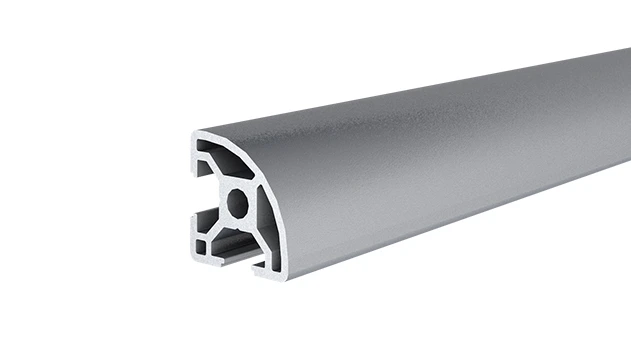
3030R is a 3.00 x 3.00CM fractional 30 series square extrusion T-slot profile with four open T-slots, two side with 3.00cm face, the other side with round face. The profile has align-a-grooves to assist in aligning connecting profiles.
Walk into any modern factory, workshop, or logistics center, and you'll likely spot a silent workhorse holding everything together: aluminum profiles. These unassuming metal structures are the backbone of assembly lines, workbenches, material racks, and even lean system setups. Among them, the 3030r EU standard aluminum profile stands out as a versatile favorite—its balanced size, durability, and compatibility with aluminum profile accessories make it a go-to for engineers and manufacturers worldwide. But have you ever wondered how this essential component goes from raw ore to the finished product that keeps production lines running smoothly? Let's take a deep dive into the manufacturing journey of the 3030r aluminum profile, exploring every step that turns simple aluminum into a cornerstone of efficient manufacturing.
1. Raw Material Selection: The Foundation of Quality
Every great product starts with great materials, and 3030r aluminum profiles are no exception. The process begins with selecting high-purity aluminum, typically sourced from bauxite ore—a reddish-brown rock rich in aluminum oxide. But aluminum alone isn't enough; to give the profile strength, flexibility, and resistance to corrosion, manufacturers blend it with specific alloys. For 3030r profiles, the most common alloy is 6063, often called "architectural aluminum" for its excellent extrudability and smooth surface finish. This alloy includes small amounts of magnesium and silicon, which work together to create a material that's both easy to shape and strong enough to support heavy loads in industrial settings.
Sustainability also plays a role here. Aluminum is 100% recyclable, and many manufacturers now use recycled aluminum scrap (known as "secondary aluminum") alongside primary aluminum. This not only reduces environmental impact but also lowers production costs without compromising quality. Before melting, the raw materials undergo rigorous testing to ensure they meet EU standards for purity—any impurities, like iron or copper, could weaken the final profile or cause defects during manufacturing. Think of it like baking a cake: using the right ingredients in the right proportions is key to a perfect result.
2. Melting and Casting: Turning Ore into Billets
Once the raw materials are selected, the next step is to melt them down. The aluminum alloy is loaded into a large furnace, where temperatures soar to around 700°C (1292°F)—hot enough to turn solid aluminum into a molten liquid. During this process, manufacturers add fluxes (chemicals) to remove impurities like dirt or gas bubbles, ensuring the molten aluminum is clean and uniform. Imagine straining pasta to remove lumps; fluxes do the same for molten metal, leaving behind a smooth, pure liquid.
After melting, the liquid aluminum is poured into molds to cool and solidify into cylindrical shapes called "billets." These billets are typically 6 to 12 meters long and 150 to 250 mm in diameter—think of them as giant aluminum logs. But before they're ready for the next step, the billets undergo a critical process called homogenization. This involves reheating the billets to around 500°C (932°F) and holding them at that temperature for several hours. Why? Homogenization ensures the alloying elements (like magnesium and silicon) are evenly distributed throughout the billet, preventing weak spots or inconsistencies in the final profile. Without this step, the 3030r profile might bend or crack under stress, which is a big no-no in industrial applications where reliability is everything.

3. Extrusion: Shaping the Profile (The "Magic" Step)
If there's one step that defines aluminum profile manufacturing, it's extrusion. This is where the cylindrical billet transforms into the familiar 3030r shape with its T-slot design—a feature that makes it easy to attach aluminum profile accessories like brackets, connectors, and panels. Here's how it works:
First, the billet is preheated to around 480°C (896°F)—not hot enough to melt, but soft enough to shape. It's then loaded into a horizontal extrusion press, a massive machine that can exert thousands of tons of force. At the end of the press is a custom-made steel die, which looks like a metal plate with a hole cut in the exact shape of the 3030r profile. The die is the blueprint here: its design determines everything from the profile's dimensions (30mm x 30mm, hence "3030r") to the size and placement of the T-slots.
Once the billet is in place, a hydraulic ram pushes it against the die with immense pressure. As the billet is squeezed through the die's opening, it takes on the die's shape, emerging on the other side as a long, continuous 3030r profile. It's similar to squeezing toothpaste through a tube—except instead of toothpaste, it's aluminum, and the "tube" is a steel die that can withstand 10,000 tons of force! The extrusion process happens surprisingly quickly: a single billet can produce tens of meters of profile in just a few minutes. As the profile exits the die, it's guided along a cooling table, where fans or water sprays cool it down and lock its shape in place.
4. Heat Treatment: Strengthening the Profile
Freshly extruded aluminum is strong, but not strong enough for heavy-duty industrial use. That's where heat treatment comes in. The 3030r profile undergoes a two-step process called solution heat treatment and aging to boost its strength and durability.
First, the profile is heated to 520°C (968°F) and held there for 1-2 hours. This "solution treatment" dissolves any remaining alloy particles into the aluminum matrix, making the material more uniform. Then, the profile is rapidly quenched—cooled down quickly using water or air. Quenching traps the alloy particles in a supersaturated state, which makes the aluminum hard but brittle, like glass. To fix this, the profile is "aged" by heating it again, but this time to a lower temperature (around 175°C/347°F) for 4-8 hours. During aging, the alloy particles slowly precipitate out of the matrix, forming tiny, evenly spaced clusters that strengthen the aluminum without making it brittle. The result? A 3030r profile with a T6 temper (the industry standard for high strength), able to support heavy loads without bending or deforming—perfect for use in workbenches, material racks, and lean system setups where stability is critical.
5. Surface Finishing: Protection and Aesthetics
After heat treatment, the 3030r profile is strong, but its surface is still rough and prone to corrosion. Surface finishing solves both problems, while also giving the profile a clean, professional look. The most common finishes for 3030r profiles include:
- Anodizing: This electrochemical process creates a protective oxide layer on the aluminum surface. The profile is submerged in an acid bath and connected to an electric current, which causes oxygen to bond with the aluminum, forming a hard, porous layer. The porous layer can then be dyed (common colors include silver, black, and blue) before being sealed to lock in the color and prevent corrosion. Anodized finishes are durable, scratch-resistant, and ideal for profiles used in harsh environments.
- Powder Coating: For a more vibrant or customized look, manufacturers use powder coating. A dry powder (made of resin and pigment) is electrostatically sprayed onto the profile, which is then baked at 180°C (356°F). The heat melts the powder, forming a smooth, even coating that's resistant to chipping and fading. Powder coating offers endless color options and is popular for profiles used in consumer-facing applications, like retail displays or office furniture.
- Electrophoresis (E-Coating): This process involves submerging the profile in a water-based paint bath and applying an electric current, which draws the paint particles to the aluminum surface. E-coating creates a thin, uniform finish that's highly corrosion-resistant, making it a good choice for profiles used outdoors or in humid environments.
No matter the finish, the goal is the same: to protect the 3030r profile from rust, scratches, and wear, ensuring it lasts for years in industrial settings.
5. Quality Control: Ensuring EU Standards
EU standard profiles like the 3030r aren't just about shape and strength—they're about consistency and reliability. That's why quality control (QC) is woven into every step of the manufacturing process. Here are some of the key checks manufacturers perform:
Dimension Testing: Every profile is measured to ensure it meets the 30mm x 30mm specification, with tolerances as tight as ±0.1mm. This is done using calipers, micrometers, or even 3D scanners for precision. The T-slots are also checked to ensure they're the right size to fit standard aluminum profile accessories —a loose or tight slot could make assembly a nightmare for customers.
Mechanical Testing: Samples of the profile are tested for strength, hardness, and flexibility. A tensile test pulls the profile until it breaks, measuring how much force it can withstand before failing. A hardness test uses a diamond-tipped tool to indent the surface, ensuring the heat treatment process worked correctly. For 3030r profiles, the tensile strength typically ranges from 180 to 250 MPa (megapascals)—strong enough to support hundreds of kilograms without bending.
Visual Inspection: Every meter of profile is checked for defects like dents, scratches, or uneven finishes. Even small flaws can weaken the profile or make it unsuitable for applications where appearance matters, like office furniture or retail displays.
Chemical Analysis: To ensure the alloy composition is correct, manufacturers use spectrometers to analyze the profile's chemical makeup. This ensures the magnesium, silicon, and other elements are present in the right proportions, guaranteeing the profile's performance.
Only profiles that pass all these tests earn the "EU standard" label—a mark of quality that gives manufacturers confidence when building everything from assembly lines to lean system setups.
6. Cutting and Machining: Precision to Length
After passing QC, the continuous 3030r profile is cut into manageable lengths. Most manufacturers use saws with diamond-tipped blades to ensure clean, precise cuts. The length depends on the customer's needs: some order 1-meter sections for small workbenches, while others need 6-meter lengths for large material racks. For added precision, CNC (Computer Numerical Control) saws are used, which can cut profiles to within ±0.5mm of the desired length—critical for projects where multiple profiles need to fit together perfectly.
In some cases, the profile may also undergo additional machining, like drilling holes for bolts or tapping threads into the T-slots. This pre-machining saves customers time during assembly, as they don't have to modify the profile themselves. For example, a profile destined for a workbench might have holes pre-drilled for attaching a wooden top, while one used in a lean system could have tapped T-slots for quick connection to accessories like roller tracks or shelves.
7. Assembly with Accessories: From Profile to System
A 3030r profile on its own is just a piece of metal—but when combined with aluminum profile accessories , it becomes a building block for endless possibilities. These accessories include:
- Connectors: Angle brackets, corner codes, and T-connectors join profiles at 90°, 45°, or 180° angles, allowing users to build frames, shelves, and workbenches.
- Panels: Aluminum, wood, or plastic panels fit into the T-slots to create work surfaces, sidewalls, or machine guards.
- Wheels/Casters: Attaching casters to the bottom of a profile frame turns it into a mobile cart, perfect for moving materials around a factory.
- Lighting and Cable Management: Specialized accessories like LED light strips or cable carriers can be mounted in the T-slots, keeping work areas organized and well-lit.
The beauty of the 3030r profile is its modularity: with the right accessories, it can be reconfigured in minutes to adapt to changing needs. A single profile might start as part of a workbench on Monday, get disassembled, and become part of a material rack by Friday—exactly the kind of flexibility that makes it a staple in lean system environments, where efficiency and adaptability are key.
| Profile Type | Dimensions (W x H) | Material Thickness | Common Alloys | Primary Applications | Key Accessories |
|---|---|---|---|---|---|
| 3030r EU Standard | 30mm x 30mm | 1.5mm - 2.0mm | 6063 | Workbenches, material racks, lean system frames, small machines | Angle brackets, T-connectors, casters, panels |
| 2020 EU Standard | 20mm x 20mm | 1.0mm - 1.5mm | 6063 | Light-duty frames, shelving, electronics enclosures | Mini connectors, small panels, cable management clips |
| 4040 EU Standard | 40mm x 40mm | 2.0mm - 3.0mm | 6061 (higher strength) | Heavy-duty workbenches, industrial machinery frames, conveyors | Heavy-duty brackets, reinforced connectors, large panels |
8. Applications: Where 3030r Profiles Shine
Now that we've explored how 3030r profiles are made, let's talk about where they're used. Their versatility makes them indispensable in industries like automotive, electronics, aerospace, and logistics. Here are a few real-world examples:
Lean Manufacturing Systems: In lean environments, where minimizing waste and maximizing efficiency are goals, 3030r profiles are used to build everything from flow racks (for organizing parts) to assembly line workstations. Their modular design allows teams to quickly reconfigure workspaces as production needs change, reducing downtime and improving workflow.
Workbenches: A 3030r frame with a wooden or metal top creates a sturdy, customizable workbench. T-slots make it easy to add tools, shelves, or lighting, turning a basic bench into a fully equipped workstation.
Material Racks and Carts: Stackable 3030r frames with shelves are perfect for storing raw materials or finished products. Add casters, and they become mobile carts that can transport goods across the factory floor with ease.
Machine Guards: Safety first! 3030r profiles with transparent panels (like polycarbonate) are used to build guards around machinery, protecting workers from moving parts while still allowing visibility.
Conclusion: The Unsung Hero of Modern Manufacturing
From raw aluminum ore to the finished profile, the journey of the 3030r EU standard aluminum profile is a testament to precision, innovation, and craftsmanship. Every step—from melting and extrusion to heat treatment and quality control—is designed to create a product that's strong, durable, and infinitely adaptable. And when combined with aluminum profile accessories , it becomes a tool for building the efficient, flexible systems that power today's factories and workshops.
The next time you walk through a manufacturing plant or use a well-organized workbench, take a moment to appreciate the 3030r profile. It may not be the most glamorous part of the operation, but without it, the world of modern manufacturing would look very different. As industries continue to evolve and demand more efficient, sustainable solutions, the 3030r profile will undoubtedly remain a key player—quietly supporting progress, one T-slot at a time.