- Company Articles
- Industry articles
- Industry standards
- How Reusable 3060 National Standard Profile A Reduces Production Waste

How Reusable 3060 National Standard Profile A Reduces Production Waste
Related Product
3060 National Standard Profile A
Workbench, production line, logistic rack, warehouse rack Industry: Manufacturer workshop, Automobile, Electronic, Assembling, logistic
For manufacturing teams, the battle against waste is a daily grind. It's in the time lost rearranging rigid workstations to fit a new product line. It's in the piles of scrap metal from outdated material racks that can't adapt. It's in the frustration of watching operators walk extra steps because a conveyor system is fixed in place, no longer serving the workflow. These aren't just minor inconveniences—they're silent profit killers. In an industry where margins grow slimmer by the day, every minute of downtime, every unused square foot of floor space, and every discarded piece of equipment adds up to missed opportunities. But what if there was a way to build production setups that grow with you , instead of holding you back? Enter the 3060 National Standard Profile A—an aluminum extrusion that's quietly revolutionizing how factories approach waste reduction, one modular component at a time.
The Hidden Costs of "Stuck" Production Systems
To understand why the 3060 National Standard Profile A matters, let's first talk about the waste that plagues most production floors. Lean manufacturing principles identify eight types of waste, or muda , but two stand out as particularly crippling: defects (wasted materials from poorly designed setups) and non-value-added activity (time spent on tasks that don't contribute to the final product). Traditional production systems—built with fixed steel frames, welded structures, or one-size-fits-all workbenches—excel at creating both.
Consider a small electronics manufacturer that suddenly lands a contract for a new gadget. Their existing workbench, bolted to the floor with a fixed height and no cable management, was perfect for their old product. Now, operators are hunched over, slowing assembly, and cables snarl into tangles that cause delays. The material rack, once ideal for storing large components, now has empty shelves because the new parts are smaller—wasting vertical space and forcing workers to trek to a secondary storage area. To fix this, the team might order custom steel shelves or hire welders to modify the workbench. By the time the changes are done, weeks have passed, and the "temporary" fixes cost thousands. Worse, when the next product comes in, the cycle repeats.
This is the reality of rigid systems: they turn adaptability into a luxury. And in today's fast-paced manufacturing landscape, where product lifecycles shrink and customer demands shift overnight, luxury is a cost no one can afford.
Meet the 3060 National Standard Profile A: More Than Just Aluminum
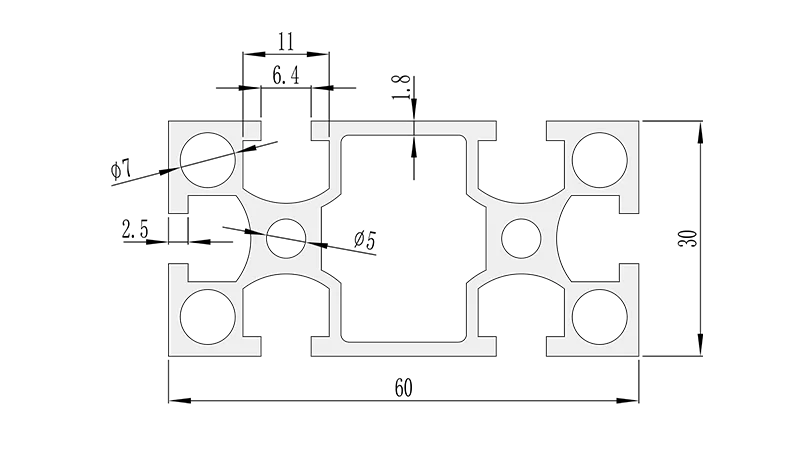
At first glance, the 3060 National Standard Profile A looks like any other aluminum extrusion—a long, rectangular tube with a sleek silver finish. But its true power lies in the details: a precision-engineered T-slot design, uniform dimensions, and compatibility with a universe of aluminum profile accessories that turn it into a building block for almost any production need. Let's break down why this matters.
First, it's modular by design . Unlike welded steel or wooden frames, the 3060 profile uses T-slot grooves that run the length of the extrusion. These slots let you attach brackets, shelves, wheels, or conveyor tracks anywhere along the profile—no drilling, welding, or special tools required. A quick twist of a bolt or a snap of a connector, and you've reconfigured a workstation in minutes, not days. This modularity means the same length of 3060 profile that builds a workbench today can become part of a material rack next month, and a conveyor guard the month after. There's no "scrap"—just repurposing.
Second, it's built to last . Made from high-grade aluminum alloy, the 3060 profile balances strength and lightness. It won't rust like steel, warp like wood, or degrade under the wear and tear of daily use. Manufacturers report using the same profiles for years, even decades, with only minor replacements of accessories like caster wheels or end caps. This durability slashes the "replacement cycle" waste that comes with flimsy, disposable setups.
Third, it's universal . As a national standard profile, the 3060's dimensions (30mm x 60mm cross-section) are consistent across suppliers, meaning you're never locked into one brand's ecosystem. Need a new connector? Any aluminum profile accessories supplier will have a compatible part. This interoperability eliminates the "vendor lock-in" waste—no more buying an entire new system because a single proprietary bracket broke.
Modularity vs. Waste: How T-Slots Turn "One and Done" Into "Many and More"
The magic of the 3060 National Standard Profile A isn't just in the aluminum itself—it's in how it connects . Let's say your team needs a new material rack to store incoming components. With traditional methods, you'd measure, cut, weld, and paint steel beams, a process that takes days and leaves no room for error. If the rack is too tall, you start over. If it's too short, you've wasted steel. With the 3060 profile, you grab a few lengths of extrusion, some 90° aluminum profile connectors, and shelf brackets. Snap them together, adjust the height by sliding brackets along the T-slots, and you're done in an hour. Need to add a shelf later? Loosen the bolts, slide in a new bracket, and tighten—no cutting, no welding, no waste.
This flexibility directly attacks two of the biggest waste culprits: overproduction and excess inventory . Traditional setups force you to "overbuild" to anticipate future needs. A steel material rack might have extra shelves "just in case," taking up space. With 3060, you build only what you need today, knowing you can expand tomorrow. And because components are lightweight and easy to store, you don't need a warehouse full of spare parts—just a bin of connectors and brackets that work across all your setups.
Even better, when a project ends or a product line is retired, the 3060 profile doesn't end up in a dumpster. Disassemble the old workstation, sort the profiles and accessories, and reuse them for the next project. A manufacturer in Guangdong recently shared that they repurposed 80% of their 3060 components when shifting from smartphone assembly to smartwatch production. The remaining 20%? Just a few worn caster wheels and end caps—easily replaced without scrapping the entire structure.
Lean Systems in Action: 3060 Profile as the Backbone of Efficiency
Lean system principles—like "just-in-time production" and "continuous improvement"—sound great on paper, but they're hard to implement without the right tools. The 3060 National Standard Profile A isn't just a tool; it's a enabler of lean. Here's how:
1. Eliminating downtime with quick changeovers : In lean terms, setup time is waste. The faster you can switch a workstation from Product A to Product B, the less idle time you have. With 3060's modular design, changeovers happen in minutes. A automotive parts supplier we worked with reduced their line changeover time from 4 hours (with welded steel workbenches) to just 25 minutes by switching to 3060-based workstations. Operators now swap out tool holders, adjust shelf heights, and reposition lighting by hand—no maintenance crew needed.
2. Reducing motion waste with tailored workflows : Ever watched an operator walk 10 extra steps per cycle because the material bin is too far from the assembly line? That's motion waste , and it adds up to hours of lost productivity yearly. 3060 profiles let you build workstations and material racks that "wrap around" the operator, placing tools and parts within arm's reach. Add casters to a 3060-based trolley, and materials glide directly to the line, cutting walking time by 60% in some cases.
3. Fighting overprocessing with adaptable tools : Overprocessing—doing more work than the customer requires—often stems from rigid setups that force operators to take extra steps. For example, a fixed-height workbench might require an operator to sand a part twice because they can't angle it properly. A 3060-based workbench with adjustable legs and tiltable surfaces lets the operator position the part once, reducing processing time and material waste from excess sanding.
From Blueprints to Reality: Real-World Applications That Cut Waste
Let's get specific. How do manufacturers actually use the 3060 National Standard Profile A to slash waste? Two applications stand out: workbenches and material racks —the backbone of any production floor.
Workbenches: Built for the Human, Not the Machine
Traditional workbenches are often afterthoughts—heavy, immovable, and designed around the equipment, not the people using it. The result? Fatigue, slow assembly, and mistakes. A 3060-based workbench flips this script. Start with a frame of 3060 profiles, add adjustable height legs (using aluminum profile accessories like height-adjustable feet), and top it with a lightweight aluminum honeycomb panel for the work surface. Need cable management? Run wires through the T-slots. Lighting? Attach LED strips to the side brackets. Casters? Snap them on for mobility. Suddenly, the workbench adapts to the operator, not the other way around. And when the next shift comes in with different needs? Loosen a few bolts, adjust the height, and you've got a workstation tailored to the new team's ergonomics. No more "one bench fits all"—and no more wasted time or energy.
Material Rack B (3 Row and 3 Floor): Storage That Grows With Demand
Material Rack B, a common setup with 3 rows and 3 floors, is a workhorse for storing small to medium parts. Built with 3060 profiles, it becomes a masterclass in adaptability. Each shelf is held in place by sliding brackets in the T-slots, so you can adjust the height between floors to fit taller boxes or stack smaller ones more densely. Need to add a fourth row? Just insert two more 3060 uprights and connect them with cross beams. The entire rack assembles without tools in under an hour, and when your inventory shifts—say, you start stocking larger components—you can reconfigure the shelves in 15 minutes. Compare that to a traditional wooden or steel rack, which would require sawing, drilling, or even replacing the entire unit. The 3060 version doesn't just store materials; it
optimizes
storage, turning unused vertical space into valuable real estate and reducing the need for extra racks.
The Numbers Speak: Traditional vs. 3060 Profile Setups
| Metric | Traditional Steel/Wooden Setups | 3060 National Standard Profile A Setups |
|---|---|---|
| Assembly Time (Workbench) | 8-12 hours (welding, painting, drilling) | 1-2 hours (modular assembly with connectors) |
| Reusability Rate | 10-20% (most components welded or bolted permanently) | 80-90% (profiles and accessories reused across setups) |
| Material Waste per Setup | 15-20% (scrap from cutting/welding errors) | 1-2% (minimal waste from accessories like end caps) |
| Changeover Time (New Product Line) | 3-5 days (requires modifications or new builds) | 1-2 hours (reconfigurable with existing components) |
| 10-Year Lifespan Cost (per workstation) | $12,000+ (replacement + modifications) | $4,500 (initial build + minor accessory replacements) |
The table above, based on data from manufacturing consultants and case studies, tells the story: 3060 National Standard Profile A setups aren't just "better"—they're exponentially more efficient. The 10-year cost difference alone is enough to justify the switch, but when you factor in reduced downtime, lower material waste, and happier, more productive teams, the ROI becomes undeniable.
Case Study: A Small Manufacturer's Journey From Waste to Efficiency
Let's put this in human terms. Consider "BrightTech," a fictional (but representative) electronics manufacturer with 50 employees. Three years ago, their production floor was a maze of welded steel workbenches, wooden material racks, and fixed conveyors. When they introduced a new line of smart home sensors, they hit a wall: the old workbenches were too low for the new assembly tools, and the material racks couldn't accommodate the smaller sensor components. The team spent $15,000 on custom steel shelves and hired welders to modify the workbenches, losing two weeks of production time. Six months later, when a larger sensor model was added, they repeated the process—another $12,000 and a week of downtime.
Then, BrightTech switched to 3060 National Standard Profile A. They started with five workbenches, built in a day using 3060 profiles, adjustable legs, and aluminum honeycomb tops. The next month, when the larger sensor line launched, they reconfigured the workbenches in 2 hours by raising the legs and adding side shelves. For material storage, they replaced their wooden racks with Material Rack B (3 row and 3 floor) setups, using 3060 profiles and sliding shelf brackets. When component sizes changed, they adjusted the shelves in minutes. In the first year, BrightTech saved $22,000 on setup costs alone, reduced material waste by 75%, and cut changeover time from weeks to hours. "It's like going from a flip phone to a smartphone," their production manager said. "We used to work around our tools; now our tools work around us."
Conclusion: Waste Reduction Starts With the Right Foundation
Production waste isn't inevitable—it's a choice. A choice to stick with rigid, one-and-done systems that trap you in cycles of replacement and rework. Or a choice to invest in tools that grow with you, adapt with you, and save with you. The 3060 National Standard Profile A isn't just an aluminum extrusion; it's a commitment to smarter manufacturing. It's about seeing your production floor not as a collection of fixed structures, but as a dynamic ecosystem that responds to your needs—today, tomorrow, and for years to come.
For manufacturers ready to stop wasting time, materials, and money, the path forward is clear: build with modularity, adapt with aluminum, and let the 3060 National Standard Profile A turn every "wasteful" challenge into an opportunity for efficiency. After all, in manufacturing, the only constant is change. Shouldn't your tools change with it?