- Company Articles
- Industry articles
- Industry standards
- How to Calculate Load Capacity for 3030a EU Standard Aluminum Profile Structures

How to Calculate Load Capacity for 3030a EU Standard Aluminum Profile Structures
Related Product
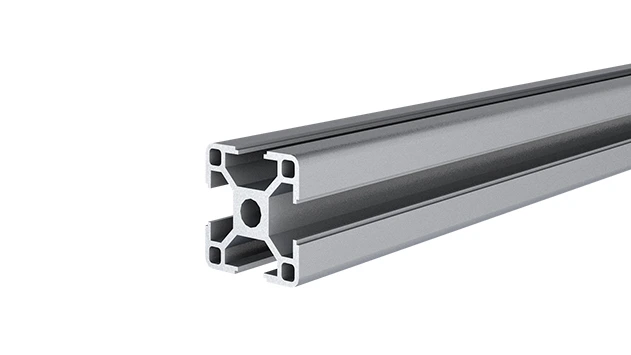
3030A EU Standard Aluminum Profile
3030 is a 3.00 x 3.00CM fractional 30 series square extrusion T-slot profile with four open T-slots, each side with 3.00cm face. The profile has align-a-grooves to assist in aligning connecting profiles.
Picture this: You've just finished assembling a sleek workbench in your workshop, using 3030a EU standard aluminum profiles. It looks sturdy, with clean lines and T-slots ready to mount tools or accessories. You load it up with a heavy vice, a stack of metal component boxes, and a few power tools—maybe a drill press or a sander. By midday, though, you notice something off: the middle of the workbench is starting to sag. Not a lot, but enough to make you pause. Is this normal? Could it get worse? And most importantly, is your setup safe?
If you've ever worked with aluminum profiles—whether building workbenches, material racks, or production line frames—you've probably asked these questions. The truth is, even the most well-designed structures can fail if you underestimate their load capacity. That's why understanding how to calculate just how much weight your 3030a aluminum profile setup can handle isn't just a "nice-to-know"—it's critical for safety, efficiency, and avoiding costly downtime. Let's dive into the details, step by step.
1. First Things First: What Even Is a 3030a EU Standard Aluminum Profile?
Before we get into calculations, let's make sure we're all on the same page about the star of the show: the 3030a EU standard aluminum profile . These profiles are the workhorses of modular construction, used everywhere from small workshops to large factories. But what makes them "3030a"?
The name breaks down simply: "3030" refers to the cross-sectional dimensions—30mm wide by 30mm tall. The "a" typically denotes a specific variation in the profile's design, often related to wall thickness, T-slot size, or rib placement (small internal supports that boost rigidity). EU standard means it adheres to European manufacturing specs, ensuring consistent quality, dimensions, and material properties across suppliers.
Most 3030a profiles are made via aluminum extrusion profile processes. Think of extrusion like squeezing toothpaste from a tube: heated aluminum alloy is pushed through a die (a metal mold) to create the profile's shape. This method ensures uniformity—no weak spots or inconsistencies—and lets manufacturers add features like T-slots (the grooves running along the length) that make it easy to attach accessories with bolts or brackets.
Real-World Use Case: Walk into any modern workshop, and you'll spot 3030a profiles in action. They're the backbone of workbenches (like the one we imagined earlier), material racks, machine guards, and even custom shelving. Their popularity comes from balancing strength, weight, and flexibility—they're light enough to assemble by hand but strong enough to handle serious loads when set up right.
Key properties of 3030a profiles you'll need to know for load calculations:
- Alloy & Temper: Most are made from 6063-T5 aluminum—an alloy with good strength and corrosion resistance. T5 temper means it's artificially aged to boost hardness without losing ductility.
- Wall Thickness: Typically 1.5mm to 3mm (check your supplier's specs!). Thicker walls = more strength, but also more weight.
- Weight: A 30x30mm profile with 2mm walls weighs roughly 1.4-1.6 kg per meter—light enough for DIY projects but substantial enough to feel solid.
- T-Slot Size: Usually 6mm or 8mm, which affects what aluminum profile accessories (like brackets or connectors) you can use.
2. The Big Question: What Actually Affects Load Capacity?
Load capacity isn't just about the profile itself—it's a team effort between the profile, how you connect it, how you support it, and even the environment. Let's break down the key players.
Material Strength: It's All in the Aluminum
Aluminum's strength comes from its alloy and temper, as we mentioned. 6063-T5 has a tensile strength (how much it can stretch before breaking) of around 180-220 MPa (megapascals) and a yield strength (how much it can stretch and still bounce back) of 150-190 MPa. For context, that's strong enough to hold a 200kg weight suspended from a single 1m length of 3030a profile—if it's supported properly at both ends.
Span Length: The "Distance Between Supports" Problem
Here's a critical truth: The longer the distance between two supports (called the "span"), the less weight a profile can carry without bending. Imagine holding a ruler at both ends—you can easily support a pencil on top. Now hold it by just the very ends, and the ruler sags even with the pencil's tiny weight. The same logic applies to aluminum profiles.
For example, a 3030a profile with a 2mm wall can comfortably hold 50kg if the span is 500mm (half a meter). Stretch that span to 1500mm (1.5 meters), and that same profile might only handle 15-20kg before noticeable sagging. Span length is often the biggest factor people overlook!
Connectors: The "Weakest Link" Risk
You could have the strongest profile in the world, but if your aluminum profile connectors (the brackets, corner codes, or T-slot bolts that hold profiles together) fail, the whole structure fails. Connectors come in all shapes—90° angles, T-joints, flanges—and their strength varies widely.
For example, a basic plastic corner connector might only handle 500N (about 50kg of force) before cracking, while a heavy-duty aluminum 90° connector could take 2000N (200kg) or more. Always check the connector's load rating from the supplier—don't assume "metal is metal" here.
Accessories: Small Parts, Big Impact
Aluminum profile accessories like end caps, gussets (triangular braces), or reinforcing plates might seem minor, but they play a huge role. Gussets, for instance, add rigidity at joints, preventing sideways wobble that can weaken the structure over time. Even something as simple as a T-slot nut—if it's not tightened properly—can slip, reducing the effective load capacity.
Load Type: Static vs. Dynamic
Not all loads are created equal. A "static" load is constant and unmoving—like a stack of boxes sitting on a workbench. A "dynamic" load is moving or changing—think of parts sliding down a roller track onto the bench, or someone leaning on the edge while working. Dynamic loads are harder on structures because they add sudden stress (impact) or vibration, which can fatigue materials over time. As a rule of thumb, if your load is dynamic, aim for a 20-30% lower capacity than what you'd calculate for static use.

2. Let's Do the Math: Calculating Load Capacity Step-by-Step
Okay, enough theory—let's get practical. Calculating load capacity for a 3030a structure isn't about complex engineering equations (though we'll touch on a simple one). It's more about combining material properties, span length, and connector strength to find a "safe working load." Here's how to do it:
| Step | Action | Example (for a Workbench) |
|---|---|---|
| 1 | Identify your profile specs (wall thickness, alloy, length) | 3030a profile, 2mm wall, 6063-T5 alloy, 1200mm length (span between legs) |
| 2 | Find the profile's "allowable deflection" (how much bend is safe) | Typically L/200 (span/200). For 1200mm span: 1200/200 = 6mm max sag |
| 3 | Calculate max load using the simple beam formula: Load (kg) = (E × I × 48) / (5 × L³) | E=70,000 MPa (aluminum's modulus of elasticity), I=10.8 cm⁴ (3030a 2mm wall moment of inertia). Plug in: (70000×10.8×48)/(5×1200³) ≈ 32kg |
| 4 | Check connector strength (use the weakest connector's rating) | Aluminum 90° connectors rated for 150kg each. 4 connectors (one per leg) = 150kg total (but we're limited by the profile's 32kg here) |
| 5 | Apply a safety factor (usually 1.5-2x) | 32kg / 2 = 16kg safe working load for the span |
Let's unpack that table with our workbench example. Say you're building a workbench 1200mm long (from leg to leg) using 3030a profiles with 2mm walls. Here's what each step means:
Step 1: Profile Specs
Start by grabbing your profile's datasheet (most suppliers provide these online). Look for: wall thickness (critical for strength), moment of inertia (I) (a measure of how well the profile resists bending—higher = stiffer), and modulus of elasticity (E) (how much the material stretches under load; aluminum's E is ~70,000 MPa).
Step 2: Allowable Deflection
Deflection is how much the profile bends under load. Even strong materials bend a little—that's normal. The question is, how much bend is "safe"? For most structures, the rule of thumb is L/200 (span divided by 200). For a 1200mm span, that's 6mm of sag. Any more, and the structure might feel unstable, or accessories (like sliding rails) might stop working smoothly.
Step 3: The Simple Beam Formula
The formula in the table (Load = (E × I × 48)/(5 × L³)) is a simplified version of the "cantilever beam" equation, assuming the load is evenly spread across the span (like boxes on a workbench). Let's plug in the numbers for our example:
E = 70,000 MPa (aluminum's stiffness), I = 10.8 cm⁴ (for 3030a 2mm wall), L = 1200mm (span). So: (70000 × 10.8 × 48) / (5 × 1200³) ≈ 32kg. That's the maximum load the profile can handle before hitting our 6mm deflection limit.
Step 4: Connector Check
Now, check your connectors. If your workbench legs use aluminum 90° connectors rated for 150kg each, you've got more than enough strength there. But if you skimped on plastic connectors rated for 40kg, suddenly 40kg is your new limit (since connectors are the weak link).
Step 5: Safety Factor
Never use the "max load" as your target. Always apply a safety factor of 1.5-2x (meaning you only use 50-66% of the max load). For our example, 32kg × 0.5 = 16kg safe working load. That might seem low, but it accounts for unexpected impacts, uneven loading, or material fatigue over time.
3. Common Mistakes That Sabotage Load Capacity (and How to Avoid Them)
Even with the best calculations, small mistakes can turn a "safe" structure into a wobbly mess. Here are the top pitfalls to watch for:
Mistake #1: Ignoring Span Length
We can't say it enough: longer spans = less capacity. A 3030a profile that handles 50kg over 600mm might only handle 10kg over 1800mm. If you need a long span, add intermediate supports (like a center leg under a workbench) to split the span into smaller sections.
Mistake #2: Overlooking Connector Tightness
A connector is only as strong as its bolts. If T-slot nuts are loose or bolts aren't tightened to the right torque, the joint will flex, reducing overall strength. Use a torque wrench for critical joints, and check them periodically—vibration can loosen bolts over time.
Mistake #3: Mixing Profile Sizes or Materials
Pairing 3030a profiles with smaller 2020 profiles in the same structure? The 2020s will fail first, even if the 3030s are strong enough. Stick to consistent profile sizes unless you've calculated the weaker ones can handle the load.
Mistake #4: Forgetting Dynamic Loads
That stack of boxes on your workbench is static, but what if someone drops a heavy tool on it? Or if you're using the bench as a assembly station where parts are constantly being placed and removed? Always factor in dynamic loads by reducing your safe working load by 20-30%.
4. Pro Tips to Boost Your Structure's Load Capacity
Want to get more out of your 3030a setup without upgrading to heavier profiles? Try these tricks:
- Add Gussets: Triangular aluminum gussets at joints (like where the workbench top meets the legs) add rigidity and prevent twisting.
- Use Reinforcing Profiles: Run a second 3030a profile along the bottom of a long span (e.g., the edge of a workbench) to create a "double beam."
- Upgrade Connectors: Swap plastic connectors for aluminum ones—they're pricier but handle 2-3x more load.
- Distribute Load Evenly: Avoid piling all the weight in one spot (like the center of a span). Use dividers or shelves to spread weight out.
5. Wrapping Up: It's All About Balance
Calculating load capacity for your 3030a EU standard aluminum profile structure isn't rocket science, but it does require attention to detail. By understanding your profile's specs, accounting for span length and connectors, and always erring on the side of safety, you can build setups that are not just functional, but reliable for years to come.
Remember that workbench we imagined at the start? With a 1200mm span and 2mm wall 3030a profiles, we calculated a safe working load of 16kg. But if we add a center support (splitting the span into two 600mm sections), that same setup could handle 40-50kg easily. It's all about balancing your needs with the laws of physics.
So next time you're planning a project with aluminum profiles, take 10 minutes to run through these steps. Your back (and your budget) will thank you when that workbench, rack, or frame stays strong—no sagging, no surprises, just smooth, safe operation.