- Company Articles
- Industry articles
- Industry standards
- How to Choose 4040r EU Standard Aluminum Profile: Project Sizing Tips

How to Choose 4040r EU Standard Aluminum Profile: Project Sizing Tips
Related Product
4040R EU Standard Aluminum Profile
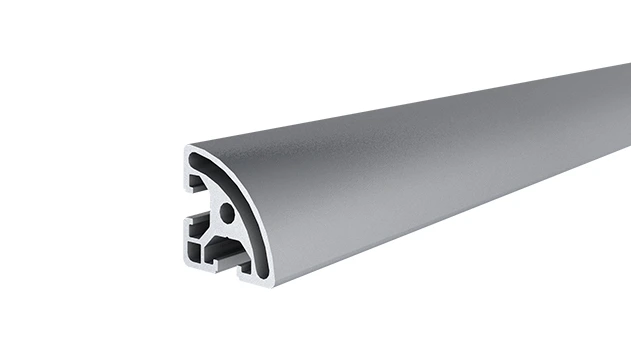
4040R is a 4.00x4.00 CM fractional 40 series square extrusion T-slot profile with two side open T-slots, each side with 4.00cm face,the other side is round face. The profile has align-a-grooves to assist in aligning connecting profiles.
Walk into any modern workshop, manufacturing plant, or lab, and you'll likely spot the unsung heroes holding everything together: aluminum profiles. These modular, versatile structures form the backbone of workbenches, material racks, conveyor systems, and even custom machinery. But here's the thing—choosing the right aluminum profile isn't just about picking a size and color. It's about sizing it to your project's unique needs. And when it comes to reliability and adaptability, the 4040r EU Standard Aluminum Profile is a crowd favorite. But to get the most out of it, you need to master the art of project sizing. Let's dive in.
What Exactly Is 4040r EU Standard Aluminum Profile?
First, let's demystify the name. The "4040" in 4040r tells you the profile's cross-section dimensions: 40mm in width and 40mm in height. That square shape makes it a workhorse for balanced load distribution, whether you're building a sturdy workbench or a multi-tiered material rack. The "r" stands for "rounded," referring to its smooth, curved edges—a small detail that makes a big difference in safety (no sharp corners to snag gloves or scrape arms) and aesthetics.
As an EU standard profile, it adheres to strict manufacturing guidelines for material quality, dimensional accuracy, and compatibility. Most 4040r profiles are made from 6063-T5 aluminum alloy, a popular choice for its winning combo of strength, lightweight properties, and corrosion resistance. This alloy is shaped using the aluminum extrusion profile process, where heated aluminum is pushed through a die to create the profile's precise cross-section—think of it like squeezing toothpaste through a tube, but with industrial precision.
What sets 4040r apart? Its modularity. Thanks to standardized T-slots running along its length, you can easily attach aluminum profile accessories like connectors, brackets, end caps, and panels without welding. Need to reconfigure your workbench next month? Just loosen a few bolts, rearrange the profiles, and you're good to go. It's this flexibility that makes 4040r a top pick for lean system setups, where adaptability is key to keeping operations efficient.
Why Project Sizing Isn't Just a "Nice-to-Have"
Let's get real: Sizing your 4040r profile correctly can mean the difference between a project that runs smoothly for years and one that turns into a costly headache. Imagine building a workbench for assembling heavy machinery parts. If you skimp on profile thickness or choose a span that's too long, you might notice the bench sagging within months. Worse, an unstable material rack could topple, damaging inventory or—worse—injuring someone.
On the flip side, over-sizing isn't a solution either. A beefier profile than you need adds unnecessary weight and cost. Those extra millimeters of aluminum might not seem like much, but multiply that across a whole production line, and you're looking at higher shipping fees, harder-to-maneuver assemblies, and wasted budget that could have gone into better accessories or tools.
Project sizing boils down to three core questions: How much weight will the profile need to support? How far apart will its supports be? And what environment will it operate in? Answer these, and you'll avoid the most common pitfalls.

Key Factors to Nail Your 4040r Sizing
1. Load Requirements: Static vs. Dynamic
Start with the basics: What's going on top of (or hanging from) your 4040r structure? Loads come in two flavors: static and dynamic. Static loads are stationary—think of a workbench holding tools, a shelf with boxes, or a machine bolted to a frame. Dynamic loads move or change—like parts sliding down a roller track, workers leaning on a bench, or a trolley being pushed into a rack.
To calculate static load, add up the weight of all permanent items. For example, a workbench might hold a 20kg toolbox, a 15kg monitor, and 10kg of parts—total static load of 45kg. But don't stop there: dynamic loads often add 30-50% more stress. If a worker places a 25kg part down quickly, that's a dynamic load spike. Always factor in a safety margin (most experts recommend 1.5x the maximum expected load) to account for unexpected stress.
4040r profiles vary in wall thickness, which directly impacts load capacity. A standard 4040r has a wall thickness of 1.5mm to 3mm. Thicker walls mean higher load capacity, but they also add weight and cost. For reference, a 2mm wall 4040r can typically support around 80-100kg per linear meter when supported at both ends. Thicker 3mm walls bump that up to 120-150kg/m. Check your supplier's load charts—reputable lean system suppliers will provide detailed specs for different wall thicknesses and spans.
2. Span Length: The Distance Between Supports
Span length—the distance between two supports (like legs on a workbench or uprights on a rack)—is just as critical as load. Even the strongest profile will sag if the span is too long. Picture a diving board: the longer it is, the more it bends under weight. The same principle applies to aluminum profiles.
As a general rule, shorter spans mean higher load capacity. For example, a 4040r with 2mm walls can handle 100kg over a 1m span, but that drops to 50kg over a 2m span. If your project needs a longer span, you have two options: add intermediate supports (like a center leg on a workbench) or upgrade to a thicker-walled 4040r. Most suppliers provide span-load charts—use them! They'll save you from guesswork.
3. Environmental Conditions
Where will your 4040r structure live? A clean lab, a dusty factory, or a humid warehouse? Aluminum's natural corrosion resistance helps, but extreme environments might call for extra precautions. In wet or chemical-heavy areas, consider anodized 4040r (a protective oxide layer added to the surface) to boost durability. For ESD-sensitive environments (like electronics manufacturing), look for profiles with conductive coatings—though ESD workstations often pair standard profiles with ESD mats or accessories, so check with your supplier on compatibility.
Temperature swings can also affect performance. Aluminum expands and contracts with heat and cold, but the EU standard 4040r is designed to handle typical industrial temperature ranges (-20°C to 60°C) without warping. Just avoid placing it near direct heat sources (like furnaces) or in uninsulated outdoor areas with extreme freeze-thaw cycles unless you've accounted for thermal movement in your design.
Choosing the Right Aluminum Profile Accessories
Your 4040r profile is only as strong as the accessories holding it together. Skimping on cheap connectors or using mismatched parts can turn a well-sized profile into a wobbly mess. Here's what to prioritize:
- Connectors: These are the glue of your structure. 90° aluminum profile connectors are the most common for joining profiles at right angles (think workbench legs to the top frame). For T-joints or crosses, use three-way or four-way connectors. Look for die-cast aluminum or steel connectors—plastic might work for light loads, but metal is better for durability.
- End Caps: Simple but essential. 4040 aluminum profile end caps plug the open ends of your profiles, keeping out dust, debris, and fingers. They also give a polished look—no more sharp, unfinished edges.
- Brackets and Gussets: For extra reinforcement, especially on corners or long spans. Gusset plates (like gusset alp 4040) add rigidity to joints, preventing twisting or bending under load.
- Fasteners: Use high-quality T-slot nuts and bolts that fit your profile's slot size (most 4040r profiles have M6 or M8 slots). Avoid over-tightening—you don't want to strip the threads or warp the profile.
Pro tip: Stick to accessories from the same supplier as your 4040r profile, or at least ones labeled "EU standard compatible." Mixing and matching non-standard parts can lead to loose fits or uneven load distribution.
Why Partnering with a Reliable Lean System Supplier Matters
You could spend hours poring over load charts and accessory specs, but nothing beats the expertise of a trusted lean system supplier. These aren't just salespeople—they're problem-solvers who've seen hundreds of projects (and hundreds of sizing mistakes). A good supplier will ask about your load, span, environment, and future plans, then recommend the right 4040r thickness, accessories, and even alternative profiles if 4040r isn't the best fit.
What to look for in a supplier? Check for ISO certifications (ISO 9001 is a good start) to ensure quality. Ask for material test reports—reputable suppliers will share data on tensile strength, yield strength, and corrosion resistance. Inquire about customization options: can they cut profiles to your exact length? Anodize them in a specific color? Provide custom accessories? And don't forget after-sales support—if you run into issues during assembly, you want a supplier who'll pick up the phone and help troubleshoot.
Common Sizing Mistakes to Avoid
Even pros make mistakes—here's how to steer clear of the biggest ones:
- Ignoring dynamic loads: Only calculating static weight is a recipe for sagging. Always add 30-50% for movement, impacts, or human interaction.
- Overlooking span length: A 4040r that works for a 1m span won't cut it for 2m. Use span-load charts religiously.
- Mixing profile standards: EU standard 4040r isn't always compatible with non-EU profiles. Mismatched slots or dimensions lead to loose joints.
- Skimping on accessories: Cheap plastic connectors might save money upfront, but they'll fail under stress. Invest in metal accessories for critical joints.
- "Bigger is better" thinking: A 40x80 profile might seem like overkill, but it adds unnecessary weight and cost. Stick to 4040r if it meets your load and span needs.
4040r vs. Other Profiles: A Quick Comparison
Not sure if 4040r is right for you? Compare it to other popular EU standard profiles to see where it shines:
| Profile Type | Dimensions (mm) | Typical Wall Thickness (mm) | Max Static Load (kg/m)* | Best For |
|---|---|---|---|---|
| 4040r EU | 40x40 (rounded edges) | 1.5-3.0 | 80-150 | Workbenches, material racks, small machine frames |
| 4040a EU | 40x40 (square edges) | 1.5-3.0 | 80-150 | Structures where sharp edges are acceptable (e.g., industrial racks) |
| 3030 EU | 30x30 | 1.2-2.0 | 50-90 | Light-duty shelves, small carts, DIY projects |
| 4080 EU | 40x80 | 2.0-3.5 | 150-250 | Heavy machinery frames, large workbenches, high-load racks |
*Based on 1m span with 2mm wall thickness. Load capacity decreases with longer spans.
As you can see, 4040r hits the sweet spot for most medium-duty applications. It's stronger than 3030 but more lightweight and affordable than 4080. The rounded edges make it ideal for workspaces where safety is a priority, like assembly lines or labs with frequent human interaction.
Final Sizing Checklist
Before you hit "order," run through this checklist to ensure you've covered all bases:
- Calculate total static load (all permanent items) and add 30-50% for dynamic loads.
- Measure the span length between supports. Use your supplier's span-load chart to find the required wall thickness.
- Note the environment: Will it be wet, dusty, or ESD-sensitive? Choose coatings or accessories accordingly.
- List all accessories needed (connectors, end caps, brackets) and ensure they're EU standard compatible.
- Consult your lean system supplier to review your specs—they might catch something you missed.
- Order a small prototype if possible (e.g., a short section of 4040r with connectors) to test fit and stability before building the full structure.
Wrapping Up: Sizing for Success
Choosing the right 4040r EU Standard Aluminum Profile isn't rocket science, but it does require attention to detail. By focusing on load, span, environment, and quality accessories, you'll build a structure that's strong, stable, and adaptable—one that grows with your project instead of holding it back.
Remember, the goal isn't just to "get by" with a profile that fits—it's to optimize for performance, safety, and cost. And when in doubt, lean on your supplier's expertise. A good lean system supplier won't just sell you profiles; they'll help you size them right, ensuring your project stands the test of time.
So go ahead—grab your measuring tape, calculate those loads, and start building. With 4040r sized to perfection, the possibilities are endless.