- Company Articles
- Industry articles
- Industry standards
- How to Choose the Right 2040 National Standard Profile Accessories

How to Choose the Right 2040 National Standard Profile Accessories
Related Product
2040 National Standard Profile
45° external bending joint, used for 45° external connection of two aluminum pipes.
If you've ever stood in front of a workshop shelf, a factory conveyor, or even a home DIY project built with aluminum extrusion profiles, you've probably admired how clean, sturdy, and adaptable those structures are. What you might not have noticed is the unsung heroes holding it all together: the accessories. For anyone working with 2040 national standard profiles—those versatile 20mm x 40mm aluminum workhorses—choosing the right accessories isn't just about slapping parts together. It's about turning a pile of metal into a system that works for you: durable, safe, and tailored to your needs. Let's dive into how to navigate this world of connectors, end caps, guide rails, and more—no confusion, no guesswork, just clear, practical advice.
Understanding 2040 National Standard Profiles: The Foundation of Modular Systems
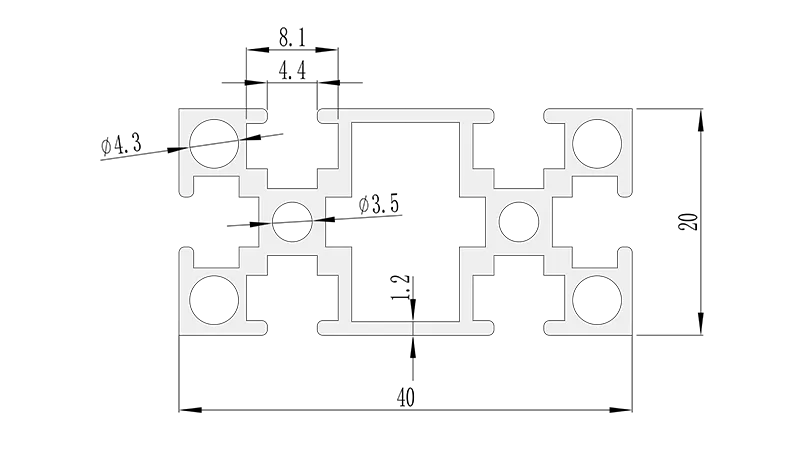
Before we talk accessories, let's get to know the star of the show: the 2040 national standard profile. These extruded aluminum beams are the backbone of modular setups in factories, workshops, labs, and even creative studios. Why? Start with their dimensions: 20mm in width and 40mm in height, with precision-machined T-slots running along their length. These slots are like the profile's "hands"—they let you attach, adjust, and reconfigure accessories without welding or drilling new holes. Made from aluminum alloy (typically 6063-T5, a grade prized for its strength-to-weight ratio), they're lightweight enough to move but tough enough to support heavy loads—think workbenches holding tools, material racks stacked with inventory, or conveyor rails guiding products down an assembly line.
What makes 2040 profiles so popular? They strike the perfect balance between size and versatility. They're narrow enough for compact projects (like small workbenches or shelving) but wide enough to add stability to larger structures (like production line frames). And because they're "national standard," you don't have to worry about mismatched sizes from different suppliers—if it's labeled "2040 national standard," it should play nice with other standard parts. But here's the catch: even the best profile is just a piece of metal without the right accessories. A loose connector can make a workbench wobble; a flimsy end cap can leave sharp edges exposed; the wrong guide rail can grind a smooth workflow to a halt. That's why choosing accessories isn't an afterthought—it's the key to unlocking the profile's full potential.
Key Categories of 2040 Profile Accessories: Your Toolkit for Building Better
Accessories for 2040 profiles come in all shapes and sizes, but they all fall into a few core categories. Let's break them down, so you know which part does what—and when to reach for it.
Connectors and Joints: The "Glue" That Holds It All Together
If profiles are the bones of your structure, connectors are the joints. They're what let you turn straight beams into angles, corners, and complex shapes. For 2040 profiles, the most common types are angle-specific connectors, and they're named for exactly what they do:
- 90° aluminum profile connector : The workhorse of right angles. Use these when you need two profiles to meet at a perfect corner—think the legs and top frame of a workbench, or the vertical and horizontal beams of a shelf. Look for models with set screws or bolts that tighten into the T-slots for a secure grip; avoid cheap plastic versions that can crack under stress.
- 45° aluminum profile connector : For slopes, ramps, or diagonal bracing. If you're building a material rack with inclined shelves (to let parts slide forward) or a frame that needs extra stability (like a triangular brace), these are your go-to. They often have offset holes to align with the 2040's T-slots, so double-check that the connector's hole spacing matches your profile.
- 135° aluminum profile connector : The "other" angle—great for creating obtuse corners, like the back of an L-shaped workbench or a frame that needs to wrap around an obstacle. These are less common than 90° or 45°, but crucial when your design can't stick to right angles.
- Three-way connectors : When one profile isn't enough. These let you attach three profiles at a single point—say, adding a vertical support beam to a horizontal shelf frame. Some three-way connectors are fixed (all angles set), while others are adjustable, giving you flexibility for custom setups.
Pro tip: Always match the connector material to your environment. If you're working in a damp area (like a garage or outdoor shed), look for connectors with anodized or powder-coated finishes to resist rust. Indoors, standard aluminum connectors work fine—just make sure they're made from the same alloy (6061 or 6063) as your profiles for compatibility.
End Caps and Covers: Protecting Profiles (and People)
Ever run your hand along an aluminum profile and felt a sharp, unfinished edge? That's where end caps and covers come in. They're small, affordable, and easy to overlook—but skip them, and you risk cuts, scratches, or debris getting stuck in the T-slots. Here's what to know:
- 2040 aluminum profile end cap : These snap or press into the open ends of profiles, covering the raw edges. They come in plastic (usually black or grey) or aluminum—plastic is lightweight and cheap, great for indoor use; aluminum is more durable for high-traffic areas (like a workshop where profiles might get bumped). Look for end caps with a snug fit—loose ones will fall off, leaving edges exposed.
- T-slot rubber seal cover : These are the strips that fill the T-slots along the length of the profile. They do two jobs: keep dirt, dust, and small tools from falling into the slots, and make the profile safer to handle (no more catching fingers on slot edges). They're usually made of flexible rubber or PVC, and they come in colors like black or grey to match your setup. For profiles used in clean environments (like labs or electronics assembly), these are non-negotiable—you don't want dust buildup gumming up your T-slots.
Guide Rails and Tracks: Making Motion Smooth
If your project involves movement—sliding shelves, conveyor systems, or parts that need to glide from one station to another—guide rails and tracks turn friction into flow. For 2040 profiles, the most useful options are:
- Aluminum guide rail a : A sleek, low-profile rail designed to mount directly to 2040 profiles via T-slots. It's often used with sliding brackets or rollers, making it ideal for drawers, tool holders, or small conveyor sections. The "a" designation usually refers to its height or slot configuration—check the specs to ensure it pairs with your rollers (look for compatibility with 1-inch or 0.5-inch swivel roller balls, for example).
- Plastic roller track guide rail : These are the yellow or grey plastic rails you'll see on material racks or assembly lines. They have built-in rollers that let boxes, bins, or parts slide with minimal effort. Plastic is gentle on delicate items (like circuit boards) and quieter than metal—perfect for environments where noise matters. Just note: plastic can warp in high heat, so avoid using them near ovens or welding stations.
Support and Stability: Feet, Levelers, and Bases
Even the sturdiest frame will wobble if it's not sitting right. Support accessories keep your structure stable, level, and safe—especially important for workbenches, racks, or any setup that holds heavy loads.
- Adjustable leveling feet : These screw into the bottom of vertical profiles, letting you tweak the height of each leg to compensate for uneven floors. They usually have a rubber or plastic base to prevent slipping and protect floors from scratches. For workbenches where precision matters (like assembly stations), get ones with a large adjustment range (at least 10mm) and a lock nut to keep them from unscrewing over time.
- Aluminum foot base : A flat, plate-like base that attaches to the bottom of a vertical profile, spreading its weight over a larger area. Use these on concrete or tile floors to prevent the profile from sinking in, or on carpet to avoid tipping. They're often paired with leveling feet for extra stability.
The Essential Accessory Decision Guide: 4 Factors to Prioritize
Now that you know the main accessory types, how do you pick the right ones for your project? It starts with asking the right questions. Here are the four key factors to consider:
1. Load Capacity: Don't Skimp on Strength
Every accessory has a breaking point—and it's your job to make sure you stay well below it. A 90° connector rated for 50kg might work for a small shelf holding light tools, but slap it on a workbench that needs to support 200kg of machinery, and you're asking for failure. Always check the manufacturer's load ratings (usually listed as "static load" for stationary setups or "dynamic load" for moving parts like conveyor rails). When in doubt, overestimate—better to have a connector that's stronger than needed than one that bends under pressure.
2. Environment: Match Accessories to Where They'll Live
A workshop in a dry, climate-controlled factory has different needs than one in a humid garage or a food processing plant with daily washdowns. For example:
- Wet or corrosive environments : Opt for stainless steel connectors or anodized aluminum (the coating resists rust). Avoid plastic accessories that can degrade in moisture.
- Clean rooms or electronics areas : Look for ESD-safe options (like black ESD wheel roller tracks) to prevent static buildup that could damage sensitive components.
- Outdoor use : Sunlight can fade plastic end caps, so go with UV-resistant materials. Rain and snow mean you'll need sealed connectors to keep water out of T-slots.
3. Compatibility: Not All "2040" Accessories Are Created Equal
Here's a common pitfall: assuming any accessory labeled "for aluminum profiles" will work with 2040 national standard profiles. Not true. Some accessories are designed for larger profiles (like 3030 or 4040), with wider T-slots or longer bolts that won't fit 2040's 20mm width. Always check the product specs for "2040 national standard" compatibility. If you're buying from a supplier, ask for a compatibility chart—reputable ones will have them. And when in doubt, buy a small sample first to test fit. It's cheaper than returning a box of mismatched parts.
4. Future-Proofing: Can You Adapt Later?
Modular systems are all about flexibility. Maybe today you need a simple shelf, but next month you want to add a sliding drawer. Choose accessories that let you adapt without rebuilding from scratch. For example, using T-slot nuts (instead of fixed bolts) lets you move components later. Quick-release connectors (like lever-operated joints) make disassembly faster than traditional bolt-on types. And extra T-slots? Always leave a few empty—you never know when you'll want to add a hook, a light, or a new rail.
Accessory Comparison Table: Which Part for Which Job?
| Accessory Type | Key Features | Best For | Material Options |
|---|---|---|---|
| 90° aluminum profile connector | Right-angle join, T-slot compatible, set-screw or bolt fastening | Workbench corners, vertical/horizontal shelf frames | Aluminum alloy (6063-T5), stainless steel (for corrosion resistance) |
| 2040 aluminum profile end cap | Snap/press-fit, covers sharp edges, dust protection | Open profile ends in workshops, labs, or public areas | Plastic (PVC/ABS), anodized aluminum |
| Aluminum guide rail a | Low-profile, T-slot mount, compatible with rollers/sliders | Sliding shelves, small conveyors, drawer systems | Anodized aluminum (corrosion-resistant finish) |
| Adjustable leveling feet | Height-adjustable (10-50mm range), anti-slip rubber base | Workbenches, racks, or setups on uneven floors | Aluminum body with rubber pad, stainless steel stem |
| T-slot rubber seal cover | Flexible, dust/water resistance, fits T-slot channels | Clean environments, profiles with exposed T-slots | PVC, EPDM rubber (chemical resistant) |
Real-World Examples: Accessories in Action
Let's put this all together with two common projects. Seeing how accessories work in context will make it easier to apply these tips to your own setup.
Example 1: Building a Heavy-Duty Workbench
Your goal: A 1.2m x 0.8m workbench for a mechanic's shop, supporting up to 300kg (tools, engine parts, etc.). Here's how to choose accessories:
- Frame connectors : Use 90° aluminum profile connectors (aluminum alloy, rated for 150kg+ per joint) at all four corners. Add three-way connectors in the middle of the horizontal beams for extra support (to prevent sagging).
- Leveling : Adjustable leveling feet with a 50mm height range and lock nuts—garage floors are rarely perfectly flat, and you need the bench stable when using power tools.
- Top surface : Mount an aluminum honeycomb panel (light but strong) using T-slot nuts and bolts (so you can remove it later if needed). Cover exposed profile ends with aluminum end caps (plastic might crack under heavy loads).
- Extras : Add aluminum guide rail a along the back edge to mount a tool holder with sliding brackets—easy access, and you can reposition tools as needed.
Example 2: Material Rack for a Warehouse
Your goal: A 2m tall rack with 3 shelves, each holding 150kg of boxes. You want boxes to slide forward when one is removed (so you don't have to reach to the back). Here's the accessory plan:
- Shelf angles : 45° aluminum profile connectors to tilt shelves at a 5° angle (gentle enough for boxes to slide, not so steep they tip).
- Sliding surface : Plastic roller track guide rail (yellow or grey) mounted to the shelf beams—rollers reduce friction, so boxes glide easily. Pair with swivel roller balls (1 inch) at the front edge to prevent jamming.
- Stability : Aluminum foot bases at the bottom of vertical profiles (spreads weight, prevents sinking into concrete) and diagonal bracing with 135° connectors (adds rigidity to keep the rack from wobbling when loaded).
- Safety : T-slot rubber seal covers on all horizontal profiles—warehouse staff walk by often, and exposed T-slots are a scratch hazard.
Final Tips: Sourcing Quality Accessories
Even the best planning falls flat if you buy shoddy parts. Here's how to find accessories that last:
- Stick to reputable suppliers : Look for suppliers who specialize in aluminum extrusion profiles and accessories—they're more likely to stock genuine national standard parts. Ask about certifications (like ISO 9001) to ensure quality control.
- Check material grades : For aluminum accessories, 6063-T5 is the gold standard—it's strong, corrosion-resistant, and easy to machine. Avoid "generic aluminum"—it might be softer and prone to bending.
- Read reviews (and ask for samples) : Other customers will tell you if a connector slips, an end cap cracks, or a guide rail warps. If you're unsure, order one or two pieces first to test fit and strength.
Conclusion: Accessories Turn Profiles Into Solutions
At the end of the day, 2040 national standard profiles are just beams—until you add the right accessories. Connectors turn them into frames; guide rails turn them into conveyors; end caps turn them into safe, clean workspaces. By focusing on load capacity, environment, compatibility, and future flexibility, you're not just buying parts—you're building a system that grows with you. So next time you're staring at that pile of aluminum extrusion accessories, take a breath. You've got this. And remember: the best accessory of all? A little patience to plan first, so you build right the first time.