- Company Articles
- Industry articles
- Industry standards
- How to Identify Authentic 3030 National Standard Profile A: Certification Checks

How to Identify Authentic 3030 National Standard Profile A: Certification Checks
Related Product
3030 National Standard Profile A
Workbench, production line, logistic rack, warehouse rack Industry: Manufacturer workshop, Automobile, Electronic, Assembling, logistic
Imagine walking into your production facility one morning to find a workbench wobbling unsteadily, its frame bending under the weight of tools it was supposed to support. A quick inspection reveals the culprit: the aluminum profile holding it together has developed hairline cracks. You'd invested in what you thought was a reliable 3030 National Standard Profile A—widely used in lean systems, assembly lines, and material racks—only to discover it was a counterfeit. The result? Delays, replacement costs, and a hit to your team's trust in the equipment they rely on daily.
In the world of manufacturing and industrial setups, the integrity of components like aluminum profiles isn't just about durability—it's about the efficiency of your entire operation. 3030 National Standard Profile A, a staple in constructing workbenches, flow racks, and lean system structures, is particularly prone to counterfeiting due to its popularity. These knockoffs often cut corners on material quality, dimensional accuracy, and certification compliance, leaving unsuspecting buyers with subpar products that fail prematurely.
So, how do you ensure the 3030 National Standard Profile A you're purchasing is the real deal? The answer lies in rigorous certification checks and a keen eye for physical details. In this guide, we'll walk you through the key steps to verify authenticity, from understanding what "national standard" truly means to cross-referencing supplier documentation and inspecting the profile itself. We'll also debunk common myths about "good enough" alternatives and show you why cutting corners on profile quality can cost far more in the long run.
What Is 3030 National Standard Profile A, Anyway?
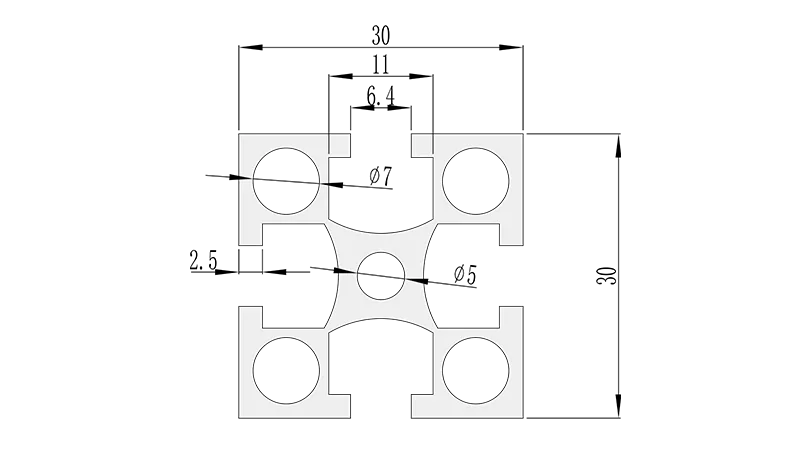
Before diving into certification checks, let's clarify what 3030 National Standard Profile A actually is. As the name suggests, it's a type of aluminum extrusion profile—a structural component made by forcing heated aluminum alloy through a die to create a specific cross-sectional shape. The "3030" refers to its dimensions: approximately 30mm in width and 30mm in height, making it a versatile choice for medium-load applications. The "National Standard" label means it adheres to strict dimensional, material, and performance criteria set by official regulatory bodies, ensuring consistency across manufacturers.
This profile is a workhorse in industrial settings. You'll find it in everything from lean system workstations and turnover trolleys to material racks and conveyor supports. Its popularity stems from its balance of strength and lightweight properties: aluminum's natural resistance to corrosion and high strength-to-weight ratio make it ideal for environments where durability and mobility matter. Plus, its T-slot design allows for easy assembly with aluminum profile accessories like brackets, connectors, and panels—no welding required, which speeds up setup and modifications.
But here's the catch: not all 30mm x 30mm aluminum profiles are created equal. Counterfeit versions may mimic the shape but skimp on critical factors like alloy composition, wall thickness, and extrusion precision. These differences might seem minor at first, but they add up. A counterfeit profile with a thinner wall, for example, can't support the same weight as an authentic one, leading to sagging shelves or unstable workbenches. Similarly, imprecise T-slots can make attaching accessories a frustrating, time-consuming process—or worse, result in loose connections that compromise safety.
Why Authenticity Matters: The Hidden Costs of Counterfeit Profiles
You might be thinking, "If it looks like 3030 National Standard Profile A and costs less, why not take the risk?" The truth is, counterfeit profiles come with hidden costs that often far exceed the initial savings. Let's break them down:
- Safety Risks: A profile that bends or cracks under load can lead to equipment failure, putting workers at risk of injury. In extreme cases, falling tools or materials could cause serious harm.
- Production Delays: When a counterfeit profile fails, you'll need to halt operations to replace it. This downtime can disrupt deadlines and cost thousands in lost productivity.
- Replacement Expenses: Buying a cheap counterfeit might save you $50 upfront, but replacing it every few months adds up. Authentic profiles, by contrast, can last for years with minimal maintenance.
- Damage to Reputation: If your products rely on structures built with counterfeit profiles, quality issues could extend to the goods you produce, damaging customer trust.
The good news? With the right certification checks and inspection techniques, you can avoid these pitfalls. Let's start with the first line of defense: verifying the certifications that prove a profile meets national standards.
Certification Checks: The Paper Trail of Authenticity
Authentic 3030 National Standard Profile A isn't just a hunk of metal—it's a product backed by documentation that proves it meets rigorous standards. Certification checks involve reviewing these documents to ensure the profile was manufactured, tested, and inspected according to official guidelines. Here are the key certifications to look for:
1. Manufacturer Quality Management Certification (ISO 9001)
Before even looking at the profile itself, start with the supplier. A reputable manufacturer of 3030 National Standard Profile A should hold an ISO 9001 certification. This international standard ensures the supplier has a quality management system (QMS) in place to consistently produce products that meet customer and regulatory requirements. It covers everything from raw material sourcing to production processes and post-sales support.
How to verify it? Ask the supplier for a copy of their ISO 9001 certificate and check the issuing body (e.g., SGS, Bureau Veritas) to ensure it's a recognized certification authority. Most certifying bodies allow you to verify certificates online using a unique ID or serial number. If a supplier hesitates to provide this document or the certificate looks outdated (ISO 9001 is typically renewed every three years), it's a red flag.
2. Material Composition Certificate
3030 National Standard Profile A is made from aluminum alloy, and the specific alloy used directly impacts its strength, corrosion resistance, and machinability. The national standard specifies the allowable alloy grades—most commonly 6063 or 6061, known for their excellent extrusion properties and weldability. A material composition certificate (often called a "mill test report" or MTR) provides a breakdown of the alloy's chemical composition, confirming it meets these standards.
What to look for in the MTR? Check for elements like silicon (Si), magnesium (Mg), and copper (Cu), which are critical to the alloy's performance. For example, 6063 alloy typically contains 0.2-0.6% silicon and 0.45-0.9% magnesium. If the MTR shows significantly lower or higher percentages, the alloy may be substandard. Also, ensure the report includes the heat treatment process—aluminum profiles are often T5 or T6 heat-treated to enhance strength, and the certificate should confirm this step was performed correctly.
3. Dimensional Certification
The "3030" in the profile's name isn't just a rough estimate—it refers to precise dimensional tolerances set by the national standard. A dimensional certification (sometimes called a "dimensional inspection report") verifies that the profile's width, height, wall thickness, and T-slot dimensions fall within these tolerances. Even small deviations can cause big problems: a T-slot that's 0.5mm too narrow, for example, won't fit standard aluminum profile accessories , forcing you to grind or modify the slot (and risking damage to the profile).
Key dimensions to check include:
- Overall width and height: Should be 30mm ±0.3mm (varies slightly by national standard).
- Wall thickness: Typically 1.2mm to 2.0mm for 3030 profiles, depending on load rating.
- T-slot width and depth: Must match standard accessory measurements (e.g., M6 or M8 bolts).
The certificate should include measurements taken at multiple points along the profile (not just a single sample) to ensure consistency. If the supplier can't provide this report, or if the measurements are handwritten without calibration data for the measuring tools, proceed with caution.
4. Surface Treatment Certification
Most 3030 National Standard Profile A undergoes surface treatment—like anodizing—to improve corrosion resistance and appearance. Anodizing creates a protective oxide layer on the aluminum, making it more durable in humid or industrial environments. A surface treatment certification confirms the anodizing process meets standards for thickness (usually 8-12 microns for industrial profiles) and uniformity.
Counterfeit profiles often skip proper anodizing or use a cheaper process, resulting in a thin, uneven coating that chips or fades quickly. To verify, the certificate should include details like the anodizing method (sulfuric acid anodizing is standard), coating thickness, and adhesion test results. If the profile's finish looks dull, patchy, or easily scratches off, it may lack proper certification.
Pro Tip: Always ask for original certification documents, not photocopies or screenshots. Counterfeiters often doctor certificates, but original copies will have watermarks, holograms, or unique serial numbers that are hard to replicate.
Beyond the Paperwork: Physical Inspection Tips
Certifications are crucial, but they're not foolproof. Some counterfeiters forge documents to look legitimate, so pairing paperwork checks with physical inspection is essential. Here's how to examine a 3030 National Standard Profile A up close to spot red flags:
1. Check the Weight
Aluminum has a consistent density, so an authentic 3030 profile will have a predictable weight per meter. Counterfeits often use thinner walls or lower-grade alloys to cut costs, resulting in a lighter profile. For example, a 3030 profile with a 1.5mm wall thickness should weigh approximately 0.7-0.8 kg per meter (exact weight varies by alloy and heat treatment). If a sample feels noticeably lighter than this range, it may be underweight.
How to test it? Weigh a 1-meter section using a precise scale. Compare the result to the weight specified in the supplier's documentation. A discrepancy of more than 5% is a warning sign.
2. Inspect the Surface Finish
Authentic 3030 National Standard Profile A has a smooth, uniform surface. Run your hand along the length of the profile—you should feel no burrs, dents, or rough patches. The anodized coating (if applicable) should be even, with no discoloration or streaks. Counterfeit profiles often have uneven finishes due to poor extrusion dies or rushed anodizing processes.
Another test: use a soft cloth to wipe the surface. If the cloth picks up black residue, it may be from unprocessed aluminum oxide or cheap paint (instead of proper anodizing). Authentic anodized profiles won't leave residue unless they're dirty.
3. Verify Dimensional Accuracy with Tools
Even if the supplier provides a dimensional certification, double-check key measurements yourself using calipers or a ruler. Focus on:
- Width and height: Measure at three points (top, middle, bottom) to ensure consistency. Variations of more than 0.5mm indicate poor extrusion control.
- Wall thickness: Use a micrometer to check the thickness at the corners and flat sections. Counterfeits often have uneven walls, with thinner sections in hard-to-measure areas.
- T-slot dimensions: insert a standard T-slot nut (common in aluminum profile accessories ) into the slot. It should slide smoothly without wobbling or sticking. If it's too tight or loose, the slot dimensions are off.
4. Test Compatibility with Accessories
3030 National Standard Profile A is designed to work seamlessly with standardized aluminum profile accessories like brackets, hinges, and panel mounts. Grab a few common accessories (e.g., a 90-degree connector or a panel clamp) and try assembling them with the profile. If the accessories don't align properly, require excessive force to attach, or feel loose after installation, the profile's tolerances are likely incorrect.
For example, a 90-degree connector should fit snugly into the T-slot, with no gaps between the connector and the profile. If you have to hammer it into place or it wiggles once attached, the profile is probably a counterfeit.
Authentic vs. Counterfeit: A Side-by-Side Comparison
| Feature | Authentic 3030 National Standard Profile A | Counterfeit Profile |
|---|---|---|
| Certification Documentation | Provides ISO 9001, material composition, dimensional, and surface treatment certificates with verifiable serial numbers. | Certificates are missing, photocopied, or contain typos/incorrect dates. Supplier hesitates to provide originals. |
| Material Weight | Consistent weight per meter (e.g., 0.7-0.8 kg for 1.5mm wall thickness). | 5%+ lighter than specified, due to thinner walls or lower-grade alloy. |
| Surface Finish | Smooth, burr-free, with even anodized coating (no streaks or discoloration). | Rough patches, visible die marks, or uneven/an overly thin anodized layer. |
| Dimensional Tolerances | Width/height within ±0.3mm; wall thickness consistent; T-slots fit standard accessories. | Width/height varies by >0.5mm; wall thickness uneven; T-slots too tight/loose for accessories. |
| Alloy Composition | Meets national standard for 6063/6061 alloy (e.g., 0.2-0.6% silicon, 0.45-0.9% magnesium). | Alloy contains high levels of impurities (e.g., iron >0.3%) or uses untested, low-grade aluminum. |
Working with Trusted Suppliers: Your First Line of Defense
Even the most thorough certification checks and physical inspections can't replace the value of working with a reputable supplier. A trustworthy aluminum extrusion profile supplier will prioritize transparency, providing all necessary documentation upfront and answering questions about their manufacturing processes. Here's how to vet a supplier before placing an order:
1. Ask for References and Reviews
Reputable suppliers will have a list of satisfied customers willing to vouch for their products. Ask for references in your industry (e.g., other manufacturers or assembly plants) and reach out to them. Ask about the supplier's product quality, delivery times, and responsiveness to issues. You can also check online review platforms or industry forums for feedback—consistent complaints about quality or documentation are a warning sign.
2. Inquire About Production Capabilities
A supplier that manufactures 3030 National Standard Profile A in-house (rather than sourcing from third parties) has more control over quality. Ask about their extrusion equipment, quality control processes, and testing protocols. For example, do they perform dimensional checks on every batch? Do they have an in-house lab for material composition testing? Suppliers that can't answer these questions may be reselling counterfeit or substandard products.
3. Request a Sample
Before placing a large order, ask for a sample profile. This gives you the chance to perform the physical inspections and certification checks outlined above. A legitimate supplier will happily provide a sample (often at minimal cost or for free), while a counterfeiter may hesitate or charge an exorbitant fee to avoid scrutiny.
4. Check for Brand Consistency
Many reputable aluminum profile manufacturers stamp their products with a brand logo, model number, or batch code. Look for these markings on the sample profile—they should be, evenly printed, and consistent with the supplier's branding. Counterfeits often have or misspelled markings, or no markings at all.
Common Myths About 3030 National Standard Profile A
Even with all this information, it's easy to fall for myths that downplay the importance of authenticity. Let's debunk a few:
Myth: "All 30mm x 30mm profiles are the same."
False. The "National Standard" label ensures specific tolerances, material quality, and performance criteria. A generic 30mm x 30mm profile may look similar but lack the engineering to meet these standards. For example, it may use a lower-grade alloy that corrodes faster or have uneven walls that weaken the structure.
Myth: "Certifications are just paperwork—what matters is how it looks."
Certifications are more than just paperwork; they're proof that the profile was manufactured to meet safety and performance standards. A profile that looks good but lacks certification may have hidden flaws (e.g., internal porosity from poor extrusion) that only reveal themselves under stress.
Myth: "Counterfeits are only a problem for cheap suppliers."
Counterfeiters often target mid-tier suppliers, too, mixing genuine and fake profiles to maximize profits. Even if you've worked with a supplier before, always verify certifications and inspect samples for new orders—quality can slip over time.
Final Thoughts: Investing in Authenticity Pays Off
Identifying authentic 3030 National Standard Profile A requires a mix of paperwork scrutiny and hands-on inspection, but the effort is well worth it. By prioritizing certification checks, verifying material quality, and working with trusted suppliers, you'll avoid the hidden costs of counterfeits and ensure your lean system, workbenches, and material racks stand the test of time.
Remember: in industrial settings, every component plays a role in the success of your operation. Cutting corners on something as fundamental as an aluminum profile isn't just a risk—it's a false economy. Authentic 3030 National Standard Profile A isn't just a purchase; it's an investment in the safety, efficiency, and reliability of your team and processes.
So, the next time you're sourcing aluminum profiles, take the time to check those certificates, weigh that sample, and test those accessories. Your production line (and your peace of mind) will thank you.