- Company Articles
- Industry articles
- Industry standards
- How to Optimize Space with 2040 National Standard Profile Material Racks

How to Optimize Space with 2040 National Standard Profile Material Racks
Related Product
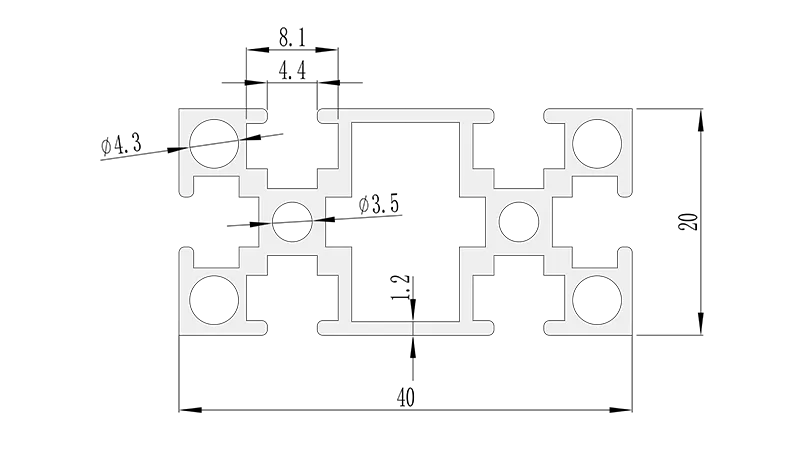
2040 National Standard Profile
45° external bending joint, used for 45° external connection of two aluminum pipes.
Walk into any busy warehouse, factory floor, or workshop, and you'll likely spot the same silent culprit: wasted space. A corner stacked with unused equipment, shelves that stop halfway up the wall, workbenches surrounded by clutter—these aren't just eyesores. They're productivity killers. Every square foot of unutilized space translates to longer travel times for workers, delayed order fulfillment, and higher operational costs. But what if there was a way to transform even the most cramped spaces into models of efficiency? Enter the 2040 national standard profile material rack—a solution that's redefining how businesses think about storage, workflow, and spatial design.
In this article, we'll dive into how the 2040 national standard profile (a lightweight yet durable aluminum extrusion) is revolutionizing material storage. We'll explore its unique features, why it outperforms traditional storage solutions, and how pairing it with the right aluminum profile accessories can turn your cluttered workspace into a streamlined, space-saving machine. Whether you're managing a small workshop or a large-scale manufacturing plant, the insights here will help you maximize every inch of your facility—without sacrificing functionality or flexibility.
What Is the 2040 National Standard Profile, Anyway?
Before we jump into space optimization, let's get to know the star of the show: the 2040 national standard profile. At its core, this is a precision-engineered aluminum extrusion with a cross-sectional dimension of 20mm (width) by 40mm (height). But don't let its slim profile fool you—this isn't just any piece of metal. Made from high-grade aluminum alloy (typically 6063-T5, a material prized for its strength and corrosion resistance), the 2040 profile is designed to be both lightweight and incredibly sturdy. Think of it as the building block of modern modular storage: strong enough to hold heavy loads, yet light enough to reconfigure without calling in a team of contractors.
What really sets the 2040 profile apart is its T-slot design. Running along its length are grooves (or "slots") that allow for easy attachment of aluminum profile accessories—brackets, shelves, guide rails, and even casters—using simple bolts, nuts, or snap-in connectors. No welding, no drilling, no messy adhesives. This modularity is key to its space-saving superpowers: if your storage needs change next month, next quarter, or next year, you can disassemble, rearrange, and rebuild your rack in hours, not days. Compare that to traditional steel racks, which are bolted or welded into place and nearly impossible to modify without cutting torches or power tools.
Why 2040 Profiles Are a Game-Changer for Material Racks
So, what makes the 2040 national standard profile the go-to choice for space-optimized material racks? Let's break down the benefits that make it stand out from wood, steel, and even other aluminum profiles.
1. Modularity: Adapt or Die (Efficiently)
In today's fast-paced business world, flexibility isn't a luxury—it's a necessity. A product line expands, a new machine arrives, or seasonal demand spikes, and suddenly your "perfect" storage setup is obsolete. With 2040 profiles, obsolescence is a thing of the past. Thanks to their T-slot design and compatible aluminum profile accessories, you can add a shelf, extend a rack, or even repurpose a section into a mobile cart with minimal effort. For example, if you need to squeeze a new workbench into your layout, you can simply disassemble a portion of your material rack, shorten it, and reattach the pieces—no need to buy a whole new system.
2. Strength-to-Weight Ratio: Stack Higher, Store More
Wasted vertical space is the biggest sin in storage design. Many facilities limit their racks to eye level, leaving feet of unused space above. Why? Because traditional materials like wood or low-grade steel can't support heavy loads at height without bowing or collapsing. The 2040 profile solves this with its impressive strength-to-weight ratio. Aluminum alloy 6063-T5 has a tensile strength of around 215 MPa, meaning a single 2-meter length of 2040 profile can easily support 50-75 kg (110-165 lbs) when properly braced. This allows you to build taller racks—up to 3-4 meters in some cases—without sacrificing stability. Suddenly, that unused airspace above your old shelves becomes prime real estate for boxes, tools, or raw materials.
3. Compatibility: Accessories That Enhance Space Savings
A 2040 profile is only as good as the accessories it pairs with. Luckily, the market is flooded with aluminum profile accessories designed specifically to boost space efficiency. Take aluminum guide rail A, for example—a sleek, low-friction rail that attaches directly to 2040 profiles. When mounted on shelves, it turns static storage into a dynamic system where bins or boxes slide smoothly, making it easy to access items from the back without rearranging everything in front. Or consider caster wheels: attach them to the base of your 2040 rack, and suddenly you have a mobile storage unit that can be rolled out of the way when not in use, freeing up floor space for other tasks. Even small touches, like T-slot end caps, keep the profile lightweight while preventing dust buildup in the slots—ensuring your accessories always fit snugly.
Designing Your Space-Optimized Material Rack: A Step-by-Step Guide
Now that you understand the "why" behind 2040 profiles, let's get into the "how." Designing a space-optimized material rack isn't about throwing together a few profiles and hoping for the best—it's a strategic process that starts with your unique needs and ends with a system that grows with your business. Here's how to do it right.
Step 1: Audit Your Space and Inventory
Before picking up a single profile, take stock of what you're storing and where. Ask yourself: What items will go on the rack? (Small parts? Bulky machinery? Raw materials?) How often do you need to access them? (Daily? Weekly? Monthly?) What's the weight of your heaviest item? And perhaps most importantly: What's the footprint of your current storage area, and where are the bottlenecks? (Is there a corner where nothing fits? A walkway that's always blocked by shelves?)
For example, if you're storing small electronic components, you'll want shallow shelves with dividers (easily added with aluminum profile accessories). If you're housing large automotive parts, you'll need deeper, sturdier shelves and possibly reinforced vertical supports. By mapping out your inventory and space constraints first, you'll avoid overbuilding (wasting space) or underbuilding (needing to rebuild sooner than later).
Step 2: Prioritize Vertical Space (Yes, All of It)
The average warehouse leaves 30-40% of its vertical space unused—and that's a tragedy. With 2040 profiles, you can reach for the ceiling (literally). Start by measuring the height of your facility—most industrial spaces have ceilings 8-12 feet high, but some have mezzanines or overhead cranes that limit rack height. Once you know your max height, design your rack to use as much of that space as possible, leaving only enough clearance for safe access (e.g., 12-18 inches below sprinklers or light fixtures).
Pro tip: Use adjustable shelving. With 2040 profiles, you can move shelves up or down in minutes by loosening the T-slot nuts, repositioning, and tightening. This means you can store taller items on the bottom (easier to lift) and shorter, lighter items on the top (accessed with a step stool or ladder). No more wasted inches between shelves!
Step 3: Integrate with Workflows (Don't Just Store—Streamline)
A material rack shouldn't exist in a vacuum. It should be part of your workflow, reducing the distance between storage and workbenches, assembly lines, or packing stations. For example, if your team assembles products at a workbench, place a 2040 profile material rack within arm's reach. Use aluminum guide rail A to create a "pick-and-place" system where parts slide directly from the rack to the workbench, eliminating the need to walk back and forth. This not only saves space (by consolidating storage and work areas) but also cuts down on labor time—win-win.
Another trick: Use mobile racks (with caster wheels) for items that aren't needed 24/7. When not in use, roll them into a corner or against a wall, freeing up floor space for other tasks like equipment maintenance or temporary inventory overflow.
Case Study: Material Rack B (3 Row and 3 Floor) Transforms a Crowded Factory
Theory is great, but real-world results speak louder. Let's look at a case study of a mid-sized electronics manufacturer that swapped its outdated storage system for a 2040 national standard profile setup—specifically, Material Rack B (3 row and 3 floor)—and saw immediate space and efficiency gains.
The Problem: The factory's old storage system consisted of wooden shelves and a few steel racks. With three production lines running simultaneously, they struggled with two major issues: (1) limited vertical space—most shelves only had 2 floors, leaving 4 feet of unused height, and (2) disorganization—parts were scattered across multiple racks, leading to 15-20 minute delays per shift as workers hunted for components.
The Solution: After consulting with a 2040 profile supplier, they installed Material Rack B: a modular system with 3 rows (to match their production lines) and 3 floors (maximizing vertical space). The rack was built using 2040 national standard profiles, reinforced with aluminum corner brackets, and fitted with aluminum guide rail A on each shelf to allow plastic bins to slide forward when needed. They also added caster wheels to the bottom of one rack, making it mobile for use during peak production.
The Results: In just two weeks, the transformation was staggering. By adding a third floor to each row, they increased storage capacity by 50% without expanding the rack's footprint. Aluminum guide rail A reduced bin retrieval time from 2 minutes to 20 seconds per part. And the mobile rack? It freed up 120 square feet of floor space during off-peak hours, which the team repurposed for a new testing station. Total space saved: ~35% in the storage area alone. "We used to trip over boxes and waste time searching," said the production manager. "Now, everything has a place, and that place is easy to reach."
The Power of Accessories: Small Additions, Big Space Wins
If 2040 profiles are the backbone of your space-optimized rack, aluminum profile accessories are the muscles that make it strong, flexible, and efficient. Here are a few must-have accessories that will take your rack from "good" to "game-changing."
Aluminum Guide Rail A: Smooth Sailing for Materials
Ever tried to pull a heavy bin from the back of a shelf? It's like wrestling a stubborn couch—you end up rearranging everything in front, wasting time and space. Aluminum guide rail A solves this by turning your shelf into a mini conveyor belt. These low-profile rails attach to 2040 profiles via T-slot connectors and use small, smooth-rolling wheels to let bins or boxes glide forward with minimal effort. Suddenly, the back of the shelf is as accessible as the front, so you can pack more items onto each shelf without sacrificing usability.
Caster Wheels: Mobility = Space Freedom
Not all storage needs to be permanent. Caster wheels (another key aluminum profile accessory) turn your static rack into a mobile unit that can be moved when not in use. Need extra floor space for a team meeting? Roll the rack to the side. Setting up a temporary assembly line? Wheel the rack right next to the workbench. Look for heavy-duty casters with brakes to ensure stability when the rack is in use—most 2040 profile suppliers offer casters rated for 100-200 kg per wheel, so even fully loaded racks stay steady.
Adjustable Dividers and Bins: Tame the Clutter
Small parts are the worst space hogs—they roll around, get mixed up, and require endless small boxes that take up more room than the parts themselves. Adjustable dividers (which clip into 2040 profiles) let you split shelves into custom-sized compartments, while stackable plastic bins (designed to fit perfectly on aluminum guide rail A) keep parts organized and visible. The result? You can fit 2-3 times more small parts on a single shelf than with loose boxes.
Material Rack Comparison: Why 2040 Profiles Beat the Competition
Still not convinced the 2040 national standard profile is right for you? Let's put it head-to-head with two common alternatives: traditional steel racks and wooden shelves. The table below compares key features that impact space optimization, cost, and flexibility.
| Feature | 2040 Profile Material Rack B (3 Row, 3 Floor) | Standard Steel Rack | Wooden Shelves |
|---|---|---|---|
| Material | Aluminum alloy (6063-T5) | Carbon steel | Plywood or particleboard |
| Assembly Time | 2-3 hours (no welding) | 8-10 hours (requires welding/drilling) | 4-5 hours (cutting, sanding, painting) |
| Max Height | Up to 12 feet (with bracing) | Up to 10 feet (heavier, harder to stabilize) | Up to 6 feet (prone to warping/collapse) |
| Weight Capacity (Per Shelf) | 150-200 kg (adjustable) | 200-300 kg (fixed, non-adjustable) | 50-100 kg (varies by wood quality) |
| Reconfigurability | Full (shelves, height, layout change in minutes) | Minimal (requires cutting/welding to modify) | None (must be rebuilt entirely) |
| Space Efficiency (Storage per sq. ft.) | High (max vertical use + adjustable shelving) | Medium (fixed shelves waste vertical space) | Low (bulky, can't stack high safely) |
As the table shows, the 2040 profile rack outperforms steel and wood in nearly every category that matters for space optimization. It's faster to build, taller, more adjustable, and far more efficient at using every square inch of your facility.
Maintaining Your 2040 Profile Rack: Keep It Space-Saving for Years
A space-optimized rack is only useful if it stays sturdy and functional. Luckily, 2040 profiles are low-maintenance—far more so than steel (which rusts) or wood (which warps or rots). Here's how to keep your rack in top shape:
- Inspect joints monthly: Check T-slot nuts and bolts for tightness. Over time, vibration from daily use can loosen them, which could cause shelves to sag. A quick tighten with a hex key takes 2 minutes and prevents bigger issues.
- Clean regularly: Dust and debris can build up in T-slots, making it harder to adjust shelves. Wipe down profiles with a damp cloth every few months, and use compressed air to blow out slots if they get clogged.
- replace worn parts: If a caster wheel starts to stick or a divider breaks, replace it immediately. Aluminum profile accessories are cheap and easy to swap out—no need to replace the entire rack.
- Watch for overloading: Even strong profiles have limits. Stick to the weight capacity you planned for, and avoid piling items higher than the shelf lip (they could topple and damage the rack or injure someone).
Conclusion: Your Space, Reimagined
Wasted space isn't just a problem—it's a missed opportunity. Every square foot of your facility has the potential to boost productivity, reduce costs, and make your team's work easier. The 2040 national standard profile material rack, paired with smart design and aluminum profile accessories like aluminum guide rail A and caster wheels, turns that potential into reality. It's modular enough to grow with your business, strong enough to reach for the ceiling, and flexible enough to adapt to whatever the future throws at you.
So, what are you waiting for? Stop accepting cluttered, inefficient storage and start reimagining your space. Whether you're building a single Material Rack B (3 row and 3 floor) or outfitting an entire warehouse, 2040 profiles are the key to a workspace that works for you—not against you. Your future self (and your bottom line) will thank you.