- Company Articles
- Industry articles
- Industry standards
- Integrating 3060 National Standard Profile A with Conveyor Systems in Logistics

Integrating 3060 National Standard Profile A with Conveyor Systems in Logistics
Related Product
3060 National Standard Profile A
Workbench, production line, logistic rack, warehouse rack Industry: Manufacturer workshop, Automobile, Electronic, Assembling, logistic
The Logistics Revolution: Where Flexibility Meets Efficiency
Walk into any modern logistics facility, and you'll see a symphony of movement: packages gliding along belts, workers retrieving items from racks, and carts zipping between stations. But behind this seamless dance lies a critical challenge: how to design systems that keep up with shifting demands—whether it's seasonal spikes, new product lines, or sudden changes in order volume. For decades, logistics managers have grappled with rigid infrastructure: conveyor belts bolted to the floor, workbenches that can't be reconfigured, and material handling setups that require weeks of downtime to modify. Today, that's changing. The key? Smart integration of modular components that adapt as quickly as your business does. At the heart of this shift is the 3060 National Standard Profile A, a versatile aluminum extrusion that's redefining how conveyor systems, workstations, and material flow solutions come together.
In this article, we'll dive into why the 3060 National Standard Profile A has become a cornerstone of flexible logistics design, how it integrates with conveyor systems to streamline operations, and the real-world impact this pairing has on efficiency, cost, and scalability. We'll also explore the role of aluminum profile accessories, roller track systems, and ergonomic workbenches in creating a cohesive, adaptable workflow. Whether you're running a small warehouse or a large-scale distribution center, understanding this integration could be the difference between keeping up with the competition and falling behind.
Meet the 3060 National Standard Profile A: More Than Just Aluminum
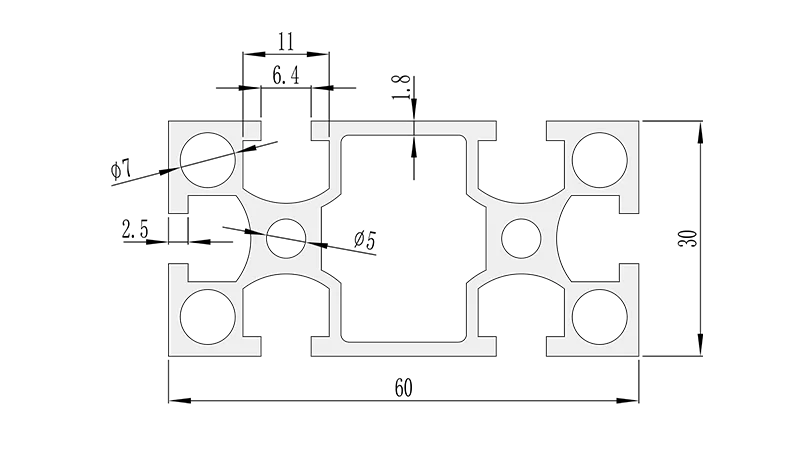
Before we talk about integration, let's get to know the star of the show: the 3060 National Standard Profile A. If you're not familiar with aluminum extrusion profiles, think of them as the building blocks of modern industrial design—hollow, lightweight beams with grooves (called "T-slots") running along their length, designed to connect with bolts, brackets, and other accessories without welding or drilling. The "3060" in its name refers to its dimensions: 30mm in width and 60mm in height, making it a mid-sized profile that strikes the perfect balance between strength and versatility. As a "national standard" profile, it adheres to strict manufacturing guidelines, ensuring compatibility across brands and suppliers—a detail that matters when you're piecing together a system from multiple components.
But what makes the 3060 Profile A stand out in logistics? For starters, it's made from high-grade aluminum, which means it's lightweight enough to reconfigure (no heavy machinery needed) but strong enough to support heavy loads—think pallets, toolboxes, or even small conveyor sections. Its T-slot design is another game-changer: instead of being limited to fixed holes or pre-drilled points, you can attach accessories anywhere along the slot, allowing for last-minute adjustments or entirely new configurations. Need to add a side rail to a conveyor? Slide a bracket into the T-slot. Want to raise a workbench by 6 inches? Swap out the leg brackets. This flexibility isn't just convenient—it's transformative for logistics operations where change is the only constant.
Compare this to traditional steel frames or wooden workbenches. Steel is durable but heavy; reconfiguring a steel-based conveyor system often requires cutting, welding, or hiring contractors, which eats into time and budget. Wood, while cheap, warps over time and can't support the weight of industrial equipment. The 3060 Profile A avoids these pitfalls, offering a middle ground that's strong, lightweight, and infinitely adaptable. It's no wonder that logistics managers are increasingly turning to aluminum profiles like this to future-proof their operations.
Conveyor Systems: The Backbone of Logistics (and Their Hidden Flaws)
Conveyors are the unsung heroes of logistics. They move materials from point A to B with minimal human intervention, reducing labor costs and minimizing errors. From belt conveyors for small packages to roller conveyors for heavy pallets, these systems come in all shapes and sizes, each tailored to specific tasks. But for all their benefits, traditional conveyor setups have a critical weakness: rigidity. Most are built to a fixed layout, designed around a single product type or workflow. When your needs change—say, you start handling larger boxes or need to reroute a section to accommodate a new packing station—you're stuck. Retrofitting a traditional conveyor can take days or even weeks, during which your operation slows to a crawl.
Another pain point is maintenance. Steel conveyors are prone to rust, especially in humid environments, and their fixed joints can loosen over time, leading to jams or misalignments. Repairs often require specialized tools or replacement parts that are slow to arrive. And let's not forget space: rigid conveyors take up valuable floor area, leaving little room for expansion or temporary setups during peak seasons.
This is where the integration of 3060 National Standard Profile A comes into play. By pairing conveyors with modular aluminum profiles, you're not just adding a frame—you're creating a system that can evolve with your needs. The profile acts as a flexible backbone, supporting conveyor sections, guiding rails, and even auxiliary components like sensors or label printers. Instead of building a conveyor system in one piece, you build it in modules, each connected via the 3060 Profile A and its accessories. Need to shorten a conveyor line? Disconnect a module and roll it to storage. Want to add a 90-degree turn? Attach a new section using T-slot brackets. It's like building with Lego blocks, but for industrial logistics.
Why 3060 Profile A and Conveyors Work: The Integration Basics
At first glance, you might wonder: Why pair an aluminum profile with a conveyor system? The answer lies in compatibility. Conveyors, by nature, need a stable, level base to operate smoothly. The 3060 Profile A provides that base, but with a twist: it's not fixed. Its modular design means you can adjust the height, width, or angle of the conveyor to match your needs, whether you're feeding items into a high shelving unit or lowering them to a packing table. But integration goes beyond just support— it's about creating a cohesive ecosystem where conveyors, workbenches, and material racks work in harmony.
Let's break down the integration process. First, the conveyor itself: many modern conveyors, especially roller or belt types, are designed with mounting holes or brackets that can attach directly to aluminum profiles. For older or custom conveyors, you can use aluminum profile accessories like L-brackets or T-slot nuts to secure the conveyor frame to the 3060 Profile A. This creates a rigid but removable connection—strong enough to handle the vibrations of a running conveyor, but easy to disconnect when you need to reconfigure.
Next, the surrounding infrastructure. Conveyors rarely work alone; they need side guides to keep items centered, chutes to redirect products, or even workbenches where operators can inspect or package items mid-flow. The 3060 Profile A excels here. For example, you can mount plastic roller track guide rails (in yellow or grey, depending on your color-coding system) along the sides of a conveyor to prevent items from slipping off. These guide rails slide into the T-slots of the profile, so you can adjust their position as needed—wider for large boxes, narrower for small packages. Or, if you need a workbench parallel to the conveyor, you can build it using the same 3060 Profile A, ensuring the height matches the conveyor belt for seamless material transfer. No more bending or reaching—operators can simply slide items from the conveyor to the workbench and back again.
Perhaps the biggest advantage of this integration is scalability. A small warehouse might start with a single 10-foot conveyor section mounted on 3060 Profile A legs. As the business grows, they can add more sections, connect them with aluminum guide rails, and even add a vertical lift using the same profile system. There's no need to overhaul the entire setup—just expand it, piece by piece. This modularity also reduces upfront costs: instead of investing in a full conveyor system at once, you can start small and add components as revenue grows.
Aluminum Profile Accessories: The Glue That Holds It All Together
You could have the best aluminum profile and the most advanced conveyor system, but without the right accessories, integration falls flat. Aluminum profile accessories are the unsung heroes of this process—small, often overlooked components that turn a basic frame into a fully functional system. Let's take a closer look at some of the key players and how they enable seamless conveyor integration.
First up: connectors. The 3060 Profile A uses a range of connectors to join profiles at different angles—90-degree connectors for corners, 45-degree connectors for slopes, and even 135-degree connectors for more complex bends. These connectors slide into the T-slots and secure with bolts, creating a strong, rattle-free joint that can withstand the vibrations of a running conveyor. Unlike traditional welding, which is permanent, these connectors can be loosened and repositioned in minutes. For example, if you need to tilt a conveyor section by 15 degrees to help items slide downward, you can swap out a straight connector for an adjustable angle bracket—no cutting or welding required.
End caps are another essential accessory. These simple plastic or aluminum caps fit over the ends of the 3060 Profile A, preventing dust, debris, or even fingers from getting stuck in the T-slots. In a busy logistics environment, where workers are moving quickly, this small detail reduces the risk of accidents and keeps the system clean. Similarly, T-slot rubber seal covers fill in the slots when they're not in use, protecting against moisture and extending the life of the profile.
Then there are the mounting brackets. These come in all shapes: flat brackets for attaching conveyors to the profile, L-brackets for adding side rails, and even height-adjustable brackets for leveling uneven floors. One particularly useful type is the roller track placon mount, which secures roller tracks to the 3060 Profile A. These mounts are designed to fit the profile's T-slots, allowing you to position the roller track exactly where you need it—whether that's along the side of a conveyor or under a workbench. And because they're adjustable, you can fine-tune the alignment to ensure items glide smoothly without jamming.
The beauty of these accessories is that they're standardized. Most aluminum profile suppliers offer a full range of compatible parts, so you don't have to worry about mismatched sizes or custom fabrication. This standardization speeds up installation and makes maintenance a breeze—if a bracket breaks, you can pick up a replacement at a local supplier or order it online and have it the next day. For logistics operations where downtime is costly, this availability is a lifesaver.
Roller Track Integration: Making Material Flow Effortless
Roller tracks are a staple in logistics, used to move boxes, totes, or pallets with minimal effort. Unlike belt conveyors, which require power, roller tracks rely on gravity or manual pushing, making them ideal for short-distance transfers or areas where electricity is limited. But to work effectively, roller tracks need a stable, level surface—and that's where the 3060 Profile A shines. By integrating roller tracks with the profile, you create a system that's both sturdy and adaptable, ensuring materials flow smoothly from conveyor to workstation and back again.
Let's start with the basics: mounting roller tracks to the 3060 Profile A. Using roller track placon mounts (mentioned earlier), you can attach the track directly to the profile's T-slots. These mounts come in different heights and angles, allowing you to adjust the track to the perfect slope. For example, a gentle 5-degree incline might be enough to move lightweight boxes, while heavier pallets might need a steeper slope or even motorized rollers (which can also be mounted to the profile). The key is that the 3060 Profile A provides a rigid base, preventing the track from sagging or shifting over time—something that's common with wooden or plastic supports.
Another advantage of integrating roller tracks with aluminum profiles is the ability to create custom layouts. Need a U-shaped roller track to route items around a workbench? Use 90-degree aluminum profile connectors to build the frame, then attach the roller track to the profile using placon mounts. Want to split a single track into two to send items to different stations? Add a diverting rail supported by the 3060 Profile A. The possibilities are endless, and because the system is modular, you can experiment with different layouts until you find the one that works best.
Roller track accessories like swivel roller balls add another layer of flexibility. These small, ball-bearing rollers can be embedded in workbench surfaces or along conveyor edges, allowing items to be rotated or redirected with a light push. For example, a packing station might have a workbench top covered in 1-inch swivel roller balls, making it easy to spin a box from the roller track to the packing table and then back onto the conveyor. When paired with the 3060 Profile A, which supports the workbench frame, this setup becomes ergonomic and efficient—operators don't have to bend or lift heavy items, reducing fatigue and injury risk.
One of the most common uses of integrated roller tracks is in pick-and-pack operations. Imagine a conveyor carrying totes of items to a picking station. The totes slide off the conveyor onto a roller track mounted on 3060 Profile A legs, positioned at waist height. The picker grabs the items, places them in a shipping box, and pushes the empty tote onto another roller track that feeds back to the storage area. The entire process is seamless, with no lifting or carrying required. And if the picker needs more space, the roller track can be repositioned by sliding the placon mounts along the T-slots of the profile—no tools, no downtime.
In high-volume environments, even small improvements in material flow add up. A study by the Material Handling Institute found that companies using modular roller track systems reported a 20% reduction in picking time and a 15% decrease in workplace injuries. When paired with the 3060 Profile A, these benefits are amplified, as the system can adapt to changing order volumes or product sizes without sacrificing efficiency.
Workbench Integration: Creating Ergonomic, Adaptable Stations
Conveyors and roller tracks move materials, but it's at the workbench where the real work happens: packing, inspecting, labeling, or assembling products. A poorly designed workbench can slow operators down, lead to errors, or cause chronic pain from awkward postures. The 3060 National Standard Profile A changes this by allowing you to build workbenches that are not only ergonomic but also fully integrated with your conveyor system.
The first step in workbench integration is height adjustability. No two operators are the same—what's comfortable for a 6-foot-tall worker might be painful for someone shorter. Traditional workbenches are fixed at a single height, forcing operators to adapt. With the 3060 Profile A, you can build workbenches with adjustable legs using height-adjustable brackets or telescoping aluminum tubes. Simply loosen the T-slot nuts, raise or lower the legs, and retighten—done. This customization reduces strain on the back, shoulders, and wrists, leading to happier, more productive workers.
Next, surface customization. Workbench tops can be made from plywood, laminate, or even aluminum honeycomb panels (lightweight but strong), and attached to the 3060 Profile A frame using T-slot brackets. But the real magic is in the accessories: tool holders, bin rails, or even monitor arms can be mounted directly to the profile's T-slots, keeping everything within arm's reach. For example, a packing station might have a label printer mounted on a swivel arm attached to the workbench frame, allowing the operator to swing it into place when needed and tuck it away when not. This keeps the work surface clear and reduces clutter, which in turn reduces errors.
Integration with conveyors is where the 3060 Profile A truly shines. By aligning the workbench height with the conveyor belt, operators can slide items directly from the conveyor to the workbench without bending or lifting. For example, a workbench built with 3060 Profile A legs can be set to the same height as the conveyor, with a roller track section connecting the two. When a tote arrives on the conveyor, the operator pulls it onto the roller track, processes the items, and pushes the tote back onto the conveyor—all in one smooth motion. No more reaching over gaps or struggling with heavy loads.
Workbenches can also be mobile. Adding casters to the 3060 Profile A frame turns a stationary bench into a rolling workstation that can be moved alongside the conveyor or stored when not in use. This is especially useful during peak seasons, when you might need extra packing stations temporarily. When the season ends, simply roll the workbench to a storage area and free up floor space. And because the casters are attached via T-slot brackets, you can lock them in place when the bench is in use, ensuring stability during operation.
The result? A workstation that adapts to the operator, not the other way around. Studies have shown that ergonomic workbenches can increase productivity by up to 15% and reduce absenteeism due to injury. When paired with a conveyor system integrated via the 3060 Profile A, this becomes a powerful combination that drives efficiency from start to finish.
The Benefits: Why This Integration Matters for Your Bottom Line
At this point, you might be wondering: Does all this integration really make a difference to the bottom line? The short answer is yes—and in more ways than one. Let's break down the key benefits:
Cost Savings: Traditional conveyor systems and fixed workbenches require significant upfront investment, and retrofits or expansions add even more costs. The 3060 Profile A's modular design reduces both upfront and long-term expenses. Because it's lightweight, installation requires fewer workers and less time. Reconfigurations are cheap and fast—no need for contractors or custom parts. And because aluminum is resistant to rust and corrosion, the system lasts longer, reducing replacement costs. Over time, these savings add up: a study by the Aluminum Extruders Council found that modular aluminum systems can reduce total ownership costs by 30% compared to traditional steel setups.
Scalability: Logistics operations rarely stay the same. Whether you're expanding into a new market or adding a product line, you need systems that can grow with you. The 3060 Profile A makes scaling easy: add more conveyor sections, extend a workbench, or build new stations using the same profile and accessories. There's no need to redesign the entire layout—just add modules as needed. This scalability is especially valuable for small to mid-sized businesses that can't afford to overinvest in infrastructure upfront.
Reduced Downtime: In logistics, every minute of downtime costs money. Traditional conveyor repairs or reconfigurations can take days, but with the 3060 Profile A, most changes can be done in hours. Need to reroute a conveyor section? Disconnect the modules, move them, and reconnect—all during a lunch break. Broken bracket? Swap it out in 10 minutes. This agility keeps your operation running smoothly, even when unexpected changes occur.
Improved Safety: A cluttered, rigid workspace is a safety hazard. Loose cables, fixed obstacles, or uneven surfaces can lead to trips, falls, or strains. The 3060 Profile A helps mitigate these risks: cable management brackets can be mounted to the profile to tuck away wires, roller tracks reduce the need for manual lifting, and adjustable workbenches prevent awkward postures. Aluminum's non-slip properties (when paired with rubber feet) also reduce the risk of slips, especially in wet or dusty environments. All of this adds up to fewer accidents, lower workers' compensation costs, and a safer, more positive work environment.
Sustainability: Aluminum is 100% recyclable, and modular systems generate less waste than traditional construction, where excess materials are often thrown away. The 3060 Profile A's durability also means it won't end up in a landfill after a few years—instead, it can be repurposed or recycled. For companies looking to reduce their environmental footprint, this is a significant advantage.
Case Study: How One Warehouse Boosted Efficiency by 25% with Integration
Let's put all this theory into practice with a hypothetical case study. Meet "LogisticsPro," a mid-sized e-commerce fulfillment center handling 10,000 orders per day. Before integrating the 3060 National Standard Profile A, their setup was typical of many warehouses: fixed steel conveyor belts, wooden workbenches, and roller tracks bolted to the floor. Their biggest challenges? Seasonal spikes (during holidays, order volume doubled, but they couldn't add conveyor capacity quickly) and high turnover due to ergonomic issues (workers complained of back pain from bending to reach conveyor belts).
LogisticsPro decided to overhaul their packing area first, replacing the steel conveyors and wooden workbenches with a system built around the 3060 Profile A. Here's what they did:
Step 1: Modular Conveyor System They replaced 50 feet of fixed steel conveyor with modular belt conveyors mounted on 3060 Profile A frames. The conveyor sections were connected using adjustable aluminum profile connectors, allowing for quick reconfiguration. They also added roller track sections between the conveyor and new workbenches, mounted using roller track placon mounts.
Step 2: Adjustable Workbenches They built 10 new workbenches using 3060 Profile A frames with height-adjustable legs and aluminum honeycomb tops. Each workbench was equipped with tool holders, bin rails, and monitor arms, all mounted to the profile's T-slots. The workbenches were aligned with the conveyor height, and roller tracks connected the two for seamless material transfer.
Step 3: Mobile Stations For peak seasons, they added 5 mobile workbenches (on casters) that could be rolled into place alongside the conveyor. When not in use, the mobile benches were stored in a corner, freeing up floor space.
The results were striking. Within three months, LogisticsPro saw:
- A 25% increase in packing speed, thanks to smoother material flow and ergonomic workbenches.
- A 40% reduction in workplace injuries, as workers no longer had to bend or lift heavy items.
- The ability to handle 15,000 orders per day during peak season without adding permanent infrastructure.
- A 30% decrease in downtime, as conveyor adjustments and repairs could be done in hours instead of days.
Perhaps most importantly, employee satisfaction scores rose by 20%—turnover decreased, and training new workers became easier, as the modular system was intuitive to use. For LogisticsPro, the investment in 3060 Profile A integration paid for itself within a year.
Traditional vs. Integrated: A Comparison
| Feature | Traditional Conveyor/Workbench Setup | 3060 Profile A Integrated System |
|---|---|---|
| Installation Time | Weeks (requires welding, drilling, or contractors) | Hours to days (modular, tool-free assembly) |
| Reconfiguration Cost | High (requires new parts, labor, or full replacement) | Low (adjustable connectors, reusable modules) |
| Ergonomics | Poor (fixed height, limited customization) | Excellent (adjustable height, customizable accessories) |
| Scalability | Limited (must redesign entire system to expand) | High (add modules as needed, no redesign) |
| Maintenance Downtime | Days (specialized tools, custom parts) | Hours (standardized parts, easy access) |
| Safety | Risk of trips/falls (fixed obstacles, poor cable management) | Safer (cable management, adjustable layouts, non-slip surfaces) |
Conclusion: The Future of Logistics Is Modular
The logistics industry is evolving faster than ever, driven by e-commerce growth, changing consumer expectations, and the need for greater efficiency. In this environment, rigid, one-size-fits-all systems are no longer viable. The 3060 National Standard Profile A, with its modular design, T-slot flexibility, and compatibility with conveyor systems, roller tracks, and workbenches, offers a path forward. By integrating these components, logistics operations can become more adaptable, efficient, and safe—all while reducing costs and downtime.
Whether you're a small warehouse looking to improve your packing station or a large distribution center planning a full overhaul, the 3060 Profile A is more than just a building material—it's a strategic investment in your future. It's about creating systems that work for you, not against you, and that can evolve as your business does. In the end, the goal of logistics is simple: to move materials quickly, safely, and cost-effectively. With the 3060 National Standard Profile A and integrated conveyor systems, that goal becomes easier to achieve than ever before.