- Company Articles
- Industry articles
- Industry standards
- ISO vs 2020 National Standard Profile: Which Is Better for 3C Assembly Lines?

ISO vs 2020 National Standard Profile: Which Is Better for 3C Assembly Lines?
Related Product
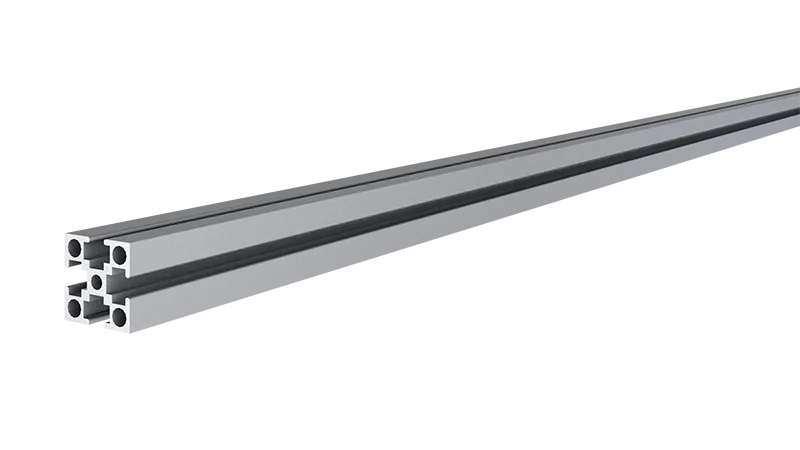
2020 National Standard Profile
45° external bending joint, used for 45° external connection of two aluminum pipes.
The 3C Assembly Line: Where Speed and Flexibility Meet
In the world of 3C manufacturing—where smartphones, laptops, and smartwatches fly off production lines at breakneck speed—every second counts. Assembly lines here aren't just about putting parts together; they're about adapting to new models, scaling up for seasonal demand, and reconfiguring workstations faster than a software update. That's where modular aluminum profiles come into play. These unassuming metal rails and connectors are the backbone of modern lean systems, letting manufacturers build, break down, and rebuild workbenches, flow racks, and material trolleys with ease.
But walk into any 3C factory today, and you'll hear a common debate: ISO standard profiles or the 2020 National Standard profiles? Both promise durability, flexibility, and compatibility with accessories—but they're not created equal. For managers balancing global supply chains, local production costs, and the need for lightning-fast line changes, the choice can feel make-or-break. Let's dive into what makes these two standards tick, and which one might be the better fit for your 3C assembly line.
First Things First: What Are We Actually Comparing?
Before we get into the nitty-gritty, let's clarify what "ISO" and "2020 National Standard" mean here. Both refer to specifications for aluminum extrusion profiles—the long, hollow bars with T-slots that make modular systems possible. These T-slots let you slide in accessories like brackets, shelves, and rollers, turning a simple pipe into a fully functional workbench or flow rack.
ISO Profiles: The Global Workhorse
ISO profiles follow international standards set by the International Organization for Standardization. Think of them as the "universal language" of aluminum extrusion. You'll find them in factories from Germany to Japan, with common sizes like 2020 (20mm x 20mm), 3030, and 4040. They're designed for interoperability, meaning an ISO 2020 bracket from one supplier should fit an ISO 2020 profile from another. This is a big plus for companies with global supply chains or plans to expand internationally.
2020 National Standard Profile: Built for Local Needs
The 2020 National Standard profile, on the other hand, is a Chinese standard (GB/T specification) introduced to streamline local manufacturing. While it shares the "2020" label with ISO's 20mm x 20mm profile, the similarities often end there. From slot dimensions to wall thickness, these profiles are tailored to China's unique manufacturing ecosystem—prioritizing cost-effectiveness, availability, and compatibility with local accessories like aluminum profile connectors and caster wheels.

Head-to-Head: Key Factors for 3C Assembly Lines
3C assembly lines have specific demands: they need to handle small, delicate parts (like smartphone motherboards), support frequent retooling (for new product launches), and keep costs in check (since profit margins in electronics are tighter than ever). Let's compare ISO and 2020 National Standard profiles across the factors that matter most.
| Factor | ISO Profile | 2020 National Standard Profile |
|---|---|---|
| Cost & Availability | Higher upfront cost; widely available globally but may require importing in China, leading to longer lead times. | Lower cost due to local production; abundant suppliers in China, meaning faster delivery and easier replacement of parts. |
| Slot & Accessory Compatibility | T-slots follow strict international specs; accessories (like roller track connectors or caster mounts) are standardized globally. | Slot dimensions may differ slightly from ISO; accessories are often designed specifically for National Standard profiles, limiting cross-use with ISO parts. |
| Load Capacity | Typically higher wall thickness (e.g., 1.5mm for 2020 ISO) for better weight support, ideal for heavy workbenches or material racks. | Wall thickness may be thinner (e.g., 1.2mm for 2020 National Standard) to reduce cost, making it better for lighter applications like small part bins. |
| Flexibility for Rapid Changes | Great for global companies with standardized processes; easy to source the same parts across multiple factories. | Perfect for local manufacturers needing quick line reconfigurations—local suppliers can deliver custom brackets or modified profiles in days, not weeks. |
| Material Quality | Mostly uses 6063-T5 aluminum alloy, known for strength and corrosion resistance; strict quality control in international production. | Also uses 6063-T5 aluminum but may vary slightly in alloy purity across local suppliers; requires vetting suppliers for consistency. |
The Hidden Factor: Lean System Integration
Here's something that doesn't always show up in spec sheets: how well each profile integrates with lean manufacturing principles. 3C lines thrive on lean systems—eliminating waste, reducing setup time, and keeping materials flowing smoothly. ISO profiles, with their global standardization, make it easy to replicate lean setups across factories (e.g., a flow rack design from your Mexico plant can work in your Shanghai plant). But 2020 National Standard profiles, paired with local suppliers, let you tweak those lean systems on the fly. Need a custom roller track to speed up PCB assembly? A local supplier can prototype it in a week, whereas an ISO part might take a month to import.
Real-World Scenarios: When to Choose Which
Theory is great, but let's ground this in real 3C manufacturing scenarios. Which profile makes sense for your factory?
Scenario 1: A Global Electronics Brand with Factories in China and Vietnam
Imagine you're running a plant in Shenzhen that assembles the same smartphone model as your factory in Ho Chi Minh City. You need workbenches, ESD workstations, and flow racks that are identical in both locations to ensure consistent quality. Here, ISO profiles shine. You can source ISO 4040 profiles from a trusted international supplier, and rest easy knowing the roller track connectors or caster wheels you use in Vietnam will fit perfectly in China. The higher upfront cost is offset by the savings in training (workers can switch between factories seamlessly) and standardized maintenance.
Scenario 2: A Local Chinese Startup Producing Smart Home Devices
Your team launches a new smart speaker every 6 months, and each model requires a totally different assembly line layout. Last quarter, you needed small turnover trolleys for circuit boards; this quarter, you need taller material racks for speaker grilles. For you, 2020 National Standard profiles are a no-brainer. Local suppliers in Guangdong can deliver custom-cut profiles and matching accessories (like plastic roller track guide rails in your brand's signature yellow) in 3 days. The lower cost also helps you stay competitive in a crowded market—you can experiment with line designs without breaking the bank.
Scenario 3: A Contract Manufacturer Handling Both Local and Export Orders
You build components for both Chinese brands (who want low costs and fast turnaround) and international clients (who demand ISO-certified equipment). Here, a hybrid approach might work. Use 2020 National Standard profiles for local orders—say, lightweight workbenches for toy drones—and ISO profiles for export orders, like heavy-duty conveyor systems for laptop assembly. Just be careful to keep the two systems separate—mixing ISO and National Standard accessories is a recipe for jamming T-slots and wasted time.
The Verdict: It's About Your "Why," Not Just "What"
At the end of the day, there's no "better" profile—only the right one for your needs. ISO profiles are the safe bet for global consistency, while 2020 National Standard profiles are the agile choice for local, cost-sensitive operations. But here's a pro tip: focus less on the profile itself and more on your end goals. If your priority is to scale globally, ISO is worth the investment. If you need to outpace competitors with faster line changes and lower costs, go local with National Standard.
And remember: in 3C manufacturing, the best assembly line is the one that evolves with your products. Whether you choose ISO or 2020 National Standard, the real win is building a lean system that lets you adapt—quickly, affordably, and without compromising on quality. After all, in a industry where the next big thing is always just around the corner, flexibility isn't a nice-to-have; it's your competitive edge.