- Company Articles
- Industry articles
- Industry standards
- Key Benefits of 3030 National Standard Profile A for Flexible Production Lines

Key Benefits of 3030 National Standard Profile A for Flexible Production Lines
Related Product
3030 National Standard Profile A
Workbench, production line, logistic rack, warehouse rack Industry: Manufacturer workshop, Automobile, Electronic, Assembling, logistic
How this aluminum extrusion profile is transforming manufacturing efficiency, adaptability, and worker satisfaction
The Changing Face of Modern Manufacturing
Walk into any manufacturing facility today, and you'll likely notice a stark difference from a decade ago. Gone are the days of rigid, fixed production lines bolted to the floor, designed to churn out the same product for years on end. Instead, factories buzz with dynamic setups: workbenches that adjust to worker heights in seconds, flow racks that reconfigure for new components overnight, and conveyors that reroute material paths with a few simple tweaks. This shift isn't just about aesthetics—it's a response to an industry under pressure: shorter product lifecycles, custom order demands, and the need to slash waste while boosting productivity. In short, modern manufacturing needs flexibility, and at the heart of this flexibility lies a quiet hero: aluminum extrusion profiles.
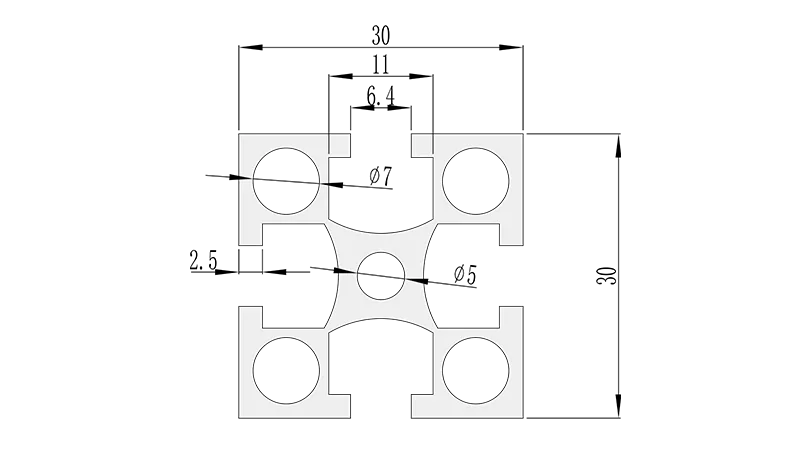
Among the many aluminum profiles available, one stands out for its versatility and reliability: the 3030 National Standard Profile A . Measuring 30mm by 30mm in cross-section, this unassuming piece of extruded aluminum has become a cornerstone of lean system design, empowering manufacturers to build production lines that adapt as quickly as their business needs change. But what makes it so special? Let's dive into the key benefits that have made the 3030 National Standard Profile A a go-to choice for engineers, plant managers, and lean manufacturing enthusiasts alike.
What Is 3030 National Standard Profile A?
Before we explore its benefits, let's start with the basics. The 3030 National Standard Profile A is an aluminum extrusion profile, meaning it's created by forcing heated aluminum alloy through a die to form a consistent cross-sectional shape. Its defining feature? A 30mm x 30mm square cross-section with a T-slot design —longitudinal grooves running along its length that allow accessories to be attached without welding, drilling, or cutting. This simple yet genius design is what unlocks its flexibility.
Manufactured from 6063-T5 aluminum alloy—a material prized for its balance of strength, lightweight properties, and corrosion resistance—the profile typically undergoes surface treatments like anodizing (for a durable, corrosion-resistant finish) or powder coating (for color customization and added protection). These treatments ensure it holds up in harsh factory environments, from dusty assembly floors to humidity-controlled cleanrooms.
But numbers tell the real story. A standard 3030 profile weighs roughly 0.8–1.2 kg per meter (depending on wall thickness), yet can support up to 50kg per linear meter when used horizontally—more than enough for most assembly, storage, or material handling applications. Its dimensions are standardized across manufacturers, meaning components from different suppliers work together seamlessly. For plant managers, this standardization eliminates the headache of mismatched parts and ensures consistent performance across the facility.
Key Benefit 1: Modularity That Turns "We Can't" into "We Can"
Imagine a production line that needs to shift from assembling smartphones to tablets overnight. With traditional steel workbenches and welded frames, this would mean days of dismantling, cutting, and rewelding—if it's even possible. With the 3030 National Standard Profile A, it's a different story. Thanks to its T-slot design and compatibility with aluminum profile accessories , reconfiguration happens in hours, not days.
T-Slots: The Secret to Tool-Free Customization
The T-slots are the profile's superpower. These grooves accept a wide range of accessories—brackets, hinges, handles, caster wheels, and even specialized components like roller track guides—using nothing more than bolts and nuts. Need to add a shelf to a workbench? Slide a bracket into the T-slot, tighten a bolt, and it's secure. Want to extend a flow rack by 2 meters? Connect two profiles with a straight joint, lock it in place, and you're done. No welding torches, no power tools, no specialized labor. Even line workers with basic training can make adjustments on the fly.
Consider a scenario at a small electronics manufacturer. Last quarter, they produced wireless earbuds; this quarter, they're adding smartwatches to their lineup. The smartwatch components are smaller, so their existing flow racks—built with 3030 profiles—needed narrower lanes. Instead of ordering new racks, the team simply added dividers using aluminum profile accessories (specifically, slot nuts and angle brackets) to split each shelf into smaller sections. Total time? 2 hours. Cost? Less than $50 in accessories. "We used to think changing line setups meant downtime and overtime," says Maria, the plant manager. "Now, we adjust during lunch breaks."
From Prototyping to Full Production—Seamlessly
Modularity isn't just for large-scale reconfigurations; it's a game-changer for prototyping too. Startups and R&D teams love the 3030 profile because it lets them build mock production lines quickly, test workflows, and iterate without investing in custom tooling. For example, a medical device company used 3030 profiles to build a prototype assembly station for a new surgical tool. They tested three different layouts in a week, adjusting the height of the workbench, the angle of the parts bin, and the position of the testing station—all by swapping out accessories. Once they finalized the design, they simply replicated it with the same profiles for full production. No redesign, no delays, just smooth scaling.
Key Benefit 2: Durability That Lowers Long-Term Costs
Flexibility is useless if the system falls apart after a few months. Fortunately, the 3030 National Standard Profile A is built to last. Aluminum alloy 6063-T5 offers an impressive strength-to-weight ratio: it's 30% lighter than steel but can handle comparable loads, reducing strain on floors and making manual adjustments easier for workers. Its corrosion resistance is another standout feature—unlike steel, which rusts when exposed to moisture or chemicals, anodized aluminum profiles withstand spills, humidity, and even occasional cleaning with industrial solvents.
Take a food packaging plant, for example. Their production lines are regularly hosed down to meet hygiene standards, and steel racks used to rust within a year, requiring costly replacements. After switching to 3030 profiles with anodized finishes, the racks have remained corrosion-free for over five years. "We used to budget for new racks every 18 months," says Raj, the maintenance supervisor. "Now, we're saving $15,000 annually just on that line alone."
Resisting Wear and Tear in High-Traffic Areas
In busy facilities, equipment takes a beating—forklifts bump into racks, workers lean on workbenches, and tools get dropped. The 3030 profile holds up here too. Its T-slot edges are rounded to resist chipping, and the aluminum alloy's ductility means it bends rather than cracks under impact, often retaining functionality even after minor collisions. A automotive parts manufacturer reported that a 3030-based flow rack survived a forklift scrape that would have crumpled a steel shelf; after bending the profile back into shape (by hand!), it continued to operate normally for another three years.
Longevity also translates to sustainability. Unlike disposable plastic or short-lived steel structures, aluminum profiles are reusable and recyclable. When a production line is retired, the profiles can be disassembled, cleaned, and repurposed for new projects—reducing waste and lowering the carbon footprint of manufacturing operations. It's a win-win for the planet and the bottom line.
Key Benefit 3: Compatibility with a Universe of Accessories
A profile is only as good as the accessories it works with, and the 3030 National Standard Profile A shines here. The T-slot design is an open invitation to a vast ecosystem of aluminum profile accessories —from simple brackets and hinges to specialized components like roller tracks, caster wheels, and tool holders. This compatibility means you're never limited by "off-the-shelf" solutions; you can build exactly what you need.
| Accessory Type | Common Uses | Why It Matters |
|---|---|---|
| Slot nuts & bolts | Attaching shelves, brackets, or panels to the profile | Secure, tool-free adjustments; no pre-drilled holes needed |
| Angle brackets | Joining profiles at 90° or 45° angles (e.g., workbench corners) | Reinforces joints without welding; ensures stability |
| Caster wheels | Adding mobility to workbenches, flow racks, or trolleys | Turns static setups into mobile units for flexible material transport |
| Roller tracks | Building flow racks or conveyor sections for gravity-fed material flow | Reduces manual handling; speeds up production by 15–20% in some cases |
| LED light brackets | Mounting task lights above workbenches | Improves visibility; reduces eye strain for workers |
Let's zoom in on a practical example: building a workbench . With 3030 profiles and the right accessories, you can customize every detail: height-adjustable legs (using telescopic brackets), a pegboard for tools (mounted with slot nuts), a power strip rail (clamped to the back), and even a footrest bar (attached with angle brackets). Need to add a computer monitor arm? Screw it into a bracket in the T-slot. Want to tilt the work surface for better ergonomics? Use hinges and gas springs. The possibilities are nearly endless, and because all accessories are standardized, you can mix and match from different suppliers without compatibility issues.
For larger systems, like a lean manufacturing cell, this compatibility is critical. A typical cell might include a 3030-based workbench, a flow rack for incoming parts, a conveyor for finished goods, and a storage trolley—all connected via shared accessories. The flow rack uses roller tracks to feed parts to the workbench; the conveyor, built with the same profiles, takes completed assemblies to quality control. If the cell needs to expand, simply add more profiles and accessories—no need to redesign the entire system.
Key Benefit 4: Ergonomics That Boost Worker Satisfaction (and Productivity)
Manufacturing isn't just about machines—it's about people. Fatigued, uncomfortable workers are less productive, more prone to errors, and more likely to miss days due to injury. The 3030 National Standard Profile A addresses this head-on by enabling ergonomic workspaces that adapt to the human body, not the other way around.
Adjustable Workbenches: One Size Fits All (Literally)
The average factory has workers of all heights, from 5'2" to 6'4". A fixed-height workbench forces taller employees to hunch and shorter ones to reach, leading to back pain and shoulder strain. With 3030 profiles, height adjustment is simple: use telescopic leg brackets or crank-adjustable feet to raise or lower the workbench in 1-inch increments. At a automotive parts plant in Michigan, workers reported a 40% reduction in neck and shoulder pain after switching to adjustable 3030-based workbenches. "I used to go home with a headache every day from bending over," says Carlos, an assembly line worker. "Now, I set the bench to my height, and I forget I'm even working."
Reducing Manual Handling with Mobile Flow Racks
Heavy lifting is another major source of workplace injuries. By adding caster wheels to 3030-based flow racks, workers can move entire racks of parts instead of carrying individual boxes. A electronics manufacturer in China replaced static steel racks with mobile 3030 flow racks and saw a 25% drop in reported back injuries. "Before, two people had to carry a bin of circuit boards across the floor," explains Li, the safety officer. "Now, one person rolls the rack right to the assembly line. It's safer, and we're getting more done."
Lighting and Accessibility: Small Touches, Big Impact
Ergonomics isn't just about physical strain—it's about creating environments that reduce mental fatigue too. 3030 profiles make it easy to add task lighting (via LED strips mounted in T-slots), reducing eye strain during detailed work like soldering or inspection. Tool rails keep frequently used equipment within arm's reach, eliminating wasted motion. Even small touches, like tilting parts bins using hinge brackets, can make a big difference in how comfortable and focused workers feel throughout their shifts.
The result? Happier, healthier employees who stay with the company longer. "Turnover used to be 20% a year in our assembly department," says Tom, HR manager at a consumer goods company. "After we redid the workstations with 3030 profiles, it dropped to 8%. People notice when you invest in their comfort."
Real-World Applications: 3030 Profiles in Action
To truly appreciate the 3030 National Standard Profile A, let's look at how it's being used in real manufacturing settings. These examples aren't hypothetical—they're stories from companies that have transformed their operations with this versatile profile.
Case Study 1: A Furniture Manufacturer Adopts Lean Principles
A mid-sized furniture company struggled with long setup times between product lines. Their traditional wooden workbenches and steel storage racks couldn't be adjusted, so switching from dining chairs to coffee tables meant 8 hours of downtime. They turned to 3030 profiles to build a lean system: adjustable workbenches with tool rails, flow racks with roller tracks for lumber and hardware, and mobile trolleys for moving. The result? Setup time dropped to 1 hour, and they increased production capacity by 30% without adding square footage. "We used to think lean was just a buzzword," says the operations director. "Now, we see it in our bottom line."
Case Study 2: A Pharmaceutical Company Meets Strict Cleanroom Standards
Pharmaceutical manufacturing requires sterile environments, and steel equipment often harbors bacteria in weld seams. The 3030 National Standard Profile A, with its smooth anodized finish and no welds, was the perfect solution. The company built cleanroom workbenches and material racks using 3030 profiles, adding HEPA filter brackets and stainless steel work surfaces (attached via T-slot nuts). The profiles' corrosion resistance also withstood daily sanitization with harsh chemicals. "Auditors love how easy it is to clean," says the quality control manager. "We've passed every inspection with zero findings since the switch."
Case Study 3: A Startup Scales from Garage to Factory
A tech startup began in a garage, building smart home devices with 3030 profiles they bought from a local supplier. They used the profiles to build workbenches, test stations, and even packaging tables. As they grew, they didn't need to replace their initial setup—they just added more profiles and accessories. Today, their 10,000 sq. ft. factory uses over 500 meters of 3030 profiles, and the original garage workbench? It's now a shipping station. "The best part is that we didn't waste money on temporary equipment," says the founder. "We invested in a system that grew with us."
Key Benefit 5: Cost-Effectiveness—More Bang for Your Buck
At this point, you might be thinking, "This all sounds great, but isn't aluminum more expensive than steel or wood?" It's true that 3030 profiles have a higher upfront cost than basic plywood or untreated steel. But when you factor in longevity, reusability, and reduced downtime, they're often cheaper in the long run. Let's break it down:
Lower Maintenance Costs
Steel racks need painting every 2–3 years to prevent rust; wood warps and rots, requiring replacement every 3–5 years. Aluminum profiles? An anodized finish lasts 10+ years with no maintenance beyond occasional cleaning. A food processing plant calculated that over 10 years, their 3030-based flow racks cost 60% less than steel racks when accounting for painting, repairs, and replacements.
Reduced Downtime During Reconfigurations
Downtime is the enemy of manufacturing. Every hour a line is down costs money in lost production. With 3030 profiles, reconfigurations take hours, not days. A consumer electronics company estimated that switching to 3030 profiles saved them $20,000 per line changeover (based on $5,000/hour in lost production). With 12 changeovers a year, that's $240,000 in savings—more than enough to offset the initial profile cost.
No Custom Tooling Fees
Custom steel fabrication requires expensive tooling and engineering drawings. With 3030 profiles, you build what you need using off-the-shelf accessories. A startup $15,000 in custom tooling costs by using 3030 profiles for their first production line. "We would have needed a loan to afford steel tooling," says the CFO. "Aluminum profiles let us bootstrap and still build a professional setup."
Why Choose 3030 Over Other Profiles?
The market offers many aluminum profiles—2020, 4040, 3060, to name a few. So why pick 3030 National Standard Profile A? It's all about balance. The 2020 profile (20mm x 20mm) is too small for heavy loads; the 4040 (40mm x 40mm) is bulkier and more expensive for light to medium applications. The 3030 hits the sweet spot: compact enough to fit in tight spaces, strong enough for most manufacturing tasks, and affordable enough to scale.
It's also the most widely available profile, meaning suppliers are plentiful, lead times are short, and accessories are easy to find. Whether you need a single meter for a DIY project or 5,000 meters for a factory overhaul, you can source 3030 profiles quickly and cost-effectively.
Final Thoughts: The Future of Manufacturing Is Flexible
The 3030 National Standard Profile A isn't just a piece of aluminum—it's a catalyst for change. In an industry where adaptability is survival, it empowers manufacturers to build production lines that grow, evolve, and innovate alongside their business. Its modularity turns downtime into uptime, its durability cuts long-term costs, its compatibility unlocks endless customization, and its ergonomics puts people first.
Whether you're a small startup or a Fortune 500 company, the question isn't "Should we use 3030 profiles?" but "How soon can we start?" From workbenches to flow racks, conveyors to lean systems, this unassuming profile is quietly transforming factories into flexible, efficient, and human-centered spaces. And in the end, that's what modern manufacturing is all about: building better products, faster, while taking care of the people who build them.
So the next time you walk through a factory and see a dynamic, adaptable production line, take a closer look. Chances are, you'll spot the 3030 National Standard Profile A hard at work—proving that sometimes, the smallest components make the biggest impact.