- Company Articles
- Industry articles
- Industry standards
- Key Features of 3030 National Standard Profile A: Why It's Ideal for Modular Structures

Key Features of 3030 National Standard Profile A: Why It's Ideal for Modular Structures
Related Product
3030 National Standard Profile A
Workbench, production line, logistic rack, warehouse rack Industry: Manufacturer workshop, Automobile, Electronic, Assembling, logistic
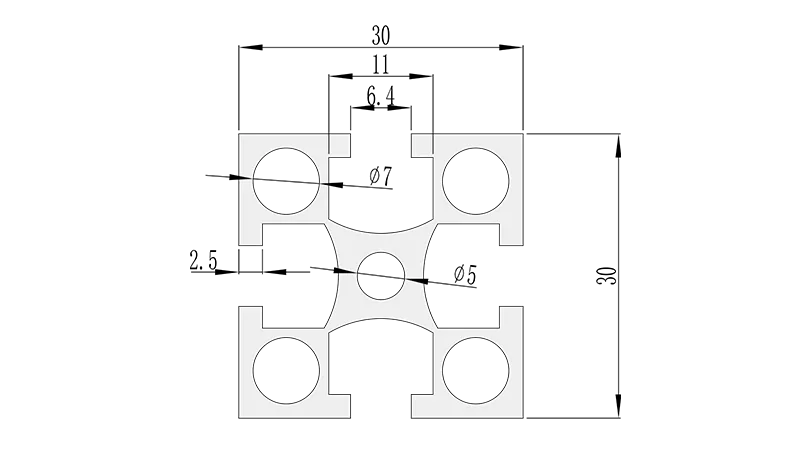
In the world of manufacturing, warehousing, and industrial design, the search for reliable, flexible, and cost-effective modular solutions is a constant. Whether you're building a workbench for a small workshop, designing a material rack for a factory floor, or optimizing a lean system for maximum efficiency, the foundation of any successful modular structure lies in the quality of its components. Among the countless options available, one product stands out for its precision, versatility, and ability to adapt to diverse needs: the 3030 National Standard Profile A. In this article, we'll explore the key features that make this aluminum profile a cornerstone of modern modular design, and why it has become a go-to choice for engineers, designers, and facility managers alike.
What is 3030 National Standard Profile A?
Before diving into its features, let's clarify what exactly the 3030 National Standard Profile A is. As part of the broader family of aluminum extrusion profiles, this product is defined by its standardized dimensions: 30mm in width and 30mm in height, hence the "3030" designation. The "National Standard" label ensures it adheres to strict manufacturing guidelines for material quality, dimensional accuracy, and compatibility with other components—critical factors in modular construction. Unlike generic or non-standard profiles, which often lead to assembly headaches and structural weaknesses, the 3030 National Standard Profile A is engineered to work seamlessly with a wide range of aluminum profile accessories, making it a versatile building block for everything from simple frames to complex industrial systems.
Crafted from high-grade aluminum alloy (typically 6063-T5, known for its excellent balance of strength and ductility), this profile undergoes precision extrusion to create a consistent cross-section with T-slots running along its length. These T-slots are the secret to its modularity: they allow for easy attachment of brackets, connectors, panels, and other accessories without the need for welding or drilling, simplifying assembly and enabling endless customization. Now, let's break down the features that set this profile apart.
Key Feature 1: Precision Engineering and Structural Integrity
At the heart of the 3030 National Standard Profile A's appeal is its unwavering commitment to precision. National standards dictate tight tolerances for dimensions, straightness, and surface finish, ensuring that every piece of Profile A you receive is identical to the last. This consistency is not just a matter of quality control—it's a practical necessity for modular structures. When building a frame, workbench, or material rack, even minor variations in profile size can lead to misaligned T-slots, loose connections, or uneven weight distribution, all of which compromise safety and functionality.
The profile's cross-sectional design further enhances its structural integrity. With wall thicknesses typically ranging from 1.5mm to 2.0mm (depending on the specific variant), it strikes an ideal balance between weight and load-bearing capacity. Tests show that a single 3030 National Standard Profile A (with 2.0mm walls) can support vertical loads of up to 300kg when properly installed, and horizontal spans of 1.2 meters can handle distributed loads of 50kg or more. This strength makes it suitable for applications ranging from lightweight shelving to heavy-duty workbenches, where stability is non-negotiable.
Another engineering detail that shouldn't be overlooked is the profile's surface treatment. Most variants come anodized, a process that creates a protective oxide layer on the aluminum surface. This layer resists corrosion, scratches, and wear, ensuring the profile maintains its appearance and structural integrity even in harsh industrial environments—think factories with high humidity, chemical exposure, or frequent cleaning. For indoor applications like office workstations or cleanrooms, the anodized finish also offers a sleek, professional look that blends with modern aesthetics.
Key Feature 2: Versatility in Modular Design
Modular design thrives on flexibility, and the 3030 National Standard Profile A excels in this area. Its T-slot configuration—typically featuring two or three slots per side—accommodates a vast array of aluminum profile accessories, from simple bolts and nuts to complex brackets, hinges, and panel mounts. This means that with just a few lengths of Profile A and the right accessories, you can build almost anything: a mobile workbench with casters, a static material rack with adjustable shelves, a protective barrier around a production line, or even a custom machine frame.
Consider, for example, the process of building a workbench using Profile A. You'd start with four vertical legs cut to your desired height, connect them with horizontal profiles to form the frame, and then attach a tabletop (made of plywood, aluminum, or a honeycomb panel) using T-slot bolts. Need to add a shelf halfway up? Simply slide shelf brackets into the T-slots and secure them with nuts. Want to mount tools or a monitor arm? Use angle brackets or specialized mounts designed to fit the profile's slots. The beauty is that none of this requires welding, drilling, or specialized tools—most assemblies can be completed with a hex key and a few basic hand tools.
This versatility extends beyond static structures. The 3030 National Standard Profile A is also compatible with dynamic components like roller tracks, conveyor systems, and casters, making it ideal for lean system setups. In a lean manufacturing environment, where workflows need to be agile and adaptable, the ability to reconfigure workstations or material handling systems quickly is invaluable. With Profile A, you can disassemble a rack, re-cut the profiles, and reassemble them into a new structure in hours, rather than days—a level of flexibility that traditional steel framing or custom fabrication simply can't match.
Key Feature 3: Compatibility with Lean Systems
Lean manufacturing principles—focused on minimizing waste, optimizing flow, and maximizing value—have revolutionized industrial operations, and the 3030 National Standard Profile A aligns perfectly with these goals. A lean system relies on tools and structures that support efficient workflows, reduce downtime, and adapt to changing production needs. Profile A checks all these boxes, making it a staple in lean environments worldwide.
One of the ways it supports lean systems is through its role in creating standardized workstations. By using Profile A to build uniform workbenches, material racks, and assembly lines, teams can reduce variability in the workplace, leading to more consistent processes and fewer errors. For example, a production line where every workbench is the same height, with the same tool placement and material storage, allows operators to transition between stations seamlessly, reducing training time and improving productivity.
Another lean-friendly feature is the profile's contribution to "5S" organization (Sort, Set in Order, Shine, Standardize, Sustain). With its T-slots and compatible accessories, it's easy to "set in order" tools, materials, and equipment—think pegboards mounted on Profile A frames, labeled bins attached to T-slot brackets, or shadow boards for tool storage. This organization reduces the time workers spend searching for items, minimizes clutter, and creates a safer, more efficient workspace.
Perhaps most importantly, the 3030 National Standard Profile A supports continuous improvement, a core tenet of lean thinking. When a process needs to change—say, a product design is updated, or production volume increases—Profile A structures can be modified quickly and cost-effectively. There's no need to replace entire systems; instead, you can add a section to a material rack, extend a conveyor, or reconfigure a workbench to accommodate new requirements. This adaptability ensures that your facility can evolve without significant capital investment, keeping operations lean and responsive.
Key Feature 4: Durability and Material Quality
Aluminum is renowned for its strength-to-weight ratio, and the 3030 National Standard Profile A leverages this advantage to deliver a product that's both lightweight and durable. Unlike steel, aluminum resists corrosion naturally, especially when anodized, making it suitable for use in environments where moisture, chemicals, or humidity are present—such as food processing plants, automotive workshops, or outdoor storage areas. This resistance to rust and degradation means Profile A structures have a longer lifespan than comparable steel frames, reducing the need for frequent replacements and lowering long-term costs.
The choice of aluminum alloy is also critical. Most 3030 National Standard Profile A variants use 6063-T5 aluminum, a heat-treated alloy that offers excellent mechanical properties: tensile strength of 180 MPa, yield strength of 110 MPa, and elongation of 8%. These figures translate to a profile that can withstand repeated use, heavy loads, and minor impacts without bending or deforming. For applications requiring even greater strength, thicker-walled versions (up to 3.0mm) are available, though they may sacrifice some of the profile's lightweight benefits.
Durability also extends to the profile's T-slots, which are precision-machined to ensure a tight, consistent fit with accessories. Over time, even with frequent assembly and disassembly, the slots maintain their shape and functionality, unlike cheaper profiles where slots may warp or wear down, leading to loose connections. This reliability is crucial in industrial settings, where equipment failure can lead to downtime, safety risks, or production delays.
Key Feature 5: Ease of Assembly and Customization
For anyone who has ever struggled with building a modular structure using mismatched parts, the 3030 National Standard Profile A is a breath of fresh air. Its standardized design and compatibility with aluminum profile accessories eliminate the guesswork from assembly. Every T-slot is positioned at a consistent distance from the profile's edges, every accessory is engineered to fit those slots, and every cut length is true to size—so you can trust that the parts will work together as intended.
Assembly is also remarkably straightforward. Unlike steel framing, which often requires welding, grinding, or painting, Profile A structures are built using mechanical connections: T-slot bolts, corner brackets, hinges, and screws. This not only speeds up the building process but also makes modifications easy. If you realize a shelf is too low, you can loosen the bolts, slide the brackets up, and re-tighten—no need to cut new parts or start over. This "build, test, adjust" cycle is invaluable for prototyping or for facilities that need to iterate on designs quickly.
Customization is another area where Profile A shines. Thanks to its extrusion process, profiles can be cut to any length (typically in increments of 1mm) to fit specific project requirements. Whether you need a 10cm short piece for a corner bracket or a 3-meter long section for a frame, most suppliers offer custom cutting services, ensuring you get exactly what you need with minimal waste. Additionally, the profile's surface can be customized with different finishes—anodized (clear, black, silver), powder-coated (any color), or even brushed—allowing it to match existing equipment or brand aesthetics.
Real-World Applications: From Workbenches to Material Racks
To truly appreciate the 3030 National Standard Profile A, it helps to look at how it's used in real-world settings. Let's take a few common applications:
- Workbenches: As mentioned earlier, Profile A is ideal for building workbenches. A typical setup might include a frame made of 3030 profiles, a plywood or aluminum top, and accessories like tool rails, LED light strips, and storage bins attached via T-slots. These workbenches are sturdy enough for assembly tasks, lightweight enough to move (with casters), and customizable enough to add features like vice mounts or monitor arms.
- Material Racks: In warehouses and factories, material racks built with Profile A are a common sight. These racks can be designed with adjustable shelves (using sliding brackets) to accommodate different-sized bins or boxes, and they often include roller tracks (another compatible accessory) to allow easy sliding of materials. For example, a "material rack B (3 row and 3 floor)" setup—popular in automotive parts storage—can be constructed using Profile A frames, with each shelf supported by cross-braces for added stability.
- Lean System Workstations: In lean manufacturing cells, Profile A is used to build integrated workstations that combine assembly areas, material storage, and quality control stations. These workstations often feature built-in conveyor tracks (using roller track accessories) to move parts between stations, and they're designed to minimize operator movement, reducing fatigue and improving efficiency.
- Protective Barriers: Safety is a top priority in industrial settings, and Profile A is frequently used to build protective barriers around machinery, conveyor systems, or hazardous areas. These barriers can be fitted with panels (acrylic, polycarbonate, or metal) to prevent access, and they're strong enough to withstand accidental impacts without collapsing.
How 3030 National Standard Profile A Compares to Other Profiles
To put the 3030 National Standard Profile A's advantages into perspective, let's compare it to two common alternatives: non-standard 3030 profiles and larger profiles like the 4040 National Standard Profile. The table below highlights key differences in dimensions, load capacity, compatibility, and cost.
Comparison of 3030 National Standard Profile A with Alternative Profiles
| Feature | 3030 National Standard Profile A (2.0mm wall) | Non-Standard 3030 Profile (1.5mm wall) | 4040 National Standard Profile (2.0mm wall) |
|---|---|---|---|
| Dimensions (W x H) | 30mm x 30mm | 30mm x 30mm (variable tolerances) | 40mm x 40mm |
| Wall Thickness | 2.0mm (consistent) | 1.5mm (inconsistent, may vary ±0.3mm) | 2.0mm (consistent) |
| Vertical Load Capacity (per meter) | 300kg | 180kg | 450kg |
| Horizontal Span Capacity (distributed load) | 50kg (at 1.2m span) | 30kg (at 1.2m span) | 80kg (at 1.2m span) |
| Compatible Accessories | All standard aluminum profile accessories | Limited (may not fit standard T-slot sizes) | All standard aluminum profile accessories (larger size) |
| Cost (per meter) | Mid-range ($8–$12) | Low ($5–$8) | High ($12–$18) |
| Best For | General modular structures, workbenches, lean systems | Lightweight, temporary structures with low load needs | Heavy-duty applications, large frames, high-load racks |
As the table shows, the 3030 National Standard Profile A strikes a balance between strength, cost, and versatility. It outperforms non-standard profiles in load capacity and compatibility, while being more affordable and space-efficient than larger profiles like the 4040. For most modular applications—especially those within the lean system framework—this balance makes it the optimal choice.
Conclusion: Why 3030 National Standard Profile A is a Modular Game-Changer
The 3030 National Standard Profile A is more than just a piece of aluminum extrusion—it's a foundation for innovation in modular design. Its precision engineering ensures structural integrity, its versatility allows for endless customization, its compatibility with lean systems drives operational efficiency, and its durability ensures long-term reliability. Whether you're building a simple workbench or a complex material handling system, this profile delivers the performance, flexibility, and value that modern industrial environments demand.
For engineers and facility managers, the choice is clear: when you need a modular solution that can adapt to changing needs, integrate with existing systems, and stand up to the rigors of daily use, the 3030 National Standard Profile A is the ideal partner. It's not just about building structures—it's about building smarter, more efficient, and more resilient operations. And in today's fast-paced industrial landscape, that's a difference that matters.