- Company Articles
- Industry articles
- Industry standards
- Lean Management Accessories: Integrating with 3030 National Standard Profile A Systems

Lean Management Accessories: Integrating with 3030 National Standard Profile A Systems
Related Product
3030 National Standard Profile A
Workbench, production line, logistic rack, warehouse rack Industry: Manufacturer workshop, Automobile, Electronic, Assembling, logistic
In today's fast-paced manufacturing and warehousing environments, the goal is simple: do more with less. Lean management isn't just a buzzword—it's a mindset that hinges on eliminating waste, streamlining processes, and creating systems that adapt to your team's needs. But here's the thing: even the best lean strategies fall flat without the right tools. That's where the 3030 National Standard Profile A comes in. This unassuming aluminum profile has become the backbone of countless efficient workspaces, and when paired with the right accessories, it transforms from a simple building block into a catalyst for operational excellence. In this article, we'll explore how key lean management accessories—from lean pipe workbenches to flow racks and beyond—seamlessly integrate with 3030 National Standard Profile A systems, and why this combination is a game-changer for businesses looking to boost productivity, reduce errors, and keep their teams happy.
Understanding 3030 National Standard Profile A: The Foundation of Lean Systems
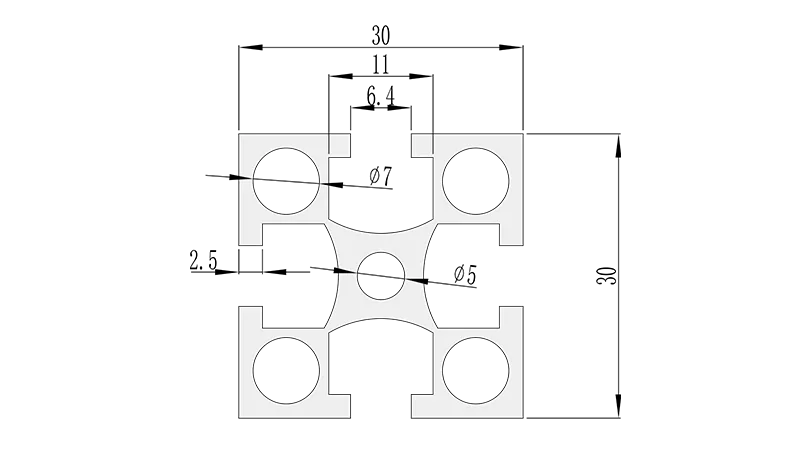
Before diving into accessories, let's get to know the star of the show: 3030 National Standard Profile A. If you've ever walked through a well-organized factory floor or a modern warehouse, you've probably seen it without realizing it. This aluminum extrusion profile gets its name from its dimensions—30mm by 30mm—and it's designed with a specific groove (or "T-slot") running along its length. That T-slot is where the magic happens: it allows for quick, tool-free attachment of accessories, making customization and reconfiguration a breeze.
What makes 3030 National Standard Profile A so special? For starters, it's built to last. Made from high-grade aluminum, it's lightweight enough to be moved or adjusted by a single person but strong enough to support heavy loads—think toolboxes, equipment, or even full pallets of materials. Its modular design means you're not stuck with a one-and-done setup. Need to add a shelf to a workstation? Swap out a section of your flow rack? The profile's compatibility with a wide range of accessories means you can tweak your space on the fly, no welding or complex machining required.
But the real beauty lies in its standardization. "National Standard" isn't just a label—it ensures that no matter which supplier you buy from, the profile's dimensions, T-slot size, and mounting points are consistent. This interoperability is a lifesaver for businesses that grow or adapt over time. You won't be locked into a single brand's ecosystem; instead, you can mix and match accessories from different manufacturers, ensuring you always get the best fit for your needs. Whether you're a small startup with a handful of workstations or a large enterprise with sprawling production lines, 3030 National Standard Profile A provides the flexibility to scale without starting from scratch.
Lean Pipe Workbench: Where Ergonomics Meets Efficiency
If 3030 National Standard Profile A is the backbone of a lean workspace, then the lean pipe workbench is its beating heart. Walk into any efficient assembly line, and you'll likely find these workbenches at the center of the action—and for good reason. Unlike clunky, fixed workstations of the past, lean pipe workbenches built with 3030 profiles are designed to adapt to the people using them, not the other way around.
Let's start with customization. Imagine a team of assemblers, each with different heights and tasks. One might need a workbench at 36 inches to avoid hunching over small components, while another requires a lower surface for heavy tool use. With 3030 Profile A, adjusting the height is as simple as swapping out a few aluminum profile accessories—no need to order a whole new bench. Add a shelf for tools, a pegboard for frequently used items, or a drawer unit for small parts, and suddenly that bench becomes a personalized command center. And because the profile is lightweight, even fully loaded workbenches can be moved (more on that later, thanks to caster wheels ) to reconfigure the workspace as production needs change.
Ergonomics isn't just about comfort—it's about reducing fatigue and errors. A well-designed lean pipe workbench minimizes unnecessary movements: tools are within arm's reach, materials flow smoothly onto the surface, and the height ensures workers aren't straining their backs or shoulders. Many models also offer ESD (Electrostatic Discharge) options, critical for electronics manufacturing where static electricity can damage sensitive components. The ESD workbench tops, paired with 3030 Profile A's conductive properties (when specified), create a grounded workspace that protects both products and workers.
But perhaps the biggest advantage is cost-effectiveness. Traditional workbenches are often overbuilt or underwhelming, forcing you to pay for features you don't need or replace them entirely when your process changes. With 3030 Profile A and lean pipe workbench components, you start with the basics and add on as needed. Need a second shelf six months down the line? Just buy the profile, cut it to length, and attach it with a few connectors. It's modularity at its finest, and it keeps your budget in check while growing with your business.
Flow Racks: Letting Gravity Do the Heavy Lifting
If workbenches are where the magic happens, then flow racks are the unsung heroes that keep the magic flowing. In lean terms, "waste" includes anything that slows down production—like searching for materials, lifting heavy boxes, or waiting for supplies to be restocked. Flow racks eliminate these inefficiencies by using gravity to move materials from the back to the front, ensuring that what your team needs is always within reach, exactly when they need it.
At first glance, a flow rack might look like a simple set of shelves with rollers. But when built with 3030 National Standard Profile A, it becomes a precision tool. The T-slots in the profile make it easy to mount roller tracks at a slight angle—just enough to let boxes or totes glide forward, but not so steep that they slide out of control. This angle can be adjusted by adding or removing shims (small pieces of aluminum or plastic) between the profile and the roller track, fine-tuning the flow to match the weight and size of your materials. For example, lightweight plastic totes might need a steeper angle than heavy metal bins, and with 3030 Profile A, that adjustment takes minutes, not hours.
Integration with other systems is another win. A well-designed flow rack doesn't exist in isolation—it connects to your lean pipe workbench, your assembly line, or even your shipping area. Imagine a scenario where parts arrive at the back of the flow rack, slide forward as the front is emptied, and are picked directly onto a workbench positioned inches away. No more walking to a distant shelf, no more double-handling, no more time wasted. And because 3030 Profile A is compatible with a wide range of roller track accessories—like plastic guide rails (yellow for high-visibility, grey for low-key) or aluminum guide rails—you can customize the flow to prevent jams, keep materials aligned, and even separate different part numbers on the same rack.
Case in point: a automotive parts manufacturer we worked with recently was struggling with delayed assembly times because workers had to walk 20 feet to retrieve bolts and washers. By installing a flow rack built with 3030 Profile A directly next to their lean pipe workbenches, they cut that travel time to zero. The result? A 15% increase in units assembled per hour and a noticeable drop in worker fatigue. It's a small change, but when multiplied across a full shift, it adds up to big results.
Aluminum Profile Accessories: The Glue That Holds Lean Systems Together
If you think of 3030 National Standard Profile A as the "bones" of your lean system, then aluminum profile accessories are the joints, muscles, and connective tissue that make it functional. These small, often overlooked components—connectors, end caps, rubber strips, and brackets—are what turn a pile of aluminum extrusions into a cohesive, adaptable workspace. Without them, even the best profiles would be little more than expensive metal sticks.
Let's start with connectors. The T-slot design of 3030 Profile A means you can attach almost anything, but connectors make it secure and repeatable. Take the 90° aluminum profile connector, for example. This simple L-shaped piece fits into the T-slots of two perpendicular profiles, locking them together with a bolt and nut. No welding, no drilling—just a wrench and a few minutes. Need a corner that can pivot? Swap in a 135° connector or a movable hinge, and suddenly your rack or workbench can fold for storage or adjust to different angles. These connectors are precision-engineered to fit the profile's T-slot exactly, ensuring a tight, rattle-free connection that stands up to daily use.
Then there are the finishing touches. End caps might seem trivial, but anyone who's ever grazed their arm on a sharp aluminum edge knows better. These plastic or rubber caps snap into the ends of the profile, protecting workers from cuts and giving the system a polished, professional look. Rubber strips, on the other hand, line the T-slots when they're not in use, keeping out dust and debris that could jam connectors later. They're small, inexpensive, and save hours of maintenance down the line.
Perhaps the most underrated accessory is the simple bracket. Whether you're mounting a shelf to a workbench, attaching a flow rack to a wall, or securing a tool holder to a profile, brackets bridge the gap between components. The roller track placon mount for aluminum profile flat, for instance, lets you attach roller tracks directly to 3030 Profile A without drilling, making it easy to build custom flow paths. And because these brackets are standardized (thanks to the National Standard designation), you can mix and match from different suppliers without worrying about compatibility. It's this interoperability that makes 3030 Profile A systems so versatile—you're not locked into one brand's ecosystem, so you can choose the best accessories for your specific needs.
| Accessory Type | Primary Function | Key Feature for 3030 Profile A Integration | Typical Use Case |
|---|---|---|---|
| Lean Pipe Workbench | Provides adjustable, ergonomic workspace for assembly or packaging | T-slot compatibility for tool-free height/shelf adjustments | Electronics assembly lines, small-part manufacturing |
| Flow Rack | Uses gravity to move materials from storage to point of use | Mounting brackets for roller tracks; angle-adjustable via profile slots | Warehouse picking, automotive parts distribution |
| Aluminum Profile Connectors | Join profiles at angles (90°, 135°, etc.) or allow pivoting | Precision-fit T-slot design for secure, tool-free assembly | Building custom workbenches, racks, or trolleys |
| Caster Wheel | Adds mobility to workbenches, racks, or trolleys | Mounting plates that bolt directly to 3030 Profile A T-slots | Movable workstations, material transport carts |
Caster Wheels: Mobility That Keeps Up with Your Workflow
What good is a modular, customizable system if you can't move it? That's where caster wheels come in. These small but mighty accessories turn stationary workbenches, flow racks, and trolleys into mobile assets that can be repositioned in seconds, adapting to changing production schedules, seasonal demands, or unexpected bottlenecks.
Not all caster wheels are created equal, and when pairing them with 3030 National Standard Profile A, the details matter. Load capacity is a big one. A lean pipe workbench loaded with tools and materials can weigh several hundred pounds, so you need casters rated to handle that weight without sagging or locking up. Many manufacturers offer casters specifically designed for aluminum profiles, with mounting plates that bolt directly into the T-slots of 3030 Profile A. This ensures a secure connection that won't loosen over time, even with frequent movement.
Locking mechanisms are another key feature. When a workstation needs to stay put—say, during precision assembly—total lock casters (which lock both the wheel and the swivel) prevent unwanted movement. For less critical tasks, a simple wheel lock might suffice. And because the casters attach via the T-slot, swapping them out is easy: need a softer wheel for hardwood floors? replace the standard rubber caster with a polyurethane one in minutes. Working in a wet environment? Swap in stainless steel casters to prevent rust. This flexibility means your mobile assets can adapt to different floors, loads, and conditions without replacing the entire unit.
Mobility also fosters collaboration. Imagine a team working on a complex project that requires input from multiple stations: instead of carrying parts back and forth, just wheel the workbench to the next team member. Or, during a deep clean of the facility, move all workbenches to one side, clean thoroughly, and reposition them for a fresh layout. In a world where agility is everything, caster wheels turn 3030 Profile A systems into dynamic tools that keep up with your team's pace, not the other way around.
Case Study: How a Small Electronics Manufacturer Boosted Efficiency by 25%
To put this all into perspective, let's look at a real-world example. A small electronics manufacturer with 20 employees was struggling with bottlenecks in their assembly line. Their workstations were fixed, made of heavy steel, and couldn't be adjusted for different tasks. Materials were stored on shelves 20 feet away, leading to constant walking and delays. Employee turnover was high due to fatigue, and errors were creeping in as workers rushed to keep up.
The solution? They invested in 3030 National Standard Profile A systems, starting with lean pipe workbenches. Each workbench was customized: adjustable height for each worker, ESD tops to protect components, and shelves stocked with tools within arm's reach. Flow racks were installed next to the workbenches, loaded with components that slid forward as needed, eliminating trips to the storage area. Caster wheels were added to the workbenches, allowing the team to reconfigure the line for different product runs in under an hour. Aluminum profile accessories—like 90° connectors and end caps—made it easy to add or remove shelves as product needs changed.
The results were striking: assembly time per unit dropped by 25%, errors decreased by 18%, and employee satisfaction scores rose significantly. Best of all, the system paid for itself in just six months through reduced labor costs and fewer wasted materials. As the plant manager put it: "We didn't just buy workbenches and racks—we bought a way to work smarter, not harder."
Why Integration Matters: The Whole Is Greater Than the Sum of Its Parts
At this point, you might be thinking, "These accessories sound great on their own—but why does integrating them with 3030 National Standard Profile A make such a difference?" The answer lies in synergy. A lean pipe workbench alone is useful, but when it's built with the same profile as your flow rack, and both use the same aluminum profile connectors and caster wheels, you create a system where every component works in harmony. There's no guesswork about compatibility, no need for custom adapters, and no wasted time figuring out how to attach one brand's shelf to another's rack.
This integration also future-proofs your investment. As your business grows, you can add new components without replacing existing ones. Need a new flow rack? Use the same 3030 Profile A and connectors you already have. Want to turn a stationary workbench into a mobile cart? Just add caster wheels that fit the T-slots. This modularity reduces downtime, lowers costs, and gives you the freedom to experiment with new layouts or processes without major overhauls.
Perhaps most importantly, this integrated system empowers your team. When workers see that their input—about height adjustments, tool placement, or workflow changes—can be implemented quickly, they feel valued and invested in the process. And engaged teams are more productive, more creative, and more likely to stay. In the end, lean management isn't just about systems and tools—it's about people. And when those people have the right tools to do their jobs efficiently, everyone wins.
Conclusion: Building a Lean Future, One Profile at a Time
Lean management is a journey, not a destination. It requires constant iteration, a willingness to adapt, and tools that grow with you. The 3030 National Standard Profile A, paired with lean pipe workbenches, flow racks, aluminum profile accessories, and caster wheels, isn't just a collection of parts—it's a foundation for that journey. It's about creating spaces where waste is minimized, workers are empowered, and efficiency feels effortless.
Whether you're a small startup looking to optimize your first assembly line or a large enterprise aiming to streamline a sprawling warehouse, the principles remain the same: start with a strong foundation (3030 Profile A), choose accessories that solve specific problems (lean pipe workbenches for ergonomics, flow racks for material flow), and ensure everything works together seamlessly. The result? A workspace that doesn't just keep up with your business—it drives it forward.
So, what's next? Take a walk through your current workspace. Where do you see waste? Is there a workstation that causes frustration? A storage area that slows your team down? Chances are, the solution starts with a simple aluminum profile and the right accessories. Invest in systems that adapt to you, and watch as lean management stops being a goal and starts being a reality.