
Walk into any modern manufacturing facility, and you'll notice a quiet revolution unfolding. The cluttered workbenches, rigid assembly lines, and wasted motion of yesteryear are giving way to sleek, adaptable spaces designed to do more with less. This isn't just about tidiness—it's the heart of lean manufacturing, a philosophy that's reshaping how products are built, from smartphones to industrial machinery. At the center of this transformation lies an unsung hero: the 4040E EU Standard Aluminum Profile. It's not just a piece of metal; it's the backbone that turns lean principles into tangible, everyday efficiency.
What is Lean Manufacturing, Anyway?
Before we dive into the specifics of aluminum profiles, let's ground ourselves in what lean manufacturing really means. At its core, lean is about eliminating waste—whether that's wasted time, materials, space, or effort—while maximizing value for the customer. It started with Toyota's famous "Toyota Production System" in the mid-20th century, but today, it's a global mindset adopted by manufacturers of all sizes. The goal? Create a production line that flows like water: smooth, uninterrupted, and responsive to change.
But here's the thing: lean isn't just a set of rules. It's a toolkit, and like any toolkit, it's only as good as the tools you use. You can't build a flexible, waste-free system with rigid, one-size-fits-all equipment. That's where modular components come in—and few components are as versatile as aluminum profiles.
Why Aluminum Profiles? The Unsung Backbone of Lean Systems
Imagine trying to build a house with bricks that can't be rearranged. You'd be stuck with a single floor plan, even if your family grows or your needs change. Manufacturing systems are no different. Traditional equipment—welded steel frames, fixed workbenches, static racks—locks you into one way of working. If your product design shifts, or demand spikes, you're forced to start from scratch, wasting time and money.
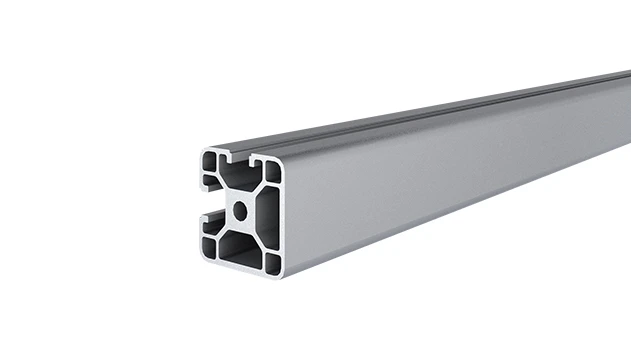
Aluminum profiles solve this problem. Lightweight yet surprisingly strong, they're designed with T-slots (those grooves running along their length) that let you attach accessories—brackets, panels, wheels, you name it—without drilling or welding. Need to add a shelf to a workbench? Slide in a bracket. Want to reconfigure a flow rack for a new product? Disassemble and rebuild in hours, not days. This modularity is the secret sauce that makes lean systems possible.
And among all aluminum profiles, one stands out as a workhorse: the 4040E EU Standard Aluminum Profile. Let's take a closer look at why it's become the go-to choice for manufacturers aiming to go lean.

Deep Dive: The 4040E EU Standard Aluminum Profile
First, let's break down the name. "4040" refers to its dimensions: 40mm by 40mm, a square cross-section that balances strength and versatility. "E" denotes its specific design under EU standards—think of it as a stamp of quality and compatibility. This isn't just a random piece of aluminum; it's engineered to work seamlessly with a universe of aluminum profile accessories, from hinges to roller tracks.
What Makes the 4040E Special?
Let's start with the basics: material. The 4040E is typically made from 6063-T5 aluminum alloy, a blend known for its strength, corrosion resistance, and machinability. It's lightweight enough to move (a 1-meter length weighs around 1.5kg) but tough enough to support heavy loads—we're talking up to 200kg per linear meter in some configurations. That means it can handle everything from small electronic components to bulky mechanical parts.
Then there's the T-slot design. The 4040E usually features two or more T-slots per side, each precision-machined to accept standard M6 or M8 bolts. This might sound trivial, but it's a game-changer. Unlike welded frames, where every change requires cutting and rewelding, the T-slots let you adjust on the fly. Need to mount a monitor arm on a workbench? Screw a bracket into the slot. Want to add a light bar above an assembly station? Slide it into place and tighten. No special tools, no downtime.
Compatibility is another key factor. The 4040E is part of the EU standard, which means it works with a vast ecosystem of aluminum profile accessories. Whether you need corner brackets, end caps, or sliding panels, there's a component designed to fit perfectly. This standardization eliminates the guesswork—you don't have to worry about parts from different suppliers not matching up.
| Profile Type | Dimensions (mm) | Typical Load Capacity (kg/m) | Best For | Key Advantage |
|---|---|---|---|---|
| 2020 EU Standard | 20x20 | 50-80 | Light-duty shelving, small workstations | Ultra-lightweight, space-saving |
| 3030 EU Standard | 30x30 | 120-150 | Medium workbenches, mobile trolleys | Balances size and strength for smaller setups |
| 4040E EU Standard | 40x40 | 180-220 | Heavy workbenches, flow racks, assembly lines | Versatile load capacity; works with most accessories |
| 4080 EU Standard | 40x80 | 250-300 | Industrial machinery frames, heavy storage | Maximum strength for large-scale applications |
As the table shows, the 4040E hits a sweet spot. It's strong enough for heavy-duty tasks like supporting a workbench loaded with tools and components, yet not so bulky that it wastes space. For most lean systems, it's the Goldilocks profile: just right.
Practical Applications: How 4040E Brings Lean to Life
Enough theory—let's talk real-world impact. How does the 4040E actually make manufacturing leaner? Let's explore three common applications where it shines: workbenches, flow racks, and modular assembly lines.
1. Workbenches: The Heart of the Assembly Line
Walk into any production facility, and you'll find workbenches everywhere. They're where the magic happens—where workers assemble parts, test products, and package goods. But a poorly designed workbench is a hotbed of waste: tools scattered, materials out of reach, workers straining to reach across cluttered surfaces.
A 4040E-based workbench changes that. Start with a frame built from 4040E profiles—adjustable in height to suit each worker (goodbye, back pain!). Add a plywood or aluminum honeycomb top for durability. Then, use aluminum profile accessories to customize: tool holders along the edge, a shelf for bins of parts, even a monitor arm for digital work instructions. Need to reconfigure for a new product? Swap out the shelf for a drawer unit, or add a lighting bar—all without cutting metal.
One electronics manufacturer I worked with recently upgraded their workbenches to 4040E setups. Within a month, they reported a 15% reduction in time spent searching for tools and a 20% drop in worker fatigue complaints. That's lean in action: small changes to the workspace, big gains in efficiency.
2. Flow Racks: Keeping Materials Moving (Without the Waste)
Lean manufacturing thrives on "pull systems"—materials should arrive at the assembly line just when they're needed, not before. Flow racks are the perfect tool for this. They use gravity to feed parts from the back (where stock is stored) to the front (where workers pick them), ensuring a steady, visual supply.
Building a flow rack with 4040E profiles is a breeze. The vertical supports are 4040E, providing the strength to hold stacked bins of materials. Then, attach roller tracks (another key accessory) to the horizontal 4040E beams. The T-slots let you adjust the angle of the tracks to control how fast parts flow—no more jams, no more wasted reaching for parts at the back of a static shelf.
Take a car parts supplier, for example. They used to store plastic components in fixed steel racks. Workers would walk 20 feet to grab a bin, then walk back—wasting 2-3 hours a day in total. By switching to a 4040E flow rack, they cut that walking time in half. Parts now roll to the worker, and the rack's modular design lets them add or remove lanes as product lines change. That's waste eliminated, plain and simple.
3. Modular Assembly Lines: Adapting to Change in Hours, Not Weeks
Perhaps the most powerful application of 4040E is in building modular assembly lines. Traditional lines are fixed: conveyor belts bolted to the floor, stations welded in place. If you need to add a step (like a quality check) or shorten the line for lower demand, you're looking at days of downtime and costly rework.
With 4040E, assembly lines become living systems. Each station is built on a 4040E frame with casters (yes, even wheels are accessories you can bolt on!). Need to add a new station? Roll it into place and lock the casters. Want to rearrange the line for a new product? Disconnect the conveyor sections (which are also 4040E-based) and reposition them. It's like building with giant, industrial Legos—and it's a game-changer for agility.
A furniture manufacturer I consulted with recently needed to pivot from making chairs to tables during a supply chain shortage. Their old steel assembly line would have taken 2 weeks to reconfigure. With 4040E-based stations, they did it in 2 days. That's the difference between losing a client and meeting a tight deadline.
Why 4040E? It's About the Ecosystem
By now, you might be thinking, "Can't I use a 3030 profile for some of this?" The answer is yes—for smaller tasks. But the 4040E's real strength lies in its ecosystem. Because it's a standard size, there are thousands of aluminum profile accessories designed specifically for it. Need a corner bracket? There's a 4040-compatible one. A panel mount? Yep. Even specialized parts like roller track placon mounts (used to connect roller tracks to profiles) are readily available.
This ecosystem means you're never stuck. A lean system needs to evolve, and with 4040E, evolution is easy. You're not locked into a single supplier or a limited set of options. It's the manufacturing equivalent of a universal adapter—working with whatever you throw at it.
Choosing the Right Profile: Why 4040E is the Smart Bet
So, how do you decide if 4040E is right for your facility? Start by asking: What's the maximum weight I need to support? How often will my system change? What accessories do I need? For most mid-to-large manufacturing setups, 4040E checks all the boxes:
- Load capacity: Handles 180-220kg per linear meter—enough for most assembly tasks, workbenches, and flow racks.
- Modularity: Works with almost every aluminum profile accessory on the market, from basic brackets to advanced roller systems.
- Durability: Aluminum resists rust and corrosion, even in dusty or humid environments. It's built to last, reducing replacement costs (another lean win).
- Cost-effectiveness: While not the cheapest profile (that would be 2020), it offers the best balance of price and performance. You won't overpay for strength you don't need, but you also won't skimp and end up with a wobbly setup.
The Future of Lean: 4040E and Beyond
Lean manufacturing isn't static. As products get more complex and customer demands more variable, manufacturers need systems that can keep up. The 4040E EU Standard Aluminum Profile isn't just a tool for today—it's a foundation for tomorrow.
Imagine a future where assembly lines reconfigure themselves overnight for a rush order, or workbenches adjust automatically to a worker's height. That future is closer than you think, and it starts with modular components like 4040E. As smart factories and Industry 4.0 take hold, the ability to connect sensors, lights, and even robots to your aluminum frame (via those handy T-slots) will make 4040E even more indispensable.
Conclusion: Lean Isn't Just a Philosophy—It's a Toolkit, and 4040E is the Swiss Army Knife
At the end of the day, lean manufacturing is about making things better: better products, better workplaces, better value for customers. And you can't make things better with broken tools. The 4040E EU Standard Aluminum Profile isn't flashy, but it's reliable, adaptable, and ready to turn lean principles into action.
Whether you're building a single workbench or a full assembly line, 4040E gives you the freedom to start small, scale up, and change course when needed. It's the backbone of lean systems, the quiet enabler of waste reduction, and the reason so many manufacturers are finally turning "lean" from a buzzword into a reality.
So, the next time you walk into a manufacturing facility and see those sleek, silver frames holding up workbenches, flow racks, and assembly lines, take a closer look. Chances are, you're looking at 4040E—and you're looking at the future of making things, one modular component at a time.