- Company Articles
- Industry articles
- Industry standards
- Lean Production Efficiency: How 3060 National Standard Profile A Reduces Downtime

Lean Production Efficiency: How 3060 National Standard Profile A Reduces Downtime
Related Product
3060 National Standard Profile A
Workbench, production line, logistic rack, warehouse rack Industry: Manufacturer workshop, Automobile, Electronic, Assembling, logistic
It's 8:15 AM on a Tuesday at BrightStar Manufacturing, and Maria, the production floor supervisor, is already staring at the downtime log. The third line has been idle for 45 minutes because the old steel workbench—bolted to the floor, heavy as a boulder—cracked a support beam. The maintenance team is struggling to unbolt it, and the replacement parts won't arrive until tomorrow. "We just lost 50 units," she mutters, rubbing her temples. "Again."
Sound familiar? For manufacturers, downtime is the silent profit killer. It's not just the minutes the line stops; it's the missed deadlines, the overtime to catch up, the frustrated workers, and the ripple effect that touches every corner of the business. But what if there was a way to build production systems that bend instead of break—systems that adapt quickly, repair easily, and keep your team moving forward instead of standing still? That's where the 3060 National Standard Profile A comes in.
The Hidden Cost of Downtime: Why Every Minute Matters
Before we dive into how aluminum profiles transform efficiency, let's talk about the problem they solve: downtime. The average manufacturer loses between 5% and 20% of productive time to unplanned stops, according to industry reports. For a factory running three shifts, that's up to 144 hours of lost production per month—enough time to build 2,000 more units, train a new team, or launch a whole new product line.
Downtime wears many faces. There's the mechanical downtime : a conveyor belt jams because a roller seized, and replacing it means disassembling half the line. There's reconfiguration downtime : when a customer changes an order, and you need to rearrange workbenches or racks—except they're welded or bolted in place, taking 8 hours instead of 8 minutes. Then there's maintenance downtime : fixing a rusted joint on a steel frame that's corroded after years of use, requiring a grinder and a trip to the hardware store.
"We used to joke that our steel workbenches were 'permanent until they broke,'" says Tom, a production manager with 15 years of experience. "When they did break, it was like surgery. We'd have to shut down the entire cell, and the maintenance guys would be in there with wrenches and cutting tools for hours. The team would stand around, twiddling their thumbs, and the pressure to meet quotas just kept mounting."
Lean Production: The Answer to Waste—But Only with the Right Tools
Lean production has been a buzzword for decades, and for good reason. At its core, lean is about eliminating waste—whether that's excess inventory, unnecessary movement, or yes, downtime. But here's the catch: lean principles only work if your physical systems support them. You can't "continuous improve" a rigid, one-size-fits-all workspace. You need tools that are as flexible as your processes, as durable as your goals, and as easy to adjust as your customer demands.
Traditional solutions—steel pipes, wooden racks, fixed conveyor systems—were built for a different era. An era where production lines ran the same product for years, and change was slow. Today, customers want customization, shorter runs, and faster turnarounds. Your factory can't afford to wait days to retool for a new order. You need a system that lets you swap out a workbench shelf, add a roller track to a material rack, or reconfigure a workstation in the time it takes to drink a cup of coffee.
Meet 3060 National Standard Profile A: The Backbone of Adaptive Manufacturing
Enter the 3060 National Standard Profile A—a simple yet revolutionary aluminum extrusion that's changing how factories are built. If you're not familiar with aluminum profiles, think of them as the "Lego blocks" of manufacturing: lightweight, strong, and designed to connect quickly with a range of accessories. The 3060 Profile A, in particular, has become a favorite for lean systems because of its unique balance of size, strength, and versatility.
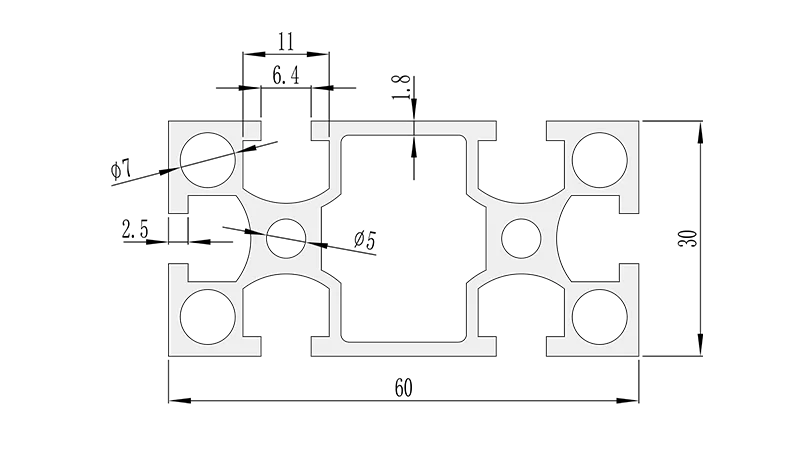
Let's break down the basics: The "3060" refers to its dimensions—30mm wide, 60mm tall. The "National Standard" means it's engineered to strict quality guidelines, ensuring consistency across suppliers. And the "A" denotes its specific slot design, which works seamlessly with common aluminum profile accessories like 90° connectors, end caps, and brackets. Unlike steel, it's corrosion-resistant, so it holds up in humid or dusty environments. Unlike wood, it won't warp or splinter. And at just 1.8kg per meter, it's light enough for two workers to carry, but strong enough to support 200kg per linear meter—plenty for most assembly tasks, material racks, or conveyor systems.
But what really sets the 3060 Profile A apart is its T-slot design. Running along its length are precision-cut slots that let you attach accessories without drilling, welding, or bolts. Need to add a shelf to a workbench? Slide in a bracket, tighten a screw, and you're done. Want to mount a roller track to a material rack? Clip on a placon mount, lock it in place, and roll. It's this "click-and-go" simplicity that slashes setup and repair time—and with it, downtime.
How 3060 Profile A Cuts Downtime: 3 Real-World Applications
Still skeptical? Let's walk through three scenarios where the 3060 Profile A turns downtime into uptime. These aren't just theoretical—they're based on stories from factories that made the switch.
1. Workbenches That Adapt, Not Obstruct
Remember Maria from BrightStar Manufacturing? Her team used to struggle with steel workbenches that took 4 hours to assemble and required a wrench (and a prayer) to adjust. When a new product came in with taller components, they had to either buy a whole new bench or spend a shift cutting and welding the old one—both options meant downtime.
After switching to 3060 Profile A workbenches, everything changed. The team now builds a basic workbench in 30 minutes using aluminum profile accessories: 90° aluminum profile connectors at the corners, a honeycomb panel top, and adjustable leveling feet to keep it stable. When a taller part comes in? They loosen the connectors, raise the shelf by 10cm, and retighten—done in 5 minutes. No welding, no cutting, no waiting.
"Last month, we reconfigured three workbenches in the time it used to take to reconfigure one," Maria says. "The team even jokes that they can 'remodel' their stations during lunch. Downtime for setup? Practically zero."
2. Roller Tracks That Repair in Minutes, Not Hours
Roller tracks are the lifelines of material handling—until a roller jams. In traditional systems, replacing a single roller often means shutting down the entire track, removing bolts, and disconnecting adjacent sections. For a 10-meter track, that's 2 hours of downtime minimum.
With 3060 Profile A, roller tracks are modular. Each roller is mounted to the profile using placon mounts—small, clip-on brackets that lock into the T-slot. If a roller seizes, a worker can pop off the damaged one, slide in a new placon mount with a fresh roller, and tighten it by hand. Total time? 10 minutes. The rest of the track keeps moving, and production stays on schedule.
"We had a roller jam during peak season last year," says Raj, a material handler at a electronics plant. "With the old steel track, I would've had to call maintenance and wait. With the 3060 profile, I grabbed a spare roller from the toolbox, swapped it out, and was back to moving parts in 8 minutes. My supervisor couldn't believe it—he thought I was exaggerating until he checked the time log."
3. Material Racks That Grow with Your Needs
Material racks are another downtime culprit. Traditional racks are built to fixed heights and widths, so when inventory sizes change, you're stuck. A client orders smaller boxes? You've got wasted vertical space. A larger component comes in? You need a new rack, and the old one sits idle, taking up floor space.
The 3060 Profile A solves this with adjustable shelving. Using parallel aluminum joints and height-adjustable brackets, you can raise, lower, or add shelves in minutes. Need to store 3-row, 3-floor material racks for small parts one week and single-row racks for large components the next? Just reposition the brackets. No need to buy new racks, no need to disassemble—just adapt.
"We used to have 12 different racks for different parts," says Lisa, a warehouse manager. "Now we have 4 racks made with 3060 Profile A, and we reconfigure them as needed. Last quarter, we saved 16 hours of downtime just from not having to move or replace racks. Plus, the floor space we freed up let us add another assembly line."
The Role of Aluminum Profile Accessories: Your Secret Weapon
The 3060 Profile A is powerful on its own, but it's the aluminum profile accessories that make it unstoppable. Think of the profile as the foundation—accessories are the tools that let you build anything on top of it. From connectors to end caps, these small parts turn a simple aluminum extrusion into a fully functional system.
Take the 90° aluminum profile connector, for example. This small, L-shaped piece slides into the T-slot of two 3060 profiles, locking them at a right angle with a single screw. No welding, no drilling—just a secure connection in 10 seconds. Or the end cap: a plastic or aluminum cap that snaps onto the end of the profile, preventing dust buildup and protecting workers from sharp edges. It takes 2 seconds to install, but it saves hours of cleaning and reduces injury risks.
Even the smallest accessories make a difference. The roller track placon mount, for instance, lets you attach roller tracks to the profile without custom brackets. The internal rotary aluminum joint lets you swivel shelves or work surfaces, so workers can position materials exactly where they need them—reducing movement waste and errors. These aren't just "nice-to-haves"; they're the reason 3060 Profile A systems are 3x faster to build and repair than traditional setups.
Traditional vs. 3060 Profile A: The Numbers Speak for Themselves
Still on the fence? Let's compare traditional steel systems to 3060 National Standard Profile A systems side by side. The table below breaks down key metrics that impact downtime:
| Metric | Traditional Steel Systems | 3060 National Standard Profile A Systems |
|---|---|---|
| Assembly Time (Basic Workbench) | 4–6 hours (welding, bolting, drilling) | 30–45 minutes (T-slot accessories, no tools needed) |
| Reconfiguration Time (Adjusting Shelf Height) | 2–3 hours (cutting, rewelding, repainting) | 5–10 minutes (loosen screws, reposition brackets) |
| Maintenance Frequency (Annual) | 8–12 repairs (rust, corrosion, bent frames) | 1–2 repairs (replace worn accessories, clean slots) |
| Downtime Impact per Incident | 2–8 hours (full line shutdown) | 10–30 minutes (modular repairs, partial line operation) |
| Long-Term ROI (5 Years) | Low (high maintenance, replacement costs) | High (80% reduction in downtime costs, adaptable to changing needs) |
The numbers tell a clear story: 3060 Profile A systems cut assembly time by 90%, reconfiguration time by 95%, and maintenance frequency by 80%. For a mid-sized factory, that translates to $150,000–$300,000 in saved downtime costs annually—more than enough to offset the initial investment.
Choosing the Right Supplier: Why Quality Matters
Not all 3060 profiles are created equal. To get the full benefits, you need a supplier that delivers high-quality profiles and accessories. Here's why:
Consistency: National Standard profiles must meet strict dimensional tolerances. A low-quality profile with misaligned slots or weak aluminum will jam accessories, break under load, and cause more downtime than it solves. A reputable supplier ensures every profile is precision-extruded and tested.
Accessory Compatibility: The best profiles are nothing without matching accessories. A good supplier offers a full range of compatible parts—from connectors to casters—so you're not mixing and matching brands that don't fit. This saves time and reduces the risk of failed connections.
Technical Support: Switching to aluminum profiles is a learning curve. A supplier with strong technical support can help you design systems, troubleshoot issues, and train your team—so you get the most out of your investment from day one.
Conclusion: Build for Change, Not Just Today
Downtime isn't inevitable. It's a choice—between systems that fight change and systems that embrace it. The 3060 National Standard Profile A isn't just a piece of aluminum; it's a commitment to building factories that adapt, grow, and thrive in a world where change is constant.
Imagine a production floor where workbenches reconfigure in minutes, roller tracks repair in seconds, and your team spends less time waiting and more time creating. That's the future of lean manufacturing—and it starts with choosing the right tools.
So, what will you build next? A factory stuck in the past, or one ready for whatever comes next? The answer is in your hands—and in the profiles you choose.