- Company Articles
- Industry articles
- Industry standards
- Load-Bearing Charts: 2040 EU Standard Aluminum Profile Capacity by Span Length

Load-Bearing Charts: 2040 EU Standard Aluminum Profile Capacity by Span Length
Related Product
2040 EU Standard Aluminum Profile
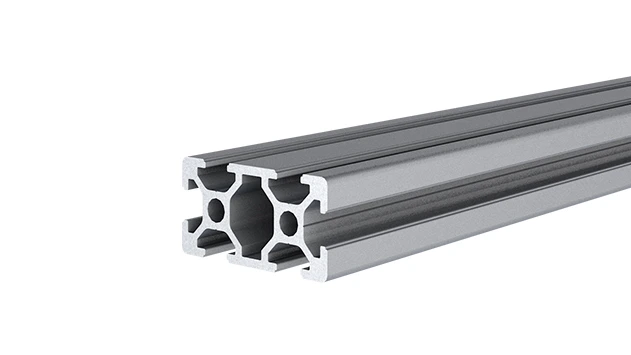
2040 is a 2.00 x 4.00CM fractional 20 series square extrusion T-slot profile with four open T-slots, two side with 2.00cm face, the other side with 4.00cm face. The profile has align-a-grooves to assist in aligning connecting profiles.
If you've ever walked through a manufacturing plant, warehouse, or even a busy workshop, you've probably seen them: sturdy, silver structures holding up tools, materials, or entire workstations. Chances are, many of those structures are built with aluminum profiles—and one of the most versatile, widely used options out there is the 2040 EU standard aluminum profile . But here's the thing: not all setups with this profile are created equal. The secret to whether a workbench sags under heavy tools or a material rack safely holds pallets of goods? It all comes down to load-bearing capacity, and a big part of that is determined by span length —the distance between two supports. Let's dive into what you need to know to make sure your next project is strong, safe, and built to last.
Why Load-Bearing Capacity Matters (Spoiler: It's About More Than Just "Strength")
Let's start with the basics: load-bearing capacity is the maximum weight a structure can hold without bending, breaking, or failing. Seems straightforward, right? But in real-world settings—like a factory floor where a workbench might hold 50kg of assembly parts, or a material rack b (3 row and 3 floor) stacked with boxes—getting this wrong can lead to more than just a wobbly shelf. It can mean damaged materials, delayed production, or even safety hazards for workers. Imagine a material rack where the middle shelf collapses because the span between supports was too long—suddenly, you're dealing with broken inventory and a potential accident. That's why understanding how span length affects load capacity isn't just a "nice-to-know"—it's critical.
And when we talk about aluminum profiles, the 2040 EU standard aluminum profile is a workhorse. Its name gives a clue to its size: "2040" refers to its cross-section, typically 20mm by 40mm (though exact dimensions can vary slightly by manufacturer). It's lightweight, corrosion-resistant, and incredibly adaptable—thanks in part to the aluminum profile accessories that let you connect, extend, and reinforce it. But even the strongest profile can underperform if you ignore span length. Let's break that down.
What Is Span Length, Anyway? (No, It's Not Just "How Long It Is")
Span length is the distance between two points that support the profile—think of it as the "gap" between two legs of a workbench, or between the uprights of a material rack. For example, if you're building a shelf with the 2040 profile, and you place supports (like vertical posts) 800mm apart, the span length is 800mm. The longer this span, the more the profile has to "bridge" that gap, and the less weight it can safely hold. It's like a diving board: a board that's 2 meters long can hold more weight than one that's 4 meters long, even if they're made of the same material. The same logic applies here.
But span length isn't the only factor. The profile's thickness, the type of supports (are they fixed or adjustable?), and even the direction of the load (is the weight spread out or concentrated?) also play a role. For the 2040 EU standard profile, though, most manufacturers design it with a standard wall thickness (often 1.5mm to 2mm) and consistent material density (6063-T5 aluminum, a common alloy for structural use), so span length becomes the biggest variable in everyday use.

Load-Bearing Charts: 2040 EU Standard Aluminum Profile Capacity by Span Length
To make this tangible, let's look at real-world data. Below is a load-bearing chart for the 2040 EU standard aluminum profile, based on common span lengths and typical use cases. Note: These numbers are general guidelines—always check with your aluminum profile supplier for exact specs, as manufacturing processes and alloys can vary slightly.
| Span Length (mm) | Maximum Uniform Load Capacity (kg/m) | Maximum Point Load Capacity (kg)* | Common Use Case |
|---|---|---|---|
| 300mm (11.8 inches) | 120 kg/m | 80 kg | Small workbench shelves, tool holders |
| 500mm (19.7 inches) | 85 kg/m | 60 kg | Medium workbench surfaces, single-level material racks |
| 800mm (31.5 inches) | 55 kg/m | 40 kg | Multi-level shelves, lightweight conveyor guides |
| 1000mm (39.4 inches) | 40 kg/m | 25 kg | Longer workbench extensions, temporary storage racks |
| 1200mm (47.2 inches) | 25 kg/m | 15 kg | Light-duty dividers, cable management trays |
*Uniform load = weight spread evenly across the profile (e.g., a box covering the entire shelf). Point load = weight concentrated in one area (e.g., a single heavy tool on a workbench). All values assume standard 1.5mm wall thickness and 6063-T5 aluminum alloy. Always verify with your supplier for exact specs.
Real-World Examples: How Span Length Affects Your Setup
Let's put this chart into context with two common scenarios: a workbench and a material rack.
Scenario 1: Building a Workbench
Suppose you're building a workbench for electronics assembly. You want a surface that's 1200mm long, and you plan to use the 2040 EU standard profile for the frame. If you set the supports (legs) at the very ends—making the span length 1200mm—the chart tells us the profile can only hold 25 kg/m uniformly. For a 1.2m surface, that's 1.2m x 25kg/m = 30kg total. But if you add a third support in the middle, splitting the span into two 600mm sections, each span can now hold ~65 kg/m (since 600mm is between 500mm and 800mm, we can estimate). Suddenly, the total capacity jumps to 1.2m x 65kg/m = 78kg—more than double! That's a huge difference, and it's all because of span length.
Scenario 2: Material Rack B (3 Row and 3 Floor)
Now, let's take the material rack b (3 row and 3 floor) —a common setup with three vertical rows and three horizontal shelves. Each shelf uses the 2040 profile, and the uprights (vertical supports) are spaced 800mm apart. From the chart, an 800mm span can hold 55 kg/m. If each shelf is 1.5m long, that's 1.5m x 55kg/m = 82.5kg per shelf. But if the design calls for uprights spaced 1000mm apart instead, the capacity drops to 40 kg/m, or 60kg per shelf. Over three shelves, that's a loss of 67.5kg total storage capacity—enough to miss out on holding several boxes of inventory. Moral of the story? Always check the span before finalizing your design.
Aluminum Profile Accessories: Your Secret Weapon for Boosting Capacity
Even with the right span length, the 2040 profile's performance depends on the aluminum profile accessories you pair with it. Think of accessories as the "glue" that holds your structure together—and in some cases, reinforces it. Here are a few key ones to consider:
- Joints and Connectors: These attach profiles at corners or T-junctions. Look for heavy-duty options like 90° aluminum crossing joints or parallel fixation aluminum joints—they distribute weight more evenly than flimsy plastic connectors.
- Reinforcement Brackets: Adding angle brackets or gussets at support points (where the profile meets the upright) reduces stress on the span. For example, a gusset plate at the base of a workbench leg can help the profile bear more weight.
- End Caps and Plates: These prevent the profile from bending at the ends, especially under heavy loads. A simple end cap might not seem like much, but it adds rigidity.
Remember: accessories aren't just for assembly—they're for safety and performance. Skimping on cheap connectors might save a few dollars upfront, but it could lead to a collapsed shelf later.
Common Mistakes to Avoid (Yes, Even Pros Make These)
Even with the chart in hand, it's easy to slip up. Here are three mistakes to watch for:
- Ignoring Dynamic Loads: The chart above assumes static loads (weight that doesn't move). If you're using the profile for something like a conveyor where items slide or vibrate, add a 20-30% buffer to the load capacity. Movement increases stress on the span.
- Overlooking Profile Orientation: The 2040 profile is rectangular—20mm by 40mm. If you mount it "flat" (40mm side up), it can hold more weight than if you mount it "tall" (20mm side up). Always check the orientation specified in the load chart!
- Forgetting Environmental Factors: Aluminum is corrosion-resistant, but extreme temperatures (like a hot factory or freezing warehouse) can slightly weaken its load capacity. If you're working in harsh conditions, consult your supplier for adjusted specs.
Final Thoughts: It's All About Balance
The 2040 EU standard aluminum profile is a fantastic tool for building everything from workbenches to material racks—but its true potential lies in how you use it. By understanding span length and load capacity, and pairing the profile with the right aluminum profile accessories , you can create structures that are strong, safe, and tailored to your needs. Whether you're setting up a small workshop or a large-scale manufacturing line, take the time to map out your spans, check the chart, and don't cut corners on accessories. Your team, your materials, and your bottom line will thank you.
And remember: when in doubt, ask your supplier. A good aluminum profile supplier will have detailed load charts, accessory recommendations, and even design tips to help you get it right. After all, the best structures aren't just built—they're planned.